
Baseball Blues
From The Challenge of Charity
It was probably 20 years ago – several years after three business friends and I decided, on what can only be defined as a whim, to pool some money and buy 1,800 acres of hills and cliffs and cow pastures on the pink sandy coastline of the Pacific Ocean in Nicaragua.
We had reached that point in pioneering where one member of the group looks at the others and asks, “Whose idea was it to do this?” And nobody takes credit.
No, actually we were beyond that point. We were at the point you can get to if you’re attempting to climb a cliff when you have no idea how to climb a cliff, wishing you could turn around and come back down but realizing that your chance of surviving is a little more likely if you keep going.
There’s a book I could write about all the business and investing misunderstandings and mistakes we had made by then in purchasing the land, figuring we could retire there and live like kings cheaply, or even live there free and maybe earn a profit by converting the acreage into some sort of rustic, seaside paradise by selling a few hundred yards of beachfront lots.
But this isn’t about the morass of misunderstandings, mistakes, and mishaps behind what eventually became the resort community of Rancho Santana. It’s about an entirely different morass of misunderstandings, mistakes, and mishaps that I was personally responsible for, having decided to put every dollar I made from developing Rancho Santana, and many more dollars I had made from other businesses, into another brilliant idea – creating a community center to benefit the hundreds of very poor people that lived in the neighboring towns and hamlets.
At that time, Nicaragua was still climbing out of the economic well it had fallen into after the 1979 Sandinista Revolution that brought socialism to the country and implemented the redistribution of wealth and property, followed by a cultural revolution that redistributed social and political power, which, against best intentions, resulted in Nicaragua transitioning from one of the wealthiest countries in all of Latin America to one of the poorest in 11 short years.
But it’s not my point to talk economic theory here. The point I interrupted myself from making is that, thanks to my brilliant idea for the community center, I found myself in a morass of misunderstandings, mistakes, and mishaps that was every bit as difficult as the business situation my partners and I stumbled into when we bought the land.
I could start from the beginning, but I will fast-forward to a story that begins just after we had finished the sports component of the community center, which consisted of an indoor complex featuring a fully-equipped gym, cardio equipment, an aerobics and yoga room, a martial arts wing, covered basketball courts, a European-sized soccer field, and a baseball field that was built to American standards – which meant that, besides having proper dugouts, bleachers, changing rooms, bathrooms, and a concession stand, it had to be covered with grass. So in constructing the field, to ensure proper drainage for the grass, we first had to remove the clay that was already there to about 30 inches, and then raise the whole thing back to ground level with several layers of rocks and gravel and sand and, finally, topsoil.
(The build-out of the sports complex cost me more than three million dollars, with the construction of the baseball field alone taking up about 10% of that because of having to truck in hundreds of loads of material from hundreds of miles away.)
Considering that the local baseball leagues had been, till then, playing their games on rocks, sand, and weeds, I was justifiably proud of our field when we opened it to the public.
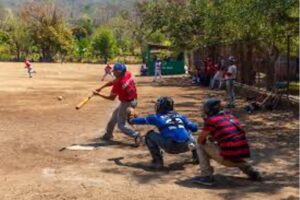
On opening day, our Rancho Santana team, dressed sharply in the uniforms and using the new gear I had bought them, took to the field looking like pros, and they played like pros. And when I say that, I’m not exaggerating. The level of skill you will see at amateur baseball games in Nicaragua far surpasses anything you will see in the US.
The rest of the story plays out like a Hallmark cliché. We lost our first game handily – but with support from Rancho Santana’s CEO and several other baseball fans among our employees and homeowners, our team got gradually better, managing to eke out a spectacular win in the last game of the season to take first place in the league.
So… a happy ending. Right?
Yes, but no. The actual story I wanted to tell you is about what happened the following year, a week or two before the start of the second season, when our team was going to be defending its championship against seven or eight other local teams.
Two representatives from the team asked to meet with our CEO and me to discuss what, if anything, we could do to further support the team in the upcoming season.
I was thinking they might be wanting more practice time on one of our fields, or perhaps an automatic pitching machine or a batting cage.
They were, indeed, interested in all those things. But they had other requests that surprised me. They wanted new equipment: new balls and bats and gloves. They also wanted – no, expected –brand-new uniforms.
“Why do you need new uniforms?” I asked. “Last year’s uniforms are still in good shape.”
The two men looked at each other sheepishly. “It is just what the team thinks is right.”
“And why is that?”
“The pro league teams get new uniforms every year,” one of them said. “And we won the championship last year,” the other chimed in.
“But this is an amateur league,” I said. “It’s like Little League in the United States. They don’t get free uniforms every year. In fact, they don’t get free uniforms ever. They have to pay for them.”
This didn’t seem to impress the team reps. Perhaps they thought I was lying. Or perhaps they thought that in America everyone is rich and so nobody needs free uniforms. But in Nicaragua, almost everyone is poor, so… so, I don’t know. Because they were poor, they should get free new uniforms every year?
It made no sense. But instead of trying to argue the point – and against my better judgement – I gave in and offered a compromise: I would buy the team new uniforms if they agreed to spend one of their days off repainting the bleachers and dugouts (which really needed it).
The reps looked almost confused by my proposal, but agreed to take it to the other players to see what they thought of it. I figured it was a no-brainer. How could they say no?
I was wrong.
When they came back a few days later, they told me that the team had discussed it and decided that it was wrong for me to ask them to work on a day off – and that I should really just give them the uniforms for free.
“I don’t think I can do that,” I said.
“If you can’t,” they said, “then we have decided. We will have to go on strike.”
“On strike!” I stammered. “What do you mean you will go on strike?”
They explained that they would not step on the field again until they could do so in brand-new uniforms.
“That’s insane,” I argued. “The old uniforms are fine. And none of the other teams in our league have uniforms like we have. They wear bits and pieces of all sorts of discarded uniforms, some of which are decades old.”
“But the guys that play for the pro leagues get new uniforms every year,” they said.
“They are professionals,” I said. “And the pro league makes a lot of money – more than enough to pay for new uniforms each year.”
They didn’t say anything more. To my credit, neither did I. We left the “negotiation” at a stalemate. I went back to working on my other businesses and didn’t think about our baseball team again until several weeks after the new season had begun. I stopped by a game one Sunday, and they were playing in the old uniforms.
Lesson Learned
I’ve probably told this story a dozen times since it happened and it always seems to have the same effect on those hearing it as it had on me: What were these people thinking?
How is it possible that, after playing league baseball in T-shirts and jeans for years and years, and someone was nice enough to give them uniforms, they would tell that person a year later that he should give them another round of new uniforms every year?
I’ve been asking myself that question since it happened – and I have a couple of ideas about some of the factors that could have contributed to their reaction.
For one thing, growing up in a socialist economy, the only financial assistance they had experienced until then had been in the form of government programs, such as the allotment of rice and beans distributed to public schools throughout the country, and these programs generally continued automatically each year.
Plus, growing up in a socialist education system, they had been taught the socialist view of government and its responsibility to the poor: to redistribute wealth from the Nicaraguans that had too much of it and spread it among those that had too little.
But these were only factors that might have helped them rationalize their expectations. Given the experiences of dozens of others that I’ve read about, providing all sorts and levels of help to people all over the world, the one thing I am sure of is that there is something in the human psyche that applies to all people: We seem to have an amazing ability to feel entitled to things we have been freely given, even if we do nothing to deserve them.
I realize that’s a pretty broad statement to make. In future chapters of this book, I will come back to it, looking at this very curious and mildly disturbing human trait to see what more we can make of it.
