
Greetings from Portugal!
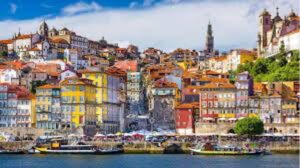
K and I are in Portugal for 12 days. The first five days by ourselves to check out Porto, which K tells me we’ve never visited before. And next week in Lisbon, where we will be meeting with 40 Ford and Fitzgerald family members for our 19th biannual Cousin Camp.
We hosted the first Cousin Camp in a beach house on Martha’s Vineyard in 1989. Back then, the “cousins” were toddlers and young children. Now, half of them are married-with-children, and the eldest is 45. They will be traveling here from both coasts of the US, and from Canada, France, and the UK.
The reason we call these things “Cousin Camps” rather than “Family Reunions” is because our initial reason for doing them was about not just getting together with our own siblings, but giving our three boys the opportunity to know and form friendships with their cousins – something I didn’t have growing up because all my cousins lived in Colorado, which, from a travel-cost consideration, might have been on Mars.
And forgive me if you’ve heard this before, but of the many significant investments I’ve made in my life, the Cousin Camps are certainly one of the best. When I hear that one of my French-American nieces is spending her holidays with her British cousins in London, or that two of my nieces, one a cryptocurrency millionaire and the other a Broadway star, are “besties,” or when I see how relaxed the ball-breaking bantering is between my boys and my nephews, I think, “Now that’s a good ROI!”
In Porto, we are staying in the Gaia district, on the shady side of the Douro River, where the country’s wines and ports are grown and stored. We’re at the Tivoli Hotel, which was built around the centuries-old port wine cellars of Kopke, the oldest port wine house in the world. The hotel building, like almost all buildings on this side of the river, looks like a 19th century warehouse with a facelift, which is probably exactly what it is.
But the inside is contemporary, clean, and minimalist, with accents of exotic woods and fine fabrics, muted lighting, and an astounding collection of artwork in abundance, indoors and outdoors, including a suite of large crayon illustrations by Jean Claude Basquiat in the spa.
Taking a tour of the facilities when we came in, we were casually escorted past at least 100 pieces worth, by my rough calculation, at least $50 million. The combination of art, interior architecture, and décor reminds me of Benesse House in Naoshima, Japan, which I wrote about when I was there last year.
I’m writing this in the late afternoon at the pool bar, recovering from a six-hour march up and down the steep stone streets of the city on both sides of the river.
Suzana, our guide, recommended by friends who were here earlier in the year, is impressively knowledgeable about all things that matter (i.e., history, architecture, culture, art), proud of her country, and yet unafraid to answer delicate questions. She’s everything I look for in a tour guide in a foreign country, especially one about which I know very little. And that’s all I can reasonably expect. But Suzana has two other qualities – frosting on the cake, as far as I’m concerned: She is completely ignorant about economics, which makes her social and political commentary adorably quaint. And she has a full set of opinions about the virtues and shortcomings of every nationality on Earth, which she is happy to discuss with you in conspiratorial tones.
Self-Aggrandizing Travel Note: After 60+ years of seeking out conversations on such matters as largesse in tipping servers, voice control in restaurants, and courtesy in moving through crowds, I consider myself a world-class expert. And, yes, since you were going to ask, I would consider – given the right multimillion-dollar offer – publishing my notes in book form someday.)
