It’s amazing that, at nearly 75, I am still discovering what feel like very basic facts about my personality. As I explain in today’s Journal excerpt, one of those discoveries has led to a change in the way I approach problem-solving.

I’m also sharing a piece by Ian King, a financial analyst that I follow. (If you’re intrigued by the potential of alternative energy sources, you might be interested in a scientific breakthrough he is excited about.)

And I’ll tell you what I think about the relationship between “privilege” and “success.”

The Good and Bad of My RFA Mentality 

On a Zoom call recently, a colleague was telling me about a problem he was having with his inbound telemarking division. In the past three months, he said, call lengths doubled while conversions halved. I asked him a few questions about the scripts he was using and then announced that I thought I knew exactly how to solve his problem. “Send me the scripts,” I said.

I felt confident that I was right because I’d experienced the same problem many times in my career. But when I read the scripts that evening, I realized that I had spoken too soon. I didn’t understand the problem. And my solution would not have worked.

I called him the following morning, asked more questions, and was eventually able to figure out what the problem really was and then offer several ways he could deal with it.

My rush to get to an answer was a part of a baked-in personality trait that I was already aware of. In a test I took several years ago on “leadership,” I was rated at the extreme end of what the test defined as the “director” style of getting group work done – quick to make decisions, impatient to get things moving, and willing to push others to accomplish goals.

Ready, Fire, Aim, the book I wrote about how to start and grow businesses, was based on this approach. The thesis was that most entrepreneurial businesses fail not because of poor planning, but because of overplanning: trying to perfect the business model. Starting a business that way will almost guarantee failure, because until you get your idea/product into the marketplace, you will not know how to present it, set the price, and sell it.

The strategy I recommended in the book was to get the idea/product out there and start testing it as soon as you can reliably do so (“Ready… Fire”!). It’s the only way to learn how to bring in new customers at an allowable acquisition rate before you have run out of money, patience, and/or time. Based on what you learn from your tests, you can then fine-tune (“Aim”) your efforts to maximize your long-term chances for success.

I have no doubt that the Ready-Fire-Aim approach is the best way to start a business or get almost any sort of major project off the ground. It is an equally good strategy for mature businesses that are launching a new product and/or product line.

But it is not necessarily the best strategy for solving problems once the business is up and running.

As a “director,” when I’m confronted with the problems that inevitably arise in any business – new or established – my instinct is to push for an immediate solution so I can get back to the challenge of growing revenues and profits. Ready. Fire. Aim. And sometimes, that works.

But some problems are gnarly and difficult even to understand. And that’s why nowadays, when I’m presented with a complicated problem, I force myself to override my instincts – to slow down, take a deep breath, listen closely to both sides of the argument, ask questions, and then push for a solution that will work well and last. (Friday, September 26, 2025)

Sun-Powered, but 10,000 Times More Powerful Than Conventional Solar Energy 

“The most powerful engine in our solar system sits a mere 93 million miles away. It fuses atoms together every second, creating more energy than humanity could use in a lifetime.”

Those were the first two sentences of a recent issue of The Daily Disruptor, written by Ian King.

I’ve been a fan of Ian King for quite a while – ever since he became the man behind the very successful trading newsletter Strategic Fortunes. His track record of identifying financial and economic trends is remarkable. But more important to me is that he is equal parts insightful, thoughtful, and modest – a rare and welcome combination in the investment advisory business.

Right now, Ian is excited about a scientific breakthrough that was made at the Los Alamos National Laboratory earlier this year and quietly disclosed to the public in July. He says that what these researchers achieved is a “milestone in fusion energy… that could reshape how America powers its factories and fuels its AI data centers as it reclaims its role as the world’s industrial leader.”

Ian explains:

“For decades, the holy grail of fusion has been ‘ignition.’ That’s the moment a reaction produces more energy than it takes to start it.

“That barrier finally fell in 2022, when scientists at the National Ignition Facility in California made history with a fusion shot that put out more energy than the lasers pumping into it. It was a scientific first and proof that ignition is possible on Earth.

“But ignition is just the beginning. The real prize is what physicists call a ‘burning plasma.’ That’s when the reaction throws off so much heat that it keeps itself alive. Our Sun does this. Its hydrogen atoms collide, fuse, and burn endlessly without outside help. And that’s what’s so exciting about what just happened in Los Alamos.

“Using a new setup called THOR, the team managed to push plasma into that self-heating zone. And for a very brief moment, the reaction didn’t just burn. It fed itself. Now, that might not sound like a big deal, but this has been one of the hardest problems in all of science to solve. It took more than a decade of trial and error just to get lasers aligned perfectly around a fuel pellet to cause ignition.

“The Los Alamos scientists improved on earlier designs with smaller chambers, sharper diagnostics, and smarter modeling. These refinements made the burn more efficient and resulted in a fusion shot that gets us closer to claiming the power of the Sun here on Earth.”

He cautions that the commercial production of fusion energy is not “there yet.” The scale of this experiment was small and the generation of electricity from fusion has not happened. “But it’s a step closer to the day when fusion could deliver nearly unlimited clean energy at costs that fossil fuels just can’t compete with.”

America’s industrial sector accounts for 35% of all US energy consumption. Most of that is in manufacturing.

At the same time, AI is triggering a power crunch unlike anything in modern history. By 2028, US data centers are projected to consume 580 terawatt-hours of electricity every year.
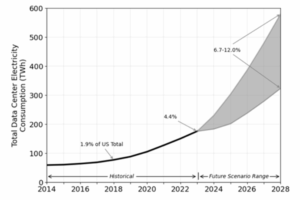
Source: US Department of Energy

That’s more than the entire power use of some countries.

Semiconductor factories are also massive energy consumers. Intel’s new Ohio “Silicon Heartland” site is expected to draw as much electricity as a small city. TSMC’s facility in Arizona will need hundreds of megawatts just to operate.

The Energy Information Administration says total US power demand will hit record highs in 2025 and 2026.

And today, natural gas still supplies nearly 40% of that energy.

Ian continues:

“But imagine if America could power all of this with virtually unlimited clean energy that isn’t tied to oil markets, gas pipelines, or foreign suppliers. US consumers already spend about $1.7 trillion a year on energy. That’s nearly 7% of GDP. And that staggering number keeps growing as demand from manufacturing and AI accelerates. But the payoff from abundant energy promises to be just as staggering. That’s why this breakthrough is so exciting. And why government labs aren’t the only ones chasing this dream.”

Private capital is becoming interested in fusion energy and industry leaders are making early bets.

In 2021, fusion companies raised about $1.9 billion. By mid-2025, that number surged past $9 billion. Helion Energy, backed by Sam Altman, has already broken ground on a fusion pilot plant in Washington State that it hopes to have running by 2028. Commonwealth Fusion Systems is targeting the early 2030s for its Virginia plant. And Xcimer Energy is planning a prototype by the end of the decade.

Ian again:

“Fusion is just one piece of a much larger puzzle. Because America is investing across multiple fronts at once. We’re building semiconductors in the desert, EV plants in the Rust Belt, AI datacenters in the South, and quantum labs in Colorado. All these investments will require as much more power as we can possibly produce right now. That’s why we’re also investing in energy breakthroughs that could power them all.

“Moments like these can create generational wealth. We saw it happen with steel in Pittsburgh, cars in Detroit, and semiconductors in Silicon Valley. Each of those industries lifted entire regions. And they made fortunes for those who invested early. With fusion, we could be watching the early signs of something just as big.”

If you’d like to know more about this story and Ian King, click here.

Don’t worry about your privilege. Worry about yourself. 

I dipped into an ongoing Facebook conversation – something I never do – in response to someone confessing to being “privileged.” I did so, against my better judgement, because it gave me an opportunity to set down some thoughts I’ve recently had on the subject of privilege in the context of succeeding in the world of wealth building (and in every competitive arena I can think of).

Here is what I wrote:

“So long as you worry about these economic issues as social problems, you will do nothing to solve them. The solution – the only solution whether you like it or not – is to think of them as your problems.

“Don’t ask yourself what can be done to protect all those underprivileged people. Ask yourself, ‘Given these trends and accepting the fact that some of these predictions may prove out, how can I provide for the current and future living costs of myself and my family.’

“Stop wasting your time, endangering your dependents, and wasting the time of all the millions of underprivileged you don’t really give a shit about. Spend your time and energy on your #1 responsibility as a human being living in a community of human beings – and that is earning the income to pay for your own expenses and those of your dependents.

“You should do that not only because it is the right thing to do ethically, but also because you understand that you can never achieve much for ‘others’ by trying to solve macro-economic and political problems socially and politically.

“Do the hard thing instead. The moral thing. Pay the full price of your own burden to society and the burden of your dependents. After you have done that, if you have money left, then you should extend beyond your immediate family. Not by throwing money at political and social organizations. They are naturally and inevitably corrupt and inefficient. Instead, do the right thing – which is, again, the hard thing.

“Take responsibility for saving one person at a time. When you do that, you will immediately feel the quicksand that social and political programs are built on: that money alone is insufficient to help anyone move above the swamp of poverty. It is nearly a full-time job. Just like the job of trying to make responsible, independent people of your own children.”

Hints: They are sisters. They lived to be 30 to 40 years old… more than 6,000 years ago. And these are not photos.

Answer: What you’re looking at is 3-D reconstructions of two adult sisters who lived and worked in a brutal mining community in what is now the Czech Republic. The stunning reconstructions are based on a new analysis of the sisters’ remains, which were unearthed more than 15 years ago from a prehistoric chert mine in the South Moravian region. According to a study published in the June 18 journal Archeological and Anthropological Sciences, new evidence suggests that the sisters worked in the mine, extracting heavy rocks to be used as tools and weapons.

The Surprising Connection Between Success in BJJ and Success in Business 

II recently came across your work and just wanted to say big respect for your BJJ achievements. As a BJJ brown belt myself, I know how badass that is.

“I randomly got into direct response by helping my partner with her business and now I’m on a mission to get my black belt in direct response and leave my job. What I find most fascinating is how the hardships from BJJ translate into business. And how fundamental positions such as mount, side control, and the dreaded closed guard are just like your favourite tools in direct response – the latest being the 4U’s, which I’ve just picked up from you.

“Thanks for sharing the wisdom.” – KB

My Response: You make a good point about the similarity between the skills we must learn to succeed in BJJ and the skills one needs to succeed in business. One that is rarely talked about is the ability to be sensitive to the weight distribution of and the force coming from your training partner. Once you develop that skill – which is a skill of perception rather than force – you have a tremendous advantage that strong and aggressive combatants won’t even notice. You will be able to find the moments and the spots where you can use your opponent’s momentum to your advantage. You will be able to protect yourself from much larger and stronger opponents and eventually overcome their natural strengths with skill.

This has always been the way I looked at building wealth. When you give yourself the goal of accomplishing what very few people do – i.e., moving to the top 10% or even 1% of the general population of income earners – you are going to run into all sorts of expected and unexpected forces. If your strategy is always to meet force with force, you will eventually fatigue yourself and fall into a set of habits that you probably won’t even recognize, let alone be able to overcome.

Success in increasing your income and growing your wealth cannot be had by being clever. And only a fool would attempt to achieve it with luck. The only realistic way is to gradually improve on the small skills that will allow you to meet and defeat any of the uncountable forces that come against you in your journey.

Today’s issue is mainly about health and wellness, two subjects I’ve been researching and writing about for 30 years. You’ll notice that I’m changing the format a bit by publishing my Journal notes just as I first wrote them… warts and all. My thinking is that this will allow me to share more of what I’ve been doing and thinking – but briefly.

“Earning, Learning, Sharing, and Caring” 

I’m still working 12+ hours a day, but I’m also napping for about a half-hour at least twice and sometimes three times. 

I don’t mind the napping per se. I quite enjoy it. But I don’t like the reason: I’m finding that every three or four hours I am besieged with a serious bout of brain fog, which makes it impossible for me to work, thus forcing me to lie down and rest. This is not a symptom of age. In every other metric of aging, I’m at least 10 years younger than my age would otherwise suggest. I’m convinced that my brain fog bouts are the result of protein spikes from COVID-19 shots. I was hoping they would go away, but they are increasing. I’m going to investigate the various vaccine “cleanses” that have been advertised to see if that can help. (Friday, September 19, 2025)

* * * * *
I had a good meeting with WMB and PF yesterday about my idea for a new non-profit project.  It would be a foundation whose mission would be to teach entrepreneurship and wealth building secrets to people who had no education in accumulating wealth and no experience in starting businesses.

I have accumulated a truckload of educational materials that could serve as the foundation’s core curriculum. Between the two dozen books I’ve published, the 17 that are half done, the 2,000+ essays, speeches, interviews on business, finance, entrepreneurship, and wealth building, we have a library of valuable information.  It would be a shame to leave all that monetizable material sitting in drawers and on shelves gathering dust.

PF asked me why I wanted to start yet another big project at this time in my life. I admitted that I wasn’t sure, but the prospect of doing it was exciting, and I had a gut feeling that doing it as a non-profit was the way to go. It would make it clear that its purpose was education, not profit. And that would give it credibility. And that would make it easier to market. Plus, if it had a sensible, achievable mission, like we have with Fun Limón, it’s quite possible it would live on long after I’m gone. When I said that, I realized the answer to PF’s question. I see it as a legacy – something of me that might endure. Oh, well, we’ll see how that goes. (Saturday, September 20, 2025)

* * * * *
SM tells me that the Legacy stock portfolio, which he and several other stock-expert friends put together for me in 2016, has done well since inception. Over the last nine years, it has grown into several approaches – the very conservative collection of stocks we assembled first, followed by several others that included industry-dominating, low-risk stocks that have boosted performance above the core collection.

That was good to hear. I designed the portfolio to keep pace with the market’s long-term ROI, but with less risk. The fact that it’s done better than that makes my heart happy and trips the marketing lobe of my brain to think about how we can make money selling that fact. Then the part of my brain that contains my conscience says, “Past performance doesn’t predict future performance.”

I mentioned, in the August 13 issue, that I made a bundle on a small investment I made in three cryptos several years ago. My Japanese readers want to know which crypto coins they should buy now. The problem is that I did not buy those coins as an investment. Or as a long-term store of value. I bought them even though I had (and still have) the view that cryptocurrencies have a dim future. They have been great for a handful of speculators who got in on the right side of hundreds of trades in the past year, but I don’t know enough about trading or the market for trading cryptos to take a chance with them now. “If you wrote a report on cryptos, it would sell,” SM advised me. I told him I’d think about it. And I will. (Monday, September 22, 2025)

* * * * *
Add one more “pleasure” to my theory about The Sustainable Pleasures in LifeMy original concept was that there were three such pleasures – working on something you value, learning something you think is worth learning, and sharing the products of the work you do and the knowledge you acquire. Last night, I was thinking of the trick of using rhyme to make commercial phrases more memorable. And that gave me earning instead of working, which gave me earning,learning, and sharing. I couldn’t think of a rhyming substitute for sharing, but when I came to caring, I realized that, too, is a sustainable pleasure. As in the pleasure you get from selfless love – i.e., the way most people love their children… most of the time. So now I have four sustainable pleasures: Earning, Learning, Sharing, and Caring. Is that too much? (Tuesday, September 23, 2025)
* * * * *
Another busy week, but mostly enjoyable and reasonably productive days. Saturday evening was a great start, with a trip to the Florida Museum of Art for an opening of an exhibit of Latin American art, which was edifying and hilariously pretentious. [Note to self: Write about that.] Next was my weekly meeting with Number Two Son to go over my and my family’s investments, followed by a meeting with Dominick, my principal broker, a meeting with the CFO of A, my largest client, a half-dozen business meetings, a board meeting for my museum of Central American art, a meet-up with a former mentee turned multimillionaire, a call with AL about our mutual interest in bad movies… and lots more that I can’t remember. (Wednesday, September 24, 2025)

Ayaan Hirsi Ali: Britain Is Turning into Somalia

In this video, Ayaan Hirsi Ali, author of Infidel, tells the story of her journey from Somalia to the West, exposing the deep cultural divides between Somali clans and Western societies. She talks clearly and courageously about welfare exploitation, the influence of the Muslim Brotherhood, clan loyalty, the impact of migration on Western values, and the growing safety concerns for women in Europe.