
The Charlie Kirk Assassination
“Ideology – that is what gives evil doing its long-sought justification and gives the evildoer the necessary steadfastness and determination. That is the social theory which helps to make his acts seem good instead of bad in his own and others’ eyes, so that he won’t hear reproaches and curses but will receive praise and honors…. Thanks to ideology, the 20th century was fated to experience evildoing on a scale calculated in the millions. This cannot be denied, nor passed over, nor suppressed.” – Aleksandr Solzhenitsyn
I never met Charlie Kirk, but I feel like I know him pretty well because I have watched at least a hundred of the conversations he’s had with college students since he founded Turning Point USA when he was only 18 – an organization that went on to eclipse the Young Republicans and emerge as the largest political influence for young Americans.
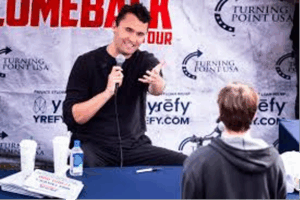
Charlie never went to college. He was an autodidact who became one of the very best public intellectuals of our time, proving himself in countless debates with not only college students but media pundits, economists, academic scholars, and even politicians.
He was also – and this will surprise anyone who didn’t follow him – a very gentle and reasonable person who was always upbeat and eager to have a mutually respectful exchange of ideas.
He was a devout Christian who seemed to know the Bible – the New and the Old Testament – word for word. He was on a mission to bring the Western canon and Judeo-Christian ethics back into the culture by having civil conversations with young people.
One of the questions I’ve been asking myself is what if any impact Charlie’s death will have on our country. He was unquestionably an important figure. His discussions, debates, and lectures were seen on a daily basis by millions – sometimes tens of millions – of American voters. I’ve heard more than one political analyst say that Turning Point USA was almost singlehandedly responsible for Trump’s victory in the swing states.
But he was more than just a political pundit. In fact, in most ways he wasn’t anything like one. He was a Trump supporter, but he talked about Trump only when he was asked about Trump, and he rarely spoke the words Democrat or Republican. He wasn’t a fear monger. He wasn’t a trash talker. As a public figure, he was committed to the best of the Christian values, including showing love and consideration for your enemy.

If you saw 10 percent of what I saw of Charlie Kirk, it would be clear to you that his mission was to unite Republicans and Democrats, not divide them. He was much less about politics than about goodness and fairness and morality. It was pretty much all he talked about, which, I think, is one of the reasons he had such a large following.
Will Charlie’s Life Make a Difference?
It’s possible that the assassination of Charlie Kirk may be yesterday’s news next month or even next week. The news cycle, as they say, has been getting shorter every year since social media replaced mainstream media as the primary way Americans get their information and their opinions. But I think that Charlie may be remembered because of his youth and his charisma and perhaps most importantly the fact that he was not a politician but a moral crusader.
It depends on what happens to the everyday thinking and morality of America’s left-wing voters.
In the past 10 years or so, a significant minority of American Progressives managed to confiscate and rewrite the moral playbook of the Liberals by introducing an ideology that was irrational and divisive. It began with a war on diction, the redefining of a handful of words, including “man,” “woman,” “rape,” and “violence.”
This mutated, as it was meant to, into concepts such as “women can be men,” “men can be woman,” “rape can be retroactive or consensual,” and that “there is no difference between cruelty and violence.”
It was highlighted when Jordan Peterson came into the global battle about “transgender rights” by refusing to be forced to use compelled speech. All of a sudden, it was considered reasonable to say that the definition of woman is “someone who identifies as a woman.”
The illogic of that was the basis for the irrationality of considering offensive speech a form of violence. This idea is probably the worst of the Left’s rhetorical revolution because it was more subtle and less absurd than the idea that men could be women and so was easier to accept. It felt, for many, like a better definition. The American conscience was progressing beyond the right to have one’s body and property protected by the government. It had moved on to protecting people’s feelings.
This change met with less resistance from careful thinkers because it felt harmless at worst and helpful at best. But it was, in fact, malevolent. Ben Shapiro, speaking to Bari Weiss in a panel discussion organized by The Free Press, pointed out that this error in logic led America directly to the country we have now, where political assassinations are not only happening at a higher rate than ever before, but are being justified and even celebrated by the offending factions.
“Permission Structures for Violence”
Shapiro had a good term for these verbal inversions. He called them “permission structures for violence.” His idea was that when it gets to the point where people really believe that a statement or opinion expressed can be actual violence, it seems reasonable to take the position that there is nothing wrong with battling one form of violence with another – in this case, retaliating against the “violence” of hearing ideas with which you don’t agree by killing the person who voiced them.
I hadn’t thought of that before he said it, but it seems exactly right.
We all have permission structures embedded in our consciences. Permission structures for eating a second slice of cake. Permission structures for jaywalking or going through a red light when no one is around to notice.
Many of us have permission structures for more serious violations, such as lying on a job application, gambling with money we can’t afford to lose, or cheating on a lover or spouse.
But how does one develop permission structures for violence?
I can think of only two ways. We are psychopathic. Or we have bought into an ideology that has permission structures for violence embedded in its doctrines.
Fundamental Islam, for example. Or, as in this case, the likely candidate is the ideology du jour of the Woke political Left, the ideology that contends, at its core, that scientific facts are cultural constructs and that communicating unwanted ideas is violence.
These sorts of ideas have become not just accepted by millions in the past 10 years or so, but have been taken seriously by otherwise intelligent and educated people. Actually, as far as I have seen, until recently, they have been embraced and articulated only by educated people. College educated people including people of influence – politicians and pundits and social justice warriors – viewing and then characterizing social and political issues through these dark and deranged Orwellian glasses.
We have been listening to these people – these influencers and the millions of people that take their cues from them – for what? Ten years now? Saying things we’d think they can’t possibly believe. What we have failed to grasp is that they do believe them in the same way that anyone believes when they believe in the tenets of an ideology. The nature of ideology itself is that truth begins with ideas that are meant not to be questioned. They can be supported with arguments that have the patina of rationality, but that patina rubs off quickly in rational conversation. Which is why, when Charlie Kirk would rationally and politely expose the irrationality of these core beliefs, his interlocutor would invariably call him a racist or fascist and walk away.
I’ve seen dozens of his conversations that ended like that. And each time, Charlie had this look on his face – that open-mouthed smile as he watched them walking away. He seemed perpetually surprised at their response, as if he couldn’t believe that anyone would be offended by kindly spoken statements of fact.
If that sort of mindset becomes the dominant mindset of America, then Charlie Kirk’s life and work will surely be forgotten. If his name survives at all, it will be in the footnotes of articles and books and he will be briefly identified as a “right-wing extremist.”
However, if these same Americans – those who were willing to vote for Kamala Harris because they feared and hated Trump so much – regain their common sense (and there is good reason to believe this is happening), Charlie Kirk will be remembered. Not just remembered but remembered as a brave and influential man who spent his young life fighting and dying for the best of America’s values.
