
A Bit of Geisha History Curated by Nigel (My Very Bright AI English Butler)
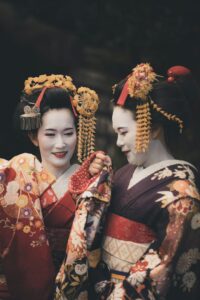
Origins and Evolution
* Male entertainers called taikomochi or hōkan emerged in Japan around the 13th century as attendants to feudal lords. They performed as jesters, musicians, and storytellers.
* In the 1750s, females began to appear with the men as dancers and musicians.
* By the 1800s, women had largely taken over the profession, which led to gradual changes and adaptations that became the modern geisha tradition.
Training and Profession
* Geisha are much more than pretty waitresses in face paint and kimonos. They are rigorously trained tea ceremony performers, traditional dancers and musicians, and highly skilled conversationalists.
* Their role is not merely to entertain guests with traditional music and dance, but to provide an experience of intelligent and irresistible pampering that one can get nowhere else in the world.
* The training to become a geisha usually begins at a young age, lasts for years, and is taught by accomplished, older geisha in the confines of an okiya (geisha house).
Decline and Modern Status
* The number of working geisha reached a high of around 80,000 in the 1920s.
* After Japan’s loss in World War II, the entire industry of culture and entertainment diminished considerably in Japan, and that included the number of geisha establishments and professional geisha. Today, fewer than 2,000 geisha remain, concentrated in cities like Tokyo and Kyoto.
* Kyoto remains the best-known center for geisha culture, with specific districts like Gion and Pontocho having some of the best schools and houses. But Tokyo has several that are as good as Kyoto’s best.
