
By Joe Seta

The primary reason so many stock investors underperform market averages is because they don’t understand a few basic facts about how stock trading works, and that allows them to allow their emotions to make the rules. Here is one of those facts: In order for an investment to work, there must be a Loser for there to be a Winner. It is a zero-sum game.
I debated this subject with ChatGPT for 2.5 hours this morning, and this was the outcome…
Question: “If you bought the S&P 500 at any record high since 1957, and the market dropped after that, how long did it actually take to get back to that level and make a new high?”
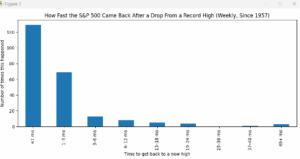
Answer: Using weekly data from 1957 to 2025, there were 232 times when the S&P 500 hit a new record, then dropped, then later climbed back up and passed that old record.
Here’s what the numbers say:
* Number of drops in market after record highs that fully recovered: 232
* Average time to get back to that old record: 3.28 months
* Middle (median) time to get back: 0.92 months (just under 1 month)
Now let’s break that down:
* Back to even in ≤ 1 month: 129 times
* Back to even in 1–3 months: 69 times
* Back to even in 3–6 months: 13 times
* Back to even in 6–12 months: 8 times
* Back to even in 13–18 months: 5 times
* Back to even in 19–24 months: 4 times
* Back to even in 25–36 months: 0 times
* Back to even in 37–48 months: 1 time
* Back to even in 49+ months: 3 times
Or in plain English:
* In 129 out of 232 cases (about 56% of the time), the S&P 500 got back to a new high in less than 1 month.
* In 198 out of 232 cases (about 85%), it got back to a new high within 3 months.
* About 91% of the time, it was back within 6 months.
* About 94% of the time, it was back within 1 year.
* About 98% of the time, it was back within 2 years.
* And in nearly 70 years, there were only 3 market drops that took longer than 4 years to fully recover.
Now add the big picture:
From 1957 through today, the S&P 500 has a perfect track record of eventually breaking its own record high after every drop.
The market didn’t just “come back” — it went on to set new records again and again.
That doesn’t mean the future is guaranteed. But if you’re going to bet on anything, you’re betting that American business doesn’t permanently collapse. If we ever reached a point where the S&P 500 never recovered, we’d be living in a world where jobs, banks, and even the dollar were in serious trouble.
If you can’t live with that tiny but real possibility, you probably shouldn’t be in stocks at all.
When it comes to stock investing, I think in terms of two buckets:
* Bucket 1 – Money I might need soon (to live on).
This needs to be invested more safely, because even if most market drops recover within months, I can’t risk being stuck in one of those rare cases that takes several years.
* Bucket 2 – Money I won’t need for many years (or that will go to my kids and grandkids).
Here, I want to take advantage of the S&P 500’s comeback record. I’m not betting on what happens this week or this month – I’m betting on a system that, so far, has a 100% historical comeback record since 1957 and has always gone on to make new highs.
Yes, the market drops sometimes. It always has. If you look at the data, you will see that most of the time, it returns to new highs in months, not decades. In fact, in almost 70 years of history, the S&P 500 has never failed to get back to its high point and then go higher still.
That’s the kind of perspective that helps you stay calm when your screen is flashing red.
About Joe Seta

Joe Seta is a campaign builder and mentor who helps people make clear and confident choices. He designs outreach tools and systems that are easy to use and share, so others can create lasting impact. Joe cares deeply about child protection and advancement making complex ideas simple, especially for young people. His work blends storytelling with practical steps, giving collaborators the confidence to act without bias. He believes in ripple effects, small actions that spread outward to create big change.
