
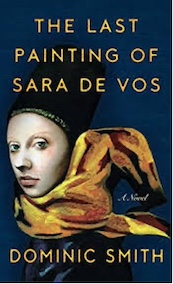

I just read The Last Painting of Sara de Vos by Dominic Smith, this month’s selection for the Mules (my book club). Smith is impressively adept at constructing sentences and in selecting le mot juste. In those regards, he merits A+. But good fiction is more than wordsmithing. It’s about creating stories that not only arrest our attention, capture our imagination, and somehow expand our minds and hearts, but do so in a way that is beautiful.
So how do I rate this book?
Aristotle wrote the foundational treatise on literary criticism with the Poetics, where he defines the essential elements that make a piece of literature work. Though his focus was on drama (tragedy, in particular), I’ve always found it very useful in helping me understand what I like and don’t like about the plays, movies, and other visual media I consume, as well as the books I read.
It is less than perfect, however, in helping me explain how much or how little I like them – which means that I’ve had to come up with my own way to evaluate the recommendations I make on this blog.
I came up with a system that I had great hope for at first – a rating based on the work’s “horizontality” and “verticality.”
Horizontality was about how well it created its fictional world (a time, a place, and a culture).
Verticality was about how well it portrayed – through plot, characterization, and dialog – a deep sense of what a human being is and is capable of being.
These analytical tools have not only been helpful to me in writing my recommendations, they have been helpful during book discussions at our Mules meetings, giving us terms we can use to better communicate our ideas and feelings.
Which gets me back to where I started…
How do I rate The Last Painting of Sara de Vos?
After finishing the book, I had two seemingly incompatible feelings about it.
On the one hand, I was much impressed by the author’s skill as a wordsmith. On the other hand, I felt that the story itself, while good, was not great. And that the way it was told – including the action, the plot, the characterization, and the theme – was handsome, but not beautiful.
So as a reader who very much appreciates the poetic aspects of literary fiction (the diction, the syntax, the metrics, etc.), I would have rated the book very highly. But in terms of my experience of the novel as a whole – the overall aesthetics – I would have rated it good, but not great.
The problem stuck in my craw, and I went to bed without a solution. But today, I had an idea – a very simple rating system that has been used successfully for decades. I’m talking about the way they rate ice skating performances at the Olympics. Competitors get two grades: one for technicality and another for beauty.
So now I’m thinking that it might be helpful to introduce this idea to the Mules: that in addition to the other frames of reference we can use to critique the literary fiction we read, we can provide two additional numeric ratings, one for technical and another for aesthetic virtuosity.
I’m thinking this could work.
Let me know what you think.
