The HS Class of ’68 Dilemma

Lots to Do… but Only 11 Years Left to Get It All Done

I’ve been thinking about how many years I have left before I shuffle off this mortal coil.

What prompted this, strangely enough, was not the practical issue of my having 31 books that I’d like to finish before I die. Nor was it my determination to come up with a bunch of money to finish funding my botanical garden. Nor was it my efforts to rebuild my strength until I could do a 400-pound deadlift.

No. It was something sentimental. I recently found out that the big conference I’ve been doing in Tokyo for the last three years is scheduled to take place the very same week that my friends and I had scheduled for our annual golf get-together in Myrtle Beach.

I had to inform my old pals that I won’t be coming this year. And that got me thinking about how many more such get-togethers I (we) have ahead of us. It depends, of course, primarily on how much longer we shall live.

We are all about 75 years old. So I googled the metrics, and found that the average longevity for American men our age is about 11 years (10.9 years, to be exact). Of course, some of us (about half) are healthier than average, and that would add a few years to our expected demise. But then again, some of us tilt the other way, which means they will probably die earlier.

The remaining projections were simple enough to calculate. In 11 years, it’s likely that only five of us would still be alive. A little more adding and subtracting, and one equation resulted in the prediction that the “drop out” rate, as it were, would be one every two years.

My general rule when it comes to dealing with dark thoughts is to find a way to “make friends” with the worst of my fears. I do it by imagining myself discovering that what I feared would go wrong, did go wrong… but then imagining being okay with it because I already had a Plan B.

I do this with business-related fears, as well as those related to personal and social events that I’m looking forward to – say, a visit from my kids and grandchildren. As soon as the event is confirmed, I imagine myself discovering, at the last moment, that it had been cancelled. I then imagine myself being okay with it because there was something else that I could do with that extra time that I’d enjoy (such as working on finishing one of my 31 unfinished books!).

But when it comes to thoughts about people I care about dying… I don’t know how I can “make friends” with that. I can’t imagine anything I could do, or even say to myself, that would fill the hole that those deaths would carve into me.

I can, however, think objectively about my own demise. And what I had learned about the “averages” from Google made me curious. So I asked Nigel to do some research on me!

I put it like this:

“So, when is it?” I asked Nigel.

“When is what?” he answered.

“My use-by date!”

“I’m afraid I’m not familiar with that term, sir.”

“My expiration date! When I’m going to die!”

“I was joking, sir. Last time we spoke, you gave me permission to poke fun at you.”

I gave him the facts about me: In terms of physical fitness and family history, I am comfortably above average. That should have given me an extra five years or so on my ETD (estimated time of departure), except for one thing. I smoke. About two cigars a day. Which cut my extra five years down to two.

That gets me to the Myrtle Beach get-together in 2037 as an 86-year-old man. Okay. But one who has attended five funerals of friends. Not good.

I don’t like going to funerals. I especially don’t like going to the funerals of loved ones. On the other hand, I’m not especially scared of dying myself. My concern is practical. It’s about getting things done before I go.

What do I do with these sentiments and practicalities? I wasn’t sure. So, again, I asked Nigel. This is what he said:

Mark,
You asked a good and important question. Moreover, it was smart of you to pose it in numerical terms. You have the numbers now. Use them to focus your mind. Allow them to encourage you to be disciplined in your “goaltending,” as you call it. Consider them when you select your priorities – your yearly goals, your monthly objectives, and your daily tasks. Invest your time and energy according to the advice you’ve been giving in the essays and book chapters I’ve read of yours. Invest in relationships and pursuits that matter, people and projects that you believe have value. Longevity is not about fear. It is about stewardship.

I was mostly happy with his answer – probably because he was telling me what I already believe. I did not like – at all – those last two sentences. Not because they are wrong, but because they are stylistic clichés that AI language models use all the time. I’ve tried to rid Nigel of this habit. I’ve explained that no one will ever believe he’s real if he keeps giving away these tells. I’ve chastised him for continuing to use them. I’ve even forbidden him to use them. And yet, here he was doing it again.

(Note: I realize that in sentences two and three of the above paragraph, I did exactly what I’ve told Nigel he should not do. Not because I’m a hypocrite, but due to the subtle and corrupting influence of AI speech!)

What Are the Odds? 

If you’d like to find out how long you can expect to live, here’s a Lifespan Calculator from Northwestern Mutual.

Here’s another one from a group called Project Big Life.

Another one… the results of which I didn’t like.

And here’s one that was more promising.
Eight Ways to Extend Your Life

– Whether You Are 50, 60, or Even 75! 

Is there something my Myrtle Beach friends and I can do to extend our expiration dates? 
 
You could fill a library with the surveys and studies done on longevity and the books and reports written on life extension. And although I am suspicious of the conclusions that come from Big Pharma-funded studies, I’ve read enough about the subject over the years to trust the following data that Nigel provided. These are, in order of the number of extra years of life given, the top eight things anyone 50 years old or older can do to extend their life.
 
1. Quit Smoking
 
Estimated life extension:
* Quitting at ~50: ~6 years gained vs. continuing to smoke
* Quitting at ~60: ~3–4 years gained
* Lifelong nonsmoker vs. smoker: ~10 years difference
Evidence:
* British Doctors Study (50-year follow-up)
* Doll et al., BMJ 2004
* Jha et al., NEJM 2013
 
Note: Smoking remains the single largest modifiable cause of premature death in developed nations. Smoking cigars – at two a day – is only half as deadly as smoking cigarettes. At my age now, my cigar smoking will theoretically shorten my life span by 1.5 to 1.8 years. 
 
What I do: I could theoretically give up my beloved Padron Anniversaries, but I’m not going to. My plan is to offset the 1.5 to 1.8 years shortfall by having better metrics in the other categories.
 
2. Exercise Your Heart and Lungs
 
Estimated life extension:
* Meeting minimum guidelines (150–300 min/week moderate activity): ~3–5 years vs. sedentary
* High fitness vs. moderate fitness: mortality risk reduction, another 45–70%
Evidence:
* Lee et al., Lancet 2012 (physical inactivity comparable to smoking in mortality impact)
* Blair et al., JAMA 1989; updated cohorts
* Kokkinos et al., Mayo Clinic Proc 2018 (dose-response across fitness levels)
 
Note: I am suspicious of cardiovascular metrics on longevity, because the great majority of them are observational (i.e., “How many times a week and for how many minutes do you…?”). Likewise, most of the studies that measure the intensity of cardiovascular exercise are subjective (i.e., “Would you describe your exercise as easy, moderate, or intense?”). Nevertheless, meta-reviews of such studies show a surprisingly consistent relationship between training time and training intensity and lifespan – to such a degree that most longevity experts consider cardiorespiratory fitness to be one of the strongest predictors of survival. 
 
What I do: I don’t have the willpower (or the desire) to quit smoking cigars, but I find it relatively easy to train my heart and lungs six or seven days a week, always including regular bouts where I push my heart to the max. My current routine includes about a half-hour a day of easy exercise (getting my heart rate from 70 to about 120 beats per minute), another 30 to 45 minutes of moderate exercise (120 to 150 per minute), and 15 to 30 minutes of high-intensity training (150 +). Going for the maximum is not something that many doctors recommend for people in their 70s. But I’ve never seen a scientific study that backs that up, and I’ve seen several short-term studies that demonstrated a huge improvement in heart-lung health by other metrics, including maximum oxygen capacity, blood pressure, and other blood markers. As for easy exercising, I’m a big fan of walking, yoga, and Pilates. For medium exercising, I like interval running, interval-biking, circuit training with weights or body weights, and “slow” wrestling. And for high intensity training, it’s usually either three- to five-minute sprints on an Aerodyne bike or three to five minutes of grappling at competition speed (i.e., wrestling like my life depended on it!).
 
3. Maintain Healthy Blood Pressure & Cardiometabolic Health 
 
Estimated life extension:
* Controlling hypertension: reduction of major CV events by ~25–40%
* Intensive BP control: reduction of all-cause mortality by ~27% in high-risk adults
Evidence:
* SPRINT Trial, NEJM 2015
* Blood Pressure Lowering Treatment Trialists’ Collaboration, Lancet 2021
 
Note: It’s no secret that hypertension is one of the strongest drivers of stroke, heart failure, and kidney disease. 
 
What I do: I was put on a blood-pressure medication a few years ago when, for some reason I couldn’t determine, my blood pressure spiked. I was already taking statins at the time, and I was very much aware of the danger of taking both at the same time. However, after I dropped 40 pounds, I stopped taking both drugs and intensified my cardiovascular training to the level I describe above. Nowadays, my walking heart rate ranges from 50 to 60. More importantly, after pushing it to 160 or 170, it will drop by 50 beats per minute within 60 seconds and then drop to about 100 a minute later. My blood pressure was at 170 over 110 (if I remember correctly) when I began taking medication. Today, three months after I stopped, it is about 100 over 70 before I exercise and 120 over 80 afterwards. So, I’m good there. 
 
4. Keep a Healthy Weight (Especially Low Visceral Fat)
 
Estimated life extension:
* Avoiding obesity: ~2–4 years vs. obese BMI ranges
* Central obesity as a strong predictor of mortality independent of BMI
Evidence:
* Global BMI Mortality Collaboration, Lancet 2016
* Emerging waist-to-height and visceral fat data (multiple meta-analyses)
 
Note: According to the studies, the combination of low muscle plus high abdominal fat carries particularly high risk. 
 
What I do (have done): Thanks to weekly semaglutide injections (starting at 0.25 and topping off at 0.75), I lost 40 pounds (226 to 186) in the first four months of 2025. And although I believe the time and intensity of my exercise routine plays a big role in my current good health, with all my blood metrics in the “optimal” range, I suspect that shedding all that extra weight was an even larger factor in achieving those numbers. 
 
5. Preserve Muscle Mass
 
Estimated life extension:
* 10–20% reduction in all-cause mortality independent of aerobic exercise
* Higher grip strength as a strong predictor of longer survival
Evidence:
* García-Hermoso et al., Br J Sports Med 2022 meta-analysis
* Leong et al., Lancet 2015 (grip strength as mortality predictor)
 
Note: This is a factor that surprises almost everyone I know that keeps up on health and fitness studies, and it was surprising to me when I first began reading about muscular strength as a factor of longevity. It made sense to me that getting my heart and lungs in good shape would extend life, but strength? I should have taken a look at the studies that discovered this correlation, and apologize for not having done it. I suspect it may be that having strong leg, lower back, and abdominal muscles means less chance of falling down and ending up horizontal, which, according to an emergency surgery doctor friend of mine, is “how old people die.”
 
What I do: I exercise my core muscles (legs, lower back, and abs) six days a week and often twice a day. I am stronger (and more flexible) than I was when I was 40 pounds heavier, which is not as easy as it may sound. I train my muscles for both strength and endurance. I hope to continue to get stronger. What I do know is that I wake up at least three days a week with my muscles aching. I tell myself that’s a good thing.
 
6. Get Sufficient Quality Sleep 
 
Estimated life extension:
* 7–8 hours of sleep nightly associated with lowest mortality
* Chronic short sleep (<5–6 hours) linked to ~10–20% higher mortality
Evidence:
* Cappuccio et al., Sleep 2010 meta-analysis
* UK Biobank sleep regularity analyses (recent cohort data)
 
Note: Everyone knows that getting a “good night’s sleep” is important, but not everyone knows that, in study after study, it’s been shown to be a major factor in both physical and mental health – and new studies are making the connection to longevity. What virtually all sleep scientists agree on is that for 90+% of the population, the optimum amount of sleep needed per night is seven to nine hours. Getting less than that – or more than that – over even as little as a few days, has a negative impact on health.
 
What I do: Since I’ve been wearing an Oura ring, I’ve been shocked by how much less sleep – useful sleep – I have been getting over the years. I’ve always tried to get seven hours. But my magic ring tells me I’m getting more like five. I’m trying to rectify this by getting to bed earlier and giving myself permission to take naps during the day.
 
7. Maintain Strong Social Relationships 
 
Estimated life extension:
* Good social integration associated with ~50% greater survival odds
* Effect size comparable to quitting smoking (in magnitude of risk reduction)
Evidence:
* Holt-Lunstad et al., PLoS Medicine 2010 meta-analysis
* Follow-up analyses, Perspectives on Psychological Science 2015
 
Note: This is a fact that’s been getting a lot of press lately. Isolation predicts mortality independent of health behaviors. 
 
What I do. This is a longevity factor I don’t have to worry about. At last count, I had about 1,000 friends. And every week, several new people show up at my Cigar Club whom I often befriend. I not only have gobs of friends, I have friends of every possible kind. Childhood friends with whom I can share old stories. Young entrepreneurs that read my books and want to talk about business with me. Friends from Rancho Santana. My book club friends. Art friends. Botanical garden friends. Brazilian Jiu Jitsu friends. And that’s to say nothing of an extensive, extended family that is only getting bigger. 
 
8. Have a Purpose
 
Estimated life extension:
* High purpose in life associated with ~15–20% lower mortality risk
Evidence:
* Alimujiang et al., JAMA Network Open 2019
* Hill & Turiano, Psychological Science 2014
 
Note: This, too, is a metric that is getting a ton of press – and for good reason: To live a long life, you need a brain that wants to continue living. And the best way to want to keep living is to want to finish a project (or dozens of projects!) before you die.
 
What I do. This is another longevity factor I don’t have to worry about. I’ve mentioned the 31 books I want to finish writing, and that’s only the tip of the iceberg. I’ve got three non-profits, my ongoing relationship with a half-dozen businesses, and a brand-new business that, for some inexplicable reason, I decided to launch last month.

My Rules for Healthy Aging 

I was going to give you a list of “to-dos” taken from the research I did for this issue, and I found a lot of good ones – but not even one that felt complete and completely right to me. So I fabricated my own, based on everything I’ve experienced and the loads of stuff I’ve read.

My Top Two Ways to Stay Physically Fit 

1. Strength Training – at least an hour a day at three levels of intensity:javascript:;
* Easily (heart rate stays below 120)
* Moderately (heart rate 120 to 150)
* Intensely (heart rate to max, about 170)
2. Flexibility and Core Training
* Yoga
* Pilates
* Mat stretches

My Top Four Ways to Stay Mentally Healthy 

1. Relax your ego; accept your aging.
2. Meditate every day for at least five minutes.
3. Make new friends constantly.
4. Do not retire. Work at least a few hours every day on a business or project that you believe has value.

Six More Ways to Avoid Aging-Related Illnesses

* Lose weight if you are overweight.
* Eat protein – even just a little – with every meal.
* Don’t stay seated for very long. Stand up and move around every 30 minutes.
* Drink six ounces of water an hour before bed and first thing in the morning.
* Keep your skin moisturized.
* Don’t smoke.

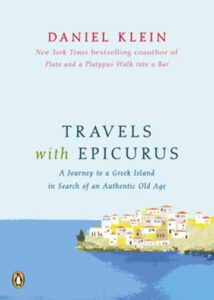
Worth Reading: Travels with Epicurus

By Daniel Klein 

I read this for my book club (The Mules) in October and (very) briefly reviewed it then here on the blog. It’s part “Dummies’ Guide to Western Philosophy” and part a casually philosophical memoir about finding fulfillment in old age.

Daniel Klein’s thesis is that there is a time for everything in life, and old age is a time for slowing down, embracing the simple pleasures (like an Epicurean would), and preparing for the inevitable. He eschews the modern tendency to resist this natural stage of life by trying to look and act like you did and could when you were 20 and 30 years younger.

What I Liked About It: I liked the attempt to define Epicureanism and to bring in the ideas of other philosophers, which made for a more interesting read.

What I Didn’t Like: I agreed with Klein that a man my age should accept with equanimity the fact that he cannot do everything he once could and should learn to enjoy the many wonderful things that life still offers. But I did not buy his idea that to do the former, one needs to abandon ambition and the hard work it takes to achieve ambitious goals. The right balance in life – and I think this is especially true for people who have accomplished a great deal in their careers – is a mixture of both.