
When Artificial Intelligence Sounds Intelligent but Also Artificial

Renato’s social media post this morning was about meeting one of his BJJ mentors. The message was written in his usual confidently positive + nimbly humble style and voice. But there was something wrong with it. Something too smooth. Artificial. Missing were the little grammatical and diction errors that I suddenly realized were a part of the personality of Renato’s writing. Not flagrant mistakes, but the minor peccadillos one would expect from someone who had learned to speak English as an adult. It was obvious to me what the problem was. Renato had used AI to edit his post (or maybe even write it from scratch).
My first response to grokking this was a positive feeling about how useful this simple AI function could be for Renato and millions of multilingual people whose second (and third) languages are not fluent or even idiomatic.
I also had a mildly negative feeling that surprised me. His AI editing had managed to maintain several of the strongest aspects of his personality. But for me, as someone who knows Renato as a close and beloved friend, I found this “improved” version of his writing lacking.
I sent him a text to let him know how I felt about it. I told him that using AI was probably a very good idea for business correspondence and for social media communication with people that don’t know him. But when he wrote to me, I’d rather it be written in the imperfect but more human voice I’m familiar with.
Challenge After Challenge After Challenge!
Making Sense Out of Being Charitable

Before 1998, I had lots of interesting ideas about the goodness and the badness of charity. Most of these ideas were upside-downed through experienced.
In retrospect, I can understand why my dream of building a multi-functional community center in a remote and poverty-stricken area of a Third World country was destined for difficulties. In the 27 years since I opened that door, I’ve been hit by dozens of reality checks, which will be recounted in the book I’m writing about it: The Challenge of Charity. (You’ll find a chapter from the book in “Works in Progress,” below.)
I don’t feel that way about my other two dreams: creating a botanical garden specializing in palm trees and building a museum.
Creating the Botanical Garden: How Could This Have Been Problematic?
When I bought the first five acres of swamp land for the garden in 2013, I was confident that I’d get full support from the city of Delray Beach, Palm Beach County, and the neighboring residents who would have the daily use of it as a secondary, luxurious backyard.
That’s not what happened. Instead, it’s been a mind-numbing slog. Delray Beach isn’t supporting us. Palm Beach County is treating us like we are creating the county’s largest rehab center. The Lake Worth Drainage Something is trying to annex swatches of our property so they can sell the rights to them to GL Homes. And GL Homes is trying to run a road through the middle of the (now 25-acre) property as a fire lane for one of their multimillion-dollar developments.
In the last several years, I’ve spent at least a million dollars on lawyers and land planners and professional advocates to persuade these bureaucracies to allow me to realize my dream. That’s a million on top of at least $15 million I’ve already spent on buying the acreage, clearing it, building out the infrastructure (always to code), and planting thousands of plants and trees, including hundreds of rare species that botanical scientists and palm tree aficionados will love. And yet I’ve not yet gotten the permission I need to do the normal things botanical gardens must do to pay the rent – like allowing for business meetings and weddings to take place on the property.
But never mind. We will make it happen.
Building the Museum: A Simple Idea That Just Keeps Getting More and More Complicated
I’ve been an art collector for many years with a special interest in Central American modern and contemporary art that began when I started my resort and non-profit projects in Nicaragua.
I have the conviction that the art produced since the 1960s in Central America (Nicaragua, Honduras, Costa Rica, El Salvador, and Guatemala) is every bit as subtle and sophisticated as the art that has been produced in Mexico – or, for that matter, in the US and Europe – at the same time.
So the mission is to get the art world to recognize the value of modern and contemporary Central America art. And one of the ways we thought we’d do that was to build a museum specifically devoted to that cause and furnish it with hundreds of outstanding examples.
About five or six years ago, I had the brilliant idea of building that museum in the botanical garden. More than a few of the botanical gardens I’ve seen have museums, and I always felt that added substantially to the enjoyment of visiting them.
And so I picked out a three-acre parcel on the property and set about designing the building. It began, like most of my plans, with a modest footprint (for a museum) of 10,000 square feet. It ended up (after I read somewhere that the Parthenon was 20,000 square feet) at 21,000 square feet.
It was a fantastic plan. If I were Donald Trump, I couldn’t describe how fantastic it was.
But then problems with the local government bureaucrats popped up. They were using the very good proposal of building that museum to extort more land from me – land that they would then sell to GL Homes for a profit.
With the money I was spending on getting the garden approved, I realized I couldn’t afford to fight them. So I decided we would locate the museum somewhere else.
And that’s where we stand now – a government approved 501-C3 non-profit museum with all the requirements such museums must adhere to, but without a building to adhere to them in.
For example, we must be open to the public at least 20 weeks a year. How to do that without a 21,000 square-foot building? Or even a measly 10,000 square feet?
The solution was to warehouse most of the collection during the time it will take to find a building and meet the requirements by holding exhibitions of individual Central American modern artists on the second floor of my cigar club/ man cave, which was completed in late February.
We had the opening of our first exhibition on March 30. The featured artist was Benjamin Cañas, a brilliant surrealist from Guatemala whose works I’ve been crazy about since I saw one in Guatemala in 2015.
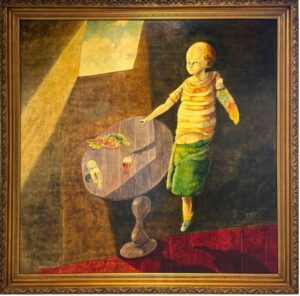
The opening, I am relieved to say, went over “smashingly.” Click here to read a piece that announced it in the local media.
And to make matters even better, just yesterday morning, Suzanne (my partner in all things art) sent me this.
