Can All-Cause Mortality Studies Answer
the Ultimate Question About the COVID Vaccines?
A week ago, I received three separate reports from health bloggers I follow on a major study conducted in Japan and released in June 2025 on a data set of 18 million Japanese people who got the COVID vaccine.
It was an all-cause mortality study, which is a very reliable way to measure the effects of any number of factors on mortality rates, from lifestyle choices, to environmental conditions, to underlying health issues, and, yes, to vaccines.
About All-Cause Mortality Studies
All-cause mortality is an objective endpoint without bias. The occurrence of death should be assessed through standard study processes and through supplemental interrogation of administrative registry databases to minimize the number of patients lost to follow-up and the need for imputation or sensitivity analyses. Factors contributing to the cause of death may be difficult to establish, and the relationship of death to the underlying MV disease or to the intervention may be uncertain.
For these reasons, all-cause mortality is preferable compared with cardiac mortality as a primary endpoint measure. Nonetheless, adjudication of the cause of death should be performed using pre-defined criteria.
The cause of death is subdivided into cardiovascular and noncardiovascular causes. Although categorizing the initiating or proximate cause of cardiovascular death may be difficult, major complications contributing to death should be identified to facilitate future efforts to reduce mortality. A diagnosis of noncardiovascular death requires the primary cause to be clearly related to another condition (e.g., trauma, cancer, or suicide). All deaths that are not unequivocally related to a noncardiovascular condition are considered cardiovascular death for regulatory purposes. (Source: Science Direct]
What the data showed was a significant correlation to all-cause mortality rates in Japan in the months following mass vaccinations.
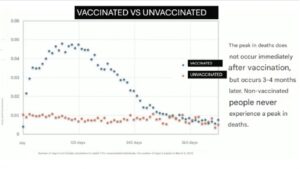
Summarizing the findings, Dr. Yasufumi Murakami, who works at the Tokyo University of Science, one of Japan’s top RNA research centers, and is the author of more than 100 scientific papers, said that the data showed a clear pattern: The more doses of the vaccine a person got, the sooner they were likely to die after their last shot.
The steepest spike was after three doses. Those who got three doses were most likely to die about 90 to 120 days after their last shot date.
But as Dr. Murakami noted, non-vaccinated people never experienced a peak in deaths.