NYC Is One of the Best Cities in the World – as Long as You Are in the Right Zip Code!
After the wedding guests had departed, K and I spent four days in the city, doing what we always do when we are there: going to the theater, visiting museums, strolling in the parks, people watching in downtown cafés, and window shopping on Madison and Fifth Avenues. Or, if K is watching a tournament at the Billie Jean King National Tennis Center, I spend my time seated comfortably in one of the plush leather chairs at our hotel, sipping espresso, working on my laptop, and smoking a world-class Nicaraguan cigar.
The weather was good throughout our time there – bright sun, warm temperatures, cloudless skies, and what seemed like genuinely fresh air. Plus, the streets were mostly clean, the buildings mostly unsullied by graffiti, and the subways mostly untainted by the smell of urine.
That got me into a positive mood and, as always happens when I’m feeling good in NYC, Paris, or Rome, I begin to think about buying a pied-à-terre there – in this case, in Manhattan.
If all I knew of New York City was what I’ve seen on social media recently – reports on the insane numbers of murders, robberies, and other violent crimes that supposedly take place each year in NYC and most of the other “Big Blue Cities” – I wouldn’t have even considered such a proposition. But if you go there as a tourist and spend your time in the parts of the city that are frequented by tourists, you will have the impression that Trump is wrong about its “crime problem,” and that maybe he’s “creating a problem that doesn’t exist” as some Big Blue City mayors have recently accused him of doing. (You might think that – but if you did, you’d be wrong. See “Just the Facts,” below.)
Notwithstanding how much I enjoyed all the outdoor activities K “exposed me to” in the city, the best times I had, on a per-hour basis, were spent indoors at three museums: The Whitney, The Frick Collection, and the Metropolitan Museum of Art.
This is not surprising. Spending time in art museums has always been my favorite thing to do as a tourist. And so it was this trip.
The Whitney Museum of American Art

The Whitney has a massive and impressive collection of modern and contemporary American art.
The Exhibition We Saw: All Day All Night

This is a retrospective of the work of Christine Sun Kim, an artist who is – IMHO – too young to be given a retrospective.
Well, no. That’s not right. In theory, at 45, she could have been producing art professionally and voluminously since she was 10. But she hasn’t. She’s been on the art scene now for barely 15 years.
So, what’s this about?
Is it about her being a woman? An Asian woman? An Asian woman from LA? No. But it could be about the fact that Christine Sun Kim is deaf.
Is Sun Kim just another affirmative-action artist, exploited by a museum wanting to be au courant with the zeitgeist of Woke Culture? My first impression of her work had me thinking, “Yes.”
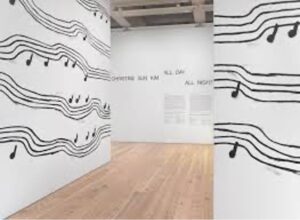
I changed my mind after about 10 minutes of looking at it carefully. Sun Kim is not someone hoping to cash in on her victimhood. There is nothing about her drawings that says she thinks her deafness makes her special or worth any special consideration.
On the contrary, what you discover when you look at the development of her work from the sound experiments she was doing in the 2010s to the graphic work and installations she is doing now – for example, a mural she created last year called Ghost(ed) Notes, which covers multiple walls on the eighth floor – it is nothing like what you might expect from an artist who is focused on her handicap and her minority status. She is not preaching or protesting. Rather, she’s doing something more revolutionary: trying to close the gap between the deaf and the hearing world modestly (almost shyly) with humor and an approachability that feels entirely authentic.
The Frick Collection at the Frick Mansion

The Frick Collection is housed in the Gilded Age mansion that was originally the home of Henry Clay Frick. When he died in 1919, as specified in his will, steps were taken to transform the building into a museum, which was opened to the public in 1935. (His will even provided a $15 million endowment for maintenance.)
The permanent collection includes works of art that Frick had assembled over a span of 40 years, and is comprised of 16 individual collections – dozens upon dozens of Old Master paintings and European sculptures that integrate Italian, French, and Spanish works, which makes it a great place to compare different schools of art from multiple regions and time periods. Which is, I’ve read, the way Henry enjoyed viewing art.
This was the first museum I ever visited. I was on my way to Sunday mass with my mother when she decided we should spend the day in the city – and our time at the Frick Mansion was, for me, the most memorable part of that day.
The Exhibition We Saw: Vermeer’s Love Letters

This exhibition is unlike any I’ve ever seen. Most are either massive retrospectives of a single artist or wide-angle perspectives of a movement or school. This one featured only three paintings.
Vermeer (1632-1675) was a meticulous artist. It has been estimated that it took him three to four months to finish a single piece, and his entire oeuvre may have consisted of only about 50 or 60 paintings. Today, only 35 or 36 Vermeers are known to exist. What’s even more curious (at least, to me) is that no drawings or etchings by him are known.
When K and I were last in Holland, we visited several museums in Amsterdam, including the Rijksmuseum, where we had the opportunity to see about a dozen of Vermeer’s paintings, as well as many more by Rembrandt, Frans Hals, and other painters from what is known as the Dutch Golden Age, a period of time roughly spanning the 17th century.
I’m a huge fan of the Dutch Golden Age painters because of the craftsmanship and technical near perfection of their compositions and their ability to create scenes that suggest that something dramatic is going on beyond the scene itself. Vermeer, IMHO, was the best of them.
If you see the exhibit, take a look at what a master he was at depicting every kind of material in exactitude – marble and concrete and wood, porcelain and glass, pewter and silk and cotton and wool. I can’t think of another artist that does it so well.
The Metropolitan Museum of Art

The Metropolitan Museum of Art, commonly referred to as The Met, is huge. By floor area, it is the third-largest museum in the world and the largest art museum in the Americas. Its collection spans the globe and the ages, with art and artifacts from Mesopotamia and ancient Egypt to Greece and Rome, from the Middle Ages, the Renaissance, the Romantic period, the Impressionists, and the Expressionists to the full range of modern art.
You could visit every day for a month, and you would not have scratched the surface of what The Met has to offer. And that is why, every time I’m in New York, I stop by to revisit favorite exhibits and to see what’s new.
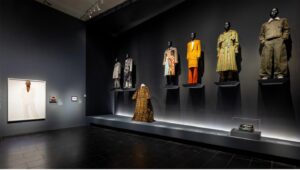
The Exhibition We Saw: Superfine: Tailoring Black Style
K and I spent an hour revisiting the French Impressionists and the American Modernists, but then headed to see this exhibit that I was eager to check out.

Curated by the museum’s Costume Institute, the exhibition presents a cultural and historical look at “Black style” over 300 years through the lens of what the catalog calls “Black dandyism.”
From the catalog: “Black dandyism, by and large engaged with by men, sprung from the intersection of African and European traditions of dress and adornment. Its history – from Enlightenment England to the contemporary art and fashion worlds of Paris, London, and New York – reflects the ways in which Black people have used dress and fashion to transform their identities, proposing new ways of embodying political and social possibilities.”
I have to say, the clothing on display was beautifully and precisely tailored as well as flamboyant in presentation.
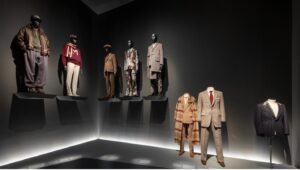
I’ve been to fewer than a half-dozen museum-centered exhibitions of fashion and have always found that they give me more than I expected. The best one I’ve seen so far was in 2011 – “Savage Beauty,” a retrospective of the work of Alexander McQueen. It was phenomenal. I saw it twice. This one is not quite at that level – primarily because it is mostly men’s fashion – but was nonetheless worth a look.