Have the FAANG Stocks Lost Their Bite?

FAANG used to be a convenient and memorable term to describe the biggest tech giants on Wall Street: Facebook, Amazon, Apple, Netflix, and Google. But Google has changed its name to Alphabet and Facebook to Meta. So, the acronym doesn’t work anymore. NAAMA? No. ANAMA? Maybe. MAANA? Like MAANA from heaven?

FAANG is not working well now in more important ways. After dominating the high-tech markets over the last 10 years, recent earnings on all five companies are looking shaky.

* Facebook lost about 500,000 daily users in Q4 2021, and suggested it could have its first year-over-year revenue drop next quarter.

* Apple recently warned it could lose $8 billion due to supply chain constraints this quarter.

* Amazon reported its first quarterly loss in seven years, resulting in the stock tumbling about 14%.

* Netflix announced it lost subscribers for the first time in over a decade, leading its stock to drop 35% the next day and wiping $50 billion from its valuation.

* Google showed slower growth than last year and missed revenue projections for Q1, thanks in part to a weak quarter for YouTube.

So far this year, all five stocks are down, with Apple being the only one outperforming the S&P 500 index.

 What is an NFT really worth? 

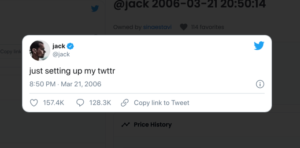
The tweet above was Jack Dorsey’s first NFT. In March 2021, during the early days of the NFT boom, it sold for $2.9 million.

Early this month, the owner, Sina Estavi, listed it for $48 million, promising to give half of that to charity. “Why not give 99% of it,” Dorsey quipped.

Two weeks later, the highest bid was for $280. It now stands at $12,000. If sold at that price, it would be a 99% loss in value.

Jonathan Perkins, cofounder of the NFT platform SuperRare, commented: “There has been a lot of experimentation in the space, and I think we’re running up against the boundaries of speculation.”

Greg Isenberg, CEO of the web3 design firm Late Checkout, had a different take. “This wasn’t a real sale,” he said. “There are only several buyers for something as big as this, and the listing price was unrealistic. Serious buyers wouldn’t bid on this. I didn’t.”

My take: Both comments are true.

The tweet above was Jack Dorsey’s first NFT. In March 2021, during the early days of the NFT boom, it sold for $2.9 million.

Early this month, the owner, Sina Estavi, listed it for $48 million, promising to give half of that to charity. “Why not give 99% of it,” Dorsey quipped.

Two weeks later, the highest bid was for $280. It now stands at $12,000. If sold at that price, it would be a 99% loss in value.

Jonathan Perkins, cofounder of the NFT platform SuperRare, commented: “There has been a lot of experimentation in the space, and I think we’re running up against the boundaries of speculation.”

Greg Isenberg, CEO of the web3 design firm Late Checkout, had a different take. “This wasn’t a real sale,” he said. “There are only several buyers for something as big as this, and the listing price was unrealistic. Serious buyers wouldn’t bid on this. I didn’t.”

My take: Both comments are true.

Rental Real Estate 101: What Does “Buying Right” Mean? 

I wrote a course on rental real estate investing 10 years ago when I was writing a blog called “Creating Wealth.” Recently, I decided to turn it into a book that recounts my personal experiences and what I’ve learned. But to make the book stronger, I asked my brother Justin to co-author it with me, since his experience is longer and stronger than mine. The following is an excerpt from an early chapter that explains a very useful trick we use to determine how much any rental property is worth. [italics]

One of the most important lessons I ever learned about investing in real estate was taught to me by my brother Justin. It is a very simple formula for estimating the value of almost any sort of rental property in a matter of seconds. It is brilliant. It is extremely useful. And it is incredibly reliable. (As most brilliant formulas are.)

I wish I had known about this formula when I made my first real estate investment. It would have saved me tens of thousands of dollars and four years of real estate hell. It gave me the confidence to invest strongly for several years, buying up dozens of single-family houses and two small apartment complexes that have given me millions of dollars in appreciated value and millions of dollars in cash flow since then.

Perhaps more importantly, it pushed me out of the market by 2006, when property values were unreasonably high, and thus kept me safe when the real estate bubble burst in the fall of 2008.

This is the formula:

If you can buy a piece of property and have it fixed up and ready to rent for less than 100 times the monthly rental income, consider buying it. If you can’t, walk away.

Example: You are looking to make your first investment. On the advice of a friend (me, perhaps), you are looking at three-bedroom, two-bath, single-family homes in working class neighborhoods in or near where you live. You find two houses that you can comfortably afford. One has a rental income of $1,500 and is priced at $145,000. Another has a rental income of $1,600 and is priced at $170,000. Which should you buy?

Using our simple formula, you multiply each rent by 100 to get your “limit.” The limit for the one renting at $1,500 is $150,000. The limit for the one renting at $1,600 is $160,000. The former meets the standard, as you can buy it for less than $150,000. The latter does not, since it’s priced above $160,000.

It’s as simple as that.

Justin calls this calculation the gross rent multiplier (GRM).

The GRM is simple. It is also a rule of thumb. In my experience, it has been reliable every time I’ve used it, without exception. But my brother warns me that there are times when you have to do more arithmetic than just the GRM. This is especially true for larger properties – apartments and complexes of 50-plus units. Hotels and motels. And the like.

But for anyone who is a novice investor, like I was when I began buying rental properties, it is a very good and trustworthy protocol to follow. It will save you loads of time and a fair bit of money considering questionable properties. It will also make you immune to seductive sales pitches because you won’t be listening to the claims and promises of owners, agents, and/or brokers. You will do the calculation mentally in a few seconds. And then you will know whether it’s worth your time to investigate the investment further.

“Save like a pessimist. Invest like an optimist.” 

I read that somewhere recently. It stuck because it is so simply true. (Sorry, you who said it. I didn’t make note of your name.)

Until I began writing about wealth building, I don’t think I ever considered that there is a distinction between saving and investing. But sometime during the intervening years, I came to believe that there is a significant difference.

The purpose of saving is to put away money for a particular need at a particular time. Like buying a car in the future. Or paying for college tuition. Or retiring at a certain age. The purpose of investing is more ambitious and more nebulous. The goal is to put some portion of one’s savings into specific assets in order to see them grow.

Thus, the number one rule of saving is: Take little or zero risk. Investing, however, mandates risk. The challenge is to determine how much risk you are willing to take.

We all have different assets and resources available to us. And different economic needs and aspirations. Thus, we must set our own goals and devise our own wealth-building schemes.

I put my “saving” money into debt instruments, rental real estate, gold, and museum-grade art.

I put my “investing” money into stocks, options, REITs, certain speculative investments, and – most of all – privately owned businesses.

What I Believe: About Investing 

To be successful at anything, we must begin with the ancient Greek aphorism, “Know thyself.”

With respect to investing, that means understanding your instincts and emotions with regard to fear and greed. Here’s an easy-to-answer question that can shed light on those characteristics right away:

What is more important to you? Becoming richer? Or being sure you won’t become poorer?

If, like me, your fear of getting poorer is greater than your desire to get richer, you must do three things:

* Diversify the assets you invest in.

* Establish a “sell point” when you first invest, in case things go south.

* And size your positions – i.e., regulate how much money you put into each asset class and each particular investment within each asset class.


Alex Green on Making Money in the Stock Market… 

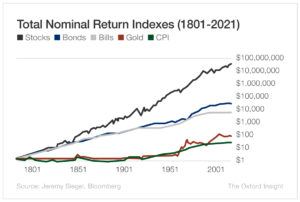
“Jeremy Siegel – a professor of finance at the Wharton School of the University of Pennsylvania and author of Stocks for the Long Run: The Definitive Guide to Financial Market Returns & Long-Term Investment Strategies – has done a thorough historical study of the returns of different types of assets over the past couple hundred years.

“What he discovered is dramatic: $1 invested in gold in 1802 would have been worth $90.05 at the end of 2021. The same dollar invested in T-bills would have grown to $4,437. A $1 investment in bonds would have been worth $36,390.

“And a single dollar invested in common stocks with dividends reinvested – drumroll, please – would have been worth over $45 million.

“Just look at the massive moves in the graph below…

“Look back through history and start whenever you choose. You’ll find the rolling returns for different asset classes are remarkably consistent.

“And equities win in a landslide. Since 1926, the stock market has generated a positive return in 71 out of 96 years.

“Historically, the odds of making money in the US stock market are 50-50 in one-day periods, 68% in one-year periods, 88% in 10-year periods, and 100% in 20-year periods.

“(That’s something to remember whenever stock prices start wilting like last week’s roses, as they have lately.)”

The Stock Market: What… 

Worried about your stock portfolio? Here are some facts from Mitch Zacks (by way of JS) that may ease your concerns:

* S&P 500 earnings have been going up while the index has been falling. That means the P/E ratio on the US stock market has moved lower. (That’s a good thing. It means stocks have gotten cheaper relative to corporate earnings.)

* Most analysts expect the US economy and US corporations to grow in 2022. At Zacks Investment Management, the expectation is 7%.

* And since corporate earnings and revenue track GDP growth, Zacks also expect corporations to have a good year.

Buying Art as a Financial Strategy 

One of the most important things to know about the supply and demand dynamic of art is very basic: When an artist dies, the supply of his work becomes fixed.

Demand is determined by a host of factors that boil down to the reputation of the artist among the art-buying public.

The “art-buying public” comprises a very large market – i.e., hundreds of millions of people. The great part of that market – like 99% – is involved in buying art whose value is worth exactly what someone is willing to pay for it. And the moment it is sold, its value usually drops by about 70%. Often more.

If you want to collect art as an investor, you must eschew that 99% of the market and focus only on art that has support among the 1%. On a global scale, this part of the market is probably limited to fewer than a million people. And that includes not only private collectors, but institutions, critics, and dealers.

Since we are talking about investing in art, let’s call this the realm of investment-grade art.

What is investment-grade art? 

For a work of art to rise to the level of “investment-grade,” two things must happen.

First, works by the artist have to make their way into the collections of major institutions and influential collectors.

Second, the artist and his/her works must make their way into the pages of respected periodicals and books on art.

The longer a piece has been in such books and collections, the more stable its value is likely to be. Like blue chip stocks, art that has a significant and longstanding reputation for being valuable tends to be a safer bet than art that has a short history – i.e., art that is hot now.

The Takeaway: If you want to start a collection of art that will appreciate in value over time, you must ignore everything you hear about the piece you are considering in terms of aesthetics. Do not even think of it as art. Think of it as a financial asset. Because ultimately, that’s what it is.