How Safe Is Your Business from Employees Like This? 

I don’t know if this is real. This guy is so charismatic, I suspect he’s a professional actor.

Take a look at this video:

This may be a con, but this sort of thing does happen. In fact, when a business gets to a certain size – say, 1000+ employees – claims of racial discrimination and sexual harassment become commonplace. Even if you have a strict code of employee conduct and even if you have a hiring practice that gives preference to minorities.

I remember the first time this happened to one of the businesses that I was a partner in. The accusation was so implausible, and the claim of innocence by the employee accused was so credible, that I wanted to not just resist the claim but sue the claimant.

The claim, after all, was a smear on the reputation of someone I knew and trusted, as well as on our company. But when I suggested my course of action to corporate counsel, he said, “We can do that, if you want. But it will cost us at least $50,000 to cover the legal expenses. Or we could settle it now for $10,000.”

I was willing to spend the money. But the rest of the board was more pragmatic. “We could lose. We might be wrong. And who wants to risk $50,000 when we can settle for $10,000?”

We settled for $10,000.

This became standard operating practice. And each year the claims arrive. We rarely bother to review them anymore. It doesn’t matter who is lying. It’s cheaper to pay off the claimant and fire the accused.

I understand the logic. But I wish we had not let the bottom line determine our protocol. I can imagine a hack doing a hit piece on us, pointing out that we must be encouraging sexual harassment and racism. How else to explain the fact that we have settled out of court 20 times?

I sent the above video to our CEO, saying, “I guess the lesson is that if you make it easy and profitable for people to extort you, some of them will.”

He replied, “Not surprising. We have found the book How to Sue Your Employer and logs on perceived misconduct in people’s desks after they were fired.”

War and Peace in Business:

What Kind of Leader Are You?

A colleague recently sent me an article titled “Peacetime CEO/Wartime CEO.” It was written by Ben Horowitz, cofounder and partner of Andreesen Horowitz, a venture capital firm. The thesis: When a business is mature and growing slowly, it is well served by a CEO that is adept at managing size and stability. But when a business is “facing an imminent existential threat,” it needs an entirely different kind of leader. Someone that is single-minded and tough. Someone willing to make decisions that no one else will.

Horowitz calls the first type a “Peacetime” CEO,” and the second a “Wartime” CEO.

The article was meant to advance a conversation we’ve been having about a company in which we are partners. After decades of growth and a decade of industry dominance, the business is floundering. The first signs of trouble arose two years ago, at which time each of the individual divisions began taking steps to move their businesses back onto solid ground. Since then, we’ve noticed that (1) some of our subsidiaries are faring better than others in regaining profitability, and (2) those that are doing better are being managed very differently than those that continue to struggle.

If Horowitz were advising us, he’d probably tell us to look at our CEOs, figure out whether they are equipped for war or peace, and then give the peacetime CEOs a choice: Change your ways or let someone else take the wheel.

I have my own theory of leadership, which I’ve written about over the years. My idea is that there are two kinds of business leaders: those that are good at growing businesses and those that are good at managing them after they’ve grown. I call the first kind Growers and the second kind Tenders.

Growers are not better than Tenders. Businesses need both. But at different times and in different places. When businesses are young, they need Growers at the helm, with Tenders reporting to them. When businesses are mature, they need Tenders at the helm, with Growers helping them develop newer parts of the business.

Horowitz’s Peacetime CEOs are very similar to my Tenders. They are thoughtful and analytical. They are capable of multitasking. And they love making plans and solving problems. They don’t like making mistakes. And they are careful about what they say. They have these preferences and characteristics because they understand that keeping a mature business running profitably is a huge challenge that requires constant attention to the three Ps: people, protocols, and products.

Wartime CEOs and Growers are also similar. They are goal-oriented and accomplishment-driven. They tend to be narrowly focused. Once they make a decision, they like to move quickly. And they don’t like people second-guessing their decisions and slowing them down. They recognize that problems need to be solved. But they expect their subordinate managers to solve them. They understand that growing a business or saving a struggling one requires extraordinary singularity of purpose. It calls for the CEO to focus almost exclusively on Job Number One. And get it done, whatever the cost.

Steve Jobs is an example. A Type-A personality, he was a natural Grower. And he grew Apple aggressively to an astonishing level of success before he was fired and replaced by someone that was less impulsive and entrepreneurial. His replacement may have fit the bill in terms of the kind of personality Apple’s board was looking for. But he couldn’t keep the company growing. And for a company like Apple, that meant it began to lose its momentum and fall behind. When Jobs was finally asked to return to Apple, he came back as a Wartime CEO, and made the radical changes needed to get Apple back on top.

As for the business I’m writing about, my partners and I have no plans to recruit warriors to replace our peacetime leaders. But we do want to persuade them to put on their helmets and start making tough and decisive decisions like wartime leaders. Here’s how they can do that…

How Peacetime Managers Can Become Wartime Generals 

Dealing with Problems: Peacetime CEOs and Tenders see their primary job as identifying and solving problems. To become more like Wartime CEOs and Growers, they have to severely limit the number of things they are paying attention to. Instead of trying to stay on top of a dozen issues, they need to identify the two or three that will make the greatest difference in accomplishing their primary goal and spend 80% of their time and energy on them. This will undoubtedly create additional problems. But they must resist their impulse to solve those problems and delegate the responsibility to others.

Conflict: Peacetime CEOs and Tenders see their primary job as helping the business run smoothly. And because they see conflicts – whether systemic or personal – as threats to the continued smooth running of the business, they focus on eliminating those conflicts. To become more like Wartime CEOs and Growers, they need to focus, instead, on the two or three things that will bring the business back to profitable growth – and make it clear to every employee that they must be focused on the same thing. They need to emphasize that any problems that might arise have to be resolved by those involved.

Deviation and Creativity: Peacetime CEOs and Tenders allow for, and even encourage, deviations and experiments in order to foment good will and creativity. To become more like Wartime CEOs and Growers, they have to make it clear to their employees that until such time as the business is stable and profitable again, there will be a zero tolerance for deviation from the core plan. “If you want to keep your job,” they must imply, “you will toe the line.”

Team Building and Consensus: Peacetime CEOs and Tenders strive for broad-based buy-in and even consensus. To become more like Wartime CEOs and Growers, they need to explain to the troops that there is no room for anyone that is not enthusiastically with the team. They need to be able to back this up by firing the doubters and laggards. Saving and growing the business doesn’t just matter. It is the only thing that matters.


Checking In on Checking Out

The last time I was in an airport, I selected a coffee and a sandwich at a kiosk, only to discover that there was no one there to check me out. I stood there, puzzled. Then I noticed that the cash register was more than just a cash register. It was a self-checkout machine.

“Oh, boy,” I thought. “This is going to be embarrassing.”

I’d had a few run-ins with such equipment before. If you’ve ever been in a situation where you’re incompetently trying to make a machine work, while people stand behind you, shaking their heads, you know what I mean. This particular machine, though, was easy to use. I felt a flush of pride when it thanked me for my purchase.

I got to wondering about automation in general and these automatic checkout machines in particular. I’m sure they’re economical in terms of labor costs. But what about the cost of dealing with people that need help to use them? And what about theft? (No one was watching me. I’m pretty sure I could have walked away without paying.)

I did a bit of research. Apparently, there are lots of people who share my discomfort with this technology. According to a report in the WSJ, two out of three shoppers report having problems with it.

Nevertheless, the number of these machines is increasing. In 2018, self-checkout accounted for 18% of grocery transactions. Last year, it was 30%. This year, it is expected to be 35% to 40%. And some chains, like Walmart, Kroger, Dollar General, and Albertsons, are testing self-checkout-only stores. (My friend and colleague, TS, tells me that Amazon is trying something even more advanced. You just pick up what you want and leave the store with it. All the items are tracked, and your account is billed.)

According to The Hustle, one of these machines costs from $14,000 to $40,000. Even amortized over two years, it’s cheaper than hiring a human checkout clerk. Do the math over a 10-year period, which is probably closer to the machines’ useful life expectancy, and you have numbers that are impossible to ignore. Humans behind cash registers will soon be a thing of the past.

In the meantime, there will be embarrassing moments for people like me. Like this one:

Click here.

Starbucks? WeWork? Here’s a Better Idea 

Remote workers and one-person business owners in LA have a new, much more enticing choice of workspace with the opening of Heimat, a luxury club owned by the Berlin-based RSG Group.

For $350 a month, members get:

* Every training machine imaginable, plus classes

* Locker rooms with meditation spaces and saunas

* A spa, juice bar, rooftop pool, restaurant, and bar

* A coworking space and library

Why is it a good deal?

Posh gym memberships typically cost $150 to $200 a month, and WeWork memberships start at $300. With Heimat, you get the benefits of both. And compared to Collette, which is about to open in NYC, it’s a steal. To enjoy the facilities at Collette, New Yorkers will have to pay an initiation fee of $125,000, plus $36,000 a year.

How Much Are Your Ferragamo Shoes Worth? Really? 

Many years ago, a friend of mine opened Rick’s, a restaurant in Chagrin Falls, OH. It was a mid-sized place with an Art Deco style that served excellent food at surprisingly inexpensive prices. Apparently (according to him), I told him, “You should close for a week, give the restaurant a French name, dress the waiters in tuxedos, put tablecloths on the tables, double the prices, and treat people like shit.”

Recently, he sent me this video clip that illustrates the point of my joke about marketing and perceived value – one that applies especially to luxury goods. And it’s great. Check it out here.

The Personalities You Need to Grow Your Business 

Some years ago, in an attempt to figure out how to deal with the challenges being faced by our fast-growing company, I developed a theory that has been helpful to me ever since. The theory: Two types of leadership skills are essential for success.

It began with the observation that growing a business requires a commitment to constant change and innovation and a willingness to test new ideas. So, the sort of person a business needs in order to stimulate growth must have a high level of interest in growth and a low level of sensitivity to the confusion and chaos it creates. I called that type of person a “grower.”

Successful entrepreneurs are growers. That’s why they have a reputation for being aggressive and pushy. They believe their job is the most important one in the company. They don’t want to be hampered by people telling them all the reasons their ideas will upset the status quo, creating messes that will have to be cleaned up. “Someone else can do that,” they think.

And they are right.

The kind of people that are perfect for the clean-up job are very different from growers. I call them “tenders.” They don’t like change. They are painfully aware of the problems it causes. But despite their aversion to disruption, they are very good at dealing with it. In response to change, tenders calm the troops and figure out ways to make the transitions as smooth as possible. As a result, the business is able to achieve growth without falling apart.

My recipe for a functioning business that wants to grow is to surround each grower with several tenders. The stronger the grower, the more tenders the business needs.

I came across an interview with research psychologist Gary Klein recently that ties in with my ideas. He takes a different approach than I took because he seems to believe that creating growth in business is a matter of training managers to see new ideas as worthy things, rather than finding managers that instinctively believe that.

“To be a good manager,” he says, “you want things to run smoothly. And insights are not ways of running smoothly. Insights are disorganizing and disruptive. And so, that’s a major reason that organizations, without even intending to, block the insights that come their way.”

He’s wrong in believing you can train tenders to promote growth. But his analysis of what is wrong with the way most businesses manage growth is exactly right.

You can watch the interview here. (Warning: His manner of expression is dry and academic. But his analysis is good.)

Here Today; Gone Tomorrow

A Lesson From the Demise of Juul

When you are part of a fast-growing business in a fast-growing industry, it’s easy to imagine that growth is normal and that the good things that come from growth are going to keep on keeping on. But as I’ve discovered many times in my career, it ain’t always so.

In fact, it’s common for fast-growing start-ups to hit a point where sales level out. Or start to fall. There are many reasons why that happens. Four of them can be lethal.

From the inside:

* Insufficient capitalization.

* An inability to discover the optimal selling strategy before the clock runs out.

From the outside:

* An economic downturn in the industry.

* An unanticipated act of government over-regulation.

This last one is what happened to Juul, a pioneer in the e-cig industry that got big fast by promoting its e-cigs to minors by producing them in flavors like mango and crème brûlée. By 2018, the company was dominating the market. Altria (Marlboro’s parent company) bought 35% of Juul for $12.8 billion, giving the business a total valuation of $38 billion.

When the media began reporting on how popular Juul’s products were in middle schools, the FDA took action, and in June banned the company from advertising in the US. Altria’s $12.8 billion investment has since crashed by 97%.

Click here.


Uber’s Latest Feature: Is It Good for the Customer Experience?

When dealing with issues in business, you’re always looking for ways to increase productivity by simplifying routines and incentivizing employees to accomplish more in the time they have.

Uber recently introduced a feature that may simplify decisions for its drivers and motivate them. But it may also reduce the quality of the customer experience. I’m talking about the new technology that shows Uber drivers the customer’s destination and what they will earn from the trip before they accept the ride. The company claims this will result in fewer cancelled trips for riders. Yes, it will reduce those annoying, last-minute cancellations. But it will also – almost certainly – mean that if you want an Uber for a short ride, perhaps anything less than 30 minutes, you may have to wait a long time to get one.

Click here.


Subscribe to a New Porsche

One of the things that the internet changed is the rise of the subscription model as a basis for business. As a newsletter publisher, my business was already taking in 90% of its income by subscription when things started moving in the late 1990s. Today, dozens of businesses that used to sell their products conventionally (pay first and keep forever) are using the subscription model, because it is, in many ways, more appealing to consumers.

Now, the auto world wants in.

* In 2017, Porsche launched a subscription service giving drivers access to a range of vehicles for $2,000+ per month. Click here.

* In 2020, Volvo launched an all-in-one subscription service that included rental fees, service, maintenance, and in-car Wi-Fi. Click here.

* BMW recently made waves by offering access to several features, like heated seats, through paid monthly subscriptions. Click here.

* Tesla did it, too, when it launched a monthly subscription for full self-driving functionality last year.

Will This Be the End of American Museums? 

Staffers at the Baltimore Museum of Art voted 89 to 29 last week to unionize amid an industry-wide movement to secure higher wages and better working conditions. BMA employees will join the American Federation of State, County, and Municipal Employees (AFSCME), Council 67.

Over the past two years, large institutions such as the New Museum and the Solomon R. Guggenheim Museum in New York and the Philadelphia Museum, as well as the MFA Boston and the Museum of Contemporary Art, Los Angeles, all formed unions. Click here. 

Amazon: It Keeps On Keeping On 
Amazon continues to grow despite (or because of) COVID, government shutdown, economic uncertainty, and inflation. The company sold 300 million items during its 48-hour “Prime Day” this year (up from 250 million last year), exceeding $12.5 billion in sales. Top sellers included home goods, electronics, and Amazon devices. Click here.

Speaking of Amazon… 

Prime Video, the company’s media division, spent a whopping $465 million producing the TV series The Lord of the Rings: The Rings of Power. Will it make that investment back, plus a profit? Judge for yourself. Click here to watch the trailer.

Move Over Tesla! 

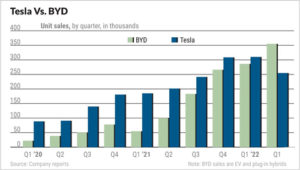
Elon Musk’s Tesla is no longer the king of electric vehicles, according to the July 5 edition of Great Stuff. “That crown now belongs to BYD Motors,” the publication asserted, and Warren Buffett’s Berkshire Hathaway controls a 7.7% stake in it. “It’s very telling that the Oracle of Omaha didn’t take that same stake in Tesla.”

In Q2, Tesla delivered 254,695 vehicles. In the same period, BYD’s deliveries stood at 355,021. Take a look at this chart from Investor’s Business Daily:

In fairness, BYD sells hybrids, not pure EVs. But as was pointed out by Graham Conway in the  TED Talk we linked to in Tuesday’s issue, there is good reason to believe that hybrid vehicles will endure, including the fact that they are currently more eco-friendly than EVs. (If you missed it on Tuesday, click here.)

The Rise of Tequila and Mezcal 

My first experience with tequila, about 50 years ago, left me prostrate at the door I couldn’t quite open where I spent the rest of the night. Thirty years later, I tried it again and found it had a better effect on me. It put me in a social, almost gregarious, mood, with and less chance of incapacitation.

That was good timing, as it was the dawn of the rise of tequila – and its smoky cousin mezcal – as a respectable alcoholic beverage at the level of scotch or bourbon.

In fact, US consumption of mezcal jumped 53% last year. Tequila jumped 27%. This year, it’s estimated that Americans will spend more on tequila and mezcal than on whiskey. And more than they spend on vodka by 2023.

What’s behind the increase?

These are the main factors:

* Their versatility – High-end offerings have pushed tequila beyond shots and margaritas and into the realm of sippable scotch and cognac. And while mezcal can substitute for tequila, it can also be used in drinks that would otherwise call for scotch or whiskey.

* The health factor –  Though it’s hard to call any spirits “healthy,” 100% agave tequila is gluten free, low in calories, and has fewer congeners. (Congeners are fermentation products that lead to hangovers.)

* Their broad appeal – Tequila and mezcal consumption spans age, gender, culture, and occasion. This gives them a wider market than other spirits.

Then there’s the celebrity factor…

Just a few of the “names” that have come up with their own brands of tequila: George Clooney, Kendall Jenner, Eva Longoria, Justin Timberlake, Dwayne “The Rock” Johnson, and Nick Jonas.

(Source: Bloomberg)

Old is new. Retro is back. 

Target is partnering with ThredUP to take advantage of the growing market for used clothes. Click here.

Meanwhile, 80s style leg warmers are bringing in big money on Amazon.

To help entrepreneurs cash in on this craze, the IndieTrackers website recently posted a list of ideas for new businesses. Click here.