Happy Talk Is Here Again!

Contrary to what The New York Times has been saying for 9 months, they are now maintaining that the number of infections is not so important after all. What’s important is… well, here are some excerpts from a recent opinion piece (titled “Good morning. The vaccine news continues to be better than many people realize.”):

* “News about the vaccines continues to be excellent – and the public discussion of it continues to be more negative than the facts warrant. Here’s the key fact: All five vaccines with public results have eliminated COVID-19 deaths.”

* “Of the roughly 75,000 people who have received one of the five [vaccines] in a research trial, no single person has died from COVID, and only a few people appear to have been hospitalized.”

* Quoting Dr. Aaron Richterman, an infectious-disease specialist at the University of Pennsylvania: “In terms of the severe outcomes, which is what we really care about, the news is fantastic.”

* “Fortunately, there is no evidence yet that [the highly contagious South African variant of the virus] increases deaths among vaccinated people. Two of the five vaccines… have reported some results from South Africa, and none of the people there who received a vaccine died of COVID.”

* “The biggest caveat is the possibility that future data will be less heartening…. But don’t confuse uncertainty with bad news. The available vaccine evidence is nearly as positive as it could conceivably be.”

Lest you think they are merely reporting positive new facts, know this: Every bit of this good news was in play before the election. The Biden administration will likely do something new and different with respect to the COVID crisis, but so far, the only thing new about what’s happening is the perspective of the mainstream media.

Purposeful Reading

I’ve long made it a practice to read at least 50 books a year – half fiction, half non-fiction. I read fiction for the experience of the story and the pleasure of the writing. Consequently, I read every paragraph and every word, sometimes more than once. I read non-fiction with an entirely different approach. I call it purposeful reading. I read to understand and judge the thesis, and to collect details that might be useful later on. Since that’s my goal, I almost never read non-fiction books word-for-word. I developed a system for consuming them quickly that suits my purpose very well. (You can read about it here.)

I’m telling you this to let you know two things: When I review a non-fiction book,  I’m not necessarily recommending that you read it. In fact, unless I say otherwise, my review is meant to give you the gist of what I got from the book, along with some key details, so that you can choose not to read it if you wish.

I try to read a question/answer each day in the French and Spanish editions of Quora to keep my language skills alive. I like Quora because the content is basic (easy to understand), and the questions are usually People Magazine dumb, which is a nice break from reading blog posts about economics and social issues. Today, there was an interesting question about Kim Basinger:

“Kim Basinger won an Oscar for LA Confidential, but her career went nowhere. Why? Did she make a huge mistake by taking a 2-year sabbatical right after that win? Why was she never again the huge movie star she once was in the early ‘90s?”

As it turns out, she didn’t take a sabbatical at all. She took a course in the School of Hard Knocks and learned a hard lesson about contract law.

Apparently, at some point in the early ‘90s, Basinger verbally agreed to star in a movie called Boxing Helena. Some time later, she backed out of it, saying she hadn’t realized that it was a story about a woman who is mutilated and held captive by a psychotic surgeon.

But by then, the movie was well into pre-production and millions had been spent, including money to put out the word about Basinger’s role in it. The producer, Main Line Pictures, then sued Basinger for breach of contract, citing losses of $6.4 million in overall sales.

Basinger was found guilty and was ordered to pay $7.4 million in damages, which forced her to file for bankruptcy. And despite her talent, her Oscar win for LA Confidential, and her bankability at the box office, the scandal damaged her reputation in Hollywood.

The lesson: Informal agreements are sometimes enforceable under the law. When you agree to something, even if you don’t have a formal, signed contract, you are obliged to fulfill your end of the bargain.

“Art is primordially eternal.” – Egon Schiele

A Record-Breaking Year for Art 

Once a year, I like to make a quick survey of the art market to get a feeling for its current health and future direction. 2020 was a very strong year, with all sorts of records broken, including some of the highest sales in history.

Take a look…

  1. Inspired by the Oresteia of Aeschylus (1981)

Francis Bacon

One of the 28 large-format triptychs created by Francis Bacon between 1962 and 1991, it rang up the highest sale price of 2020. It was described in Sotheby’s pre-auction literature as “rife with tragic allusion and fraught with chilling grandeur.”

Final 2020 sale price: $84.55 million at Sotheby’s New York on June 29.

 

  1. Ten Views of a Lingbi Stone (1610)

Wu Bin

Created during the Ming dynasty by the court painter Wu Bin, this 11-meter-long scroll depicts 10 views of a single stone from a famous site in China. It set an auction record for Chinese paintings/calligraphy.

Final 2020 sale price: $76.6 million at Poly International in Beijing on July 10.
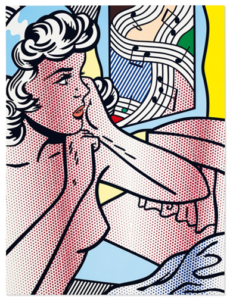
 

  1. Nude With Joyous Painting (1994)

Roy Lichtenstein

Painted toward the end of Lichtenstein’s career, this piece had never before been offered at auction. It was estimated to sell for around $30 million.

Final 2020 sale price: $46.2 million at Christie’s New York on July 10.

 

  1. Five Drunken Princes Returning on Horseback (late 13th/ early 14th century)

Ren Renfa

This rare, two-meter-long, 700-year-old scroll tells the story of five drunken princes (including one who became the longest-reigning emperor of the Tang dynasty) and their attendants on their way home. Once owned by Chinese emperors, it was moved from the Forbidden City in 1922 by Pu Yi, the last emperor of China, after the fall of the Qing dynasty.

Final 2020 sale price: $39.5 million at Sotheby’s Hong Kong on October 8.
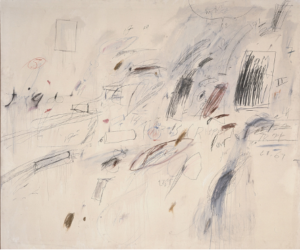
 

  1. Untitled (1969)

Cy Twombly

From Twombly’s “Bolsena” series, one of 14 large paintings done in August and September of 1969 when Twombly was living in a house overlooking the lake of Bolsena north of Rome. According to the artist, some of the images in the series allude to the July 1969 Apollo space flight/ moon landing. This painting previously sold at auction in 1992 (to New York dealer Larry Gagosian) for $1.65 million.

Final 2020 sale price: $38.7 million at Christie’s New York on October 6.

 

  1. Quatre Nus (1950)

Sanyu

Sanyu, the “Chinese Matisse,” was unrecognized in his lifetime. He died, destitute, in Paris in 1966. But now, prices for his work have been soaring. This piece, for example, previously sold in 2005 for “only” $2.1 million.

Final 2020 sale price: $33.3 million at Sotheby’s Hong Kong on July 8.
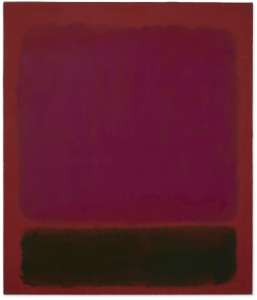
 

  1. Untitled (1967)

Mark Rothko

While not Rothko’s highest-selling piece ever (Orange, Red, Yellow sold for $86.9 million in 2012), this one raked in 26 times its previous (1998) $1.2 million selling price.

Final 2020 sale price: $31.3 million at Christie’s New York on October 6.

 

  1. The Splash (1966)

David Hockney

In 2006, this acrylic sold at Sotheby’s London for $5.4 million. The price climbed by $26 million in 14 years.

Final 2020 sale price: $31.2 million at Sotheby’s London on February 11.

 

  1. Complements (2004 – 2007)

Brice Marden

This diptych, painted between 2004 and 2007, sold for a record amount that makes Marden (at 82 years old) among the 10 most successful living artists.

Final 2020 sale price: $30.9 million at Christie’s New York on July 10.

 

  1. Onement V (1952)

Barnett Newman

Part of a group of six paintings, this was Newman’s third best-selling auction result, an $8.4 million increase from its $22.5 million sale price in 2012.

Final 2020 sale price: $30.9 million at Christie’s New York on July 10.

And now… here’s the latest news from the art world: On Thursday, January 28, a Botticelli portrait sold for $92 million, the second-most-expensive Old Master work ever auctioned! Read about it here.


For the past week or so, the press has been covering what it calls a dangerous new strain of COVID-19 (B.1.1.7 ). You’ve probably heard and/or read about it.

The increase in risk, the reports say, is 30% higher.

That’s misleading.

In terms of relative risk, it’s a fact. But the actual, absolute risk of the new virus is only a small fraction higher than the original. So small, it could be a rounding error.

Here’s how it works: With the original COVID-19, out of 1000 people aged 60 or older, about 10 might be at risk of death. But with the new B.1.1.7 variant, 13 or 14 out of 1000 who are 60 or older might die.

This is a common problem with published reports on the relative risks of any disease: The average reader is misled into thinking the difference is significant. And that misconception sells. It sells drugs. And medical procedures. And it sells papers.

“Bad actors try to cry, and good actors try not to. Bad actors try to laugh, and good actors try not to.” – Martin Landau


It’s Not All About the Director 

The same is true with making movies. Contrary to what the auteur school of film criticism would have you believe, a great director is not the sole reason for a great movie. There are others involved: the cinematographer (also known as the DP or Director of Photography), the editor, and the actors.

Yes, the actors.

I’ve made four movies, and the most surprising thing I learned about the process is how important acting is. As an amateur film buff, I had subscribed to the preeminence of the director. And when I got on the set and saw how the director really is the boss of just about every aspect of the filming, it made double sense to me.

But even at the level I was working at (low budget), I could see a huge difference in how a scene worked, with the same direction, when we auditioned several actors to play the same role.

Good actors can make a good or even a mediocre script into a compelling scene. Bad actors can ruin the best script in the world.

Gifted actors don’t need a director to tell them how. Here’s an example: Henry Thomas’s audition for E.T.: The Extra-Terrestrial. Watch how this 9-year-old boy plays the lead role of Elliott without direction…

o start and grow a good business, you need more than yourself – even if you are a natural-born entrepreneur. You need to surround yourself with a small team of talented, super-smart, and relentlessly determined people, each of whom can do their job as well as or better than you.

“Okay kid, you got the job.”

My First Real Boss 

My first boss was my mother. She had me working at 6 or 7 years old. But I’m sure I’ll be talking about her in more depth another time.

My first real boss?

I’m not sure. I got a job at the Rockville Centre Car Wash when I was 12. That was the youngest age at the time for employment. I remember I had to fill out a form certifying that I was 12. Thinking back on that now, it seems rather young to be doing the work I was doing. I was a weekend employee and my job was cleaning the interiors of the cars as they rolled out of the automated car wash. The work took no mental skill, but significant physical and mental endurance. When a car emerged from the wash, dripping wet, two or three of my colleagues would go to work wiping down the exterior and wheels with rags, while I hopped inside, emptied the ashtrays, wiped down the dashboard, washed and dried the windows, and vacuumed the floor.

When volume was slow, I could do my work at a comfortable pace. But when the volume was high – and it was high for at least six hours of the eight-hour shift – I was in a state of frantic rushing. Cars would emerge from the wash every 90 seconds. (I know that because there was a stretch, towards the end of my career there, when I looked up at the clock every time I got out of the car.) It was boring work, but it was a real job. I punched a time clock, got a half-hour off for lunch, and made $1.25 an hour.

I don’t remember the name of my boss. I remember what he looked like: short, stout, and balding. He wore a suit and tie, even on hot days, and always had a big cigar hanging from his lips. He didn’t do any work that I could see. He mostly chatted with the customers and occasionally, when one of them would complain about something that wasn’t dried or cleaned properly, he would berate the offending worker in front of everyone.

Other than the public scolding, he didn’t do anything I can remember that was offensive. He paid us on time. He gave us our time off for lunch. And he didn’t cheat us on our hours. Still, we saw him as a fat little cigar-chomping prick. And that’s how we referred to him when we talked about work. We disliked everything about him – from the tone of his voice to the way he walked, like a penguin. Even if he had been better about how he corrected problems, we would have still despised him.

There was a sort of seniority to the jobs one would do there. The top spot was the guy that put the car into the automated washer. This was the top position because it involved interacting with the customers. A customer would drive his car up to a certain point, put it in park, and he would open the door for them, hop in, and steer the car into the mechanism that gripped the front tires and guided the car through. He was tall and handsome – I remember that – and garrulous. And he was always smiling. The customers liked him and he seemed to like them.

Next in the hierarchy was the guy that pressure cleaned the tires. He was a short wiry man that flew around the cars like a bee, moving here and there erratically, spraying the tires and hubcaps expertly with the nozzle, and occasionally getting down on his knees with a rag and solvent to take care of some particularly difficult stain.

Next were the three men that dried the outside of the car, of which only one was allowed to drive it out of the wash.

And, finally… me. The person that cleaned the cars’ interiors.

During the time I worked there, all of the employees were African-American-mostly in their 20s and 30s. My job was always done by a Caucasian man-child,  one who was smallish in stature, athletic, and presumably agile enough to move quickly through his chores without any problem. In retrospect, I’m guessing that was the idea of my boss, who probably felt the customers would worry less about having a dark-skinned boy hopping around the inside of their vehicles.

I can say for certain that I never learned anything from that fat little cigar-chomping guy, except that he probably had no idea how much we despised him. I have kept that in mind as an adult. I try to treat my employees with respect, but I don’t try to win their affection. I knew, from this first job at age 12, that the divide between boss and employee is a wide one.

Some say that old-fashioned, objective journalism no longer exists – that major media have abandoned their longstanding commitment to restricting their social, political, and personal views to the editorial pages.

Could this be true?

Here is a sampling of headlines from The Washington Post’s digital newsletter earlier this week:

* Trump to flee Washington and seek rehabilitation in a MAGA oasis: Florida

* Undeterred, Biden will push unity in a capital locked down after an insurrection

* How Twitter, on the front lines of history, finally decided to ban Trump

* Joe Biden has already shown us that governing is back

* As Trump exits Washington, he tells the modest crowd, “We’ll be back in some form.”

* Trump ends it all with one final scam

Are these headlines factual? Are they unbiased? You decide.

The Migrants Are Coming! The Migrants Are Coming!

While watching the inauguration, my brother-in-law said, “Biden wasn’t even in office yet and the Trumpsters were already starting their conspiracy theories about Latino caravans marching towards our southern border.”

He’s generally much more up-to-date on this sort of thing than I am, so I didn’t challenge him. But I did think to myself: Why wouldn’t caravans be forming? If I lived in Central America and wanted a better life for my family, I’d be on my way. (I subscribe to the theory that economics is a key factor in human behavior, and people generally respond to economic incentives and disincentives in predictable ways. In much of academia today, this is a very unpopular idea.)

I asked Amaru to check it out, and I was right. Instead of conspiracies theories, he found more than 20 stories – from sources including NBC News, Fox News, BBC News, Bloomberg, The Washington Post, and NPR – verifying that thousands of migrants from Honduras and Guatemala were already on the move, hoping to take advantage of the new administration’s plans for immigration reform.

Everything Isn’t Always About You, Betsy! 

January 17, 1983

Dear Betsy;

You are sensitive to your own feelings; you indulge yourself in feelings which are always and exhaustingly about your reactions to people and events. You haven’t the faintest idea about other people’s feelings – how you affect them. You invent complications, you analyse without reason or need very simple occurrences, and you analyse with very little true knowledge of people. It does not occur to you that this is an outrageous burden on others; not friendship but emotional tyranny.

Emotional tyranny, Betsy. The rule, your rule, is: tread softly, by God, or you will disturb my feelings. It’s an enormous stupid tedious bore. You can have all the feelings you want, but the only practical way you can handle this is: cut out the people who distress your feelings and take the rest of the world at face value, the face the world presents, because everyone has enough real problems without getting bogged down in the problems you manufacture.

You have no idea why I won’t travel with you again. Because, with all your feelings, you have never stopped to look at yourself: a woman who sulks when events don’t work out as desired, who has innumerable absolute needs which are not life and death matters but your absolutes, who has to be kept happy or else by golly it’s miseryville all round.

Friendship is fun and a loose mutual aid society. It isn’t soul-picking (your soul, note) and you’ve made me as furious as I’ve ever been. I won’t have this nonsense and this tyranny. I have never had it from anyone else and I’m not having it any more from you. Try growing up.

Love,

M