The Iran War, AI, Media Bias, and the Great Divide

Notes from My Journal: 

The political event that, in 2016, sliced America into two political/social tribes, and has steadily widened and deepened in the past 10 years, is about to become an irreversible fact in our nation’s future. At least, that’s how I am feeling as I absorb the incredibly rapid expansion and progression of AI technology throughout every aspect of my life.

Last night at the Cigar Club, I took part in a “So-what-are-you-up to?” conversation with four friends and Number One Son (who was visiting with his family for a week and is in the process of inventing some sort of AI tool) that slid quickly into a succession of animated accounts about businesses started in minutes and millions of jobs being rendered redundant with every passing month.

This is something I’ve been thinking about since I saw how AI had already and forever disrupted the commercial advertising industry in the summer of 2025, which I wrote about last month in the Feb. 28 issue. That’s when I introduced my “80/20” hypothesis about how AI is going to radically deflate the value of 80% of the highest-paying trades and professions, leaving workers unable to even earn a living without increasing their production 500% through the competent use of AI.

The conversation last night quickly mutated into a techno-pigeon form of English that I could not fully understand, but understood enough to recognize that, whatever subtle differences the others had between them about this or that future development, they all shared my view of how quickly and deeply AI is about to change the world and the probability of an 80/20 outcome.

And that gave me one more reason to get going with my $100 million 80/20 Club project. If only I knew what, exactly, that is going to be.

When I look at the world around me, I see so much in flux that I’m hesitant to make a lot of predictions. Well… that’s not true. I’m eager to make predictions that will in some way disturb or downright irritate 80+% of the people that read the following:

10 Ways the World Will Be Different in 10 Years

1. The current monetary system will be completely reinvented. Cash and cryptocurrencies will be illegal and the diehards that hold onto them, believing that they have safety in the “crypto,” will be in jail. The only legal currency will be digital, and the most dominant one will be – surprise, surprise – the digital dollar!

2. There will be no more annual filing for income taxes, or quarterly filing for corporate taxes, or filing for any sort of taxes at all. Taxes will be entirely controlled by governmental AI accounting systems. Every dollar that every citizen owes to the government, whether he or she knows it or not, will be determined and collected by this hugely more powerful taxing authority. All of it will be done without any input from individual income earners or corporations.

3. Serious crimes – including murder, kidnapping, rape, human trafficking, severe child abuse, armed robbery, carjacking, arson, larceny, arms dealing, large-scale manufacturing and/or distribution of controlled substances, embezzlement, money laundering, identity theft, tax evasion, forgery, insider trading, and terrorism – will have been nearly 100% eliminated, except for crimes committed by the really (not judicially determined) insane.

4. Most misdemeanor crimes – including simple assault, domestic violence, trespassing, possession of stolen property, public intoxication, traffic violations, littering, loitering, public inebriation, smoking and/or drinking in prohibited areas – will be extremely rare because the detection, prosecution, and punishment of them will be supervised and executed by advanced AI technology, including video and audio recording systems, as well as digitalized and AI-run judicial and prosecutorial systems.

5. There will be no more illegal migration, no more illegal voting, no more smuggling, people trafficking, or human slavery, except when permitted by governments.

6. Nation-states as they currently exist will be transformed into three or four “digital mega-states” that will each have their own laws, judicial protocols, and processes that will exist to reinforce the cultural values determined by AI algorithms that have already been designed.

7. Personal and financial privacy will cease to exist. Every action of every citizen will be recorded and embedded on blockchains that will be owned and controlled by the managers of the digital mega-states. There will be only minor and sporadic objections to these changes because the great percentage of the populations affected by them will welcome them with open arms.

8. Social credit scoring will be universal, with credits given for all actions in compliance with digital mega-state mandates and deductions given for all actions, including expressions of thought, that are contrary to the values and principles of the digital mega-states, which will have been permanently embedded in their algorithms. Again, these changes will be not only accepted by the majority of the citizenry, they will be embraced by them.

9. Drug addiction will no longer be treated as a threat to society, although people convicted as drug addicts will be incarcerated in open-air prisons that will provide them with enough nutrition to keep them alive, along with strong drugs that will keep them unable to leave the open-air prisons.

10. Having more than two children will be illegal in all digital mega-states and will be enforced through massive vaccination systems. As a result, the world population will fall precipitously each year, and eventually settle at three to five billion.

An Open Letter to Outraged Victims of Discrimination 

Part 1: Let’s Sort Out the Truths and the Myths of Social Injustice

Did you know that being tall gives you a measurable advantage in life? Tall people are hired and promoted at a higher rate than people of average height because they are perceived as being smarter than average-height people with similar IQs. And if that were not advantage enough, they are often perceived to be more reliable, credible, and confident. (See box below.)

If you are shorter than average, it’s even worse. Studies have shown that short people are perceived as less intelligent, less credible, and less confident than people with similar qualities and capabilities that are of average height.

And here’s a shocker: Did you know that people who are unwashed, shabbily dressed, obese, and malodorous are less likely to get jobs, receive promotions, and even be invited to office parties than clean, well dressed, pleasant-smelling people with average BMIs?

It’s true. And social scientists have discovered the reason for it. It’s because they are unwashed, shabbily dressed, malodorous, and obese!

Some Facts from Nigel 

1. Height Premium on Earnings
A large body of research shows that taller individuals, on average, hold higher-status jobs and earn more than shorter workers. This effect appears consistently across countries and over time.

2. Income Gains per Unit of Height
Some studies estimate that each additional centimeter of adult height is associated with a measurable increase in annual income, even after controlling for factors like gender, age, and education. For example, research suggests an approximate 1.3% income increase per additional centimeter of height.

3. Height and Education/Status
Analyses of large population samples find a strong positive correlation between taller stature and higher levels of education and professional job class. One standard deviation increase in height (about ~6 cm) is linked to higher odds of attaining degrees and working in skilled or professional roles – often leading to higher earnings.

4. Associated Cognitive and Development Factors
Research shows that taller children score higher on cognitive tests from an early age and are more likely to enter higher-paid occupations as adults. This suggests that height differences partly reflect earlier developmental and health advantages that carry forward into socioeconomic success.

Yes, My Little One. Life Is Unfair. 

Okay. I’m having a bit of fun with this. But I’m doing it to make what I think is a very important (however obvious) point: There are such things as physical and social handicaps – personal characteristics that pose obstacles to those that have them. Some of these characteristics are what politically correct public personalities call “immutable,” meaning they are impossible to change.  Other physical and social handicaps can be changed. Obesity, body odor, and bad manners are three examples. There are, of course, many more.

In days of yore, when I was young, open-minded people who believed in equal rights saw a clear-cut distinction between prejudices against handicaps that were immutable and those that were mutable.

We were, therefore, sympathetic to people who were discriminated against because of such things as their skin color, sex, or height. But we had no sympathy for people that felt cheated in life because of any mutable “handicaps” they chose to have.

How Did All This Happen? 

You could track much of the history of the US and other developed countries in the last 200+ years through the lens of changing public sentiments about this binary. Once a society accepts the notion that all men are created equal (and, thus, have equal rights), then no man or group of men should be advantaged or disadvantaged legally because of any immutable personal characteristics.

The abolition of Jim Crow laws, certain Supreme Court decisions (Brown vs. Board of Education), and the Equal Rights Amendment protected Americans from being discriminated against because of their skin color or their sex. The Americans with Disabilities Act of 1990 ensured equal treatment under the law for people with physical handicaps.

As for people with mutable characteristics, the general view was that they should not be protected if they infringed on peace and prosperity, law and order, and the general good of society and its fundamental Judeo-Christian values.

An Important (but Largely Overlooked) Exception 

There was one notable exception, and it took place when the ink was still drying on the Constitution. I’m thinking, of course, of the First Amendment, which, among other prohibitions, proscribed legal discrimination against citizens based on their choice of religion. And one’s religion, in the US, is a characteristic one is permitted to abandon or change. That was, after all, one of the primary reasons for the American Revolution and is still universally viewed as a righteous protection and one that should be preserved.

It might surprise you (it did me) to know that “gay rights” – i.e., the right of homosexuals to be treated equally under the law – have never been concretely and specifically protected. But the concept is generally adhered to in federal and state laws, the most important of which have occurred very recently, beginning with the ruling on same-sex marriage in 2015.

What we’ve had since then in the US and other Western democracies is a concerted effort to give equal legal protection to other “groups” – beginning with people with gender dysphoria and extending to any and every sort of sexual preference, including those who “identify” as “Furries” (animals).

Thanks to the First Amendment, there was a legal method to this madness – a precedent for protecting mutable characteristics. And yet, oddly, in retrospect, those who so strongly advocated for gay rights over the last 50 years and trans rights and other LGBTQ+ rights over the last 15 years, have done so not by arguing that some mutable characteristics should be protected, but rather that these sexual preferences and psychological dispositions were worthy of protection because they were actually immutable – i.e., already formed at birth and impossible to change.

(I’m not thinking here about the contention that a transwoman is a real woman. That idea, as brightly as it burned for 10 years, has been finally, and I hope permanently, extinguished by a happy surge of common sense.)

Here’s How We Can Fix It 

In my mind, this gets us back to the important distinction between mutable and immutable personal characteristics.

My thesis that people with immutable characteristics such as sex and skin color are correctly provided with legal protection against discrimination in the US and in all other developed Western Democracies. But in saying that, we must also acknowledge that there is a constitutionally defined protection for one very mutable characteristic: one’s choice of religion.

And if that is the case, it seems reasonable to believe that the US and other countries can provide legal protection against discrimination to people with other mutable characteristics. In fact, most of the groups I’m thinking of already have such protections in the form of human rights, which were established by the Bill of Rights and have been strengthened in dozens of Supreme Court rulings since then.

What we should not do is accept as justification for special protection either of two absurd arguments that have been part of the discussion in the past 10 years: That (1) people have the right to choose any personal identity they want, including those that are immutable, or (2) the rest of us are required to accept their chosen identities, just because the individuals who claim them might feel emotionally injured if we don’t.

I promised myself I’d keep my essays down to about 1,200 words from now on, so I’m going to stop here. But this is only Part 1. In the second half of this essay, I’m going to argue a point that many will find more difficult to accept: that even if discrimination against skin color or sex (or any other immutable characteristic) exists at a sub-legal level in a business or social group or any other environment where individuals compete against one another for recognition and advancement, there is little or nothing to be gained by trying to “fix it.” The smart move is to ignore it and, nevertheless, succeed.

Avoiding Two Real and Present Dangers 

One of my favorite longtime friends is a New York City denizen. She loves the Big Apple and is a staunch proponent of its many virtues. She and her husband (also a good friend from long ago) spent a week in and around Delray Beach last week.

We had several great and fun conversations, but we did not dive into a conversation about their recently elected mayor, Zohran Mamdani. She once told me how much she admired him, and that she voted for him knowing he was both a Socialist and an anti-Zionist Muslim. We have too many miles of good memories between us, so I thought discretion in this case would be to keep my mouth shut.

That’s not true. The truth is that I was dying to bring up the topic in a teasing way, but K cautioned me not to do it. I didn’t want to argue because I’ve never won an argument with K. Even scarier: I was afraid I’d discover that she, too, is a Mamdani fan!

So, rather than risk those very real and present dangers, I stayed mute and used the stored energy to write a piece on him for today.

Is Mainstream Media Terminally Ill?

Or Has It Already Become the Walking Dead? 

Mainstream media has been in a downward slide that began soon after Trump’s first term in office (2016), and the numbers have been getting worse with every passing year.

* Industry tracking shows US traditional pay TV subscriptions roughly halved over the last 11 years.

* Pew’s analysis shows cable news saw “meaningful declines” in key periods since 2016, with the steepest drops happening in CNN and MSNBC.

* Trade coverage ratings showed the same thing, with especially deep declines for MSNBC and CNN in key demographics in 2025.

* The Wall Street Journal reported CNN’s prime-time audience dropped 74% since its 2020 high, alongside layoffs and a digital pivot – useful to argue that whatever the Trump-era “attention boom” was, it did not translate into durable linear-TV strength.

* And the S&P Global Market Intelligence says only about half of US homes are expected to have pay TV by end of 2025. That’s down almost 90% since 2010.

The same thing has been going on with mainstream newspapers. A US Congressional Research Service report notes print advertising revenue for newspapers fell 92% from 2000 to 2023 (to about $6B in 2023), and total inflation-adjusted industry revenues fell about 80% from the 2000 peak. While that’s longer-run, it’s a strong backdrop for “demise” framing.

Meanwhile…

There has been an equally astounding rate of growth among the alternative media – bloggers, podcasters, and digital journalists and analysts, to whom the American public has turned for their daily consumption of political, social, economic, and even financial news and analysis.

* YouTube – while not exclusive to podcasts – reports over one billion monthly viewers for podcast content, underscoring how alternative audio/video journalism is reaching massive audiences beyond traditional platforms.

* Megyn Kelly’s independent media venture, The Megyn Kelly Show on YouTube, drew 116.8 million views in July 2023, surpassing major broadcasters like NBC and CBS during the same period. Her channel now has over 4 million subscribers and ranks among the top podcasts in the US.

* Piers Morgan Uncensored, launched outside traditional TV in 2022 and fully on YouTube in 2024, has reached 4 million YouTube subscribers with over 1 billion views since inception, showing how digital talk/news formats scale massively online.

* Substack reached 5 million paid subscriptions as of March 2025, up from about 3 million the year before. Today, Substack supports over 50,000 paid creators, with top earners collectively generating over $40 million annually.

What Happened?

It seems to me that there are four reasons for this.

First, Trump’s election in 2016 divided the country into two roughly equal-sized political groups: those that loved Trump (MAGA) and those that hated him (people with Trump Derangement Syndrome). Fox News was the only news channel that supported some of Trump’s policies (though not all of them), but the rest of mainstream TV took opposition to everything he said or did.

That created hundreds – even thousands – of opportunities for anyone with ambition and a social media account to develop an online presence by being forcefully with Trump or against him.

Second, as some of these social media producers developed large, even massive, followings, money started inserting itself into the equation, which made the idea of making good money from the basement or in a bar feel like a realistic way to grow wealth.

Third, social media algorithms developed the ability to shape the political and social opinions of millions of people, which prompted social media developers to make the technology of the algorithms increasingly more profitable. And that led to the development of digital tribal groups whose inclinations and prejudices were being amplified every day through the manipulation of these algorithms.

And fourth, with the availability of hard-core news and views on every political, social, and cultural topic ubiquitous, mainstream media began to feel – for most Americans on either side of the aisle – stale, dubious, and inauthentic.

That takes us where we are today, with practically 90% of the news and views being consumed by Americans being provided by independent journalists.

And some of them are changing the world.

Take Nick Shirley, the 23-year-old vlogger who, on December 26, posted a 42-minute video in which he approaches day care centers in Minneapolis and attempts to get information about what they do, only to discover that the centers are devoid of caretakers and children. In his initial report, he identifies over a million dollars in day care fraud. Within seven days, with the help of dozens of other citizen reporters who rushed in after him, the total estimated fraud was believed to be between $9 billion and $19 billion.

And then last week, citizen journalists traveled to LA, Chicago, San Francisco, and New York, only to discover that the Minneapolis day care scheme was well entrenched in all these cities, as well as other kinds of fraud related to elder care and various government boondoggles.

This turns out to be the biggest scam on US taxpayers in US history. And it was uncovered by the courageous work of a single, independent, digital journalist. The mainstream media knew about it for years, but decided it was not a story they wanted to tell.

I can’t see mainstream media coming back from this, do you? The heart may still be beating feebly, but the brain has long been dead.

Minnesota Scams, Big Medicine, and Media Showdowns

* Our Taxes Support Somalian Scams?
This woman is making a point that has been coming up since Musk tried to get government waste under control with DOGE, but has accelerated since the Somali scams in Minnesota have become national news. Some Americans are wondering whether they should stop paying taxes and start scamming for a living, like the Somalis do.

* The Unholy Marriage of Big Insurance and Big Medicine
Josh Hawley is looking into a national scam that is probably more than 10 times what is being perpetrated by the Somali community in Minnesota.

* Piers Morgan Talks About Tommy Robinson with Jordan Peterson

This is a very good depiction of the embarrassment one must feel watching a pretentious public nitwit discussing a nuanced topic with a genuine intellectual. (Notice how kindly Peterson treats Morgan here.)

College Education Has Been Getting Worse for Years

Today, It’s a Hugely Expensive and Demonstrably Provable Failure 

The idea that education in America is bad and/or broken is not new. More than 100 years ago, theorists were criticizing the system for abandoning the classical emphasis on reason, rhetoric, and character in favor of catering to the exploding demand for unskilled, semi-skilled, and clerically skilled workers as a result of the Industrial Revolution.

This may have been good for the temporary needs of the economy, these critics argued, but it was making the population as a whole less educated in the ideas that matter (i.e., the great ideas of the past) and more comfortable with the mostly thoughtless and mind-numbingly repetitive jobs that would be dominant in the first half of the 20th century.

And while this was going on with traditionalist, conservative critics, a separate criticism was being developed in Europe by what are called “post-modern” thinkers – mostly from Europe – who were arguing against the traditional notions of objective truth and even science in favor of relativism, intersectionality, intertextuality, gender theory, critical race theory, and the idea that all perspectives, and indeed all cultures, are equal in terms of their value. All truth, they believe, is merely the preferred perspectives of those in power.

By the time I was attending high school and college (in the late 1960s and early 1970s), the worst of these “revolutionary” ideas had resulted in a widespread conviction that the purpose of education was no longer to produce graduates useful to the greater economy, but to produce graduates who could “think creatively” and “come to their own conclusions” about truth and falsity, beauty and ugliness, good and bad.

That was certainly my experience, and it was an education that I felt was good for me. I had developed three or four skills that I now believe were essential to the success I had after college. First and foremost, I had become pretty good at critical analysis. I could look at a big, complex problem, identify its parts, and then figure out a way to solve it. I had also learned the art of rhetoric – how to research and assemble a persuasive argument (a skill that I’d go on to use profitably on a nearly daily basis for the next 50 years). And finally, I had learned – from several of the teachers I befriended – the importance of loyalty and gratitude, and how necessary those characteristics are for moving up in a competitive world.

But when I got into the investment newsletter business in the mid-1980s, I was surprised to discover that some of the best thinkers in that industry – including many economists and highly successful investment analysts – didn’t share my positive view of US education. In particular, I remember listening to bestselling author Doug Casey denounce American education and predict that it would likely get much worse in the future.

He was right. By every perspective I can think of, US college education is worse today than it was when I was a student. With a few exceptions, colleges are producing graduates who have very strong views on social and political issues, but little to no ability to articulate them.

In the 1950s, many of the good colleges still had Latin or Greek requirements. Today, almost every one of them is introducing remedial English and language arts classes for incoming freshmen who did not learn the basics in high school.

In the 1950s, the normal high school graduate could parse a sentence. Today’s average college English major would be hard-pressed to identify a gerund or participle.

But it’s actually worse than that.

Take a look at this.

And this.

I’ve seen so many videos like these in the past six months that I’m fully convinced that what you see here – the amazing level of ignorance of basic facts among college students – is the rule, not the exception.

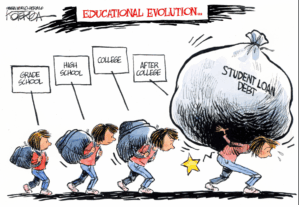
And from the perspective of the investment made – tens of thousands of dollars times four years – the value of a college degree is diminishing fast. According to Labor Department statistics, college costs have risen 188% since 1998, while real hourly wages for grads have increased by only 26%.

In this video, Shane Hummus, who got himself a doctorate degree, identifies seven college majors – very popular majors – that lead to careers that, from an economic and job-satisfaction perspective, are not worth the money they cost to acquire.

But from at least one point of view – dollars in vs. dollars out – a college degree is still a decent investment. The median bachelor’s degree offers a net ROI of approximately $306,000. The median annual return on investment (internal rate of return) for a college degree is about 12.5%, outperforming the historical returns of traditional stock and bond investments.

All of which brings me to the two “Worth Reading” recommendations I have for you today – two ways to approach America’s higher education problem.