Chart of the Week: Presidential Elections and the Stock Market 

How will the election affect the stock market? As Sean points out, there is no reliable correlation, from any number of perspectives, between election results and subsequent stock market performance. One reason is that the stock market is responsive to many factors that are mostly economic rather than political. And even if a conservative, pro-business, tax-reducing candidate wins, experienced stock market pros know that any substantial legislation enacted in one term of office tends to have its impact four to seven years later. So we might see an upward bump if Trump wins – or a downward move if Harris wins. But those will be temporary. Enough, perhaps, to trade on (although the odds are so obvious, the gains won’t be great). But in my own portfolio – the one that Dominick and Sean manage – there will be no changes made as a result of what happens in November. – MF

During my recent trip to Japan, I received one question repeatedly: How will the US presidential election affect the stock market?

Now that Kamala Harris is the presumptive Democratic nominee, I want to revisit this question and offer what I hope will be received as a healthy, nonpartisan dose of “perspective.”

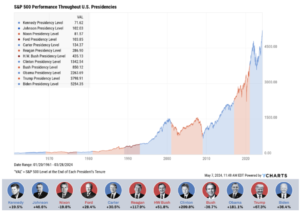
Take a look at this chart showing how the markets performed under every presidency for the last 60 years:

Under both Democratic and Republican presidents, the stock market generally trends up long term.

Why?

Because presidents have little to no control over the things that affect stock prices.

For example, George W. Bush’s presidency was marked by the September 11 attacks on the World Trade Center, the Enron Scandal, and the 2008 Great Financial Crisis.

The market went down, of course. As it would have regardless of party, policy, or person.

To further emphasize this point, take a look at this chart that shows the growth of a $10,000 investment if you only invested during Republican presidencies (the red line), Democratic presidencies (the blue line), or just bought and held the market the whole time (gray).

Choosing to invest in the S&P 500 only during Democratic presidencies since 1950 and sticking to cash otherwise resulted in a 5.11% annualized return. Similarly, a strategy of investing exclusively during Republican presidencies generated an even smaller 2.8% annualized return.

Though there have been several peaks and valleys along the way, the S&P 500 has grown in value over the long term regardless of who’s in office.

While elections may create some short-term uncertainty, simply “staying the course” produces the best results for investors.

Let me put this as bluntly as I can…

Through wars, recessions, inflation, onerous regulation, deregulation, high taxes, low taxes, welfare, housing crises, hyper-socialist policies, hyper-capitalist policies, liberals, conservatives, moderates…

The market has trended up.

The only guaranteed way to lose out on money is to make major investment decisions based on a president’s political party.

So don’t do it.

– Sean MacIntyre

Check out Sean’s YouTube channel here.

Chart of the Week: Small Caps Rebound? 

I’m halfway through a piece I’m writing on what I’m calling “the state of the US economy.” I’m looking at it from the perspective of what I see happening among my friends and acquaintances – those that have small companies (with revenues of less than $500 million) and those in the real estate business as well as the luxury goods and fine art markets. The outlook, as you will see when the piece is published, is not positive. But history tells us that the ups and downs of the stock market are not always corelated to the economy, including the market for low cap stocks, as Sean explains in his column this week. – MF 

Individual stocks typically swing up and down with unpredictable caprice.

But in aggregate, when you divide them up into industries or sort them by factors, stocks do seem to obey the simple physics of a pendulum swing.

We’re seeing that right now with small cap stocks. That is, shares of smaller companies with market capitalization of between $250 million and $1 billion.

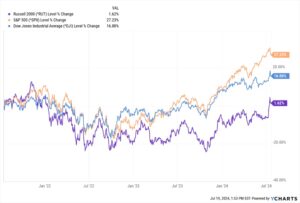
While the major stock indices like the S&P 500 and Dow recovered from the 2022 bear market, small cap stocks, like those in the Russell 2000 (the purple line in the chart above), did not.

And that’s despite the fact that, historically, small caps tend to offer better long-term returns than the market overall.

Forbes, in June, even pointed to this as evidence of “extreme divergence” in the stock market, which can be an early sign of a faltering market.

The wealth management firm Pathstone points out that small caps had “their worst first half of the year compared to the S&P 500 on record. As interest rates have remained higher for longer, earnings for smaller and less growth-oriented businesses have been more heavily impacted.”

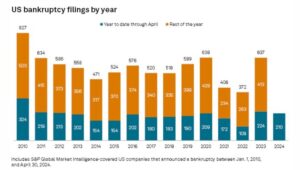
However, we’ve finally seen this start to change with the Russell 2000’s 3-year returns finally breaking positive. Even though the rate of corporate bankruptcies has been high and rising since 2023 as the cost of debt has exploded.

This raises an important question: Why? What’s leading small cap stocks higher?

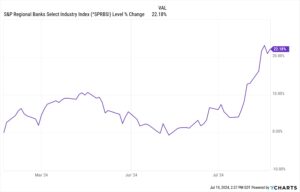
Surprisingly enough, the answer is small regional banks, which have just spiked in a big way over the last few weeks.

Small regional banks have dragged down the performance of small cap indices since (1) interest rates spiked and the yield curve inverted, (2) the failures of Silicon Valley Bank, Signature Bank, First Republic Bank, Heartland Tri-State Bank, and Citizens Bank in 2023, and (3) Fed Chairman Jerome Powell’s assertion that “There will be bank failures” caused by exposure to commercial real estate loans.

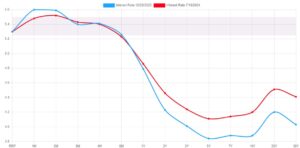
But now that interest rate decreases are increasingly likely and the yield curve is looking just slightly less inverted compared to where it was at the start of the year, the future prospects for smaller banks are looking a little brighter.

Does that mean one should rush out to buy small caps or regional bank stocks right now?

No. The time to do that was December 2023, when these stocks were still cheap, hated, and at the beginning of an uptrend. And with all the other potential problems facing small banks right now, we don’t yet know if this growth is sustainable.

But if we take this data and combine it with the recent selloff in large growth stocks, we seem to be at the beginning of a big “churn” in the markets.

Money is on the move.

And I think this is foreshadowing quite a bit of volatility in August and September.

I have my trailing stops set for some of my positions that I don’t want to hold forever. I’m also amassing a war chest of cash and bonds to take advantage of any big opportunities that come up in the coming months.

I suggest you consider doing the same. Stay safe out there.

– Sean MacIntyre

Check out Sean’s YouTube channel here.

American Workers Have Quit Quitting, for Now 

The job-hopping frenzy of the pandemic years has given way to what some economists are calling the “big stay.” Click here. 


Home Insurance Keeps Surging 

Home insurers are pushing for big rate increases and weakened consumer protections – and states, fearful of losing their coverage, appear to be buckling.

Click here.


Another Victory for Unions 

GM sent in this article about a small coffee chain closing in Philadelphia after employees thought it might be a good idea to unionize and demand higher pay. “I’m sure they all planned on how to spend their newly won gains before, oops, the SHTF,” said GM.

Chart of the Week: Retail Declines Again 

Before I read Sean’s piece for this week’s issue, I was looking at retail numbers myself. I was wondering why the data was still largely positive when so many of my friends and acquaintances in the retail field are feeling like sales are slowing down.

At the same time, there are still more retail jobs open than are being filled. That again feels wrong to me. I don’t doubt the data, but I wonder if the scarcity of job hunters isn’t because millions of formerly employed workers are still hanging out, spending the last of the cash they received from the COVID bailouts and stimulus packages that the Biden administration enacted.

As you will see from his comments, Sean has a better grasp of this sort of data than I do. But when my personal sources are giving me the same sort of cautionary signals that Sean sees in the numbers, it leaves me wondering when the bill is going to be paid. – MF

I’m going to start calling it the “slow roll recession.”

Signs of US economic weakness keep appearing in the data. Taken individually, none of it feels particularly scary. But added up, we have a pretty strong reason to worry.

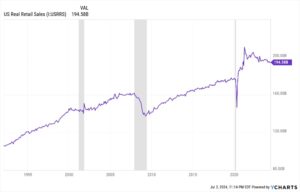
Here’s the latest thing I’ve seen that has me mildly concerned: Inflation-adjusted retail sales fell 0.9% in May and are currently about $15 billion below their April 2021 peak.

Right now, if this trend continues, we’re on track for a retail recession, with two consecutive quarters of year-over-year declines.

US recessions are labeled in gray in the chart above, and you can see how retail recessions are often a precursor to broader economic recessions.

That’s because consuming products and services makes up about 70% of US GDP. And retail sales account for nearly 40% of consumption.

Retail sales are like a canary in the coal mine. If they drop dead, you know we’re in trouble.

So should we be worried right now?

Well, if the American economy had a tachometer, the engine’s not running in the red yet – but lots of data suggests we’re somewhere in the yellow “warning” zone.

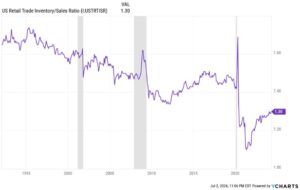
There’s another measure I’m watching closely, which is the ratio between retail inventory value and sales.

We sometimes don’t know we’re in a recession until months after a recession has begun.

But what we do know is that, when recessions occur, people stop buying stuff. Sales go down while inventory piles up.

Hence, we see big spikes in the Inventory/Sales ratio during recessions.

And we’re just not seeing that yet. Though “yet” is doing a lot of heavy lifting in that previous sentence.

So what should investors do?

Well, let me tell you this. I run stock screeners looking for value plays in the market pretty much every week. A value play in the market is simply a stock that looks like it is performing better financially than its price action would suggest.

Recently, a lot of retail stocks have been showing up on my screens. Dillard’s (DDS) for example. Dillard’s financial performance up to now has been exceptional… their price action, also exceptional… their valuation based on historical fundamentals, extremely attractive.

But what has happened tells us nothing about what will happen.

If American consumption is starting to sputter and there’s a risk that it starts to plummet as prohibitive cost inflation and high debt take their toll?

Retail stocks that don’t sell essentials are probably the last place you want to be as an investor.

So be careful out there.

– Sean MacIntyre

Check out Sean’s YouTube channel here.

Chart of the Week: It’s Up! It’s Down! What’s Going on with Nvidia? 

Thanks to my broker Dominick’s recommendation, I was an early investor in Nvidia, and profited very handsomely from it.

From the start, there was all sorts of hype about the company, which Dominick and I discussed several times during our monthly meetings. The result was that we gradually lowered my position size by pocketing a lot of the profits and reinvesting them elsewhere.

Recently, there’s been another public conversation about Nvidia, with some pundits very bullish on it and some quite skeptical.

Last week, I sent an email to both Dominick and Sean, asking them how they see the future of the company and its share price. Their perspectives were largely similar, which gave me some comfort.

Below is what Sean had to say. – MF 

I received Mark’s message about Nvidia at the same moment – literally – that I was finishing a column comparing Nvidia’s and Broadcom’s rise in recent years to Cisco and Qualcomm in the year 2000.

Even if Nvidia has not reached the same insane, anoxic heights of Cisco’s valuation…

The parallels do provide an interesting glimpse into the nature of bubbles and the allure of stocks caught up in a wave of legitimate but extreme exuberance.

Because I do believe that, like the internet in 2000, AI and machine learning services for consumers and businesses is very much the future.

Just as early adopters of the internet created webpages that sent many designers to an early grave…

AI image generators now produce portraits of people that sometimes look like an uncanny tangle of knuckles.

But we can certainly imagine a future when AI writes or generates images that feel more… usable, and not merely a novelty.

And that’s why people are excited about Nvidia. Or, at least, Nvidia’s chip architecture and CUDA platform.

You see, Nvidia makes chips that are quite good at doing lots of linear algebra, calculus, and matrix multiplication very fast – which is all a neural net AI algorithm is, really.

This proved exceptionally useful for calculating vectors in video game graphics, and then running hashing algorithms on block data to mine cryptocurrencies, and then molecular modeling simulations, and then doing machine learning on very big datasets necessary for modern AI algorithms.

The “edge” that Nvidia’s chips possess is their ability to break complex tasks into thousands of smaller operations that can be worked on in parallel.

This is the main reason why I recommended buying Nvidia in June 2022, after it had fallen about -50% in a few months.

But with the explosion of AI, Nvidia’s prospects look nothing shy of extraordinary.

Sources say it took about 10,000 Nvidia A100 GPU processors to train OpenAI’s GPT-3 model.

Nvidia’s A100 chips cost about $10,000 each.

And that’s just one of many AI applications that Nvidia’s chips are being used for.

Do some quick multiplication, and you can see why Nvidia’s revenue and profit in recent years looks like a scythe.
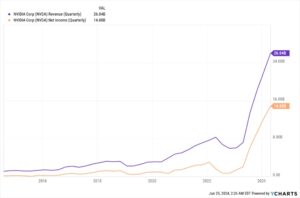
But that, alone, would not justify Nvidia’s insane valuations at the moment.

For that, investors would need to see further growth. Accelerated growth. Sustainable growth.

So here’s why some investors think this growth will continue for years to come:

There are about 10,300 data centers in the world as I write this. By 2030, it’s estimated that we’ll have 2 to 4 times as many.

A medium-size data center can hold about 50 to 100 server racks, while a very large one can hold 5,000 or more.

A standard rack can hold 40 to 50 server computers.

Each server computer can hold up to 10 GPUs or more. (Really, cooling and power are the limiting factors there. So innovations might increase this number.)

Future AI models with more data and more parameters may require 30,000 training GPUs or more to train in a reasonable amount of time.

And while the A100s cost $10,000, Nvidia’s new Blackwell chips will cost $30,000 to $40,000 each.

Once you start multiplying these numbers together… we’re suddenly talking about the potential for trillions of dollars of revenue in the coming years and decades.

If you make some very charitable assumptions, find the net present value of all that future revenue, carry the one, drop some acid, and delude yourself into believing that exponential growth is a real thing…

You can start to imagine why an investor, especially an inexperienced or excessively optimistic investor, might look at Nvidia’s valuations as “fair” or “reasonable.”

So if you want to know why folks have been bidding up the price of this stock… That’s why.

Clearly, I like the stock and have recommended it before. I think they make a great product. And they have amazing future prospects.

But there are a whole host of reasons why I don’t think this will necessarily translate into a whole lot more stock price growth from here.

Let’s start with the most basic facts…

Nvidia was the top play for all these high-tech digital applications, like AI and machine learning, because it controlled a vast majority of the market share for GPUs and TPUs.

For that reason, it commanded a lot of the revenue of this market… up to this point.

But Google and Meta are working with Nvidia’s competitor, Broadcom, to develop their own AI chips in house.

Intel is rolling out its Gaudi 3 AI accelerator chip, which is both cheaper and consumes less power. AMD is launching its MI300 AI accelerator chip, which is being adopted by Meta, OpenAI, and Microsoft.

“The move signals a notable shift among tech companies seeking alternatives to Nvidia’s costly graphics processors,” a reporter for TechWire writes.

Also, there’s a huge presupposition right now that AI tools will continue to be hosted in datacenters, on the cloud. But because AI is so computationally intensive, the cost of – for example – one query in ChatGPT costs 10 times as much as a Google search.

To put that another way, each word generated on ChatGPT costs $0.0003.

So companies like Qualcomm are working on small systems-on-a-chip that have mini-versions of AI models that can fit on individual devices, handling some AI tasks without having to take on the expense of sending data to a data center.

To put it bluntly: Even if Nvidia has the most dominant chips and the largest market share, it has heavy competition on the way, and its customers actively wish to stop paying Nvidia’s prices.

So that’s one thing.

Another thing: Nvidia’s business model is (at the moment) naturally limited.

Microsoft makes money because it collects recurring revenue from Azure customers, from Windows and Office customers, from selling advertising on Bing. Its customers don’t just pay once.

But Nvidia? Only a small fraction of its revenue comes from recurring sources – its Cloud and AI Enterprise services. And these are fairly niche services.

That means that, once Nvidia sells a chip, the only way it makes more money is if it sells another chip.

And at some point in the future, nearer to now than anyone is comfortable admitting, Nvidia is going to run out of customers who want to shell out $40,000 a pop for dozens and dozens of AI server chips… and then get on the perpetual treadmill of upgrading those same chips.

As the CEO of Nvidia, Jensen Huang, once said: “Nvidia is a one trick pony.”

All the companies that approached and breached a trillion-dollar market cap? Apple, Microsoft, Amazon, Google, Meta? They all have more than one trick.

And this might be why, the week that Nvidia’s market cap blew past Microsoft’s to the number one position, just about every single Nvidia executive cashed in on the stock.

The CEO’s stock sales were practically perfectly timed with Nvidia’s recent high.

Not to put too fine a point on it…

I think that Nvidia is worth holding. But I do not think, at these valuations, that it should be any more than 1% to 3% of anyone’s portfolio.

So if you want to initiate a position? Throw a small amount in and prepare to hang on for what will inevitably be a wild ride.

If you have seen tremendous appreciation already and it’s now a significant proportion of your portfolio?

I would take a lesson from Nvidia’s executive team and trim your holdings.

When I ran a DCF analysis of Nvidia’s free cash flow and compared it to its peers in the semiconductor industry…

I can see the stock growing to $140 to $180 by 2030. That gives the company about 20% to 50% more upside over the coming years.

And that’s even if the company manages to maintain the skin-sloughing rapidity of its profit growth for the next 5 years, which it… won’t.

I’m not even going to hedge that claim. Nvidia will not be able to maintain the growth trajectory it’s on.

For anyone who thinks otherwise: I have some tulips to sell you.

– Sean MacIntyre

Check out Sean’s YouTube channel here.

Americans Are Still Losing Money on Their Money 

As the Fed raised interest rates over the past two years, the returns on bonds and other debt instruments have increased substantially. While I’ve seen so many investment options become more expensive and/or more risky, the lure of getting 4.5% to 5.5% guaranteed is getting stronger. Such ROIs are still only a point or two above inflation, but it’s still a lot better than what I was getting previously – which in some cases was less than one-half of one percent.

That, by the way, is what you can expect from a bank savings account these days. One-half of one percent. Who would want to see the real value of their savings depreciate every year?

A whole lot of people, apparently. According to the WSJ, commercial banks are currently holding about $17.5 trillion in their vaults (on their ledgers). That is a whole lotta money sitting there and losing money. Click here.

I wrote the above before I saw Sean’s column this week. His thoughts and his data will give you the bigger picture. – MF


Chart of the Week: The Effect of Interest Rate Expenses

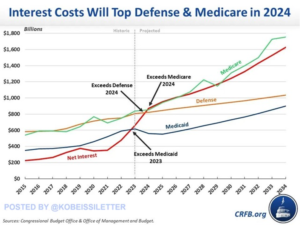
This week’s chart comes by way of The Kobeissi Letter, which had this to say:

For the first time in history, annual interest payments on US national debt will overtake defense spending in 2024, according to the CBO.

It is projected that for the full Fiscal Year 2024 (FY 2024), interest spending will hit $900 BILLION.

In Q1 2024, interest costs hit $1 trillion on an annualized basis and were $29 billion higher than defense outlays.

In the first 7 months of FY 2024, interest was also higher than spending on Medicaid, Medicare, and Defense, at $514 billion.

Meanwhile, in 2023, interest as % of GDP was the highest in 25 years and even exceeded World War II levels.

The US government needs lower interest rates more than ever.

As bad as $900 billion spent on debt servicing sounds, the US is projected to spend $6.5 trillion and bring in $4.9 trillion in 2024.

To make an analogy: Lenders typically look for a debt expenses-to-income ratio of 36% or lower. $900 billion is 18.3% of the US’s projected revenue. So we’re about halfway to the point where a theoretical lender would deny the US a loan on that basis.

But, importantly, debt servicing is economically stimulative. So is deficit spending. Government tax revenue would not remain flat if both persist. We’d see growth.

The whole thing is a calculus problem. Fortunately, someone else already did the math.

As I related in my column in the May 1 issue, we have about 20 years, probably less, before the US public debt spirals out of control. And that’s if the crazy monetary and fiscal policies we have persist.

But that likelihood will diminish if any combination of four things happens: Lower interest rates, lower government spending, steadily higher inflation, and higher taxes.

Of those four, we’re likely to see lower interest rates the soonest, though certainly not as low as we’ve come to expect since 2008.

The Swiss central bank recently lowered rates. As did the European Central Bank and the Bank of Canada.

Now that headline unemployment in the US is creeping up above 4%, we’re starting to see some shakiness in the job market.

And now that Target, Walgreens, Walmart, and Amazon are lowering prices, we’re going to see inflation start to level out. Rates were raised to combat high inflation. Now that deflation is happening in some sectors of the economy, there’s less of a need to hold high interest rates in the first place.

I stand by what I’ve said in the past: We’re probably going to see some rate cuts in late 2024, and we’re definitely going to see some in 2025.

This will be good for bonds and bond funds. It might also be good for profitable dividend-paying companies and utilities. And it will probably be bad for growth stocks in the short term, but beneficial long term.

Allocate accordingly.

– Sean MacIntyre

Check out Sean’s YouTube channel here.

A Good Time to Live in the South! 

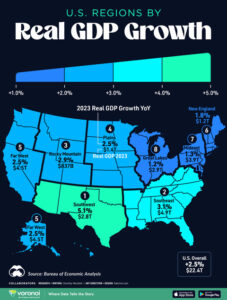
America’s real GDP grew by 2.5 percent in 2023. That was a country-wide average. But, as you can see from this map, some areas of the country did considerably better than others.

The lowest real GDP growth in the country was seen in the Great Lakes and Mideast regions, at 1.2% and 1.3% respectively, while the greatest GDP growth took place in the Southwest and Southeast, at 5.1% and 3.1% respectively. (Map created by Visual Capitalist based on data from the Bureau of Economic Analysis.)


Chart of the Week: The Next Phase of the AI Rollout 

Several weeks ago, a reader asked my thoughts about AI and State-of-the Art Robotics. These are subjects that the publishing business I’ve been consulting with for nearly 30 years writes about all the time. As investment publishers, their angle is investing – i.e., whether these technological advancements offer big profits for investors and, if so, which sectors and companies offer the greatest potential rewards.

In deference to my reader, and out of concern for my kids and grandkids, I will be writing a Special Issue on the risks and rewards of these technologies in the near future. Meanwhile, I’m grateful to Sean for taking the lead with this week’s essay. – MF 

There’s been much ado about the AI rollout recently…

Especially since investors have been hearing that AI could contribute up to $15.7 trillion to the global economy by 2030.

But there’s still a lot about AI investments we do not know.

We do not know who will dominate AI software. (The winners will likely be the big tech companies, since they have the most data.)

We do not know who will dominate AI chips. (Plenty of companies are nipping at Nvidia’s heels, and companies like Google and Meta are trying to take their AI chipmaking inhouse.)

Basically, we do not yet know who will be the big winners in the AI market 10 years from now.

But we do know something for sure…

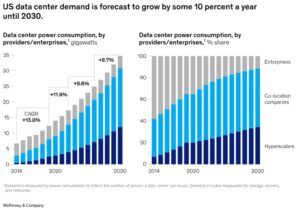
The amount of power needed to fuel the AI rollout is about to explode.

As of December 2023, there were about 10,978 data center locations in the world.

By 2030, the power consumption from these data centers and new construction is expected to double to 35 gigawatts in the US alone.

Nvidia projects that $1 trillion will be spent on data center upgrades for AI with most of the cost paid by Amazon, Microsoft, Google, and Meta.

Simply put, one of the biggest investments in the coming years will be improvements to the existing power infrastructure.

And there’s one thing we know about this aspect of the AI rollout as well…

Green energy isn’t going to cut it when it comes to data center energy needs.

A hyperscaler data center can use as much power as 80,000 households. Tech companies are already talking about building a data center that consumes as much as 1 gigawatt of power.

That’s the equivalent of 2.5 million solar panels. At 2 square meters per panel, that’s 1,235 acres of land needed to power a single one of these enormous data centers.

Not to put too fine a point on it, but there’s really only one source of energy that has the capacity to handle the energy needs we’re talking about, here…

And that’s nuclear power.

So if you want an investment idea out of all of this, look into data center REITs, utility companies that operate in nuclear-friendly regions, and uranium (miners and the commodity itself).

– Sean MacIntyre

Check out Sean’s YouTube channel here.
Why Is the Market Going Up?

This week, for a change, I am not commenting on a chart that Sean sent us to illustrate some points about the stock market and investing. Instead, I’ve asked him to explain why, given all the instability in the financial markets and all the obvious problems with inflation and the efforts to reduce the power of the US dollar, the stock market hit an all-time high on May 16, with the Dow breaking 40,000.

Look for his answer in a Special Issue later this week.

Meanwhile, here’s a video clip Sean put together to test the market with a new promotion for a wealth building course I designed several years ago. Although there are elements of this that I would normally avoid in selling wealth-building promos (such as humor), I think he did a good job with it.

Let me know if you agree.


How Many Hours Do Americans Work?
(The Answer May Surprise and/or Disturb You) 

Check out these charts.

They show the average hours per week that Americans work by age. As you can see, most people work the most hours in their 30s and 40s, with a modest drop in the 50s and then a deep drop after that.

Look at my decade – the 70s. It looks like my coevals are hardly working at all! I know, most of them are retired. And I’m sure most of them have earned the right to retire. But retire to do what? I suspect many people my age are still working 20 to 30 hours a week, but on jobs that they value but don’t get paid for. What do you think?

Once Again, the Idea of a Wealth Tax Surfaces 

In the new global/socialist age, the desire to tax and redistribute income and wealth is greater than ever. And the good people of the UN and G-20 are doing everything they can to reduce the gap between the very rich and everyone else.

The latest brainstorm arrives in a proposal by four countries in the G-20 to impose a 2% wealth tax on the world’s billionaires. And don’t think this couldn’t happen.

“The tax could be designed as a minimum levy equivalent to 2% of the wealth of the super-rich,” write economic ministers of Germany, Spain, Brazil, and South Africa in The Guardian. They say the levy would raise about $250 billion a year from some 3,000 billionaires and “would boost social justice and increase trust in the effectiveness of fiscal redistribution.”

They plan to float this at the next G-20 meeting in June.

As you might expect, it would principally be a tax raid on Americans (the most numerous billionaires). It would also be taxation without representation – a body of global elites attempting to impose a tax on Americans without it being passed by Congress.

Chart of the Week: Sell in May and Go Away? 

Today, Sean gives us several graphs that depict one of the core insights of the Legacy Portfolio, which I developed with Sean and a small team of very smart analysts years ago. It’s proven itself over those years, and we’ve even made some tweaks to it that have boosted the returns a point or two. But the core strategy underpins the faith I have in the portfolio matching or exceeding historical returns in the future. – MF  

There’s an old adage among experienced stock investors: “Sell in May and go away.”

The “sell in May” saying supposedly originated in England, centuries ago. Merchants and bankers in London’s financial district noticed that investment returns generally did worse in the summer.

That is to say, the most profitable business months of the year occurred when aristocrats were in London doing business and not spending their summer trying to escape the heat.

In fact, the original saying went “Sell in May and go away, and come back on St. Leger’s Day” (a holiday in mid-September).

In America, it has essentially come to refer to the period between Memorial Day and Labor Day, the first Monday of September.

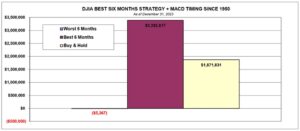
The historical pattern was further popularized by the Stock Trader’s Almanac, which found investing in stocks as represented by the Dow Jones Industriaal Average from November to April and switching into bonds the other six months would have “produced reliable returns with reduced risk since 1950.”

And in all honesty, when you look at the Stock Trader’s Almanac data, it looks impressive at first:

Following this strategy, with an added technical indicator called a “MACD crossover” (which is too complicated to explain at the moment), certainly produced exceptional results.

In fact, you’d have made over $3 million compared to the $1.8 million just buying and holding stocks – my preferred strategy most of the time.

That is, you would have made this money if you followed this strategy… for 73 years.

But I want to point something out that should be obvious:

The stock market in 2024 is not the same as the stock market in 1950.

We have computerized market makers now. And publicly traded derivatives. And passive index funds that definitely do not ever “sell in May.”

The market no longer depends on rich Lords being in London. There is, therefore, no logical reason why this strategy should be superior in the modern era.

To prove this, I looked at the data published by the Stock Trader’s Almanac.

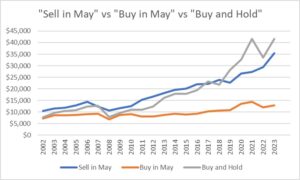
Specifically, I looked at their S&P 500 results since 2002 based on the three portfolios they’re tracking: Sell in May, Buy in May, and Buy and Hold.

Let’s test this by investing $10,000 into each strategy in 2002.

Here are the results:

Both “Buy and Hold” and “Buy in May” had a rough start, due to the dot-com bubble collapse. “Sell in May” avoided that catastrophe.

But in most of the subsequent years, “Sell in May” actually underperformed – 2022 being a notable exception. “Buy and Hold” caught up and then surpassed “Sell in May” in 2019.

And even though we’re still waiting on 2024’s data, it still seems that “Buy and Hold” is dominating.

Over the last 10 years, the average return for “Sell in May” was 7.3%. But the average return for “Buy and Hold” was 12.7%. (“Buy in May” was 4.7%.)

In recent years, “Buy in May” has actually been outperforming “Sell in May.” In fact, during the recovery from the Corona Crash in 2020, “Buy in May” beat both “Buy and Hold” and “Sell in May.”

Long story short: “sell in May and go away” can help smooth out the growth of your portfolio, it seems, but it doesn’t beat simply buying and holding a basket of large, safe companies and weathering the slings and arrows of the market.

Especially when you consider how little time or effort you need to put in to make that strategy work.

But also, the stock market, more than most human endeavors, obeys Sturgeon’s Law: “Nothing is ever absolutely so.”

A strategy that outperforms for a decade can suddenly underperform for a decade, based on unpredictable shifts in demography, economics, or market dynamics.

Do not seek to find the best investment strategy. It doesn’t exist. Find, instead, the best strategy for you, your goals, and your temperament.

For me, that has almost always been “Buy and Hold.”

And I imagine that most of you will discover the same thing.

– Sean MacIntyre

Check out Sean’s YouTube channel here.
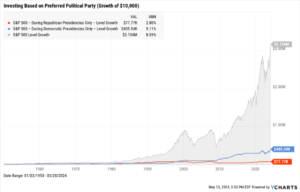
Chart of the Week: When to Buy Stocks 

One thing any experienced salesperson knows is that, despite what we like to think, people make the decision to buy things based on their emotions rather than their reason. And that is true with buying stocks. The reason individual investors, on average and over the long term, earn less than one-third of the average stock market investor, it is because they are motivated to buy from greed and sell from fear. This week’s chart, as Sean explains, gives you a vivid way of understanding that and how it relates to the investing strategy we use. – MF

It’s often said that the stock market is not the economy, and the economy is not the stock market.

Scholarship backs this up. A study titled “Is Economic Growth Good for Investors?” found that, across countries and stock markets, GDP growth is bad for long-term stock returns. Conversely, GDP declines are typically followed by very good periods for stocks.

But I learned this years ago when I started asking myself a simple question: What economic conditions are best for purchasing stocks?

There’s one chart that taught me more about the relationship between economics and stock returns than any other… and it’s not one you’d expect.

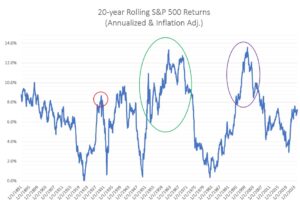
I’m talking about the chart of rolling 20-year stock market returns.

This chart shows how the S&P 500 performed over previous 20-year periods. For example, in the early 1960s, it shows how, for the previous 20 years, the return of the market was as high as 15% per year on average.

If you want to know what economic conditions lead to high stock returns, just pull up this chart, find the spikes in returns, and then ask yourself: “What happened 20 years before those spikes?”

For example, take a look at the spike in 1928 and 1929 (the red circle on the chart). Why were returns so good for the 20 years leading up to that one?

If you look back, what you see is that the US economy was doing terribly!

The US moved in and out of five recessions between 1899 and 1911. There was a recession before AND after World War I.

So what should you have done during those times when business activity and trade dropped by double digits?

Buy stocks.

Let’s take a look at the mid-1950s and 1960s (the green oval on the chart), when average stock market returns reached nearly 14% per year.

What happened 20 years before that?

The Great Depression. World War II. Some of the biggest stock market collapses in history.

So what should you have done when the world was falling apart?

Buy stocks.

Or how about the 1990s (the purple oval on the chart), when stock market returns reached unprecedented heights?

Go 20 years before that, when the US was crippled by stagflation, supply shortages led to lines at gas stations, the economy rolled in and out of recessions, and interest rates reached as high as 20%!

Guess what asset would have made you wealthier than any other while all of that was happening?

Stocks.

Baron Rothschild, the 18th century banker, famously said, “Buy when there’s blood in the streets, even if the blood is your own.”

I have only one problem with that advice: Nobody ever wants to actually follow it. In the moment, they get too scared.

Business is cyclical. So are investment patterns. And the best time to get in is usually at the bottom. Not the top.

So here’s what I want you to do.

The next time you read a report about all the coming economic catastrophes…

The next time you see evidence of an impending recession, or a “dead decade” in the stock market, or an epic market crash…

I want you to say, “Great. I can’t wait to buy more stocks when that finally happens.”

Because that’s the mindset that Mark has adopted with his Legacy Portfolio of stocks – a mindset that will allow you to actually profit from the inevitable up-and-down cycles of the economy and the stock market.

– Sean MacIntyre

Check out Sean’s YouTube channel here.