Confessions of a YouTube Addict 

I admit it. I’ve become addicted to YouTube.

Not exclusively. I occasionally snort another short-form content platform. But I mainline YouTube.

I don’t indulge myself during the day. I know how self-destructive that would be. But after dinner, and after my evening job of trying to finish half the work I assigned myself in the morning, usually about 10:00 pm, I close my laptop and open my iPad and hit the Red Box.

I tell myself that I’ve worked a long, hard day. I deserve a little relaxation. And anyway, it’s not like I’m having fun. I’m doing research for my blog and books. And that’s true. Sort of.

The Serious Stuff

I spend about an hour of my YouTube time researching topics and fodder for my writing. These typically include clips about:

* The Fragile Position of the Dollar as the World’s Reserve Currency
* The Decline and Fall of Post-Modern Thinking in America
* Facts About the Israel-Arab Conflict
* Facts About the Russia-Ukraine War and What It Means to the US
* The COVID Scam – the Virus and the Vaccines
* The Threat and Promise of Artificial Intelligence
* The Disintegration of Free Speech and Common Sense in Europe
* The End of Enlightenment and the Decline of Western Civilization
* Donald Trump: His Wins. His Losses. His Chances of Winning.
* US Debt and the End of the Dollar as the World’s Reserve Currency
* Racism and Racial Politics in the US
* The Reinvention of Words and the Destruction of Meaning by Leftist Ideologs
* The Russian Collusion Hoax and the Jan. 6 Fraternity Party
* The Utter Hypocrisy of Progressives in Every Area of Politics

The Rabbit Holes 

At about 11:00 pm, I tell myself that I will go inside and upstairs and get into bed. But then I give myself permission to spend just another half-hour – an hour, at the very most – watching YouTube for Addicts.

That’s what I call the rabbit holes I find myself going into. I should be embarrassed to admit this to you – but at my age, having divulged so much personal information in my 25 years of writing, my embarrassment instinct no longer functions.

Some of my favorite rabbit holes:

* Karens Gone Wild
* Wild Karens Getting Their Just Deserts
* Idiot Drivers Endangering Others
* Assholes Talking Shit to Cops
* Asshole Cops Bullying Black and Brown Drivers
* Black and Brown Young People Vandalizing Department Stores
* Middle-Aged White Women Stealing
* Amazingly Gifted Young People (Mostly Asian) Playing Piano
* Constitutionalists Refusing to Stop Videotaping Public Buildings
* College Kids Unable to Answer Grammar School-Level Questions
* Progressive People Unable to Define What a Woman Is
* Kids Succeeding at Insane Stunts
* Kids Failing at Insane Stunts
* Human Beings Reunited with Animals After Years of Separation
* Hurricanes and Tsunamis Destroying Valuable Property
* Cute Animals Being Cute and Cuddly
* Great Mixed Martial Arts Fights
* Package Thieves Being Surprised


A Typical Binge 

The First Hour 

* Bill Clinton Shocks Muslim Crowd with Facts About Palestine

* Ted Cruz Confronts Judge About Putting Child Rapist in Women’s Prison

* Sometimes you know how the story ends, but are still moved by it.

* When Teenagers Should Be Tried as Adults

* India May Have Made a Huge Mistake

* Coleman Hughes on the Palestinian Movement

* Looters “Wipe Out” 47 DC Stores… Mayor Panics

* Former Democrat Batya Ungar-Sargon Just Cooked the Entire CNN Panel

* Pro-Muslim Trans Advocate Hears the Truth About Islam

* UK Reform Party Leader Nigel Farage Likens UK to North Korea

* Bill Maher Defends COVID Vaccine and RFK Jr. Humiliates Him

* Tommy Robinson Educates TV Hosts on What the Quran Really Says

* The Feds are raiding Chicago: Here’s why…

* How Richard Branson Started Virgin Airlines with Zero Capital

* Christianity has a basic flaw. This shows it.

* Israel-Hamas War: A Two-on-Two Debate 

* Hamas Sympathizer Gets Furious with Israeli Activist

* Jew Reads Quran

* Adam Schiff Faces a Firestorm

* IDF Soldier Has Brutally Honest Message for Palestinian

* In Georgia, it’s illegal for judges to meet with one side of a dispute. Does this judge look guilty?

 * How Insurance Companies Get Extra Rich


The Second Hour 

* Amazing Drummer

* This man knows bulls. 

* When your dad is Nigerian…

* 60 Animals Reunited with Their Owners 

* Last Ride in Horse Elevator

*  Another Thing About Men and Women

* When Package Thieves Get Caught by Booby Traps!

* Christmas in July

* Great Fight: Movsar Evloev vs. Aljamain Sterling

* Cops Freaked Out by What Was in the Woman’s Trunk

* Another example of why being a cop is difficult.

* Piglet Befriends Lamb

* Are true crime stories like this better than movies?

* Stephen A. Smith on the Big Secret About Angel Reese

* He lays it down about first-generation LA immigrants.

* We need more cops like this. 

* Home Decorating Hero

* Sunny Hostin Humiliated After Getting Fact-Checked

* Nicholas De Santo: Women Hate Accountability!

* Copywriting Masterclass

* I don’t know. Did he target her because she was Black? Maybe.

An Excerpt from Lions and Scavengers 
By Ben Shapiro
(via The Free Press

I spent virtually my entire life in Los Angeles. I was born in 1984 in Burbank, California, a firmly middle-class suburb – clean, well-run, and friendly – in a 1,100-square-foot home with two bedrooms and a bathroom for six people.

As my parents became more observant in their Jewish practice, they sought an Orthodox community, and we moved to Valley Village, where we ended up on a quiet street in a 2,400-square-foot home. That’s where I spent the rest of my childhood. At the age of 16, I went to college at the University of California, Los Angeles.

When I came back from Harvard Law School at age 23, my sister introduced me to my future wife, then a junior at UCLA; she went on to graduate from UCLA Medical School. We both worked hard, and eventually we earned enough money to buy a condo, then a home, then another home in Valley Village. In 2016, we bought a gorgeous, historically preserved place in Hollywood – the house where Judy Garland had celebrated her 16th birthday party – and made renovations. This was supposed to be our forever home.

But things began collapsing.

They began collapsing because Los Angeles – and California more broadly – had spent two decades actively driving away Lions and lionizing Scavengers.

What do I mean by Lions and Scavengers?

Lions are people guided by the spirit of success, responsibility, and duty. The Lion understands that the universe is constructed by a set of rules he can discern. He thrills in his capacity to choose. He embraces his moral duties, revels in his responsibilities. When faced with a problem, the Lion does not complain about the unfairness of life: He seeks an answer.

The spirit of the Scavenger is the spirit of envy. The Scavenger is driven by a burning impulse: the impulse to escape his own failures and shortcomings by blaming others. The Scavenger believes that his own failure is the fault of the stars, and of the fates, but mostly, of the Lion. The Scavenger does not believe in an understandable universe in which success is the result of performance of duty; any such argument, he believes, is a guise for power, and power alone.

The Scavenger mentality has consumed LA in the form of disastrous policies: confiscatory tax rates designed to punish business rather than reward innovation; public policy treating homelessness as a right rather than as a plight; a brutal crackdown on the police’s ability to fight crime and public disorder; failing public schools; decaying public services.

My family felt the effects of these policies personally. Whether it was walking past drug addicts passed out face down in the gutter just outside the gates of our home or spotting open needles on the streets where we walked our children, the quality of life in Los Angeles declined slowly. And then rapidly. And then all at once.

When the COVID pandemic broke out, the state of California lost its mind. Everyone was confined to quarters for months on end. Schools and public parks were closed. Los Angeles became a ghost town. Then, after the death of George Floyd that summer, it burst into riots.

While the authorities threatened law-abiding citizens for congregating in private or public, Black Lives Matter rioters were allowed to run roughshod over the city. Police officers were villainized, told to stand down as the city burned. Videos of police cars burning on Melrose Avenue became ubiquitous. Looters smashed the windows of our local Walgreens and Foot Locker.

At night, after we put our kids to bed, my wife and I could sit in our living room and hear the sounds of helicopters and gunfire nearby. My business, The Daily Wire, had to be boarded up after rioters attacked it. That’s when my family decided to leave for Florida, and my company for Nashville, along with nearly 100 employees. The Scavengers won in LA, and we had to get out.

We’ve now lived in Florida for nearly five years. There’s a reason why so many people are relocating here. The state of Florida is geared toward protecting the fundamental foundations of a successful, civilized Western society.

When I was living in Los Angeles, I applied for a concealed carry weapon permit, on account of the enormous number of death threats I received daily. I went to the Los Angeles Police Department with a binder of documented threats and explained that the FBI had already arrested and jailed someone for threatening my life. Yet the LAPD denied my application. Their reasoning? The person was already behind bars, and none of the other threats had been acted on, so I had nothing to worry about. It was the very definition of a Catch-22.

This would never happen in Florida. Florida has been a constitutional carry state since July 2023, meaning that qualifying legal residents may carry concealed weapons without a government-issued license. This policy expands a “shall-issue” permit law in place since 1987 and reflects a broader cultural emphasis on self-reliance and natural rights. Combined with widespread respect for law enforcement, the result is an empowered citizenry and a well-funded, competent police force.

In Florida, security is treated not as a dangerous indulgence, but as a civic necessity. This is what a healthy society does: prizes individual autonomy and celebrates the fulfillment of personal responsibility.

And not only when it comes to crime. Florida elevates individual rights of all kinds, while California subordinates religious rights to progressive ideology.

In California, I was constantly worried that the rubric of antidiscrimination law would be used to punish schools – particularly religious ones – that failed to comply with left-leaning social policies.

For instance, a school could have state funding revoked for abiding by traditional religious standards with regard to sexual behavior. Of course, there would most likely be a legal response to a situation like that, but what school district or parent wants to be subjected to that kind of madness?

Florida, by contrast, has universal school choice: Taxpayer money follows students to whichever school they choose, including many private and religious ones.

California sees religion as something to be regulated and eventually broken – another institution to tear down. Florida sees it as a partner in building strong communities, and as a fundamental pillar of a civilized society.

And rightly so. Religion instills civilizations with a moral core. It helps explain why Lions fight for things: truth, duty, and God-given dignity. Scavengers unite only in opposition: against the Lion, against the “system.” The Scavengers tear down; the Lions lift up.

Why, then, have the Scavengers enjoyed such success?

Envy, a hallmark of the Scavenger philosophy, is an irresistible force. Politicians understand this reality, and they weaponize it. I will be your warrior against the person you envy, they promise. And I will eradicate your envy by punishing that person, who is the reason for your suffering.

Zohran Mamdani, New York City’s Democratic mayoral candidate, embodies this approach. His coalition believes that the West is exploitative and brutal, that it’s uniquely responsible for suffering around the world, and that punishing the rich and successful will advance the plight of the poor.

This is the driving force behind self-contradictory movements like “Queers for Palestine.” How can Mamdani supporters preach the wonders of Palestinian culture – which in Gaza means throwing gay people off of buildings – while simultaneously advocating taxpayer-funded gender transitions for minors?

The answer is simple: Both beliefs run counter to Western values. There is no undergirding philosophy to the Scavengers. There is only opposition to the thing that is, and that therefore must be destroyed.

The logical extension of this ideology is violence.

Consider Luigi Mangione, the alleged murderer of UnitedHealthcare CEO Brian Thompson. According to Mangione’s defenders, Thompson ran a greedy, venal, and corrupt healthcare company. His coverage decisions led to people’s deaths. Thus, he is a murderer and killing him was just.

It sounds barbaric. And it is. But that’s the Scavenger logic: If the system is irredeemably corrupt and can’t be fixed from within, then violence is justified to tear it all down.

This is the most radical manifestation of the Scavenger mentality. And it’s spreading. Worse, it doesn’t need to reach a majority of the population to take control. All it requires is a dedicated core group of believers, and the complicity of everyone else.

That is exactly what has happened over the past several decades.

In direct and open wars between Lions and Scavengers, Lions almost always win, because Lions are warriors, while Scavengers are cowards.

But in recent years, defenders of the West have gone silent. Some, because they believed the battle had been won with the fall of Communism. Others, because they fell for the lie of Western sin, paralyzed by unfounded guilt for societal problems.

Any civilization that loses its confidence opens itself to predations from those who would tear it down, from within and without. And so the Scavengers have thrived – feeding on shame, elevating victimhood, and spreading anti-Americanism.

But perhaps not anymore.

In January of this year, I attended Donald Trump’s presidential inauguration. He pledged himself to a “golden era.” He vowed, “We will forge a society that is color-blind and merit-based…. We will begin the complete restoration of America and the revolution of common sense.” He spoke about prosperity, pride, victory, and freedom. He spoke of the Lions.

I believed, then, that a new day was dawning. Seven months later, I still do.

The Trump administration has dismantled the edifice of diversity, equity, and inclusion – the core of Scavenger philosophy – and restored common sense.

On the foreign stage, deterrence has replaced hesitation, and strength has prevented chaos. Look no further than the decision to help Israel neutralize Iran’s nuclear enrichment capacity. That singular act may have saved the world decades of violence and terrorism.

These policies are popular, and for good reason. The American people are tired of the idea that crime is a manifestation of the exploitation of the oppressed. They’re tired of the idea that the meritocracy has to be put to heel because of the evils of a white supremacist system. They’re tired of the notion that the “system” has somehow harmed the “marginalized,” simply because people demand decent, law-abiding behavior – equality before the law.

Could these sentiments fall out of favor? Absolutely. People forget. Prosperity breeds complacency. A single economic downturn, a single careless policy, and the Scavengers will retake power.

This isn’t only about civilizational Lions and Scavengers and the policy battles between them. It’s also a question of the individual human heart. For if we all have two impulses beating within us – the spirit of the Lion and the spirit of the Scavenger – then the failure of the Lions is the success of the Scavenger. And when Lions fail to pass down their values to their children, their children join the Scavengers.

Bred into unearned prosperity but taught ignorance and dependency, livid at the men and women who defend the very country they inhabit, unmoored from a civilization their parents refuse to defend, they become rabid, and seek revenge on those who left them adrift. They become the hellish mutation of a spent culture.

In each of us, the battle between Lion and Scavenger rages. Sin crouches at all of our doors. But we can conquer it. For the Lions to win requires no great scheme, no clever machinations, but rather courage, pride, responsible parenting, and constant vigilance.

We must not become creatures of envy. And we must deny the creatures of envy the ammunition of our unearned shame.

The Scavengers will never surrender. The battle will go on for the rest of time. But they cannot win. Unless we let them.

he So-Called “Gender Pay Gap” in the WNBA 

Sexist and Unjust?

There is a huge difference in player compensation between the NBA and the WNBA.

The average salary in the NBA is about $11 million vs. $110,000 in the WNBA. The highest paid WNBA players will bring in about $300,000, counting bonuses. The minimum NBA salary is $1 million. The minimum WNBA salary is $66,000. As for the highest paid players? The top three WNBA players average around $300,000 a year, including bonuses. The top three NBA players make 100 to 200 times that much.

However… 

There are good, economic reasons for this. For example:

Revenue Disparity. The most significant factor is that the NBA generates vastly more revenue through higher ticket sales, broadcasting rights, and merchandise.

Revenue Sharing. Unlike the NBA, WNBA salaries have not been directly tied to revenue sharing. The NBA is contractually obligated to give 50% of its net proceeds to its players, while WNBA players have no such guarantee and receive only about 10% of the net.

Revenues and Profitability: As I said, there are several good reasons for that disparity. Firstly, the NBA makes much, much, much more money. Their revenues last year exceeded $11 billion. The WNBA, on the other hand, made only $200 million last year, and that was considerably higher than it has made in the past – in part because it never had a big following and big media attention until Caitlin Clark was drafted.

Worth Watching: Just Briefs 

White Boy Doing Reggae 
Acoustic guitar + Great voice – “This is speaking directly to my soul.”
Click here.

Hyenas vs. Lions 
A very satisfying revenge movie.
Click here.

Financial Literacy for Dummies 
I don’t know who this guy is, but he understands wealth building.
Click here.

Kids Playing Chess with Adults 
Not what she expected.
Click here.

The Social Experiment Disguised as a Joke 
Laugh First. Think Later.
Click here.

Jon Batiste Plays Beethoven’s “Für Elise” 
I knew his name, but that was it. This made me look into him.
Click here.

Could this be the best MMA fight ever? 
Khamzat Chimaez vs. Gilbert Burns
Click here.

Prof. Richard Susskind Talks AI Vertical 
What would ChatGPT 6 look like?
Click here.

Childhood Trauma 
I’m seeing this guy a lot these days, and I have to admit: He’s deep!
Click here.

The black guy is great. I’d like to know him. 
Of course, he’s wrong.
Click here.

The Virtue of Discipline 
Khabib Nurmagomedov, the great MMA fighter, on Discipline.
Click here.

Good News & Bad News from the Orchestra 
Itzhak Perlman and the “substitute” violinist.
Click here.

“Speaking words of wisdom”… 
Let it be.
Click here.

He Hooked a Big One 
Now can he reel it in?
Click here.

Is it racist for an American to speak Japanese with a Japanese accent? 
I asked one of my Japanese friends and they agreed with this.
Click here.

Tracy Cortez: Beautiful and Ferocious 
MMA is one of the few sports where women can earn as much as men.
Click here.

This guy is very funny. 
Funny is Jay Leno or David Letterman. Very funny is telling a brave truth that unites us.
Click here.

Epstein and The Illuminati: Could this be true? 
Epstein family member says Epstein was in the cult of Baal.
Click here.

Serious Martial Arts Skills 
I expected her to be totally fake, but she’s actually pretty impressive.
Click here.

Speaking of Martial Arts: The robots are coming! 
The first-ever robot kickboxing competition in China. At this stage, it’s more interesting than entertaining, but it’s easy to imagine what this will look like in five years – with limbs being broken and maybe even heads severed.
Click here.

Clever Commercial: The Conquest of Australia 
The great Steve Buscemi plays an evil overlord intent on conquering Australia with a massive “Scamageddon” cyber-attack in this ad for Telstra, the Australian telecommunications provider.
Click here.

What I’m Doing with My Money 

As I said above, it’s that time again when I pull out the records of all my business and financial transactions over the previous 12 months and take a longish view of all the assets I have, in what categories and in what proportions, think about how they got to be what they got to be, and then figure out how I feel about all that, given the economy and the business environment and the state of the financial markets.

I just reread that last paragraph and I realize it makes me sound like a Type-A brain-breaking financial analyst. I am not. Rather than spend the hundred hours it would take me to research and analyze all the data myself, I rely on the insights and acumen of six or eight economists and investment analysts for whom I have enormous respect and confidence because I’ve been working with them and seeing the results of their work for nearly 40 years.

What I do in preparation for this annual report, then, is have Gio print out all of the financial statements from all of my passive investments and all of the P&Ls from all of my businesses, and then ask my three boys, each of whom now manages these various projects, businesses, and investments, to write summary accounts for me in language I can understand.

That usually prompts concerns and questions that I talk to them about and then, if needed, run by one of my six trusted financial advisors, including Dominick, my stockbroker, and Sean, my partner in several investment and wealth building publications, and then, based on all that, decide what I’m going to leave as is (which is usually most of it) and what I should change.

I realize that many of those reading this now will be thinking, “I don’t care about all that, Mark. Just tell me what you are doing with your stock portfolios. Are you buying? Are you selling? Are you changing the balance of assets? And if so, why?”

Those are fair questions. And I mean to answer them. But I want to give you an answer that is more important than telling you what I’m doing with my stock accounts. I want to talk about all the major asset classes I invest in. I want to tell you exactly what I’m doing to preserve my wealth and perhaps bring it up a notch or two before the end of this year.

It’s Not About Stock Investing. It’s About Building Wealth. 

I started writing about “money” in 2010, when I began writing essays for a new digital publication called Creating Wealth.

Creating Wealth was intended to be my version of an investment advisory newsletter – which most people would expect to be my advice about investing in stocks. But since very little of my wealth came from stock investing, and since the stock investing that I did at the time was limited to a single index fund, I didn’t have much to say about it. I did, however, have plenty to say about all the other financial assets that had been the primary generators of the outsized income I made that grew my wealth.

Stocks and bonds are certainly a part of what I call my Wealth Portfolio, but just a part. A bigger part is comprised of income-producing real estate, rental properties that I control and oversee. An even larger portion is in private equity – often in businesses that I started and/or funded in the past. I also have a sizeable portion in private debt. And another portion in collectible assets such as rare books and fine art. And I own a bunch of gold and silver, some rare coins, and a basket of cryptocurrencies (even though I’ve never been a believer in the long-term potential of cryptos).

Isn’t that just too much? 
Wouldn’t it be easier to stick with stocks and bonds? 

Yes, that’s a lot of different financial assets. And yes, it would be easier if, like most investors, I invested solely in stocks and bonds.

The reason I don’t is mostly because that is not how I got rich.

Let’s Talk About Stocks and the Stock Markets 

I am not a stock picker. Never was. Never wanted to be. But I’ve worked in the C-Suites of the financial advisory publishing world for more than 40 years, and I’ve learned enough to know dozens of ways to lose money with stocks.

I know, too, what anyone who has studied stock investing and/or the history of the stock market knows: It’s difficult to achieve an overall return on a stock portfolio that is better than the historical ROI on stocks, which has been about 9% to 10% over the last hundred years.

Difficult but not impossible. It can be done. It can even be done without taking imprudent risks. I’ve done it. But I’ve gotten considerably better returns from other investments. In fact, over the years, stocks have represented less than 15% of my net investible wealth.

That said… What am I doing with my stocks right now?

When I began to write about money-making strategies for Creating Wealth, I had all of my own “stock” money in an index fund.

But since so many of the subscribers to Creating Wealth were interested in individual stocks, I felt an obligation to do something more than just mention the fund I had invested in. So I decided to create my own model stock portfolio for my readers, based on Warren Buffett’s investing ideas. I brought together some of the best stock analysts I knew and asked them to help me build a model portfolio that would represent “what Buffett would buy if he were starting Berkshire Hathaway today.”

When it was completed, we had a model portfolio made up of big, safe companies with significant competitive advantages. (I believe Buffett calls them “moats.”) I called it the Legacy Portfolio, because all of the stocks in that portfolio were meant to be held more or less forever. I invested in them myself – and I held on to them. That’s why my answer to the question of what I’m doing each year with my stocks has usually been “nothing.”

This year, however, I’m going to be making some major changes to the portfolios in three of my five Legacy accounts.

What changes am I making? And why?

I have rarely made investment decisions based on what I think will happen in the future – either with the global economy, the US economy, or even in industry sectors.

There are some financial analysts who have been able to warn their clients/subscribers of upcoming major market shifts and give them opportunities to profit from them. But having been in the financial advisory business for more than 40 years, I can tell you that these people are rare. And even the best of them, at one point or another, miss the mark.

Given what I know – and especially what I know about what I don’t know – I have always taken their individual predictions and recommendations as significant but imperfect considerations in making the ultimate decision, which must always be mine.

But when they (not the general population of prognosticators but the half-dozen I trust and respect) are all worried about the same thing, I tell myself that it would be foolish of me to ignore them – and I see if there are some adjustments I can make in the way I’ve allocated my financial assets that (1) would not be an abandonment of my core investment strategy, and (2) would, at the same time, insure and/or leverage my portfolio based on the assumption that they might be right.

Around 2004 and 2005, for example, it became clear to me that the real estate experts I trusted had become bearish while the market was heating up. Since my approach to rental real estate investing is very conservative (in the same way that my approach to stock investing is), I didn’t feel the need to sell any of the properties I owned. But I did desist from buying new properties until after the 2008 crash when those that were coming to market were very, very cheap.

On the leveraging side, in 2017, although I believed that cryptocurrencies had no long-term chance of survival, I bought five coins each of Bitcoin, Litecoin, and Ethereum as a hedge when the price of Bitcoin was hovering around $1,000.

And in the early 2000s, I was finally persuaded by a consensus of the conservative economists I read that there was good reason to start buying gold. I began slowly, buying Canadian Maple Leafs and then South African Krugerrands. And I continued buying until about 2005 for an average price of about $400 a coin.

As far as stocks are concerned, I’ve been strict about not fiddling with my Legacy portfolios on a year-to-year basis. But every three or four years, I may adjust them in a minor way by removing the stock of a company whose business model has drastically changed or adding shares of a company or two that either Sean or Dominick has convinced me should be added.

And that’s what I’m doing this year. Sort of…

My two main concerns: debt and current market analytics

I am not an economist. Nor am I a market analyst. I don’t have the mind for that sort of slow and careful thinking.

What I do to compensate for my lack of expertise in those two areas is to follow about a half-dozen economists and stock market analysts that I know (from working with them for decades) have proven instincts when it comes to dangers and opportunities in the markets.

In terms of economics, the big concern they all have is debt. Primarily US government debt that is now north of $36 trillion. But also commercial debt, student debt, and consumer debt.

They are convinced that the US cannot sustain this level of debt. And I haven’t read a counter argument that is convincing.

This I do know about economics: National debts are always repaid – one way or another.

One way is through a major depression. Another is through hyperinflation – an extended period of high inflation. And the third is by an extended period of massive GDP growth.

Trump is counting on option three. And although I have hope that some of his executive orders – decreasing regulation, lowering taxes, and using tariff threats to bring foreign businesses back to the US and lower tariffs overall – will work, I don’t see it happening in the next three to five years.

Either one of the other two options – a major depression or hyperinflation – is likely to bring the stock market down in a big way. And my limbic brain is telling me the meltdown is going to happen in the not-too-distant future.

As far as market analytics go, I have another worry. The current P/E ratio of stocks in the major indexes stands at 30. That means investors believe that these companies are valuable enough to merit selling their shares for 30 times earnings.

Would you spend $3 million on a landscape company whose annual profits are only $100,000?

I wouldn’t.

The bottom line: I believe there is a fair to good chance that we will see the stock market take a 30% to 50% tumble in the next five years.

That is not necessarily a fear that would prompt me to sell any of the stocks in my two core Legacy portfolios. Those decisions I will leave to the two experts who manage my two Legacy accounts: Dominick and Sean.

But for the three Legacy portfolios that fund my family’s three non-profit enterprises, I am inclined to take steps immediately to safeguard those portfolios from such a correction. I’m considering trading some of the shares I have in stocks like Nvidia, which have done so well for me in the past few years, to shares of bread-and-butter companies that will likely be less affected by a 30% to 50% drop if it happens.

Why am I doing that?

I’m doing it not because I have lost trust in the long-term viability of the Legacy portfolios. On the contrary, for my personal accounts, I’m leaving them just as they are.

But these endowment accounts have a second financial purpose that my personal accounts don’t have. They are meant to increase their value over the long run, but they are also meant to pay for the current expenses of the non-profit entities. For the past many years, I’ve been confident that they could do that because they could cover those expenses with a distribution of less than 4% of the account balances every year.

The account we have for Fun Limón, for example, the community center our family foundation sponsors in Nicaragua, is about $8 million. The cost of running that operation is about $250,000 to $300,000 a year – or 3.5% to 4% of the balance.

Based on industry standards, if I can keep the distributions from these accounts to those levels, I shouldn’t have to worry about the endowment shrinking. A distribution of 3% to 4% has proven to be low enough to avoid a situation where the principal is in danger.

And since I get five-year government bonds with yields of about 4.5%, I wouldn’t have to worry about a market crash and seeing that $8 million drop to $5.5 million or even $4 million, which would mean that I would be forced to spend down the principal at the worst possible time.

Knowing that I can keep the account at $8 million for the next three to five years without any exposure to market risk feels like the right move to make, given the purpose of these funds.

At least that’s what I’m thinking now. I’m going to speak with Dominick later today and see what he has to say. If there’s something wrong with my thinking, he’ll point it out to me, and I’ll pass that on to you next week. But for the moment, that’s my plan.

Important: I’m not dumping the stocks in my personal accounts. Here’s why…

As I mentioned above, I’m not going to ask Dominick or Sean to lighten my stock holdings in my two Legacy accounts. I’m going to do what I’ve always done – with good results. I’m going to let them make those decisions.

This has worked since I established those accounts – and that’s because the stocks in the Legacy portfolios were designed to withstand the test of time, to continue to become more valuable over the long haul, regardless of market fluctuations. They were set up in response to my desire to build a portfolio of the kind of stocks that Warren Buffett would buy if he were getting into stocks for the first time.

As for what Dominick does within my personal Legacy accounts, he is always making minor adjustments to optimize the ROI. When a single stock hits 10% of the value of the portfolio as a whole, he shaves some of it off the top and puts it into other Legacy stocks whose pricing is attractive for the time being. He also sells puts and does covered calls to increase the cash flow. These are the two safest ways to use options in a stock portfolio that I know of, and since Dominick is very good at doing it within the guidelines of my conservative mandates, I can let him make these adjustments at will. That has improved the overall performance of the portfolio by 10% to 20% over the past five years.

Now let me tell you what I’m doing with the other parts of my Wealth Portfolio.


My Investments in Rental Real Estate 

I’ve been investing in real estate since 1981, but it wasn’t until 2007 that I figured out how to make it work.

Well, that’s wrong. I didn’t figure it out. My brother did. He quit his job that year and put all his time and money into building a real estate empire.

These days, I’m looking for individual rental properties that I can buy for about 100 times the monthly rent roll. When I used to buy single-family homes, for example, I would pay up to $200,000 for a house that I could easily rent for $2,000 a month. Today, I’m on the lookout for larger properties – apartment buildings and offices – that I can get for the same cost/rent ration. If I can find an eight-unit apartment building that generates $12,000 a month in rent, I’ll be interested in buying it if I can get it for about $1.2 million or less.

(This is, admittedly, a rough calculation that gives me an initial indication of the value of the deal. Before I commit to buying a property, I ask whoever I’ve chosen to manage it to dig deep into the numbers to make sure there are no hidden surprises on the cost side or no significant risks of deflation on the income side.)

By taking this approach, I don’t have to worry about the larger countrywide real estate market, the way I would if I were investing in some of the larger, more reliable REITS. I simply look for the deals. And if I can’t find them, I hold on to my cash.

Right now, in the local real estate ponds I fish in, I haven’t been able to find anything that meets my criteria. So I’m not buying anything. But if something comes along – this year or next year – I will.

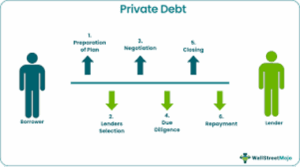
My Investments in Private Debt 

Between 1987 and 1995, I went in with my former partners who had started a business that was in the business of lending money – writing loans for private individuals and companies that had significant assets that were to some degree illiquid, in return for interest rates considerably higher than they could get with, say, government bonds.

The range of debt they were financing ranged from used-car loans, to short-term business loans secured against receivables, to financing commercial receivables, and to buying out life insurance settlements and lottery claims.

The ROIs they were getting from those investments ranged from 15% to 20%. That was three to four times what I was getting from municipal bonds, and better even than I was getting from my rental real estate properties. I remember thinking, “Why doesn’t every investor do this?”

I eventually found out why.

When my partners set up those deals, they felt that we had full control over how much we were willing to lend and on what terms and at what rates.

Let’s take, for example, the deals we were making with lottery winners. These were individuals that had won multimillion-dollar prizes, but the money was going to go to them over many years. We could offer to pay them, say, 75% of the total amount, pocket the 25%, and be confident that we’d get paid off by the state in full and on time because no state was going to risk destroying its lottery income by defaulting on a payoff.

But financing used cars is considerably riskier because the people that need to borrow money to buy a used car are usually doing so because they don’t have the creditworthiness that cash buyers have. Their net worths are usually small or even negative. Which means that if they default on the loan, there’s very little the lender can do about it. The lender could, of course, sue for the money. But the chances that such a suit would be financially feasible are depressingly small.

That is the primary reason why this sort of lending is rarely done by big institutions and why the smaller lenders that get into it tend to charge much higher rates and establish contractual demands that are much tougher than what is “normal” for a loan.

So, on the one hand, this sort of lending will usually produce higher (sometimes considerably higher) ROIs. On the other hand, private lenders, despite measures taken to protect themselves, are always taking on more risk.

The safeguards my partners had installed worked well during economic good times. But when the economy slowed and made it nearly impossible for our type of borrower to pay back their loans, the defaults shot up far higher than our most aggressive expectations.

The same principal holds true for my investments in private debt. I could, if I knew something about public companies that engage in private lending, find a stock or two that would emulate the market. Or I could invest in banks if I knew what was going to happen to them. When our family foundation makes loans to private individuals, we follow a strict protocol that is not dependent on guesses about the future of the economy or the banking industry or even the private debt industry. It is based solely on facts: Does the borrower have enough collateral to back the loan 100%, and will we get an ROI on the loan that is worth getting?

In other words, private debt, like rental real estate, is best used in an active way, by investing in one deal at a time with people you know and trust. One could invest in a public company that makes a profit that way, but the risk there is so much greater because you are two or three steps removed from the individual borrower.


My Investments in Private Equity 

Private equity investing is buying and/or owning shares of private (i.e., non-public) businesses. It’s the active equivalent of investing in stocks.

There are two very important differences, however. One is that to be successful as a private equity investor, you need to know a lot more about the companies you are investing in than you do when you are investing in stocks. The other is that if you know what you need to know about the businesses you invest in, you can make a lot more money with private equity than you can by investing in public companies on a stock exchange.

How much more?

Way more. Way, way more. Like turning a $15,000 investment into $15 million over 15 years.

That said, I don’t recommend private equity investing as a realistic way for ordinary investors to build wealth. And that’s because the odds of getting richer this way are extremely poor.

Unless…

Unless, like me, you have had the opportunity to work in an industry for many years and at a high level, giving you an “inside” perspective on that industry that you truly understand and can use to invest in it as an insider.

This is, admittedly, a high fence to climb over. But I believe, based on 40 years of making mistakes and making profits, that it is a fence that should be high. Jumping over little obstacles to take a chance at getting rich is basically gambling. And the only people that get rich in the game of gambling are the people dealing out the cards.

If you are wondering whether I would “greenlight” you to invest in private equities, measure your own experience against my 5 rules:

My 5 Rules for Not Losing Money in Private Equity

1. Don’t invest in businesses unless you understand them from the inside out. And by that I mean: Invest only in businesses that you have been personally involved in, at a senior level (CEO, CMO, Growth Strategist) for at least 10 years.

2. Invest only in businesses that are run, or are going to be run, by someone you know and trust. In other words, people that you have worked with as a colleague, mentor, or competitor for at least five years.

3. In negotiating your investment contract, make sure it gives you some degree of say about the major decisions of the business and make sure the CEO and other key people are comfortable with that.

4. Make the agreement a win-win for both sides. Since you know the business as well as or better than the person who will be running it, make sure that he/she is properly treated and compensated to avoid problems later.

5. Be prepared to take a role in the business that will almost certainly be more active than either you or the current CEO thinks it will be when the contract is signed. And that includes having difficult discussions and making tough decisions when needed. Ultimately, you and the CEO must agree that the purpose of the business is not to line your pockets, but to build a trusted brand and grow its net revenues in a way that ensures it will be around for a long time.


Fine Art & Collectibles: What I Own and Why I Own It 

By collectibles, I mean fine art and artifacts that tend to appreciate in value over time. What I like about collectibles is that (1) like real estate, the arithmetic of investing in them is not difficult, and (2) I get to use and enjoy them while their value grows.

I now have a number of collections, each of which has appreciated nicely, and all of which I regularly enjoy.

I have about a dozen rare first-edition books by writers I admire (Mark Twain, William Faulkner, Ernest Hemingway, et al); about a hundred rare gold coins; a half-dozen watches, two of which are worth their weight in gold – literally; and several Greek and Roman vases.

But my primary investment in collectibles has been in fine art, museum-quality art – important pieces that will almost certainly become more valuable as they age. My intention is for my main collection in this category – a pretty extensive collection of Central American modern and contemporary art – to end up in a museum after K and I die, and I have started to take steps to make sure this will happen.

I’ve written lots about my experiences as an investor in collectibles. I’ve told my stories of success and failure. Collecting art and artifacts can be a very risky business if you don’t know what you are doing. When I began, I knew absolutely nothing, so it won’t surprise you to know that I made every mistake in the book.

But I started in my early 30s, when I didn’t have that much money to invest, so my losses were bearable. And by the time my disposable income was large enough to make big mistakes, I had the experience to avoid them.

My 6 Rules for Investing in Collectibles

1. Practice. Before you start investing real money in real collectibles (i.e., stuff that will appreciate in value), buy at least 100 inexpensive “objects” that appeal to you in some way at flea markets.

2. Specialize. And Specialize. And Specialize. Start with one general category that interests you and keep narrowing it down. Let’s say you are interested in antiques. Narrow that down to European antiques, then 19th century European antiques, then 19th century French antiques, then 19th century French armoires… and so on.

3. Buy Authentic. The collectibles industry is riddled with fakes. At the beginning, buy only from dealers and auction houses that guarantee authenticity.

4. Buy Rare. Whether you are collecting art, antiques, cars, rare coins, or whatever, the same rule holds when it comes to ROI: rarity is king.

5. Give Preference to What Is Coveted. Next to rarity, the biggest factor in price appreciation is dictated by authority – i.e., the period or style of the object that is considered by experts to be the best in its class.

6. Pay Attention to Condition. Once-damaged and now-restored pieces can still be very valuable, but those in perfect (or near-perfect) condition are usually a better investment.


My Investments in Cryptocurrencies 

Yes, I have some money in cryptocurrencies. And yes, their current worth is considerably more than my investment. But I’m not buying any more because I believe they will one day be made illegal and confiscated by our government. That will happen after our government issues its own “stable coin” – a digital dollar that will be an inflatable currency just like the paper dollar, as well as another high-tech tool to monitor our daily business and personal activities and track every dollar we make and spend.

You might be thinking: “Mark, if you believe that’s going to happen, why did you buy those coins in the first place?” And the answer, to be honest, is that if it turns out I am wrong about my dystopian prediction, I can still say, “Yeah, I bought crypto early and made a killing on it.”

Why Aren’t the NYT and the Mainstream Media Reporting on This? 

In

In the past week, Tulsi Gabbard, Director of US National Intelligence, has released a trove of documents from, among other classified files, the CIA’s 2017 Intelligence Community Assessment (ICA).

What they reveal is more detailed and documented proof that the whole Russian Collusion story was built on a house of cards – misinformation, doctored evidence, and completely fictitious, and in some cases salacious, whole-cloth lies.

For some of us, this is not news. We’ve been reporting on it – in bits and pieces – since Trump took office in January of 2017. But that reporting often felt like pissing in the wind because the entire intelligence community of the Biden administration was calling the facts that we cited “disinformation” and our surmises of what was going on within the “Deep State” conspiracy theories. And while our voices were belittled and our characters besmirched, their voices were amplified by the mainstream media, and their stories were winning them Pulitzer Prizes!

The Propagandists: Will They Ever Tell the Truth? 

None of what is coming out now will be news to all those who participated in the fraud. But it should be news, shocking news, for anyone who genuinely believed that Trump was colluding with the Russians and anyone who believed a word of what Chuck Schumer said non-stop from 2016 to… well, today.

These recent disclosures prove that the NYT, The Washington Post, CNN, MSNBC, and a host of other corrupt media were telling lies. Lies that were obvious to anyone who had a shred of intellectual integrity and political curiosity – which rules out the mainstream media, half of our elected officials, nearly the entirety of Hollywood and the Entertainment Industry, and the tens of millions of US voters who succumbed to TDS.

And by the way, all of it is available to the public – the actual memos and meeting notes and email transcriptions that were gathered and held by high-ranking officials in the intelligence committee, the Justice Department, and the FBI.

I meant to cover this in a long report next month, but so much has been coming out in the last two weeks that I felt I had to write about it now.

The latest data dump by Gabbard provides indisputable confirmation that the 2017 ICA, which claimed that Putin “developed a clear preference” for Trump and “aspired to help” his chances, was primarily based on four pieces of evidence, none of it credible.

Bought and Paid For by Hillary Clinton and the DNC 

The main one – the Steele dossier – which was paid for by Hillary Clinton’s campaign and the DNC, was commissioned at first to sway voters against Trump in the 2016 election. When that failed, it was used to cripple his presidency by diverting Congress from giving any attention to his agenda, which was achieved, and to get him impeached and booted from office, which ultimately failed.

The other three pieces of so-called evidence were even worse. Their sources were anonymous, unverifiable, and largely discredited. And it was not members of the Trump administration saying that. The CIA, which was looking at the evidence separately, concluded (in writing) that it was either weak or outright fabricated. (Among the written and recorded reactions by CIA investigators were descriptors ranging from “seriously flawed” to “factually false” to “manipulating the manipulations.”)

When John Brennan, James Comey, and others at the top of the intelligence community saw the report, they alerted Obama to its conclusion and assured him that they were going to bury it so deep in the files that not even a bunker-busting bomb could dig it up. And that is when Obama stepped in, calling them together to come up with a second draft.

As Matt Taibbi said in a recent post, this saga bears a disturbing resemblance to the Iraq WMD scandal of 2002-2003, where fake intelligence was pushed to justify a war. James Clapper even admitted that he was ordered by Dick Cheney to “find the WMD sites,” and boasted that those fake images “carried the day” at the UN. Today’s media and officials are doing the same thing – pushing “evidence” that doesn’t hold up and refusing to face the truth.

The Actors, the Actions, and the Actual Facts 

The leaked, manipulated reports and the political vetting process demonstrate how intelligence was weaponized for partisan purposes, not truth.

* In the agency’s 2017 ICA, the CIA’s analysts concluded, with some debate over certain heavily redacted portions of the documentation, that the evidence supporting Putin’s “preference” for Trump was “seriously flawed,” “fabricated,” or “uncorroborated.” Their concerns were overridden by Brennan and others, leading to the final assessment.
(Source: House Permanent Select Committee on Intelligence, 2020)

* The main supporting source – the Steele dossier, which was paid for by Hillary Clinton’s campaign and the DNC– was basically bought-and-paid-for political propaganda. The dossier, a 35-page report assembled from June to December 2016 under contract by Christopher Steele, a counterintelligence specialist, contained allegations of misconduct, conspiracy, and cooperation between Trump’s presidential campaign and the government of Russia prior to and during the election campaign.

Both the 2019 OIG report and the 2023 Durham report raised doubts about the dossier’s reliability and sources, with the latter stating that “the FBI was not able to corroborate a single substantive allegation contained in the Steele Reports.” The new evidence, which includes much of the redacted material, goes a step farther, exposing evidence that the report was not only riddled with unverified statements, but that many if not most of them were known to be false when the report was written.
(Source: The New York Times, 2019)

* FBI and CIA analysts have testified that they repeatedly advised supervisors that the dossier was not credible. In fact, they said it failed to meet even the most basic standards of credibility. But their warnings were ignored. This was corroborated in some of the documents that were declassified and released to the public last week.
(Source: House Intelligence Committee reports, 2020)

* John Brennan, Obama’s CIA director, ordered the inclusion of unverified information to support the narrative, despite internal objections. Until Gabbard began releasing these classified documents, there was plenty of speculation that the cover-up began at the highest level, including with Brennan, but nothing solid enough to refute his denials of wrongdoing. Now there is.
(Source: Newly declassified memos, 2023)

* The “evidence” of Russian “aspiration” to help Trump was based on a suspicious, unanswered email from 2014, with no source or verification. This was one of many unverified “facts” that Chuck Schumer and the other leaders of the Democratic coalition used to justify their years-long campaign to besmirch Trump’s reputation and have him impeached.
(Source: House Intel, 2020)

* The intelligence community’s own review concluded that Russia was not trying to support Trump’s election. It did report on various attempts by Russia to make the election seem manipulated, but the purpose of that, they said, was not to help Trump. (In fact, there is evidence in the newly released files indicating that Russia preferred dealing with someone they considered a predictable enemy than with Trump, who they saw as dangerously unpredictable.)
(Source: ODNI, 2020)

* The Brenan-revised report was given to the FBI for approval and endorsement, but the FBI demurred. The FBI review was conducted independently by its own analysts. They found so many suspicious claims and unverified assertions that they refused to endorse it. They described it bluntly as “not credible.”
(Source: FBI internal records, 2020)

* Although dozens of CIA agents were involved in analyzing the evidence, the final report was written by just five senior-level analysts. And despite the nearly unanimous assertions by the analysts that the report was largely unverified and riddled with doubtful claims, they decided to publish it as it was, with only vague admissions in small type that they knew much of the evidence was weak or fabricated.
(Source: House Intelligence, 2020)

* A key piece of the evidence that supported the Russian Collusion narrative was an email proposing engagement with “a pro-Kremlin official.” The newly released evidence reveals that this was a 10-month-old copy of a report that contained no clear source, no date, and no facts that could be verified.
(Source: House Intelligence, 2020)

* Top officials, including Brennan and Comey, decided to provide the report to the Oval Office. Once President Obama got hold of it, it was only a matter of days before the mainstream press got it – treating it as credible throughout Trump’s administration.
(Source: House Intelligence, 2020)

* A recent analysis of the declassified documents reveals that much of the intelligence used was “manipulated” and “cherry-picked” to produce a desired narrative – similar to the fake WMD intel used to justify the Iraq war.
(Sources: Webb, 2020; Clapper, 2020)

* Despite promises of transparency, the government suppressed or redacted critical evidence, including the absence of any credible proof that Russia “aspired” to elect Trump.
(Sources: House Intelligence, 2020; Wired, 2020; Webb, 2020; Greenwald, 2020)

Okay, that’s my summary of the essays, articles, and documents I’ve read in just the last six days. I think it’s convincing, although I admit that if you haven’t been following the story as closely as I have, this may all be too much to take in.

I’m giving you a bunch of links below so that you can, if you want to, look more deeply and carefully into the evidence and arguments. Spend an hour today reading through them and then ask yourself: Is this really news?

And if it is, aren’t you shocked by it? Or do you think it’s just the way the game of politics is played today – and that in the future, regardless of who is in the Oval Office, we should expect more of the same?

Here are the links:

Classified Report on Hillary Clinton, Loretta Lynch, and James Comey Finally Released
Click here.

New Whistleblower Report Drops as Pressure Mounts in Russia Case
Click here.

Note on New Trump-Russia Disclosures
Click here.

Will Democrats Go to Jail for Russiagate? 
Click here.

FBI Helped Clinton Campaign Orchestrate Russiagate
Click here.

New Whistleblower Report
Click here.

Another Major Document Release
Click here.

Not convinced? Here’s what I invite you to do: Write me an essay refuting the facts above, citing your sources (as I did), and I’ll publish it in the next issue.

My Big-Apple Friends: Are You Ready for Mamdani? 
Are You Sure? 

If Zohran Mamdani becomes the next mayor of NYC in November, he will have achieved several political firsts.

He will be the first Asian, the first Muslim, the first card-carrying Socialist, and the first crusader for a global intifada to reside in Gracie Mansion.

Oh, and lest I forget, the first up-and-coming ex hip-hop star!

Mamdani’s rise to his current level of political recognition is an amazing, inspiring, only-in-America story.

He was born in Kampala, Uganda, and spent the first six years of his life living there (and later in South Africa) the way educated second- and third-generation Indians live in Uganda and Kenya and virtually any country in which they settle: in safe, upper-middle-class neighborhoods, working assiduously to advance themselves.

Mamdani’s father, Mahmood, was a scholar of Socialist economics. His mother, Mira Nair, worked her way up in the film industry from entry-level assistant, to assistant director, and eventually to becoming the recognized director of several award-winning films.

In his seventh year, the Mamdanis moved to America, where Mahmood took a job teaching at NYU. Ensconced in the Upper West Side of Manhattan, the family did what most educated second- and third- generation Indians do when they relocate: They became respected and successful, while preserving a great deal of the best features of their native culture. In the Mamdanis’ case, it included passing on their academic and ideological biases to their son, with a preference for Socialism and the performing arts.

The young Mamdani was educated first at the Bank Street School for Children on the Upper West Side, then at the Bronx High School of Science (one of New York’s most prestigious public schools), and finally at the well-regarded Bowdoin College, graduating with a degree in “Africana Studies.”

As I’ve so far implied, all of that was remarkably unremarkable for a child born into a family like his. But Mamdani’s rise to political prominence after college is extraordinary, considering that he wasn’t granted US citizenship until 2018.

During his high school and college years, Mamdani tried his hand as a performing artist, pursuing a career playing rap music and eventually releasing, with childhood friend Abdul Car Hussein, a song titled “#1 Spice” under the name Young Cardamom, which was featured in Disney’s Queen of Katwe, directed by Mamdani’s mother.

Mamdani was also actively promoting social justice according to Socialist principles, co-founding the first Students for Justice in Palestine chapter at Bowdoin.

His Views on Economics 

It’s not surprising that the child of an academically respected Socialist writer and professor would lean in that direction. In Mamdani’s case, his political preferences and projects were more a headlong plunge than a tilt.

His stated views on economics are straight out of the Socialist Party textbook, including opposing free markets, state control over the “means of production,” and advocating the Alexandria Ocasio-Cortez (AOC) level of opaqueness on economic issues such as inflation, which, he many times suggested, was caused by price gouging rather than unfettered government spending.

His Campaign Promises 

Mamdani’s campaign promises were consistent with his economic theory, which was unambiguously enunciated in the charter of the political party he joined and represented, the Democratic Socialists of America, whose stated purpose is “fighting for the abolition of Capitalism.”

During his political ascension, and particularly in his campaign for mayor of NYC, Mamdani said he would raise $10 billion in new revenue by increasing taxes on the wealthy and corporations to fund his social agenda, including:

* Citywide rent freezes and other forms of rent “stabilization”
* Free bus transportation throughout the city
* Free childcare
* Subsidized city-owned grocery stores that will buy and sell at wholesale prices
* Defunding the NYPD and redirecting funds toward “community-based safety and social programs”
* Supporting homeless camps in subways
* Centralized storage and distribution of vital goods
* The downsizing and outright abolishment of prisons

Mamdani is also a big believer in global warming and has argued that somehow going green is “essential to achieving social justice in New York City.” In 2021, he organized volunteers and lobbied Governor Kathy Hochul to prevent the expansion of a gas-fired peaker power plant in Astoria, citing environmental concerns for low-income nonwhite communities.

His Views on Israel, Zionism, and the Holocaust

Mamdani’s views on Israel are not nuanced. He is staunchly pro-Palestine and pro-Iran and has participated in numerous demonstrations opposing Israeli political policies towards Gaza and against US support of Israel.

He has aligned himself with virtually all of the Leftist, neocon, and anti-Zionist stances, calling Israel a colonial occupier and characterizing its governing policies as racist and apartheid and its war against Hamas and the Iranian proxies as genocide against the Islamic people of Gaza and the West Bank. Consistent with that, he has promoted campaigns to boycott Israel.

He has repeatedly criticized Israeli Prime Minister Benjamin Netanyahu as an illegitimate ruler and threatened to have him arrested if he sets foot in NYC. He’s defended phrases like “globalize the intifada” and “from the river to the sea.”

He has even refused to recognize Israel’s “right to exist” and refused to sign a State Assembly resolution recognizing the Holocaust.

Memorable Mamdani Quotes

“We don’t need an investigation to know that the NYPD is racist, anti-queer & a major threat to public safety. What we need is to #DefundTheNYPD.”

“Policing is something that does not create safety.”

“The end goal [is] seizing the means of production.”

“We can establish community land trusts to gradually buy up housing on the private market and convert it to community ownership.”

So, Why Is Mamdani So Popular? 
And Who’s Voting for Him? 

Mamdani’s quick rise to not just city but national prominence as a politician dedicated to dismantling the city’s economy and his unvarnished antisemitism should have made his quest for the mayorship all but absurd.

There is no doubt that one reason for his success is that he is charismatic. He’s intelligent and well-spoken. He presents himself as a moderate and as a nice, thoughtful person. He even looks like a mensch.

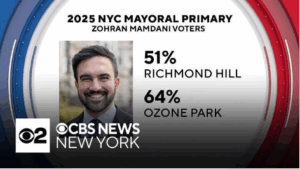
A recent survey of NYC voters gives us some idea of who Mamdani’s are.

They are well-born, Ivy League-educated, mostly young people who are relatively wealthy, progressive, and live in Brooklyn. In other words, AOC voters! She endorsed him – and when he won, she wrote this in a post on X:

Your dedication to an affordable, welcoming, and safe New York City where working families can have a shot has inspired people across the city. Billionaires and lobbyists poured millions against you and our public finance system. And you won.

What If He Wins in November? 

I can’t say.

I think it’s possible that, once installed in office, he may soften his political and social stances when he recognizes how unpopular they are with the wealthy corporations and families that call NYC home. I haven’t found anything in my research to support that, but he’s young and he seems to enjoy his popularity. He’s also intelligent, which means to me that if he wants to be more than just a one-term mayor overseeing a city on its way down, he could modify his views and abort the worst of his political projects.

If he doesn’t – if he takes a note from Trump 2.01 and manages to get his campaign promises put into action – then, as I said, I can see him as a one-time wonder with few prospects for the presidency while he make New York City Not Great Again, crippling the city’s economy by the rapid attrition of its corporate and individual tax base, and bringing back the disorder, dysfunction, and criminality it had sunk into during the 1980s, before Guiliani was elected and instituted the “broken window” policies, ratcheting down the crime rates dramatically and allowing The Big Apple to return to the relative safety and prosperity it currently enjoys.

What would that look like? I like how Nellie Bowles put it in a recent edition of The Free Press:

Those of us who saw San Francisco 2014–2024 know what is going to happen, and all we can do is put on our assless chaps and walk away. The cycle cannot be stopped.

New Yorkers need a couple years of tent encampments in Central Park, 200 more subway stabbings, and a rent freeze that’ll drive prices to astronomical levels.

They need to open a thousand empty government grocery stores. They yearn for Socialism. We can’t help them now. New Yorkers, from a San Franciscan, listen carefully when I say: Human urine ruins car upholstery. If you park on the street, don’t bother investing in the leather interiors for a few years.

Work, Learn, Share – The 3 Sustainable Pleasures
How to Be Happy in the Real World 

“Hollywood produces a lot of movies inspired by naïve world views and downright stupid ideas, but there may be none more foolish and destructive than the movies made about what makes for a happy life.” 

                                                                                                 -Michael Masterson

“Eat, Pray, Love” is a great title for a book/movie. It captures the Hollywood philosophy, which has been widely embraced by the Coastal elites, of how to live a happy and meaningful life.

But if, instead of a movie starring Julia Roberts, it was a book of classical philosophy – you know, the kind of thinking that was done by men who knew how to think rationally – the title would have been Live Like a Hedonist. Think Like a Fatalist. Act Like a Solipsist.

Eat: Hedonism, in the contemporary sense, is the idea that happiness comes from filling oneself with all the luxurious things life has to offer – gourmet food, fine wine, exotic experiences, etc.

Pray: Fatalism, to the modern mind, is represented in the adolescent notion that happiness can be achieved by finding one’s soulmate and discovering one’s passion.

Love: Solipsism has infested itself into virtually every corner of popular modern psychology – the belief that happiness starts from taking the time to pay attention to and love oneself.

Another way to put this us that Eat, Pray, Love is one of many popular movies made in the last 20 years that are premised on the idea that the world would be a happier place if adults could act more like adolescents.

Adolescence is a stage of life between childhood and adulthood, in which children must, as the poet said, “put away childish things” and take on adult responsibilities. For most children, this is a time of making foolish and selfish mistakes for which they must suffer the consequences. And that is why, for most of us, adolescence is a cocktail of equal parts of thoughtless happiness, excruciating embarrassment, and emotional pain.

But there are some for whom their teenage years are seldom hard and painful, but mostly joyful and easy. These are the “privileged” few whose parents, for whatever reason, have decided to continue to treat their babies as babies forever.

This results in 20- and 30-year-olds that act like adolescents – spoiled, self-centered, and incapable of fending for themselves. You know them by the behaviors they exhibit:

* An extraordinary lack of self-awareness, leading to…

* A sense of entitlement about almost everything, leading to…

* Putting themselves at the head of every line…

* Inserting themselves into every conversation…

* Assuming that their problems are uniquely challenging and should be a grave concern for others.

Properly raised adults know that life doesn’t work that way. Having suffered through adolescence, they are able to move into the workforce, get married, and have children, with the realistic expectation that all of these experiences will be difficult.

Life, they have learned, is not meant to be an uninterrupted pleasure cruise. For those that have thought seriously about the matter, the central question is not how to best enjoy life, but rather how to get through it with the least amount of suffering.

This is, of course, a central tenet of Buddhism and an issue that has been dealt with by every important moral philosopher, starting with Aristotle.

For Albert Camus, for example, “To decide whether life is worth living is to answer the fundamental question of philosophy.” Every other question, he said in The Myth of Sisyphus, is “child’s play.”

For Rabindranath Tagore, life was a duty, an obligation – and happiness came as a result of meeting that obligation.

In Yes to Life: In Spite of Everything, Viktor Frankl, expanding on Tagore’s idea, put it neatly. Happiness in life, he said, “cannot be “willed into being.”  Happiness should not, must not, and can never be a goal, but only an outcome.”

I’ve been writing about happiness since I began writing Early to Rise. 25 years ago. During that time, I’ve done the required reading and have become at least superficially familiar with most of the major theses on happiness, which I have always measured against my own experience. What I’ve come up with is my own three-part formula. Interestingly, my three tenets are almost polar opposites to “Eat, Pray, Love.”

Let me explain.

Don’t Eat. Stay Hungry. For Knowledge

In Eat, Pray, Love, the protagonist comes to understand an enlightened way of eating – one that provides her with greater pleasure than, say, the way I eat: consuming food as fuel, and as quickly as possible, so I can get back to work.

What she learns is what every “foodie” desires to know: that to truly enjoy eating, one must eat “consciously” and with discrimination. That is, of course, true. It is also the lesson from the great philosopher Epicurus.

But if the question is “Can eating make for a happy life?” one has to consider the fact that eating as a path to happiness has an undeniable limitation. No matter how conscious and discriminating the eating may be, one cannot continue eating beyond satiety without getting (literally) fed up and either cease or get sick.

In my lexicon, therefore, eating is not sustainable.

Since my thesis is about sustainable pleasures, I have to rule out eating and see if I can find a replacement. I think I have one. It is learning – learning about something you value, something you believe worth learning.

Think about any sort of learning that you enjoy. Think about how it makes you feel. Now ask yourself: Does the pleasure you get from learning have a time limit? Do you get “fed up” with learning something you find interesting and worthwhile?

I don’t. In fact, the more I learn about a subject I value, the more pleasure I get from learning more. I’m sure I’m not the exception.

If that is so, doesn’t it make sense to recognize it? To be aware that, of all the many things you are called to do and choose to do on a daily basis – many of which may bore, frustrate, or even upset you – isn’t it sensible to put aside some of your time, if only 30 minutes a day, for something that will give you sustainable pleasure?

The point I’m making is that learning about something you value provides a sense of pleasure that is enduring and one that gets more pleasurable the more you do it.

A Takeaway…

Instead of trying to find happiness by buying and consuming things that you want (that you think will make you happy), recognize that you can get pleasure – sustained and unlimited pleasure – by doing something that needn’t cost a dime: learning something you think is worth learning.

Don’t Pray; Get to Work

The Pray mandate in Work, Pray, Love is just as incapable of bringing you sustainable pleasure as the Eat mandate is, only in a different way.

The idea of praying, as depicted in the movie, is also a Hollywood fantasy. It is the idea that the way to find satisfaction in one’s career is to discover the kind of work you were always meant to do – i.e., the work for which you have a passion.

This idea is wrong in several ways. First, as I mentioned at the top of this essay, it is based on a fatalistic view of the universe: that we are each put on Earth with something that is missing inside of us, which is making us feel unfulfilled – and the way to overcome that is to find the things we are missing.

Second, it is based on another fantasy – that we can achieve what we want from life by praying for it. It’s Think and Grow Rich by someone who has never read the book, and the Law of Attraction for someone who has. These ideas are themselves based on the idea that the universe exists to support our individual lives and that to get what we want (and deserve) we merely have to pray for it.

You don’t need decades of real life to know that the universe is not designed this way. Not only is it uninterested in giving us the happiness we want, it’s designed to make happiness eternally difficult. (I’ve written a small book on this called The Seven Natural Laws of Building Wealth, which itemizes those laws and explains how they work. It explains how, for example, friction and gravity are always there to make forward progress difficult. And that entropy, the natural law that says, in Chinua Achebe’s words, “everything put together eventually falls apart,” is the overall effect of it.

No, there is no amount of positive thinking and/or praying that will help you succeed in business. It is all about time and energy applied. And our willingness to supply that time and energy depends on whether we believe that the goal is worthwhile.
A Takeaway…

Instead of searching for the career that you are passionate about… or for some person or entity (such as the government) to end your suffering… get to work on doing something – anything – that is about someone or something other than you. Stop blaming fate for your troubles. Stop blaming others for your fate. Take responsibility for the person you are and the place you find yourself.

Forget all the things you hate about your job. Focus on doing a better job, on becoming a better worker, on working to make the lives of everyone you work with better.

Rather than spending your time complaining about all the ways you are victimized by society, work on improving the society you actually live in.


Don’t Look to Be Loved by Others You See as Valuable; Look to Give Love to Others by Sharing Something You Value
 
Again, because Eat, Pray, Love was a large-budget Hollywood movie, it was inevitable that the love that Julia Roberts’ character, Elizabeth, finds at the end is not in any way wisdom or serenity, but a hunky Brazilian named Felipe.

In The Road Less Traveled, which I read nearly 50 years ago, the author, Scott Peck, contends that genuine happiness comes through spiritual progress, and spiritual progress comes from hard work, self-discipline, and an active commitment to overcoming obstacles.

At 28, I was not religious and would have recoiled at the thought of being considered a “spiritual” person, so it was a bit challenging for me to read that book, written by a Christian psychologist and philosopher, with an open mind.

But the moment I began reading the chapter about love, I became an immediate fan. A third of the way into the book, Scott takes on the idea of love – what it is, what it can do, and what it can’t do.

And his argument, although expressed in religious terms, made perfect sense to me – and still does, after all these years. He begins by making a distinction between what he calls selfish love and selfless love. Selfish love, he says, is what most people call romantic love. It is based on this fatalistic idea that underpins Elizabeth’s experience of finding love, by finding Felipe, who is presumably going to fill the hole in her heart with his magnificent Brazilian wonderfulness.

Even at the age of 28, I had already come to the conclusion that this idea was not only wrong, but was destructive to all relationships based on it, because it was based on what the other can give to the one, rather than what the one can   give to the other.

Selfless love, Peck asserts, is the kind of of love that healthy minded parents give to their children. It’s the act of giving what value one has for the benefit of the loved one, rather than taking for oneself whatever value one perceives the other can bring him.

In my three-part formula for happiness, I have substituted love – because it is so often equated with selfish love – with the concept of sharing.

For anyone who has given selflessly – i.e., with the sole intention of giving to the other person – it’s easy to understand why the moral cliché of “It’s better to give than to receive” is true.

However, it’s not just giving that makes for true happiness (sustained pleasure). It’s giving something of value. And specifically, it’s giving the products of the other two sustainable pleasures – the things you have purchased from your love of work and the things you have acquired from your love of learning.

At a certain point in life – and it doesn’t have to be when you are older – sharing what you have acquired from a lifetime of hard work and persistent learning, the products of your values, will provide you with a deeper sense of satisfaction than you can ever get from trying to acquire more of them or hold on to them.

A Takeaway…

You can’t get the kind of sustained pleasure I’m referring to here by giving away something you don’t care about or by giving away so little of something you do care about that it cannot have a significant and enduring effect on those with whom you share.

An Afterthought

Two thought experiments that I did in preparation for writing this essay:

1. Take 30 minutes or so to think about the things you’ve done in your life that you are proud of. And then remember how you felt when you did them. What you will find is that they made you feel good. They made you feel good for two reasons:
(a) Because they were activities that, somewhere in that heart of yours, corresponded to your highest values.
(b) They were activities that were outwardly focused. They were not about you, but about things – people, projects, aspirations – that were outside of you.

2. Spend some time thinking about things you’ve done – and are probably still doing – that made you unhappy. Then remember how unhappiness feels to you and where it lives. You will find that it feels very tight and painful and constricting. And that it lives in your core – in your chest and in your abdomen.

Contraction is, obviously, a moving-inwards, which is a concentration of energetic impulses. In its extreme, it cannot reverse itself. It is a continuous inward collapsing. In astrophysics, it is a black hole. In human consciousness, it is extreme depression and anxiety, the kind for which the only remedy for the sufferer seems to be death.

Expansion, on the other hand, is how the universe began and continues to exist. And that is also true of the human spirit. We are made to flourish by expanding our consciousness outside of our selves. And that comes from two things:

(1) Letting go of – as much as possible – our worries and concerns about ourselves.
(2) Using positive energy to fill the space left by the letting go.

Consider this: Both energetic impulses can create pleasure. But only contraction causes pain. In negotiating a life of happiness, be alert to what each activity feels like, keeping in mind that the sustainable pleasures, the ones that can give you enduring happiness, are always expansive.

21 Ways to Make Your Life Miserable 

1. Believe that, just by virtue of your being a human being, you are entitled to life, liberty, and the pursuit of happiness.

2. Believe that, as a citizen of the wealthiest country in the world, you have the right to free healthcare, free education, and a comfortable standard of living.

3. Believe that your parents’ failures at parenting account for your shortcomings.

4. Believe that you have a right NOT to be offended.

5. Keep a mental record of the harm others have done to you.

6. Keep a mental record of anyone doing better than you that doesn’t deserve to be.

7. Postpone or avoid experiences that take you out of your comfort zone.

8. Be attentive to aging. Imagine that every ache and pain is another sign of your senescence.

9. When listening to others, think about how what they are saying applies to you.

10. Try to improve your financial situation by befriending wealthier people.

11. Try to improve your emotional situation by climbing the social ladder.

12. Allow bullies to bully you.

13. Spend time with people that you don’t like or admire.

14. Socialize with people that don’t like or admire you.

15. Depend on your spouse, your family, or your friends for your self-esteem.

16. Depend on anyone but yourself for your financial wellbeing.

17. Do work that you don’t value.

18. Forgo learning for amusement.

19. Think about yourself… incessantly.

20. When you have the choice, always take the easier path.

21. See yourself, unconsciously, at the center of the universe.

Listen Up, My Info-Marketing Colleagues! 
AI Is Going to Rock Our World… Get Ready! 

Artificial Intelligence (AI) wasn’t much more than a curiosity for direct-response marketers and publishers (like me!) until very recently. But it’s fast becoming a real thing – something everyone in the information industry needs to pay attention to. And it’s not because it’s going to make all of us happier and richer, which is what some pundits are claiming. We have to pay attention to AI because it is going to significantly change the economics of what we’re doing.

I should not have said “going to.” AI is already moving forward with its inevitable, unconscious mission. It is making it much easier and cheaper to produce informational content. And it is doing so in a very user-friendly manner, so that anyone – even people without any AI experience or interest in learning about it – can do it.

The effect of that is already obvious. AI is drastically expanding the supply side of information marketing by allowing millions of complete amateurs all over the world to insert themselves into the arena and compete with the rest of us who have been in it for decades.

You may be thinking: “Okay. AI may be allowing some newbies to try their hand at what we do, but – given the knowledge and skill that we apply to it – it can’t possibly do it with truly creative work.”

Well, I’m here to tell you that, yes, there are undeniable limits to AIs abilities now. But my recent experience working with it has me thinking that there may be no limits to what it can do. And in fact, much of the high-paid “creative” work that exists in plenitude in the information industry now may be the first to be replaced.

AI is not currently producing the highest levels of creative and analytical writing that most of our best writers are producing. And there are good reasons for that which I’ll mention later. But from what I’ve been seeing in the last few months, it’s clear to me that AI is capable right now of producing B-level writing. And that’s not nothing. Especially when you consider that probably 80% of all commercial (i.e., paid for) writing is B-level quality.

With respect to writing, AI’s biggest handicap is how it’s designed: as a predictive machine that is always searching for the word or sentence more likely to follow the word or sentence that was just written.

What this does is bias the writing towards logic and common sense. And writing that is both logical and sensible is writing that is correct but also obvious and therefore unremarkable.

TS, a colleague of mine and an A-level copywriter, pointed this out to me several months ago. In response to my amazement at the many writing chores that AI does perfectly well and with lightning speed, he said that most of the copywriters in our industry are using AI now – but as far as he knew, none of the AI-generated copy was outperforming copy written by flesh-and-blood masters.

His theory on that was very good. He said that breakthrough advertising is almost always in some important way unconventional. It could be in the theme, or in the language, or in the writer’s approach to the subject, or even in the tone of voice. But there is always something about copy that blows away its competition that is uncommon.

As soon as he said it, I knew he was right. But he was talking about the capability of AI to write advertising copy today. The nature of AI is that it is a self-teaching and learning machine. It improves its skills, all of its skills, every day and hour and minute.

If you contemplate how many millions of ambitious people are already using AI to get into information marketing, it’s impossible to avoid the possibility (probability) that in the not too distant future, AI will be producing copy that will be as good as or better than the copy produced by A-level human copywriters And if that happens, what?

Am I the Only One Worried About This?

That’s the question I ask my colleagues when they tell me they don’t believe AI will ever be able to match what the best copywriters can do.

When they make that claim, I wonder if it’s because they don’t grasp the precarious situation they (we) are in. Or if it’s because they do understand the threat, but have no idea what to do about it, so they’ve decided to simply ignore it.

I tell myself that they could be reassuring themselves with an almost-always-true fact about technological innovations – that most of the time, while they do lay waste to some jobs and some professions, they stimulate alternative market needs and opportunities that make up for all the jobs lost, and usually expand the economy.

And I consider the possibility that I am wrong to worry about AI as a job disruptor and they are right.

If that is so, then reading what I have to say here may be a 15-minute waste of your time.

But what if I’m right?

If I’m right, you should not only read what I have to say but read it twice and think about it more than twice and get prepared to survive the future.

There is one thing that no one that knows anything about AI would dispute: AI technology is developing extremely fast – much faster than anyone believed just a year ago. And the speed at which it is changing is getting faster.

How Will That Affect Our Industry? 

My prediction – well, I’ll call it an intuition at this point – is that we are at the first stage of a reconstitution of the market environment we’ve been working in for the last 20 to 25 years. It will render obsolete a good part of the marketing and product-development knowledge we have gained and many of the valuable skills we have developed – the important competitive advantages that have made so many of us so many hundreds of millions of dollars for so many years.

And unless we begin to act now, we could very well be left struggling and losing market share to the many smaller competitors that are coming online in droves every month as they figure out the new standards and protocols and move ahead of us.

What I’m Seeing That Worries Me 

In the June 6  issue of this blog, I recounted some recent experiences I’ve had with small- and medium-sized companies that produce graphic art – everything from creating signs for local businesses to making videos for influencers and direct response marketers on the internet to making A-quality video commercials for TV.

And what has shocked me is not that so many of these businesses are beginning to incorporate AI into their production protocols, but that they are losing contracts and clients to much newer and smaller companies (and sometimes even to individual creatives) that are producing equal or better quality graphic products and selling them for a fraction of what they were getting just a year ago.

What I’ve seen convinces me that this area of the information publishing/marketing industry is at the early stages of a massive deflation in both the perceived value of the products they produce and also in the prices they will be able to charge.

I see the same future for the production of editorial and marketing content.

In fact, I just heard a story about a freelance copywriter who was given a contract for $10,000 to write one long-form advertising piece and supplied it, along with three variants, two weeks before his deadline.

I wonder how he did that!

Those of us on the content side of the information industry may be able to accept my view of the implosion of the graphic side of our business, but we are much less willing to believe that the same thing could happen to us.

And that’s because we believe that there is something in the work we do that is so high on the skill hierarchy of creativity that no mechanical system will ever be able to compete with us.

I don’t think that’s true. My secret belief is that the greater the amount of creativity required, the easier it will be for AI to eventually learn how to do it. But that’s a theory.

What AI Is Capable of Delivering Now 

I know from personal experience and because I am working with content creators on a daily basis that AI is already being used for several of the most common content-creation jobs.

Doing Research: Most of the writers (editorial and copy) I know, for example, are currently using AI for research. It doesn’t take much experimentation to discover that research that would take hours without AI can be done in – at most – half an hour. And that’s assuming the AI user is new to the subject he is writing about and is thus not capable of giving AI all the direction it needs to produce what he’s looking for.

He reviews the 30-minute output and spends maybe another 30 minutes giving AI some corrections and directions (mostly things he could have done on the first round if he’d had more experience). He hits “send,” and in about 15 seconds he gets pretty much the equivalent of what he could have produced in eight hours the old-fashioned way.

Creating Outlines: Experienced writers know that they will produce much better work with much less rewriting if they start with an outline, however much they may chaff at doing it.

I’ve been using AI to write outlines for my longer essays and even, retroactively, for the books I’m writing. I’ve found it enormously helpful in providing structure for what I’m planning to cover, right from the start. And that, too, can save me a lot of time.

As with research, I don’t expect the first outline I ask for to be exactly what I need. But since I know I can give AI feedback on how to revise the outline, and get that done in a matter of seconds, I am now in the habit of generating two or three outlines before I begin a writing project, just to see what the possibilities are.

Fact-Checking: The speed at which AI can run through a 2,500-word essay or article and identify all questionable facts is almost scary. And since we know that facts can be spun in any number of ways, we can use AI to give us the facts we want and give us ways of presenting the facts we don’t want in a way that does not completely undermine our intents.

Editing: AI can also edit copy – and not just in the way we writers have become used to editing – i.e., spelling and grammar checks and FK scores and other ways of rating readability. AI can provide a higher level of editing, the sort you’d expect to get from a seasoned professional, to make your argument solid and even persuasive.

The one thing that, in my experience, AI cannot do all that well right now is generate text from the outlines that satisfies me. Because of the way AI works – i.e., looking for the next most likely word or phrase – the bulk of the text itself will tend to feel solid enough but hardly riveting.

So what I’m saying is that, right now, writers can use AI to reduce the time it takes to produce a middle-to-longish piece by between 20% and 50%.

And what that means to businesses that buy information content is that their expectations of how many dollars they are willing to pay for each word they purchase is going to come down gradually but significantly in the next five years, starting in 12 to 18 months.

What Will Change (Sooner Than We Think) 

Here’s how I think all of the above is going to change the economics of content creation and the value of information in the years ahead.

Let’s begin by thinking in terms of Economics 101: supply and demand.

On the supply side, I foresee an exponential increase in the volume of published content – both free and paid. Consider these scary facts…

* In 2025, there are more than 4,100 Media Streaming Services, Social Networks, and other content providers in the US alone.

* The number of internet service providers is much higher, with nearly 3,000 providers, including those offering DSL, cable, fiber, fixed wireless, and mobile broadband.

* And how about this? In 2023 alone, daily AI-assisted blog production rose from under 1 million to over 5 million posts.

* But that’s nothing compared to this: The number of active bloggers in the US in 2025 is approximately 31.7 million.

* And by 2026, over 90% of online content will be AI-generated, (according to Europol)

* And finally this: OpenAI’s GPT-4 Turbo and Google’s Gemini 1.5 can already produce hundreds of pages per hour.

On the demand side, I don’t see AI reducing the public appetite for information, even though the literate world is already flooded with – no, drowning in – information. Even as I write this, I’d bet that the supply of information available for sale in the information industry is probably ten times more than the current demand.

And as I alluded to before, I don’t see any other industries popping up as a result of all this increase in supply. There may be something I haven’t thought of, but I’ve been trying to imagine what that could be, and so far, I’ve got nothing.

What I do see, thanks to AI, is a gradual increase in the expectations of information consumers. They will expect more than what they are getting now for less. And they will expect the quality of what they are getting to get better over time, just as their technological tools have gotten better over the last 20 to 25 years.

Specifically, I believe information consumers are going to fairly quickly become…

* Less trusting of information and advice they receive from sources they know

* Skeptical of information and advice they receive from sources they don’t know

* Leery of anything presented as fact

* Distrustful of visual evidence, such as videos and photos

At the same time, they will expect…

* An infinite supply of digital information/ education/ entertainment on any topic of interest to them for free

* Hollywood-level production values for information/ education/ entertainment presented in video formats

* Intuitive, one-touch navigation and ordering technology, including forms, queries, and passcodes delivered automatically, safely, and instantly by AI

* One-touch, hyper-helpful and friendly AI-driven customer service, including order taking, complaint making, and processing address changes, cancellations, and refunds

What Won’t Work Anymore 

If I’m right about that, then a lot of the kinds of information we are publishing and marketing now will become less and less valuable in the eyes of consumers in the years ahead.

On the positive side, I see an advantage for information publishers and marketers that can produce more specialized, high-quality content that the small- and medium-sized producers will not be able to afford.

On the negative side, I believe that a great deal of content that is just good enough for yesterday’s information consumers will no longer be marketable.

Even some of the content delivery systems – blogs, vlogs, digital newsletters, and so on – will have trouble keeping up with consumers’ growing expectations.

What the Information Publishing Industry Must Do to Survive (and Maybe Prosper) 
 
We need to rethink the nature and value of the information products we are selling.

We need to recognize that the market for “okay” level information is going to shrink as it becomes flooded with okay-information producers. And we must find ways to reinvent our products so that they provide better quality information at either the same prices we are charging now or more.

We must also recognize that in every universe of every sort of information buyer, there will be a large block of consumers that are going to demand “okay” and even “good” quality information in more quantity and at cheaper prices. But there will also be a smaller segment of the market (maybe 20%) that will be more than happy to pay considerably more for what they see as ultra-high-quality information. If we can acquire a fair portion of those customers, it’s possible that our profit margins may even go up.

And there is something else I believe we must do that is even more important than increasing the amount and quality of the information we sell. I think we need to figure out how to give our customers things that AI will never be able to give them – things like trust, respect, admiration, affirmation, comradery, intimacy, and hope.

How, you might rightly ask, do we do that?

Here’s where I have to look into my crystal ball. And what I see is that we need to convert our publications into something bigger and more inviting, into something that can deliver trust, respect, affirmation, etc.

Instead of just disembodied ideas and advice from distant experts, we need to provide our customers with environments – immersive, evolving, multi-platform digital communities where they can go not just for news and education and information and entertainment, but for identity, connection, and transformation.

We need to put our customers on journeys they are inspired to take, journeys they can take with like-minded travelers with the same world views and values, moving along the same road towards a common objective that is, for them, a worthy personal and social good.

These communities must also be populated with people whom they admire and trust. Not just as experts talking to them, but as fellow travelers they can meet, not just on a printed page, but on the community’s social media sites and, at least once a year, in person.

What Our Publications Will Look Like… If I’m Right About This 

The following is, admittedly, speculation. But because we don’t know exactly what will happen, we need to speculate.

In the future (including the near future), our typical information product would contain three levels of information: superficial, competent, and masterful.

It would also have three delivery information vehicles: text content, audio content, and video content. (This is inevitable because of how efficient AI is becoming in translating text content into other media.)

In terms of the quantity and timing of publications, I think it will largely continue as it now: daily, weekly, and monthly content. I think that’s going to stay the same because that protocol has been tested now for more than 25 years and it seems to work universally.

Here’s how I think it might look:

* Daily free content focusing primarily on topic-related news

* A weekly essay or speech that reinforces the core belief system of the “community”

* A weekly Zoom chat between senior members that can be audited by all

* A front-end and several back-end advisories – as we do now, but each would exist within the context of an active community of users with direct access to experts.

And there’s one more big change that AI is going to make for information publishers and marketers…

The Enormous Potential of Using AI to “DOGE” Everything We Do!

For those that get to work on developing it now, AI has the potential to make everything we do easier, faster, and cheaper. That would include basic tasks and functions like inputting and tracking orders, processing payments, making bank deposits, issuing refunds, and all aspects of product fulfillment and back-end sales.

This is already being done by several of my clients and the early results are promising. Based on what I’ve seen, I expect operational costs for businesses like ours to drop by 20% to 50%.

That is no small reduction. It will allow us to significantly increase our gross profit margins or at least keep them where they are if the market demands lower pricing.

I feel confident that these changes are going to happen quickly. The last major shift – from print publishing to digital publishing – took a decade. The shift from human-driven to AI-powered content production (and reduction in overhead costs) may take just three years. And a good deal of it will start happening in the next 6 to 12 months.

Again, I may be wrong about this. But I may be right. And if I am right, or even half right, it behooves every information marketer and publisher reading this to begin preparing for the change now.

The AI Revolution Is Already Here… 
and It’s Changing the World Fast! 

For most of my life, my interest in artificial intelligence was more curious than intense. That began to change a couple of years ago when AI-generated images and content began appearing in TV commercials, internet ads, and on social media sites. Then, about a year ago, I found out that some of the writers that worked for us were using it for research. And by the beginning of this year, it seemed like every creative person in our industry – from writers and editors to financial analysts and economists to marketers and salespeople to graphic artists and illustrators – was dabbling in it.

It was getting real, and closer to my hunting grounds, so my interest perked up. Since then, I’ve been reading and noting and filing at least a dozen stories a week. And what I’ve been seeing is an industry (actually, it’s much more than an industry, as I’ll explain) that is fast infusing itself into every nook and cranny of our economy and our daily lives.

What follows are excerpts from the first part of a White Paper I’m drafting for one of my clients – a large digital publishing company based in Japan. They themselves have been on top of this story for longer than I have. And they are already making incremental adjustments to how they are doing business, both to protect their top-ranking position in the market and to take advantage of any new opportunities for expanding their market share in the coming months and years.

They commissioned me to write this report because they sell a lot of my books on wealth building and investing over there, and they wanted me to create something they could give or sell to my readers about how to prepare for and profit from the upcoming Artificial Intelligence Revolution – which they, like I have, recognized is happening much faster than expected.

They gave me permission to publish several parts of it here, including the section where I predict what I think is going to happen in the next five years and how it is going to completely change not just our industry (information publishing) but the entire global economy.

True Story #1 

If you’ve been reading this blog recently, you know that I’ve added a second story to my “cigar club” to serve as an office for me and Giovanna and an exhibition space for some of my collection of Central American modern art.

When the work was completed, I asked Gio to put me in touch with a local graphic designer to help me come up with a blueprint for a brushed aluminum sign for the exhibition space. I had a vague idea of what I wanted the sign to look like, and I wanted to work with someone local who wouldn’t charge me an arm and a leg to produce the drawing that would be used to produce it. I figured $1,500 would do it.

But Gio said, “Why not try to do it yourself with Mid-Journey.” I had no idea what she was talking about.

She showed me how to use the app in about 30 seconds. And before I even had the chance to question her about how it works, Mid-Journey had printed out its first suggestion for me.

It took less than 15 seconds. And what it gave me was exactly what I was looking for, even though I don’t think I consciously knew what I was looking for. Mid-Journey somehow figured out what I wanted and gave it to me quickly. And for free.

Question: So why would anyone ever pay a graphic designer good money for doing something they could do themself, quickly and easily, for free?

Another Quick Story 

Just north of my office/ art gallery/ cigar club is an old, one-story building with several spaces that are currently occupied by a Haitian social club, a video and audio recording studio, a surf and retro-clothing shop, and one that serves as an atelier for an artist I’ve mentioned before.

It’s a nice vibe. It makes me feel like I’m part of a younger, groovier community. The occupants drop by occasionally during Happy Hour and I do business with a few of them, so it’s all good, as they say.

Last week, I was over at the recording studio checking out the soundproof room they had just built. There were about half a dozen people there – all in one way or another making a living by producing art. I asked them how their businesses were going, and they were all upbeat about the future – as they should be, given their youth, their talent, and their work ethic. (It’s not unusual for me to bump into them when I’m coming to my office in the early morning or leaving late at night.)

Since I was working on this White Paper, I asked them if they were using AI in their work.

Yes, they said, they were all using it in various ways. They all felt that the technology was rapidly developing, but didn’t feel especially threatened by it because they believe that AI can’t do the most important things that they do – the instinctive and intuitive aspects of the creative process.

But then one of them, JC, told me a story about a cousin of his that made me realize how unrealistic they were.

What JC Told Me 

JC’s cousin had worked for many years as an employee of a large company that produced video TV commercials for major car makers, and had recently started his own production company to “do the same thing.”

By “doing the same thing,” I assumed he meant that his cousin would be making video ads for the kind of small companies that advertise on the internet.

No, he said. His cousin was competing with his former employer. He was actually making TV commercials that were every bit as good as those that he and a crew of other creative people did while he was working for them.

JC must have seen the look of doubt on my face, because he pulled out his phone and showed me one of them. It was a very entertaining and very polished 30-second ad for Porsche that could have been a trailer for a Mission: Impossible movie.

“That’s amazing,” I said. “The production values are fantastic,” I added (trying to sound like I knew what I was talking about). “Where did he get that done?”

“In his basement,” he said.

“What?”

Yes, he did it in his basement. An entire 30-second commercial – including script and scenery changes, all aspects of production, post-production – in his basement by himself. He had used an AI-driven video generator to create realistic scenes, AI voices for narration, and even AI actors.

“And he’s already sold it.”

“To Porsche?” I stammered.

“To Porsche,” he said.

Then he said something that sent shivers down my spine.

“He sold it for $50,000. And it only cost him $7,000 to make!”

“Really?”

“And they’ve already ordered two more!”

I am not in the TV commercial business, but like so many other things in my crazy career, I’ve been involved in it enough to know that the commercial I had just seen should have cost at least $500,000 just to make. And that the typical price a company like Porsche would pay for such a product could easily be twice that.

No wonder Porsche ordered two more!

I didn’t ask any more questions. I had been thinking about my Mid-Journey experience, and JC’s story about his cousin confirmed the hypothesis that was already forming in my mind.

If a single individual can now do the work of an entire creative team at about 2% of the cost, it means that the TV commercial industry has crossed over a threshold that will bring it into an entirely new world with brand-new supply-and-demand dynamics and into a marketplace that will soon become unrecognizable from what it had been only a year before. So how long will it take for companies in every industry to realize they could cut their TV commercial advertising budgets by 90% or more by contracting with creative people who know how to use AI?

Since then, I’ve been finding similar stories of ambitious businesspeople and entrepreneurs who are using state-of-the-art AI technology to gobble up market share and change the way business has been done.

Important: I should make this clear. This is not the future. It is the now. As you read this, AI is taking over vast swaths of high-end professions. It is not just replacing low- and middle-level repetitive jobs, it’s revolutionizing the kind of prestigious, well-paid creative work that most people assumed would be the least and last affected by it.

Faster Than Anyone Imagined 

What began as an almost unnoticeable incline of development has been quietly curving upwards in the last 10 years and is now, I believe, at an inflection point where the technology will improve at lightning speed. I believe we are at the base of a hockey-stick upward rise. Like this:

The comfortable story that so many of us in creative fields have been telling ourselves – that we have until 2040 or 2050 to prepare for AI upheaval – is a delusion. And a dangerous one. Those who cling to “It won’t happen to my field” will find out the hard way that no field is safe. White-collar, blue-collar, creative, analytical – all kinds of work will be touched. And the reshuffling is going to happen at a blistering pace.

The public discourse hasn’t caught up to the velocity of the change. By the time today’s middle schoolers enter college, the economic landscape could be unrecognizable.

Here’s what I think we could be looking at:

As AI reshapes the economy, entire sectors of the workforce will be radically altered, with 80% of the creative and professional work moving away from the companies and individuals that today are dominant and over to the companies and individuals that know how to use the technology to greatly diminish timetables and costs.

Moreover, this shift won’t affect just a portion of wage earners and business owners. It will affect every dimension of human interactivity: the job market, the stock market, education, healthcare, art, entertainment, government. Nothing will be untouched. It will be as if every aspect of the way we live and work today has been flipped upside down and then completely reset. 

Over the next five years – but starting as early as the end of this year – we are going to see entire industries radically shrinking or disappearing altogether, and trillions of dollars changing hands in a very short span of time.

I am envisioning an America whose population has been reorganized into three new economic communities: those that are lucky enough to be working in a handful of industries that will not be affected by the AI Revolution, a small group of people who see the future now and prepare themselves to profit from it, and an incredibly large group of people that will wake up one day in the not too distant future and realize they are up Shit’s Creek without a paddle.


A Quick History of How We Got Here 

From Turing to GPT: A 70-Year Sprint 
AI’s story begins in 1950 with Alan Turing’s question: “Can machines think?” That launched a journey from theory to practice.

Progress was slow for decades. Computers were weak, data was scarce, and AI went through repeated “winters.” But foundational pieces emerged: expert systems in the ’80s, neural nets in the ’90s, and early machine learning by the 2000s.

Then came the tipping point:

* Data from the internet and smartphones

* Cloud computing for scalable power

* Deep learning able to decode complex patterns

By 2012, AlexNet’s win in image recognition proved AI could move from lab to product – and quickly, it learned to read, write, and speak.

Moore’s Law Isn’t Enough Anymore 

Moore’s Law once explained how tech doubled every two years. But AI is outpacing that curve. Between 2018 and 2024, model sizes jumped over 10,000x. GPT-2 had 1.5B parameters. GPT-4? Possibly over 1T.

As technology expert Bernard Marr notes, these models aren’t just larger – they’re smarter, faster, and integrated into daily life. Growth is now exponential, and so is disruption.

Three Breakthroughs Reshaping Work 

1. Large Language Models (LLMs): Tools like GPT and Claude now write, code, summarize, and teach. In two years, they’ve gone from toys to business-critical systems.

2. Multimodal AI: Next-gen models process text, images, audio, and code – generating video, translating podcasts, and collapsing content boundaries into “super apps.”

3. Autonomous Agents: AutoGPT and Devin can plan, code, and execute tasks independently. Marr calls this “taskification” – AIs doing not just jobs, but job functions.

Why the Future Is Task-Based 

AI is reshaping work at the task level first. Copywriting, onboarding, scheduling, and research are all being absorbed. It’s not manual labor being replaced first – it’s cognitive tasks.

As Marr warns, the winners won’t be job holders, but problem solvers – those who can wield AI, not resist it.

We’ve Crossed the Point of No Return

The genie is out of the bottle – and it’s not going back in. AI now touches every major industry and professional domain:

* It writes ad copy for global brands.
* It runs diagnostics in hospitals.
* It automates legal discovery.
* It generates investment reports.
* It powers logistics, pricing, and customer service.

And it’s only getting better.

Marr highlights a telling statistic: Over 90% of businesses expect to integrate AI into their operations in the next five years, but fewer than 30% have clear strategies for upskilling their workforce. That gap spells disaster for unprepared businesses and professionals – and a windfall for those who are ready.

Sources: 

1. Krizhevsky, A., Sutskever, I., & Hinton, G. E. (2012). “ImageNet Classification with Deep Convolutional Neural Networks”
2. OpenAI model specs; see GPT-2 and GPT-4 architecture comparisons
3. Bernard Marr, The Great Skill Shift: How AI Is Transforming 70% of Jobs by 2030
4. Bernard Marr, How AI Agents Will Revolutionize Your Day-to-Day Life
5. Bernard Marr, AI Agents Are Coming For Your Job Tasks – Here’s How To Stay Ahead
6. Bernard Marr, The Great Skill Shift: How AI Is Transforming 70% of Jobs by 2030
7. Bernard Marr, 15 Mind-Blowing AI Statistics Everyone Must Know About Now

What’s About to Happen – and to Whom

I’m not a technologist.

But I’ve been right before. Not because I could write code or build hardware, but because I paid attention to what happens when new technologies start doing existing jobs better, faster, and cheaper. I saw it and warned my readers about it before the stock market crash in the late 1980s. I saw it and warned my readers about it during dot-com boom. I saw it and helped my readers save fortunes before the real estate bust. And I’m seeing it now… and the picture is getting clearer every day.

I made those calls, not because I was smarter than anyone else. I made them because there were very clear signals – signals of danger and signals of opportunity – for what was about to happen.

And yet in every case, the mainstream business and investment media were discounting the obvious. They were assuring businesspeople and investors that even if some sea change in the economy was about to happen, it would only bring more prosperity to everyone. They should stay calm and stay invested. Under no circumstances should they make any radical moves.

Well, they were wrong. Or they were lying.

History shows us they were wrong. I don’t think they were all lying, but I do think that the industries that were making fortunes in the years leading up to these seismic economic shifts understood that what was best for them to keep their millions rolling in would be to have their investors and shareholders do nothing.

And here we are again.

We’re standing on the edge of a sharp curve – one that will redefine how work gets done, who profits from it, and what happens to those left behind. AI isn’t just another wave of automation. It’s a full-scale reordering of economic reality.

Two Big Surprises 
* AI will usher in a new kind of deflationary crisis.
* AI will wreak havoc on creative professions first.

One of the most underappreciated consequences of the AI Revolution will be its deflationary impact across a broad swath of industries. As machine intelligence takes over creative and skilled services, the market value of those services will collapse. This won’t happen gradually. It will happen in a sharp, fast wave.

Take television and video-based advertising. Today, it’s not unusual for a company to spend $500,000 to $1 million to produce a single high-end commercial. But as AI tools for scripting, casting, animating, directing, and editing mature, that same commercial can be produced – at nearly the same quality – for $50,000 or less.

Once that becomes the norm, the entire market will recalibrate. The $1 million production budgets will vanish. A few elite firms might still command $100,000 or $150,000, but not 10 times that. And while the total number of commercials made might stay the same – or even increase due to lower costs – most of that business will consolidate around a much smaller number of AI-augmented producers who can deliver 10 times the volume.

But this effect is not limited to media and marketing.

AI will drive a similar collapse in pricing and margins across:

Creative services (graphic design, copywriting, content creation)
Advisory services (business consulting, personal development, mental health coaching, and notably financial and estate planning)
Legal and administrative services (contracts, compliance, documentation)
Education and training (tutoring, instructional design, corporate L&D)
Mid-layer tech roles (software maintenance, QA, system integration, DevOps)
Healthcare diagnostics and recommendations (radiology, pathology, mental health, treatment planning)
Real estate services (valuation, listing, marketing, closing support)
Customer support and service centers (voice, email, and chat agents)
Insurance and underwriting (claims processing, policy pricing, risk profiling)
Architecture and engineering (drafting, modeling, simulations, project estimation)

These are industries that today represent vast portions of the global economy.
In the US alone:

* Advertising and marketing: $475 billion
* Professional and management consulting: $350 billion
* Financial advisory and estate planning: $140 billion
* Legal services: $400 billion
* Corporate IT and mid-tier tech: $600 billion
* Education and training: $250 billion
* Healthcare diagnostics and telehealth services: $300 billion
* Real estate services: $250 billion
* Customer service and support: $150 billion
* Insurance and financial underwriting: $450 billion
* Architecture and engineering services: $350 billion

Total: Over $3.7 trillion annually in the US economy alone. Global equivalents could easily exceed $30 trillion.

Even if demand for services holds steady or increases, prices won’t. The economics of these industries are about to be rewritten. Businesses that can adapt will thrive. But 80% to 90% of firms in these sectors will go under because they’ll be priced out. The gross activity – the economic output – may stay roughly the same. But the rewards will go to a fraction of the current participants.

This is not a traditional recession. It’s not about people spending less. It’s about the price of production collapsing because AI can do it faster, better, and cheaper. And it will cause a deflationary spiral – a radical decline in the value of human labor and the businesses built to monetize it – that will likely be the major cause behind the greatest economic disruption and wealth transfer since the Industrial Revolution.

It won’t happen in 30 or 40 years. It will begin within two years. It will be widespread within five.

A Five-Year Forecast 

In the next 12 to 24 months, the AI Revolution will be in full swing, putting tens of thousands of companies and possibly hundreds of thousands of workers and professionals out of work.

And although this will happen across a broad swath of the economy and up and down the revenue and income hierarchy, it will happen soonest and hit hardest the companies and workers once thought immune: creative jobs, consulting gigs, and mid-level tech work. The full shock won’t register until it’s too late.

Before New Year’s Day of 2030, I believe we will have seen:

* The collapse of multiple white-collar job categories
* A wave of business failures in services once considered “un-automatable”
* A widening wealth gap, worse than anything we’ve seen since the Gilded Age
* A massive, coordinated government response that will come too late and aim in the wrong direction

Let’s break it down.

Who’s About to Be Displaced? 

You’ve heard for years that factory jobs would go. And they did. But the great surprise of this next transition is that it’s coming for white-collar professionals – many of whom thought they were too smart, too specialized, or too human to be replaced.

1. Creative Professions 

The biggest and most ironic casualties will be in so-called creative industries:

* Copywriters, screenwriters, and speechwriters
* Costume designers and set decorators
* Graphic artists and even composers

AI is already better than the average practitioner. It’s faster, it never sleeps, and it doesn’t ask for royalties. That means studios, publishers, and marketing departments will happily use it to cut costs and increase output. Some jobs will be preserved at the high end – but the middle will be hollowed out.

2. Advisory Services 

AI will be devastating for anyone selling knowledge or advice:

* Business coaches and consultants
* Financial advisors and estate planners
* Mental health coaches and self-improvement gurus
* HR departments and in-house trainers

Already, AI can digest more information, generate more options, and tailor guidance more precisely than most human experts. A solopreneur with an AI assistant can do what once took a firm.

3. Mid-Level Tech Management 

It sounds strange, but many people in the tech world – especially in middle management, systems architecture, or testing – are also at risk. That’s because AI is becoming the new layer of integration: It can write code, test systems, monitor uptime, and auto-correct.

If you’re not inventing the technology or controlling the infrastructure, you’re replaceable.

The Economic Fallout 

If AI changes the business landscape and replaces the workers so drastically who gets rich?

The companies that control the platforms of change and the people who invest in them will certainly benefit, including many of today’s largest beneficiaries of the internet revolution (e.g., Nvidia, Microsoft, and Google). There will also be thousands of small- and middle-sized companies that, acting now to put themselves in the stream of the AI Revolution, will skyrocket to stardom in the next few years.

But there will be others – and it’s difficult to say exactly who right now – that will lose revenues and market share during this economic storm.

The question for you, my reader, is: Which side of this tectonic shift will you be on?

One More Story… 

This happened yesterday afternoon, just before I finished editing that last section of the report.

A longstanding friend of mine, a man who once held a senior position in the movie and record industry, stopped by my cigar club/office to tell me that he was getting back into that business and he wanted to tell me why.

In the six or seven months since we had last spoken, he had joined with two people he used to know in the movie business to start a new company that was taking full advantage of AI.

I won’t tell you exactly what they are doing, because he told it to me in confidence. But I will say that in several ways it is similar to the stories I told you earlier about me using AI to design my sign and about JC’s cousin using AI to make TV commercials in his basement.

Basically, my friend is not only in the position of producing A-level movies at a tiny fraction of what studios are spending today, he is able to get the production time down to less than 30% of what it has always been. And he is doing it with AI technology – without a nickel coming from his pocket and with nearly zero risk for his investors.

His business plan was not based on speculation of what could happen in the future. (In my books and courses on entrepreneurship and investing, I have always discouraged investing “in the future.”) It was based on what was happening in real time in development, in production, and even in distribution.

The point I want to make with this story is that it seems clear to me that the traditional way of making and selling movies is doomed. And it will die a quick death – possibly in as little as two or three years.

My friend has a very good chance of being on the “right side” of that change. If I see him in another six to eight months, he may already be among an elite new type of moviemakers that take no risks while they gobble up and dominate the industry.

This is just another example of the way the AI Revolution is already starting to affect, positively and negatively, thousands of companies and millions of people.

As a result, we’re about to see the rise of a new wealth class: an AI Elite – entrepreneurs, investors, creators, and early adopters who moved early (as in this year) to surf the AI wave. Everyone else will be playing catch-up – including many well-paid professionals, business executives, and even business owners and entrepreneurs.

So… How Do You Surf on (Rather Than Get Smashed by) the Coming AI Wave? 

I am going to answer this question in depth in the second part of the White Paper commissioned by my clients in Japan. In that part, I’m going to give company owners, entrepreneurs, professionals, creatives, and corporate executives a detailed list of the types of companies and jobs that are going to be severely damaged, if not extinguished, and the businesses and jobs that will survive and even thrive.

Sean Macintyre, my partner in several businesses and my co-author of the White Paper, will identify the financial asset classes that will no longer be viable in five years (so that readers can move away from them), the ones that belong in the “wait and see” category, and the ones that have the potential for explosive growth and astronomical ROIs.

In the meantime, I would urge anyone interested in preserving and/or building income and wealth to keep the opportunities inherent in the brave new world being created by the AI Revolution in mind.

Sources: 

1. Advertising market size estimate sourced from IBISWorld and Statista, 2024 data
2. US professional services and management consulting revenue estimated from McKinsey and IBISWorld, 2024
3. Financial advisory and estate planning revenue based on data from the US Bureau of Labor Statistics and Deloitte, 2023
4. Legal services industry revenue from the American Bar Association and IBISWorld, 2024
5. Corporate IT and mid-tier tech services figure sourced from Gartner and IDC, 2024 estimates
6. US education and training sector value includes private tutoring, online education, and corporate L&D; sourced from HolonIQ and IBISWorld, 2024
7. Healthcare diagnostics and telehealth data from American Hospital Association and McKinsey Health Institute, 2024
8. Real estate services market size estimate based on National Association of Realtors and IBISWorld data, 2024
9. Customer service and support sector estimates from Zendesk, Forrester Research, and Deloitte, 2023–2024
10. Insurance and underwriting revenue estimates from S&P Global and NAIC, 2023
11. Architecture and engineering market size based on AIA (American Institute of Architects) and industry reports, 2024
12. Global equivalents projected based on World Bank global GDP and sectoral multipliers

What If I’m Wrong? 

I’ve written this report rhetorically, trying to convince you that my view of how quickly and drastically AI is going to change our world is logical, even irrefutable.

Could it be that I’ve left out certain important facts that I should have known and considered? Is it possible that my enthusiasm overtook my sense and that although AI will change the world, it won’t happen as quickly and as greatly as I’m predicting?

Yes, I may be wrong. But what if I’m right?

If I’m right, that means that you, me, everyone reading this will experience the greatest economic transition since the Industrial Revolution. But unlike that revolution, this one won’t take 20 to 30 years. It will happen in five years, with your ability to prepare for it and profit from it in a shorter window – the next two years.

Why would you dismiss this as something you don’t have the time or the inclination to think about when, if it’s true, it could mean the difference between spending the next several years in the catbird seat for fantastic income and wealth-building opportunities or waking up one day to find that you have been left behind?

The Bottom Line

As I said at the beginning of this report, the age of artificial intelligence isn’t coming. It’s here.

The only variable now is readiness – whether companies and individuals can adapt fast enough to ride the wave rather than get wiped out by it. If you’re still treating AI like a novelty – or a long-term problem – you’re already behind.