A Complete Unknown
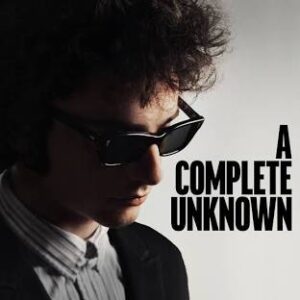
Directed by James Mangold
Starring Timothée Chalamet, Edward Norton, Elle Fanning, and Monica Barbaro
Released: Dec. 25, 2024
Watch Time: 141 min.
K and I meant to watch A Complete Unknown prior to the Academy Awards, but didn’t get to it. Friends of ours who had seen it recommended it, but for various reasons and with various quibbles and qualifications. Such generally positive but mixed revues are a plus for me. It translates to: This movie will be worth your time. Either because of its essential value or because you’ll go into it seeking opinions which you can agree with or dispute. One comment they all made was that the principal actors all did their own singing and that they were very good.
So, when we both had several free hours after dinner one evening (a rare occurrence), we rented it.
The Plot
A Complete Unknown is essentially a biopic that tells the story of Bob Dylan’s rise to fame – from his 1961 arrival in New York City as a complete unknown to national stardom in a few short years. It ends with his controversial electric performance at the 1965 Newport Folk Festival.
The story is told through Dylan’s relationships with key figures in his life:
* Pete Seeger – the traditionalist folk singer who mentored Dylan upon his arrival in New York.
* Joan Baez – depicted as both a romantic partner and musical collaborator.
* Sylvie Russo – a character inspired by Suze Rotolo, Dylan’s early girlfriend.
* Woody Guthrie – Dylan’s musical idol.
I liked A Complete Unknown. For sure. But here it is, two weeks since I watched it, and I’m still trying to figure out what exactly I liked about it and what, if anything, I disliked. And for those who read this review: How would I rate it?
Happily, the new rating system I cooked up should help me answer those questions. Starting with…
What I Liked About It
* The upside of the story. This young Jewish kid from the Midwest decides to become a musician… teaches himself not only the music of Black Blues and American Folk, but develops a unique style of playing and singing that is a blend of both… sheds his Jewish name and with it much of his past… and reinvents himself as some kind of wandering mysterious minstrel comes to New York City to see if he can make it. And he does. In fact, his rise to stardom – because of his undeniable genius, both as a composer and a lyricist – is almost meteoric. In that respect, I enjoyed it like I enjoyed the story of Mozart in Amadeus.
* Edward Norton’s performance. Norton’s portrayal of Pete Seeger is remarkable. Known for intense roles in films like American History X, Norton convincingly embodies the gentle, principled Seeger, showcasing his versatility as an actor.
What I Didn’t Like
* The downside of the story. I’m not sure how I developed this aversion, but I don’t like thinking about what happens to super-successful people that hit their peak when they are young. A Complete Unknown begins when Dylan is unknown and races forward to when he is an international icon. It ends just four years later when he is arguably at the peak of his fame, but on the verge of decline. Dylan’s life continued. And he has created and produced a great deal of good and great music since then. But one gets the feeling that his life has been, at best, a struggle to equal or exceed his earliest work. (Different from, for example, the career trajectory of Paul Simon.) But never mind. This aversion is, admittedly, a personal one, and probably something I should not mention in a critique of this film. But there. I just did.
* The film didn’t do a good job of explaining Dylan’s genius. Here’s a more legitimate gripe. One could think of A Complete Unknown as a study of both Dylan’s impressive musical genius and also of his disagreeable and self-centered artistic persona. And director Mangold provided sufficient evidence of both. But I did not get enough from the movie, either explicitly or otherwise, to shed light on how that mattered. To his partners. To his friends. To his lovers. And to his audience.
To be fair to Mangold, trying to make sense of that within the limited scope of this film might have been irresponsible. Perhaps no one but Dylan could have done it. From the beginning and throughout his career, he played a conscious, cleverly imagined, and sometimes mercurial role of himself as a tortured and isolated artist.
Side Note: I remember going to one of his concerts back in the 1980s in Florida. It was a small venue so I’d hoped he would open up a bit. Maybe tell some stories or some jokes. But he did not. On the contrary, he did the entire thing standing in the middle of the stage with his back to the audience.
Critical Reception
A Complete Unknown received widespread acclaim, earning eight nominations at the 97th Academy Awards, including Best Picture, Best Director (James Mangold), Best Actor (Timothée Chalamet), Best Supporting Actor (Edward Norton), and Best Supporting Actress (Monica Barbaro). Although it didn’t secure any Oscars, the film’s recognition underscores its impact.
At the 31st Screen Actors Guild Awards, Chalamet won Best Actor, while the ensemble cast received a nomination for Outstanding Performance by a Cast in a Motion Picture. The film also garnered nominations at the BAFTA, Golden Globes, and Critics’ Choice awards.
The film has an 82% approval rating with critics on Rotten Tomatoes, 95% with audiences. Metacritic scores it at 70/100, indicating generally favorable reviews. CinemaScore audiences awarded it an “A” grade, reflecting strong viewer satisfaction.
Interesting
* The film is said to be based on Elijah Wald’s 2015 book Dylan Goes Electric!: Newport, Seeger, Dylan, and the Night That Split the Sixties, which examines the cultural impact of Dylan’s 1965 Newport performance.
* Despite his reputation for privacy, Dylan publicly expressed support for the film, praising Timothée Chalamet as a “brilliant actor” and encouraging audiences to read Wald’s book.
* Chalamet dedicated himself to the role over several years, learning to play the guitar and harmonica and working with vocal coaches to capture Dylan’s distinctive voice.
My Rating of A Complete Unknown (based on my new system)
* Verticality: 7.0
* Horizontality: 6.0
* Visual Resonance: 7.0
* Acting: 9.0
* Directing: 8.0
* Editing: 8.5
Total Score: 45.5 out of 60
Verdict: Worth Watching
See what you think. You can watch the official trailer here.
A Man for All Seasons
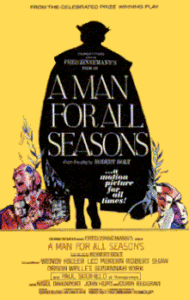
Adapted by Robert Bolt from his 1960 play
Directed by Fred Zinnemann
Starring Paul Scofield, Wendy Hiller, Leo McKern, Orson Wells, Robert Shaw, Susannah York, and John Hurt
Released: Dec. 12, 1966
Watch Time: 2 hours
This is a movie that I’ve been sort of wanting to see for nearly 60 years – since it first came out in 1966. And guess what? It was good. Very good. Much better than I expected. Maybe one of the best movies I’ve ever seen.
Of course, I was 16 in 1966. So if I had seen it then, I doubt I would have liked it very much. (I wasn’t much interested in historical dramas.) But I did see the play several years later when it was presented at a college in my hometown, a production that my father directed, and I enjoyed it.
The Plot
A Man for All Seasons tells the story of a man whose conscience couldn’t be bought.
When the highly respected British statesman Sir Thomas More (Paul Scofield) refuses to pressure the Pope into annulling the marriage of King Henry VIII (Robert Shaw), his clashes with the King grow more dangerous. A devout Catholic, More stands by his principles and leaves the royal court. But Henry is not satisfied, and soon More is charged with treason.
What I Liked About It
Everything. The history behind the screenplay is fascinating. The liberties Robert Bolt took made the story even more dramatic. The script is nearly flawless. The acting is uniformly superb – intelligent, nuanced, and engaging. The direction is invisible (and thus perfect), and the cinematography is moving. Even the music is wonderful.
What I Didn’t Like (So Much)
It made me nervous. I knew what was coming, and I kept bracing for it.
Critical Reception
* A Man for All Seasons was a box office hit, becoming one of the highest-grossing films of 1966.
* The film has an 89% approval rating with critics on Rotten Tomatoes, 87% with audiences, and a Metacritic score of 72/100.
* It won multiple Academy Awards, including Best Picture, Best Director, Best Actor (Scofield), and Best Adapted Screenplay. It also swept the BAFTAs.
* Critics praised its script, direction, and particularly Paul Scofield’s performance. A.D. Murphy of Variety called it “an excellent, handsome, and stirring film.” Kate Cameron of the New York Daily News called Scofield’s portrayal of More “genteel” and “steadfast.”
* Pauline Kael had a more negative take, saying the film resembled a school pageant in rhythm and style.
Interesting
* Producers feared Scofield wasn’t a big enough name, so they approached Richard Burton and Laurence Olivier before ultimately casting Scofield, who had played the role on stage.
* Vanessa Redgrave did a cameo as Anne Boleyn for fun – and without credit.
* The film marked John Hurt’s first major screen role.
* The real-life Thomas More was more controversial than the film suggests. Historian Richard Marius criticized the play and film for presenting him as saintly while ignoring his aggressive persecution of Protestants.
My Rating of A Man for All Seasons (based on my new system)
* Verticality: 10.0
* Horizontality: 9.0
* Visual Resonance: 8.0
* Acting: 9.3
* Directing: 9.0
* Editing: 9.0
Total Score: 54.3 out of 60
Verdict: Strongly Recommended
See what you think. You can watch the official trailer here.
Four Short Documentaries About Henry Moore
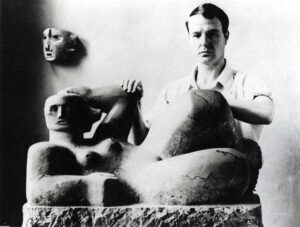
I’m a huge fan of Henry Moore. In my mind, he’s one of the three greatest sculptors of the first half of the 20th century. The other two are Constantin Brâncuși and Alberto Giacometti.
Late one evening last week, I stumbled upon a BBC documentary about him that was produced in 1958. It was mesmerizing – as much from the quality of the commentary as from the images of the sculptures themselves.
I enjoyed it so much that I decided to watch it again the following evening. And I discovered it was just one of six similar documentaries the BBC had done on Moore. The first four, which I include below, were produced by the same person: John Read. Read has a unique and charming style – long, exploratory film sequences set to an uplifting musical score.
I haven’t watched the final two yet, but I’m looking forward to seeing them.
About Henry Moore
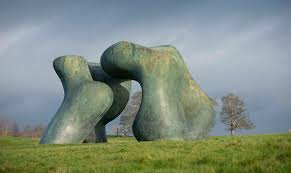
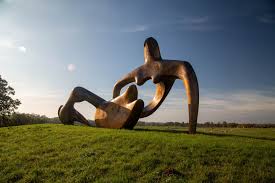
Henry Moore’s career stretched over 60 years and more than a thousand sculptures, from early direct carvings in marble and wood to monumental bronzes cast in the last decades of his life. His pieces are now found in museums, plazas, and parks around the world – quietly commanding attention.
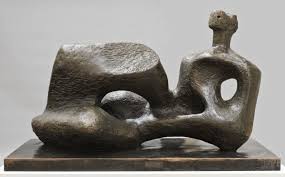
His signature style – fluid, rounded, and often pierced with space – was, as one critic put it, “a blend of the primitive and the poetic.” The art historian David Sylvester once said that Moore’s best sculptures “look as if nature herself made them.” What makes them so powerful is their merging of the human body with natural shapes – figures that feel as much like boulders or waves as they do torsos and limbs.
Moore described his titles as deliberately vague, believing that art should “suggest, not describe.” His work invites interpretation, not instruction.
For me, the fascination with Moore lies in how immediately appealing his forms are – both intellectually and emotionally. They make you want to look at them from every angle. They make you want to touch them – almost fondle them. And the fact that he could take just a few themes – mother and child, the reclining figure – and create over a thousand uniquely beautiful works from them? That’s genius.
Henry Moore – A Sculptor’s Landscape
Producer: John Read
Narrated by Sir Ralph Richardson
BBC, 1958
Watch Time: 27 min.
This is the first Moore documentary I watched. I was immediately absorbed by it – first by Richardson’s voice, then by the story he tells about Moore, and along the way by the images of the sculptures themselves.
Check it out. It’s only 27 minutes long. I’m sure you will like it. If you don’t, you can skip the other three.
Henry Moore – One Yorkshireman Looks at His World
Producer: John Read
BBC, 1967
Watch Time: 59 min.
This is the second one I watched, produced nine years later.
In this one, Read visits Castleford, the artist’s hometown, and explores how the surrounding landscape might have influenced Moore’s work. As a bonus, Moore provides thoughts and comments of his own.
Henry Moore: The Language of Sculpture
Producer: John Read
BBC, 1973
Watch Time: 49 min.
This is a look at the 1972 exhibition of Moore’s work in the impressive Forte de Belvedere in Florence, which I visited once. (It was partly designed by Michelangelo and overlooks the city.)
Read provides insightful analysis and detailed views of several of the pieces. There are also contributions from Moore himself, and a selection of very early sketches from the time he was a reluctant student of art in Italy at the age of 26.
The exhibition was an artistic gamble and a logistical nightmare to put together given the narrow access points, the slippery cobbles of the fortress courtyards, and the effect of heat on wax in the mixed-media works. However, concerns that some might object to the fact that the first major show of a living artist’s work at the Belvedere was by a foreigner proved to be unfounded and the exhibition was a popular and artistic success.
Moore himself said in 1974 that it was the pinnacle of his career and led him to create works on a larger scale.
Henry Moore at Home – A Private View of a Personal Collection
Producer: John Read
BBC, 1974
Watch Time: 49 min.
In this one, Moore talks about his fascination with sheep and their “ancient biblical quality.”
He also discusses in detail several of his sculptures and introduces us to some of the pieces by other artists that he keeps in his sitting room. They include a Cezanne painting, Degas drawings, and several statues from ancient cultures.