Looking Back at 2025: Favorites, Highlights, and Holiday Notes

My “Best of 2025” lists – and not just films and books. I also take a look at key political and cultural moments of the year.

But first…

I’m putting this issue together on Saturday night, just after the last of our many guests for the holiday week departed. Rather than give you an account of the entire (very) busy week, I’ve reproduced the contents of my Christmas Day journal below.

Christmas Day at the Ford-Fitzgerald Beach House 

This year, Number One and Number Two sons were spending the holidays with their in-laws. However, we’ve had K’s siblings and their offspring here at the beach house, as well as the usual family-less friends. All of which made for a group of about 30 – more than enough to make the house merry for a full week.

I woke at 8:00 this morning, feeling noticeably more clearheaded and more energetic than usual. Some of that improvement was due to having had a full eight hours of sleep rather than six or seven, which has, in recent years, become the norm for me.

But some of that improvement must have been due to my having drunk much less alcohol last night than usual – less than two ounces of rum. My “usual” – about 1,000 calories of alcohol a day – may seem excessive. I’m sure it would qualify me as alcoholic in some of the analytical diagnostics. But it never stopped me from putting in a full day of work – i.e., six to eight hours of “work” work, two to three hours of research and writing, and another hour or two of exercise. So “alcoholic” never felt like me.

Still… I remember that I had the same sense of improvement the last time I cut out or reduced my alcohol consumption. It’s not something I have a definite opinion about now, but it deserves to have some attention given to it.

Breakfast was served at 10:00 as usual, and in the usual Christmas Day manner – buffet-style in the kitchen with seating in the living room or dining room or at one of the tables outdoors. The menu was much like it has always been, leading off with K’s mouth-watering, once-a-year egg frittatas; sliced ham; refried mashed potatoes (my one specialty); a stack of maple-syrup-coated Canadian bacon; somebody’s Christmas casserole; cereals (for the kiddies); honey-flavored Greek yogurt; a cornucopia of fresh fruits; muffins and coffee cake; and bagels with lox and cream cheese.

The mood was holiday festive, the conversation cheerful. And for those in need, there were holiday quaffs and Christmas libations – sufficient to carry one into the new year.

Afterwards, came the first of three gift unwrappings (the first for the children, the next for the adults, and the last one, later, in private, for K and me). And after that, there were phone calls to siblings and cousins, stop-by visits from friends and neighbors, and pool time for the families with small children.

It was a beautiful clear day, the temperature in the low 70s. At about 4:00, some of us crossed the street to sit on the beach and watch the children, eager for more excitement, play in the surf. I brought a beach chair and a copy of a book I remembered having read and enjoyed many years ago: Ten Philosophical Mistakes by Mortimer Adler. It wasn’t, admittedly, Christmas fare, but it was just what the doctor ordered. I spent a very pleasant hour reading the preface, introduction, and first chapter.

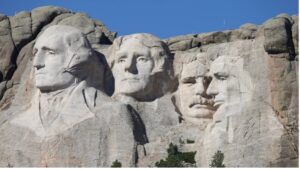
Back home as the sun was setting, I found the music room deserted, and opened my laptop to check on my email. There were, as always, about 200 new messages, most of which I was able to scan, sort, and discard or save for the following day. I did respond to the personal notes, though, including a thread of emails courtesy of my Myrtle Beach golf buddies. asking: “If Theodore Roosevelt were removed from the face of Mt. Rushmore, which president would you replace him with?”

The answers posted ranged from Franklin Roosevelt to John F. Kennedy to Donald Trump. (That last one was from yours truly and succeeded in stirring the pot.) And that had led to nominations for a “Mt. Rushmore of Sports.” It had produced the usual suspects: Michael Jordan, Mohammad Ali, Babe Ruth, etc., etc. But while I was reading that, seven other “Mt. Rushmore” categories were suggested in a surprising range of subjects. Here they are, along with my nominations for each:

Inventors/Scientists: Isaac Newton, Charles Darwin, and Albert Einstein

Philosophers: Aristotle, Confucius, Immanuel Kant, and John Locke

Humanitarians: Marcus Aurelius, Jesus of Nazareth, Martin Luther King, and Elon Musk

Comedians (American): Lenny Bruce, George Carlin, Richard Pryor, and Dave Chappelle

Novelists (English-Language): Jane Austen, Mark Twain, Ernest Hemingway, and Vladimir Nabokov

Poets (English-Language): William Shakespeare, W.H. Auden, W.B. Yeats, and T.S. Eliot

Dramatists (English-Language): William Shakespeare, George Bernard Shaw, Anton Chekhov, and Tom Stoppard

Painters (European): Hieronymus Bosch, Caravaggio, Paul Cezanne, and Pablo Picasso

Modern Dancers: Mikhail Baryshnikov, George Balanchine, Fred Astaire, and Michael Jackson

If you’re sitting around during the holidays with relatives and nothing left to talk about, try challenging them to come up with their own “Mt. Rushmore” categories… and let me know what happens.

The Best of the Best of 2025 (According to Yours Truly) 

The “Mt. Rushmore” exercise inspired me to create my “Best of 2025” lists of films and books.

I had a problem with the films. Because when I looked through my journal, I realized that I hadn’t watched even a dozen from beginning to end all year long. The excuse I gave myself was that, between the four businesses for which I’m actively working and the half-dozen books I was trying to finish in 2025, I didn’t have the time. But another factor – perhaps the real factor – was that my attention span for video entertainment has been attenuating steadily since I began watching YouTube shorts almost every night. To make matters worse, the best movies that I watched in 2025 were classics I had seen two or three times before (The Godfather I & II, The Conversation, Blow Up, and Five Easy Pieces).

So since it would do you no good for me to recommend those universally acclaimed films to you, I am, instead, giving you a list of 10 movies I intend to watch in 2026 because the reviews I had read of them convinced me they would be worth the effort.

My Top 10 Films (I Didn’t Watch) 
1. Guillermo del Toro’s Frankenstein
2. Nouvelle Vague
3. 28 Years Later
4. One Battle After Another
5. Marty Supreme
6. Orwell: 2+2=5
7. Best Wishes to All
8. No Other Choice
9. Train Dreams
10. My Undesirable Friends

My book selections, however, were easy because I’d already written reviews of all the books I’d read during the year in my journal. (I had met my goal of reading a book a week: 20 books of fiction and 32 of non-fiction.)

My Top 10 Books (Fiction & Poetry) 
1. Dubliners by James Joyce
2. The Reivers by William Faulkner
3. Small Things Like These by Claire Keegan
4. Factotum by Charles Bukowski
5. The Iliad by Homer
6. A Ladder to the Sky by John Boyne
7. To Have and Have Not by Ernest Hemingway
8. The Wasteland by T.S. Eliot
9. West Into the Night by Beryl Markham
10. It Bleeds by Stephen King

My Top 10 Books (Non-fiction) 
1. Guns, Germs, and Steel by Jared Diamond
2. Introduction to Cognitive Science by Thad A. Polk
3. The Better Angels of Our Nature by Steven Pinker
4. How the Mind Works by Steven Pinker
5. Einstein in Time and Space by Samuel Graydon
6. The Blind Watchmaker by Richard Dawkins
7. Elon Musk by Walter Isaacson
8. Poor Charlie’s Almanack by Charles Munger
9. Stoic Paradoxes by Cicero, translated by Quintus Curtius
10. Milton Friedman, The Last Conservative by Jennifer Burns

Those three lists should have satisfied my “Mt. Rushmore” inspiration. Alas, it only triggered several more, three of which follow…

The 10 Best Karmic Moments in Pop Culture 
1. Sean “Diddy” Combs Convicted
2. Tilly Norwood Almost Got an Agent
3. Disney’s Snow White Went Woke and Then Broke
4. Disney CEO Bob Iger Sues AI and Then Embraces It
5. Jimmy Kimmel Suspended for Tasteless Humor
6. Stephen Colbert Cancelled for Angry Banter
7. Robert De Niro’s The Alto Nights Flops at Box Office
8. Prince Andrew Dethroned
9. Jeff Bezos Reaches New High in Garish Weddings
10. NYC Liberals Inherit Zohran Mamdani

The 10 Best Geopolitical Moments for the US 
1. US/Mexico Border Finally Closed
2. US Brokers Ceasefire in Gaza
3. Thailand and Cambodia Sign Peace Treaty
4. India and Pakistan Sign Peace Treaty
5. US Brokers Ceasefire in Decades-Long Congo/Rwanda War
6. US and Israel Disable Iran’s Nuclear Capabilities
7. Withdrawal of US from World Health Organization
8. Nasry Asfura Elected in Honduras
9. Javier Milei Elected in Argentina
10. José Antonio Kast Elected in Chile

The 10 Worst Political Moments for Wokesters and Leftists 
1. Federal agencies must now list 10 existing regulations for repeal for every new one they propose.
2. The Supreme Court upheld a Tennessee law banning transgender surgeries for minors.
3. The “Rescissions Act of 2025” cut $9 billion in federal spending.
4. Taxpayers are no longer required to fund National Public Radio (NPR).
5. USAID loses federal funding.
6. The Laken Riley Act passed, ensuring criminal illegal aliens are no longer released into US territory.
7. The Take It Down Act passed, forcing criminalizing the non-consensual distribution of intimate images on social media.
8. The HALT Fentanyl Act passed, classifying fentanyl as a Schedule I drug, and giving law enforcement stronger tools against fentanyl trafficking.
9. $7 billion shutdown ended without bankrupting US healthcare.
10. The “No Kings” march proved that Donald Trump is not a king.

The Evolution of Teenagers in Film and on TV 

This is a completely new-to-me thesis on how English language inflections changed over the decades based on cultural and economic facts. It is an idea I’ve never encountered before. Yet, it felt plausible, if not perceptive. In other words, it was/is well worth considering. Check it out and let me know if you think she’s up to something.

From Page to Discussion: My Full Review of Coetzee

I haven’t written many book reviews this year – but not because I’ve slowed down on my reading. My average rate is about a book a week. I always read at least one book of fiction for the Mules (my book club). The other three are usually nonfiction.

In looking over the recent reviews that I have done, I can see that, for the last six months, anyway, most of them have been more like mini-reviews. Well, I’m going to remedy that in this issue with a fairly in-depth look at the Mules’ selection for November: Waiting for the Barbarians by J.M. Coetzee. It’s an interesting book and served as rich fodder for a vigorous debate on its quality and an edifying discussion of literature and literary fiction in general.

As you’ll see, I have a lot to say about all of that.

Beautiful Sentences, Weak Characters: Reviewing Coetzee

Waiting for the Barbarians 
By J.M. Coetzee 
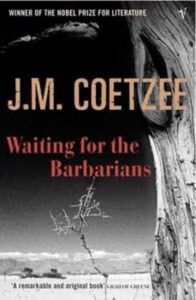
192 pages
Publication Date: April, 1982

Waiting for the Barbarians, written during the apartheid regime in South Africa, examines and questions the legitimacy of colonialism through the eyes of its protagonist, an unnamed Magistrate who governs a province that borders lands inhabited by a population of so-called barbarians.

Amazon describes it as “an allegory of the war between oppressor and oppressed. The Magistrate is not simply a man living through a crisis of conscience in an obscure place in remote times, his situation is that of all men living in unbearable complicity with regimes that elevate their own survival above justice and decency.”

Most of my fellow Mules gave it very high ratings, but a few of us were more critical.

What it was lacking was a compelling plot line. The actions – such as there are – take place in an unnamed desert outpost of an unnamed colonial power whose ostensible purpose is to “protect” the empire from the barbarians. But, as one might expect from the set up so far (and the good reviews it got from the leftist press), the barbarians behave like Rousseau-like innocents and most of the colonial soldiers behave like… yes, you guessed it, barbarians.

Most of what happens in the story happens within the mind of the Magistrate, the outpost commander who, in contrast to Colonel Joll, a bureaucrat sent by the central government to try to wipe out the encroachment by the barbarians, has a conscience, which fuels his constant and actually incessant worrying about the treatment of the barbarians, and a heart, which he used to develop some sort of emotional attraction to a female barbarian that he keeps in his bedroom as a sort of pretend-lover and anthropological subject.

What I Liked About It

The interior monologue is well written, as are the external monologues and the descriptive passages. This is where Coetzee shows his skill set. There’s no denying he is a master of diction and a skillful assembler of sentences.

What I Didn’t Like So Much

But as to the development of his characters, I was disappointed. Apart from the protagonist, the players in this drama are more types than flesh-and-blood people with all the complications that flesh-and-blood Homo sapiens have.

On top of that – and this might be me – it was difficult to read this book as an existential novel, which is what I think Coetzee meant it to be, because of all the parallels and associations in the plot and characterization that whisper (if not shout) “Apartheid South Africa.”

So, would I recommend Waiting for the Barbarians?

Before I answer that…

A Few Words About the Way I Evaluate the Books (Fiction) That I Review Here

My approach to every serious novel that I read (and my contributions to the Mules’ discussions) is guided by a very helpful lesson about how to understand and appreciate modern drama that I learned in graduate school from Robert W. Corrigan, a visiting professor for whom I served as a teaching assistant and from whom I learned more than I ever expected to. (See “Notes From My Journal,” above.)

Here’s the gist of it:

In Professor Corrigan’s view, modern theater could be understood best by looking at it from the perspective of Aristotle’s Poetics. In that treatise, the greatest philosopher of all time identified six elements of drama: plot, character, thought, diction, song, and spectacle – basically in that order of importance.

Writing a great plot, Aristotle understood, is the most difficult of the dramatist’s challenges because a great plot is much more than one-thing-led-to-another. It is a very detailed and delicate fabric that, if not woven together by a master, will unravel faster than a ribbon in a windstorm.

Next in line is character. And then thought. (Let’s call it the psychology of the characters.) Then diction and song (the poetry of the drama). And, finally, spectacle (costumes, scenery, visual and sound effects, etc.).

What modern dramatists do, Corrigan argued, is reverse the importance of these elements, prioritizing diction, song, and spectacle while diminishing the attention given to plot, character, and thought. The clearest example of this is Samuel Beckett’s Waiting for Godot.

But it’s not just modern drama that has been affected by this inversion. It’s also poetry, fiction, and – this may surprise you – art.

The inversion in aesthetic values that took place in modern art in the second half of the 20th century paralleled what happened in drama and literature. The three core elements of traditional art – draftsmanship, perspective, and story – were abandoned and replace by their opposites: abstraction, expression, and thought. (I just made that up. But it’s pretty good!)

So how does all of this apply to Waiting for the Barbarians?

What I see in that novel is a gifted writer who prides himself on his poetic skills and recognizes that if he can create the right sort of socio-political scenes and write the dialogue and descriptions beautifully he will win praise from post-modern illuminati, even if the plot is boring and the characters are cardboard thin.

Coetzee gifted us with well-chosen words, artfully crafted sentences, knowingly selected metaphors, poetic density, and rhythm – and that’s a lot. But I felt that it was not enough to compensate for an anemic plot, thin characters, and thought content that borders on a Morality Play.

Bottom Line

Yes, it’s a good book. Maybe even a very good book. But not by any means a great book.

Which brings me back to the question: Would I recommend Waiting for the Barbarians?

The answer: Well, maybe. I will say this, though, I do intend to read another of Coetzee’s novels.

About the Author

John Maxwell Coetzee is a South African and Australian novelist, essayist, linguist, and translator. The recipient of the 2003 Nobel Prize in Literature, Coetzee is one of the most critically acclaimed and decorated authors in the English language.


Three Days of Non-Stop Meetings – Oh Boy! 

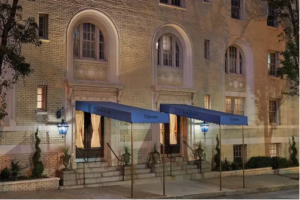
I had my first meeting right after I checked in to my room at Baltimore’s Hotel Ulysses, which is a few blocks from Agora’s headquarters in central Mount Vernon.

Yesterday, my partner and I met with the CEOs of six of Agora’s profit centers – three publishing franchises, one real estate marketing company, and two specialized investment services – all of which are doing well. Surprisingly well, if you consider the marketing environment we have been in for the last four years.

Today, we began at 9:00 am and went until 5:00. I was back in my room by 5:30, took a nap, and was down here at the hotel bar writing this at 6:30.

Agora’s holiday party – always a gala event – will be held at the historic Maryland Club, and it begins at 7:30. I could easily be there on time if I stop writing now – but being on time for a party, I’ve been told, is très déclassé. So I’ll finish up this Journal entry and plan to show up at 8:00.

When I checked in, the receptionist told me that Hotel Ulysses is three years old, which surprised me because I hadn’t heard of it until Gio booked it for me. (Since I abandoned my pied-à-terre in downtown Baltimore years ago, I’ve been trying out the hotels within walking distance of the company’s headquarters and I thought I knew them all.)

Like several other hotels in the area, it’s a converted apartment building. But unlike the rest, this one is charming. Charming is hardly five-star, but it’s about 300% better than the best of the others.

Let me see if I can describe it to you…

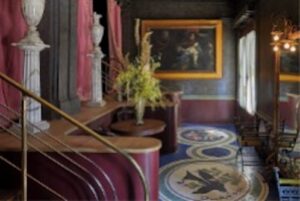
I’ll start with the bar. It’s modest in size – seating at max maybe 40. It’s funky, stylish, and plush with good lighting. The bartenders are young and Brooklyn hipster-looking – i.e., tattoos (not sleeves but that apparently cooler random style), unique hair styles, bracelets, earrings, nose rings, and who knows what. They are dressed mostly in black. They aren’t mixologists, but they are modestly skilled and eager to learn. Most importantly, they are efficiently friendly (which is the only way a server should ever be) and quick to notice an empty glass.

The bartender waiting on me now is a blonde with black lipstick, a beguiling smile, a small nose ring, a few tattoos, and a voice that doesn’t help me identify his/her gender. If I were younger than a baby boomer, I could say “Dude” and get away with it. Old as I am, my mind is rifling through a series of alternatives: Champ, Sport, Pal, Chief? All masculine and all from my father’s generation.

Maybe Comrade? Is that gender-neutral?

Oh well. Never mind. Let me continue.

The prevailing décor of the hotel works for me – an eclectic selection of furniture, fabrics, curtains, carpets, floor and wall finishes, collectibles, art, and artifacts, curated with a respect for the budget and an authentic sense of humor. It is not high concept, for sure. But neither does it make me suspect it was designed by someone’s “really creative” sister-in-law.

The color scheme is also working for me. Reds from scarlet to crimson to claret. Blues from sapphire to turquois to midnight blue. And best of all, a very evidently conscious knowledge of effective lighting.

This is true throughout the hotel. Every space (and there are many distinctly different ones) feels exactly like it should.

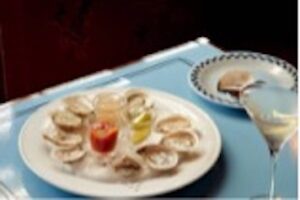
Here are some photos…

The Entrance


The Foyer


The Restaurant Bar


The food


The Feeling of the Rooms


My View

I’d like to tell you about Baltimore – the city I met about 35 years ago, after I gave up on my first attempt at retirement and went back to work in the information publishing industry with a former competitor. He – BB, the founder of The Agora Companies – chose Baltimore for the birthplace of his then-fledgling business because he was able to buy a building there for a single US dollar. (He’s a value investor.)

Today, 40-something years later, The Agora Companies is the world’s largest financial information publisher, larger than The Wall Street Journal and Barron’s put together.

I’m proud to have been a part of that history.

But never mind. That’s another story.

Let’s get to what I really want to talk about in this issue… some simple, basic concepts about why and how businesses work that every aspiring business builder should know.

“Speedoo” by Speedo & The Cadillacs 

“Speedoo” was a big hit during my high school years. I still remember the lyrics, but I never saw it performed until a friend sent this link a few weeks ago.

What is especially interesting about the song is how little content it has. This is pretty much all there is to it: “Well now, they call me Speedoo / But my real name is Mr. Earl.”