
What You Don’t Know About the People You Are Trusting to Run Your Business

In our personal lives, we want to believe that our friends and siblings have the same values and sensibilities that we do. If we are caring and attentive, we want them to be caring and attentive. If we are loyal, we want them to be loyal. If we value good hygiene, we’d like them to do the same.
But what we learn if our emotional intelligence grows beyond adolescence is that, when it comes to values, beliefs, and preferences, reciprocity is the exception, rather than the rule.
When I decided to get rich 41 years ago, I had instant clarity about the most important thing I needed to do to start my journey. I realized that, as a mid-level employee of a brilliant and very ambitious entrepreneur, the number one change I had to make was to stop resenting his wealth and self-confidence – to instead train myself to become not only his hardest-working employee, but to be the employee he could trust the most.
If you want to get rich as a Number Two, as I’ve done several times, that’s the formula, the one and only formula, that will work for you.
But as important as it is, that’s not the business secret I want to dig into today. Instead, I want to show you its “sister” secret – a surprising fact that every entrepreneur and business owner should know.
Let’s start with this…
The Difference Between Being a Shareholder in a Business,
a Manager of a Business, or “Just” an Employee
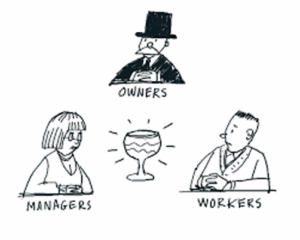
Early in my career, after moving myself up the corporate ladder to CEO with a minor but significant stake in the business, we went through a growth period when just about everything we did in terms of marketing and product development worked. The business grew quickly, and because my partner/boss wanted to move in that direction, we gradually diversified our product lines horizontally and gradually became a company of six separate profit centers, each sharing the same marketing strategy.
I had to find people capable of managing those profit centers, and I had given up on the idea that I could recruit them from afar. I knew from experience that the most likely way to find the leaders we needed would be to pluck superstar performers from our existing management teams.
The young people I put into the positions were selected on the basis of qualities I’d come to see as significant – not on academic degrees or even years of experience, but on three qualities that I recognized as having been essential to my own success. They had to be smart. They had to be willing to work long days and weekends. And they had to be fearless enough to take on a job that they knew they were at that point incapable of doing with ease.
And guess what? For nearly three years, they all performed very well in their new roles, leading each of their profit centers forward, with revenues and profits growing – although, understandably at different speeds and to different levels, since each was effectively growing in a market that had different economic and commercial dynamics.
But then, as happens inevitably if you are fortunate enough to have a business that endures for many years, the general economic environment began to change, and revenues in every one of those profit centers began to recede.
When this happens in a business you own, your first impulse is to put your head in the sand and hope that whatever is causing the problem will magically evaporate, bringing sales back up to where they were before and giving you the pleasure of having the problem solved without doing anything.
When that doesn’t happen, what next occurs to you is that unless you do something drastic, your business will continue to weaken and eventually go bust.
In this case, I kept my head in the sand a bit longer than I probably should have. But after three or four consecutive months of shrinkage, I called our profit center CEOs together and told them that they had to solve the shrinkage problem fast. “Do whatever you think you should do,” I told them. “I just don’t want to see any red ink on the bottom line.”
If You Are the Boss,
It’s Your Problem to Solve!

I gave them the liberty to figure out their own solutions, and I didn’t micro-manage their individual decisions. But I did pay close enough attention to realize that some of them were doing things that made me hopeful, while others were doing things that felt wrong.
Given the common marketing strategy all of the profit centers shared, there were basically three things they could have done to keep their parts of the business profitable.
One was to drastically reduce overhead by eliminating any non-essential procedures and protocols, which would mean closing some departments and firing the people that worked in them. That is never an easy thing to do, even for the most bloodless CEO.
Another option was to cut back on the marketing budget, which is always a sizeable portion of the money you spend.
And a third was to rethink and, in many cases, reinvent the sales and marketing approaches that were in place in a nearly desperate attempt to find something new that would quickly start working well and bring revenues back up.
These are all, in my mind, reasonable courses of action. I knew that if I were a CEO of one of those profit centers, I would do all three.
I would want to cut back on all non-essential protocols and procedures because I believe such activities are not just wasteful, but are more than likely damaging to the rest of the businesses in ways that are not obvious – e.g., creating resentment among employees who are doing essential work and wondering why some of their fellow workers are getting paid as much as or more than they are to accomplish relatively unimportant objectives.
I would also reduce marketing spend. But I would be hyper-aware that when you do that, you are almost guaranteeing that your revenues in future years will get smaller, because most businesses depend on at least a steady, but preferably rising, base of new customers to whom they can sell additional, higher priced “back end” products to preserve and grow the bottom line. (In other words, you must see this option as temporary. You do it because you don’t want to suffer short-term losses, but you abandon it as soon as you can.)
The third option – quickly testing all sorts of new things (new products, new prices, new advertising copy) – is the most immediately beneficial to the business if you can do it successfully. But it is also the most difficult because the reason you are in the position you are in is because the things you know how to do are no longer working.
There is Always More Than One Solution
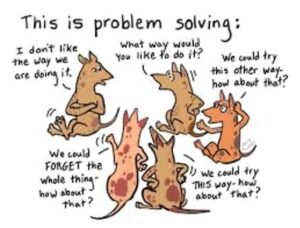
What happened in this case was that two of our CEOs executed one option – cutting back on marketing spending. Two others executed two of the options – cutting marketing spending and cutting overhead. And two of them executed all three options – cutting marketing spending, cutting overhead, and pushing their teams to test all sorts of different things to discover something new that would start bringing in new customers.
I don’t have to tell you what happened. You know from what I’ve said so far that the two CEOs who did nothing but cut marketing spending stayed profitable for a while (about a year, if I remember correctly), but then revenues tanked and never recovered. The CEOs that cut both marketing spending and overhead stayed profitable, but at significantly lower levels. And the two CEOs who put all three options into action not only maintained a positive bottom line but continued to grow rapidly.
The Hidden Business Secret
The obvious lesson I learned from that experience is this: When a business starts to founder and/or flounder, the CEO must be willing to do just about anything and everything to get it back on course. And for most businesses, that means reducing marketing spends temporarily, cutting overhead costs almost ruthlessly, and testing every halfway intelligent idea to find a new path forward.
But there is another lesson I learned – a related lesson – that has been just as useful to me in subsequent years, even though it was something that, at first, I didn’t want to believe.
It’s this…
However great the people running your business are – however hardworking, knowledgeable, and skillful they might be – it’s more than likely that their commitment to your business is less than you think. And that matters.
The executives I chose to run our profit centers were among our best employees, having proven time and again to be excellent at what they did. But though I gave them free rein to do what they had to do to turn their rapidly deteriorating bottom lines around, I wasn’t entirely passive in terms of working with them. My partner and I met with them once a month to review their P&Ls, and I met with them at least once a week to talk about marketing and copywriting and whatever else was on their minds.
The situation we were in was as strange and as stressful for them as it was for me, so those conversations allowed me to get an insight into their thinking and, to some extent, their instincts and feelings about what they were going through. And it wasn’t what I expected.
Financially, I was in a comfortable position. I knew I would be able to live, if I had to, without an income for however long as it took to get the business going again. So for me, a big part of restoring sales and profits was a matter of pride. But for some of our CEOs, the slump we were in was an immediate threat to their income and in that a threat to the comfort and security of their families. They knew that they were not in a position where they could forgo even a part of their compensation. They also knew that, if things continued to worsen, they could jump ship and get a senior position with one of our competitors.
In other words, we were invested differently in the future of the company.
For them, making hard decisions about the profitability of their individual profit centers was tied up with considerations about their own income and income security.
For me, there were no options. Although I had the financial independence to not care, I cared too deeply to do anything but everything, including putting pressure on already hardworking people and firing people who were good employees but not essential to the survival of the business.
I had to accept the fact that I was wrong to assume that these good and hardworking executives would fight as hard to keep the business alive as I would. They were willing to do a great many things to see it succeed – and they did during the fat years. But at an important point, their personal interests verged from mine. And that, I continue to remind myself 40 years later, is something I should not only recognize as a possibility but expect as a probability.
