
It’s the 4th of July!
I heard this or read this somewhere: You can move to France and live there for the rest of your life and you will never be French. The same would be true if you moved to Germany or Japan or Thailand or Saudi Arabia. But someone from any of those countries can immigrate to the United States and become an American. No other country in the world can do that. The poem that follows does a good job of expressing that without oversimplifying or ignoring the challenges.
Immigrant Picnic
By Gregory Djanikian
It’s the Fourth of July, the flags
are painting the town,
the plastic forks and knives
are laid out like a parade.
And I’m grilling, I’ve got my apron,
I’ve got potato salad, macaroni, relish,
I’ve got a hat shaped
like the state of Pennsylvania.
I ask my father what’s his pleasure
and he says, “Hot dog, medium rare,”
and then, “Hamburger, sure,
what’s the big difference,”
as if he’s really asking.
I put on hamburgers and hot dogs,
slice up the sour pickles and Bermudas,
uncap the condiments. The paper napkins
are fluttering away like lost messages.
“You’re running around,” my mother says,
“like a chicken with its head loose.”
“Ma,” I say, “you mean cut off,
loose and cut off being as far apart
as, say, son and daughter.”
She gives me a quizzical look as though
I’ve been caught in some impropriety.
“I love you and your sister just the same,” she says,
“Sure,” my grandmother pipes in,
“you’re both our children, so why worry?”
That’s not the point I begin telling them,
and I’m comparing words to fish now,
like the ones in the sea at Port Said,
or like birds among the date palms by the Nile,
unrepentantly elusive, wild.
“Sonia,” my father says to my mother,
“what the hell is he talking about?”
“He’s on a ball,” my mother says.
“That’s roll!” I say, throwing up my hands,
“as in hot dog, hamburger, dinner roll….”
“And what about roll out the barrels?” my mother asks,
and my father claps his hands, “Why sure,” he says,
“let’s have some fun,” and launches
into a polka, twirling my mother
around and around like the happiest top,
and my uncle is shaking his head, saying
“You could grow nuts listening to us,”
and I’m thinking of pistachios in the Sinai
burgeoning without end,
pecans in the South, the jumbled
flavor of them suddenly in my mouth,
wordless, confusing,
crowding out everything else.
A Pleasant Conversation
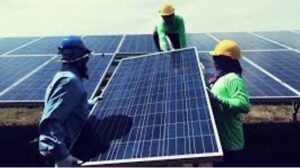
This morning, at 6:30, I met Dylan, the crew chief of the small team of technicians that were going to install solar panels on the roof of my office. He looked young to be in a supervisory position – and, in fact, at 26 years old, he was. I brought him upstairs to my office to sign some paperwork, which meant that we walked through the exhibition gallery and my paintings by Benjamin Cañas, the Salvadoran surrealist for whom we were having a retrospective that I told you about last week. He was visibly excited by the Cañas paintings and said, “I’ve always wanted to do art for a living. And everyone says that you should follow your passion. But I have to pay rent and buy food, so I got this job and it’s okay, but it’s not my passion.”
You are doing the right thing,” I said. “Following your passion is what lucky people that get rich say when they are accepting awards. For the rest of us, we must first follow our moral obligations – and the most important of those is to pay for our lives and the lives of those who depend on us.”
He liked that idea. We became friends.
