
Today, I take an in-depth look at two “local” issues – one on the East Coast (the Mamdani question) and one on the West Coast (the failure of San Francisco) – that have potentially serious consequences for everyone in the country.
Greetings from Portugal!
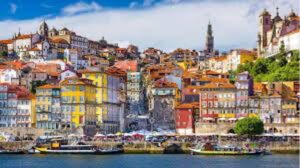
K and I are in Portugal for 12 days. The first five days by ourselves to check out Porto, which K tells me we’ve never visited before. And next week in Lisbon, where we will be meeting with 40 Ford and Fitzgerald family members for our 19th biannual Cousin Camp.
We hosted the first Cousin Camp in a beach house on Martha’s Vineyard in 1989. Back then, the “cousins” were toddlers and young children. Now, half of them are married-with-children, and the eldest is 45. They will be traveling here from both coasts of the US, and from Canada, France, and the UK.
The reason we call these things “Cousin Camps” rather than “Family Reunions” is because our initial reason for doing them was about not just getting together with our own siblings, but giving our three boys the opportunity to know and form friendships with their cousins – something I didn’t have growing up because all my cousins lived in Colorado, which, from a travel-cost consideration, might have been on Mars.
And forgive me if you’ve heard this before, but of the many significant investments I’ve made in my life, the Cousin Camps are certainly one of the best. When I hear that one of my French-American nieces is spending her holidays with her British cousins in London, or that two of my nieces, one a cryptocurrency millionaire and the other a Broadway star, are “besties,” or when I see how relaxed the ball-breaking bantering is between my boys and my nephews, I think, “Now that’s a good ROI!”
In Porto, we are staying in the Gaia district, on the shady side of the Douro River, where the country’s wines and ports are grown and stored. We’re at the Tivoli Hotel, which was built around the centuries-old port wine cellars of Kopke, the oldest port wine house in the world. The hotel building, like almost all buildings on this side of the river, looks like a 19th century warehouse with a facelift, which is probably exactly what it is.
But the inside is contemporary, clean, and minimalist, with accents of exotic woods and fine fabrics, muted lighting, and an astounding collection of artwork in abundance, indoors and outdoors, including a suite of large crayon illustrations by Jean Claude Basquiat in the spa.
Taking a tour of the facilities when we came in, we were casually escorted past at least 100 pieces worth, by my rough calculation, at least $50 million. The combination of art, interior architecture, and décor reminds me of Benesse House in Naoshima, Japan, which I wrote about when I was there last year.
I’m writing this in the late afternoon at the pool bar, recovering from a six-hour march up and down the steep stone streets of the city on both sides of the river.
Suzana, our guide, recommended by friends who were here earlier in the year, is impressively knowledgeable about all things that matter (i.e., history, architecture, culture, art), proud of her country, and yet unafraid to answer delicate questions. She’s everything I look for in a tour guide in a foreign country, especially one about which I know very little. And that’s all I can reasonably expect. But Suzana has two other qualities – frosting on the cake, as far as I’m concerned: She is completely ignorant about economics, which makes her social and political commentary adorably quaint. And she has a full set of opinions about the virtues and shortcomings of every nationality on Earth, which she is happy to discuss with you in conspiratorial tones.
Self-Aggrandizing Travel Note: After 60+ years of seeking out conversations on such matters as largesse in tipping servers, voice control in restaurants, and courtesy in moving through crowds, I consider myself a world-class expert. And, yes, since you were going to ask, I would consider – given the right multimillion-dollar offer – publishing my notes in book form someday.)
My Big-Apple Friends: Are You Ready for Mamdani?
Are You Sure?
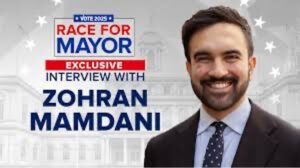
If Zohran Mamdani becomes the next mayor of NYC in November, he will have achieved several political firsts.
He will be the first Asian, the first Muslim, the first card-carrying Socialist, and the first crusader for a global intifada to reside in Gracie Mansion.
Oh, and lest I forget, the first up-and-coming ex hip-hop star!
Mamdani’s rise to his current level of political recognition is an amazing, inspiring, only-in-America story.
He was born in Kampala, Uganda, and spent the first six years of his life living there (and later in South Africa) the way educated second- and third-generation Indians live in Uganda and Kenya and virtually any country in which they settle: in safe, upper-middle-class neighborhoods, working assiduously to advance themselves.
Mamdani’s father, Mahmood, was a scholar of Socialist economics. His mother, Mira Nair, worked her way up in the film industry from entry-level assistant, to assistant director, and eventually to becoming the recognized director of several award-winning films.
In his seventh year, the Mamdanis moved to America, where Mahmood took a job teaching at NYU. Ensconced in the Upper West Side of Manhattan, the family did what most educated second- and third- generation Indians do when they relocate: They became respected and successful, while preserving a great deal of the best features of their native culture. In the Mamdanis’ case, it included passing on their academic and ideological biases to their son, with a preference for Socialism and the performing arts.
The young Mamdani was educated first at the Bank Street School for Children on the Upper West Side, then at the Bronx High School of Science (one of New York’s most prestigious public schools), and finally at the well-regarded Bowdoin College, graduating with a degree in “Africana Studies.”
As I’ve so far implied, all of that was remarkably unremarkable for a child born into a family like his. But Mamdani’s rise to political prominence after college is extraordinary, considering that he wasn’t granted US citizenship until 2018.
During his high school and college years, Mamdani tried his hand as a performing artist, pursuing a career playing rap music and eventually releasing, with childhood friend Abdul Car Hussein, a song titled “#1 Spice” under the name Young Cardamom, which was featured in Disney’s Queen of Katwe, directed by Mamdani’s mother.
Mamdani was also actively promoting social justice according to Socialist principles, co-founding the first Students for Justice in Palestine chapter at Bowdoin.
His Views on Economics
It’s not surprising that the child of an academically respected Socialist writer and professor would lean in that direction. In Mamdani’s case, his political preferences and projects were more a headlong plunge than a tilt.
His stated views on economics are straight out of the Socialist Party textbook, including opposing free markets, state control over the “means of production,” and advocating the Alexandria Ocasio-Cortez (AOC) level of opaqueness on economic issues such as inflation, which, he many times suggested, was caused by price gouging rather than unfettered government spending.
His Campaign Promises
Mamdani’s campaign promises were consistent with his economic theory, which was unambiguously enunciated in the charter of the political party he joined and represented, the Democratic Socialists of America, whose stated purpose is “fighting for the abolition of Capitalism.”
During his political ascension, and particularly in his campaign for mayor of NYC, Mamdani said he would raise $10 billion in new revenue by increasing taxes on the wealthy and corporations to fund his social agenda, including:
* Citywide rent freezes and other forms of rent “stabilization”
* Free bus transportation throughout the city
* Free childcare
* Subsidized city-owned grocery stores that will buy and sell at wholesale prices
* Defunding the NYPD and redirecting funds toward “community-based safety and social programs”
* Supporting homeless camps in subways
* Centralized storage and distribution of vital goods
* The downsizing and outright abolishment of prisons
Mamdani is also a big believer in global warming and has argued that somehow going green is “essential to achieving social justice in New York City.” In 2021, he organized volunteers and lobbied Governor Kathy Hochul to prevent the expansion of a gas-fired peaker power plant in Astoria, citing environmental concerns for low-income nonwhite communities.
His Views on Israel, Zionism, and the Holocaust
Mamdani’s views on Israel are not nuanced. He is staunchly pro-Palestine and pro-Iran and has participated in numerous demonstrations opposing Israeli political policies towards Gaza and against US support of Israel.
He has aligned himself with virtually all of the Leftist, neocon, and anti-Zionist stances, calling Israel a colonial occupier and characterizing its governing policies as racist and apartheid and its war against Hamas and the Iranian proxies as genocide against the Islamic people of Gaza and the West Bank. Consistent with that, he has promoted campaigns to boycott Israel.
He has repeatedly criticized Israeli Prime Minister Benjamin Netanyahu as an illegitimate ruler and threatened to have him arrested if he sets foot in NYC. He’s defended phrases like “globalize the intifada” and “from the river to the sea.”
He has even refused to recognize Israel’s “right to exist” and refused to sign a State Assembly resolution recognizing the Holocaust.
Memorable Mamdani Quotes
“We don’t need an investigation to know that the NYPD is racist, anti-queer & a major threat to public safety. What we need is to #DefundTheNYPD.”
“Policing is something that does not create safety.”
“The end goal [is] seizing the means of production.”
“We can establish community land trusts to gradually buy up housing on the private market and convert it to community ownership.”
So, Why Is Mamdani So Popular?
And Who’s Voting for Him?
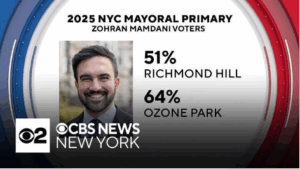
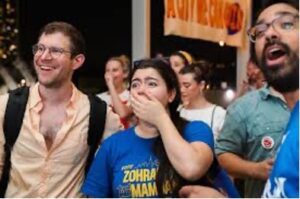
Mamdani’s quick rise to not just city but national prominence as a politician dedicated to dismantling the city’s economy and his unvarnished antisemitism should have made his quest for the mayorship all but absurd.
There is no doubt that one reason for his success is that he is charismatic. He’s intelligent and well-spoken. He presents himself as a moderate and as a nice, thoughtful person. He even looks like a mensch.
A recent survey of NYC voters gives us some idea of who Mamdani’s are.
They are well-born, Ivy League-educated, mostly young people who are relatively wealthy, progressive, and live in Brooklyn. In other words, AOC voters! She endorsed him – and when he won, she wrote this in a post on X:
Your dedication to an affordable, welcoming, and safe New York City where working families can have a shot has inspired people across the city. Billionaires and lobbyists poured millions against you and our public finance system. And you won.
What If He Wins in November?
I can’t say.
I think it’s possible that, once installed in office, he may soften his political and social stances when he recognizes how unpopular they are with the wealthy corporations and families that call NYC home. I haven’t found anything in my research to support that, but he’s young and he seems to enjoy his popularity. He’s also intelligent, which means to me that if he wants to be more than just a one-term mayor overseeing a city on its way down, he could modify his views and abort the worst of his political projects.
If he doesn’t – if he takes a note from Trump 2.01 and manages to get his campaign promises put into action – then, as I said, I can see him as a one-time wonder with few prospects for the presidency while he make New York City Not Great Again, crippling the city’s economy by the rapid attrition of its corporate and individual tax base, and bringing back the disorder, dysfunction, and criminality it had sunk into during the 1980s, before Guiliani was elected and instituted the “broken window” policies, ratcheting down the crime rates dramatically and allowing The Big Apple to return to the relative safety and prosperity it currently enjoys.
What would that look like? I like how Nellie Bowles put it in a recent edition of The Free Press:
Those of us who saw San Francisco 2014–2024 know what is going to happen, and all we can do is put on our assless chaps and walk away. The cycle cannot be stopped.
New Yorkers need a couple years of tent encampments in Central Park, 200 more subway stabbings, and a rent freeze that’ll drive prices to astronomical levels.
They need to open a thousand empty government grocery stores. They yearn for Socialism. We can’t help them now. New Yorkers, from a San Franciscan, listen carefully when I say: Human urine ruins car upholstery. If you park on the street, don’t bother investing in the leather interiors for a few years.
Can Zohran Mamdani Make NYC as Great as Gavin Newsom Made San Francisco?
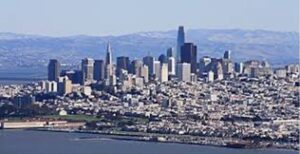
For most of my life, the image of a “failed American city” was Detroit, whose population dropped from 1.85 million in 1950 to about 630,000 today. I became familiar with Detroit during the mid-1970s, when I was studying for my MA at the University of Michigan.
I visited the city several times and was saddened to see what was once a wealthy industrial city and the hub of the American automotive industry in the process of rapid decline, with large sections of the cityscape converted to public housing and blocks of the downtown commercial district already in a state of abandonment and disrepair. It has deteriorated since then.
Efforts to revive Detroit through various federal handouts and city projects have failed. It’s now an economic disaster zone. I find it difficult to imagine it ever recovering.
And Now… There’s a New Failing City on the Map
Between 2019 and 2021, San Francisco lost 6.3% of its population, a greater rate of decline than any two-year period in Detroit’s history and unprecedented in any major US city.
Detroit’s fall was primarily driven by the relocation of the US auto industry to southern, right-to-work states, where auto producers, including foreign firms who build autos here, were able to avoid the union conflict that was endemic in Detroit.
San Francisco’s decline is not driven by macro-economic events out of its control, but by absurdly bad local economic policies supported by the same voters that are supporting Mamdani now.
During the same period, San Francisco lost 6.3% of its population, representing nearly $7 billion of household income, even after accounting for people who moved into the city.
Taxpayers who filed 2019 tax returns from San Francisco and 2021 returns from a new location reported an average annual adjusted gross income (AGI) of nearly $196,000. But because the income distribution is such that the median income is greater than its simple arithmetic average, the median income of taxpayers who left San Francisco would probably have been around $250,000.
And as those dollars left, so did the economic activity that those individuals directly and indirectly created.
Where’ve the Big Companies & Wealthy Taxpayers Gone?
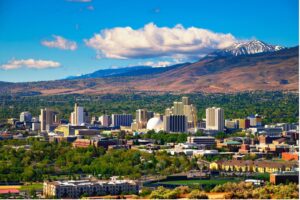
They are moving to destinations that do not have San Francisco’s drug and crime issues, its poorly performing public schools, its homelessness, its extremely high cost of doing business, and other problems that people have been tolerating only because San Francisco was once one of the world’s great cities. As someone who loved San Francisco, it pains me to say it no longer is. And I suspect that those who departed the city, whose exits left it with 60,000 fewer taxpayers, feel the same way.
Washoe County, Nevada, site of Lake Tahoe, a popular ski resort, attracted hundreds of San Franciscans who have an average AGI of well over $300,000. So did Palm Beach, Florida (where there is no state income tax).
The broader Bay Area, home to Silicon Valley, lost over 2% of its tax filers. The San Francisco metro area lost a total of nearly $14 billion in household income between 2019 and 2021 – and those leaving were wealthy enough that the city’s median income dropped by 4.6%.
Teton County, Wyoming, home to Jackson Hole and other well-known ski resorts, has been the chosen destination of the wealthiest San Francisco ex-pats, representing an average annual household income of nearly $600,000 and a total income loss for San Francisco of $37 million over that same two-year period.
These people did not leave San Francisco because of high housing prices.
According to Zillow, the median home price in Jackson Hole, one of the few locations in the United States where home prices are still rising, is $1.5 million, which is $200,000 higher than San Francisco’s median home price, which continues to fall.
So How Bad Is San Francisco Now?
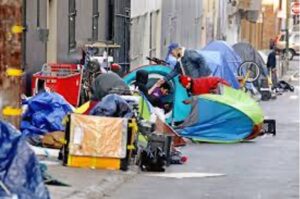
Some city blocks are still safe and beautiful. As in every declining city, the primary tourist areas and wealthiest neighborhoods are well policed and still providing street-savvy citizens and unsuspecting visitors with protected areas to enjoy. But the safe zones are getting smaller as big companies, their rich founders, and their highly paid executives choose to live their lives somewhere else.
Other city blocks have been taken over by drug gangs selling fentanyl in open-air superstores. (Think of an opioid version of Costco, without the membership card.).
San Francisco’s downtown has suffered the most, as many tech companies have decided to reduce or eliminate their office space footprint in the area. The office vacancy rate in the city is 27%, up from just 4% in 2019.
One San Francisco tech entrepreneur took photos of the downtown on weekday mornings, times when the area historically has been crowded. Look at these photos and you will think that they were taken on a Sunday or a holiday, not during a normal workday.
The city estimates that downtown foot traffic has declined about 64% compared to 2019. Empty office buildings could cost San Francisco $200 million per year in lost property taxes. And as tenants have sublet their office space, nearly 50% of that space will be up for renewal in about two years, raising the potential for even more losses.
Can San Francisco Be Saved?
As what happened in Detroit, San Francisco leadership is waking up late to the realization that the city is imploding.
Mayor London Breed has suggested converting part of downtown’s tech and finance presence to biology-based industries – which would likely require a substantial (and expensive) renovation of existing office space.
A San Francisco business group commissioned a 143-page plan to revitalize the downtown. Some of what is recommended is predictable and has all the right buzzwords and phrases, including creating a “Pedestrian Paradise,” envisioning “Downtown as a Stage” with public performances and events, and “Rediscover[ing] Public Open Spaces.”
But none of this will ever become a reality without a more sensible Board of Supervisors and a crime, homelessness, and drug abuse do-over. Interestingly, the plan is silent on these issues.
A search of its 143 pages for the words “homeless,” “homelessness,” “crime,” “drugs,” and “opioids” came up empty. The plan does, however, include the words “safety” and “cleanliness” several times.
Perhaps these euphemisms are as far as a business group could wander into city politics without upsetting the precarious apple cart of the city’s Board of Supervisors, who were not involved in commissioning the study and who don’t seem to understand the gravity of the city’s current state.
Supervisor Aaron Peskin said that it was important for the mayor and other city officials to get past trying to return downtown San Francisco to the economic powerhouse it had been in 2019, noting that he believed the loss in economic activity wasn’t “profound.”
Detroit died a slow, insidious death, one that unfolded over 70 years. San Francisco is experiencing something much more striking, rapid, and prominent. Will San Francisco’s politics change in response to its residents’ leaving – a situation that has created a $7 billion net income loss for the city?
I would like to think that the answer to this question is “yes.” But on the other hand, the city is at the mercy of a Board of Supervisors that is largely responsible for what it has become. A board that ended up quashing the opportunity for the city to have a vacant building turned into a new Whole Foods market – a business that neighborhood residents had hoped to attract, a business that had agreed to the Board’s demand to build affordable housing in order to receive its approval.
That opportunity is now gone. And as of last year, nearly five years after Whole Foods was denied approval, the building for the proposed market remained empty, in disrepair, and subject to frequent break-ins, most likely associated with drug use and prostitution. So, on second thought, the answer to the question posed above is “no.” At least not until San Franciscans decide to vote differently.
A Walking Tour of Frisco’s Tourist Destinations
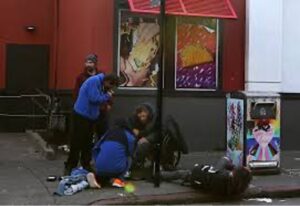
An NBC Bay Area “investigative unit” surveyed more than 150 San Francisco blocks, including some of the city’s top tourist destinations, and discovered conditions that are now being compared to some of the worst slums in the world.
Digital Correspondent Abbey Fernández went behind the story, walking the streets of San Francisco with Senior Investigative Unit Reporter Bigad Shaban, whose initial reporting shed new light on the epidemic, and Digital Video Journalist Jonathan Bloom, who examined how technology could provide some solutions.
Watch the video here.
There are only three ways to wholeheartedly believe in Socialism:
1. You are a middle-class college student at a liberal arts college with your tuition paid for by your parents.
2. You are a university professor at a federally funded public or richly endowed private school.
3. You work for the government, either as a politician, a lobbyist, a high-ranking employee of the government, or an employee of a publicly funded, non-profit institution.
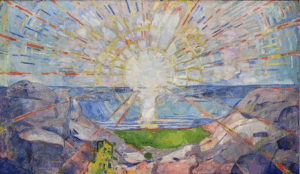
Hint: Yes, it’s a painting. It’s by an artist, a foreign artist, a modern artist whose name you know – but you won’t guess his name judging from what you see here.
Answer: It’s The Sun by Edvard Munch.
Edward Munch is defined by The Scream as an artist of angst, alienation, and agony. Yet he had a long, prolific, and varied career, producing portraits, landscapes, and decorative commissions from late 19th century Naturalism to WWII. Here are 10 paintings that prove he was much more than that single open-mouthed howl.
Re the July 16 issue on Happiness:
Fron SL: “Hey Mark, Thanks for the tip about Arthur C. Brooks. I just listened to his From Strength to Strength on advice for transitioning from the fluid intelligence period of your life, which lasts a shockingly short time for most professions (except being a historian), to the crystalized intelligence phase, when it’s good to become a mentor, teacher, etc. Many people rage against the ebb of their fluid intelligence phase, but they could save themselves much anguish by being more knowledgeable and accepting of its end and wisely guide themselves towards the next stage, which can be just as fulfilling. Next, I’ll listen to his interview, Conversations with Coleman. I’ll share my feedback.”
From SLT: “I really enjoyed the issue. Your critique of Eat, Pray, Love and your idea about the three ‘enduring pleasures in life’ were especially good.”
Re my assessment of Trump’s record so far in the May 13 and July 4 issues:
“I’ve kept copies of your early ‘report cards’ on Trump to see how your thoughts and predictions turn out. When will you publish an update?” – PF
My Response: You’re not the only one. Other readers have been saying the same thing. And, of course, I’m sure all my friends with TDS have kept copies so they can one day tell me, “I told you so!” (And “I told you so!” will be, admittedly, my motivation in writing all of my upcoming Trump report cards. I’m working on the next one now…)

Amazing Prestidigitation
Magician vs. NBA players: How is what you see him do here possible?