Gob-Smacked in NYC
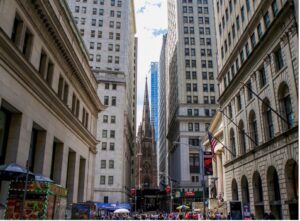
I’m in NYC for a week to attend the wedding of one of my nine beautiful, intelligent, and talented nieces. K and I have been holed up in The Wall Street Hotel, which is – interestingly enough – on Wall Street. It’s my first time here, and I wasn’t sure what to expect since the nightly rate is less than $350 (which is hostel-level pricing in the Big Apple). But it’s quite nice – comfortable, clean, well designed and decorated, and with a great vintage-looking bar staffed by bartenders that know what a “double” really means.
Later this week, we’ll move to The Fifth Avenue Hotel (which is… well I bet you guessed where it is located). We’ve stayed there “many times before,” according to K, but nowadays my long-term memory is about 45 seconds, so I’ll be interested to see if it’s as nice as The Wall Street Hotel.
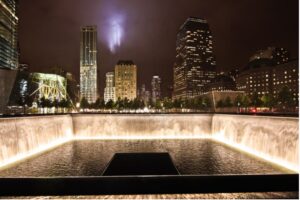
We spent yesterday afternoon with G, K’s sister, and G, her main man, touring the neighborhood, which included a stop at “Ground Zero,” the 9/11 Memorial – two enormous square craters occupying what used to be the footprint of the Twin Towers.
I’ve visited this memorial before, and I remember being impressed by it – by its size and the way the names of the dead were arranged, in no discernible way, along the bronze-plated parapet that encloses it. But this time I had an additional response it – to the depth of the granite walls and the way the water streamed down their sides to a smaller square opening at the center, whose bottom cannot be seen, giving the impression that the water is falling into an endless black abyss. It was not a sentimental response to the human tragedy of 9/11. It was a gut reaction to the genius of the monument’s design, to the aesthetic and intellectual brilliance of it. It felt almost perfect.
I’m trying to think of any American memorial I’ve seen that has had this powerful of an effect on me. Not the Washington Monument. Not the Lincoln Memorial. Not even the Statue of Liberty, although if I were sentimental about the history of American immigration, Lady Liberty might come close.
About a dozen years ago, I was finishing a book and needed several weeks of semi-isolation to get it done. It was summer and K had plans for us to spend time in NYC, so we decided to book a hotel in Battery Park for six weeks. It was close to Downtown and Brooklyn, where we had friends and children, and it was isolated enough to give me the seclusion I needed.
Battery Park borders on the Financial District, which was – except during work hours on work days – a ghost city of granite, steel, and glass buildings so high that you could walk for blocks on a sunny day in the shade. It felt vacant and impersonal. I left thinking I’d never stay there again.
But here we were. And this time, the vibe was very different.
Most notably, there were lots of human beings moving about – not just during working hours, but in the evening and on the weekend. Most of them were tourists, like we were, but some of them looked local. (There is a reason for that. After 9/11, the city made the area very livable by putting in many pathways and small parks along the Hudson River, and more than a few former buildings that had held banks and insurance companies were converted to apartment buildings.)
In a single afternoon, we saw not only the 9/11 Memorial and the four towers of the new World Trade Center Complex, but the “Oculus,” the largest, the most elaborate, and the most elegant train station I have ever seen. (It is also, quite probably, the most expensive. I read that the architect, Santiago Calatrava, was given a $2 billion budget to get it done, and he finished it 12 years later, well past the deadline, for a total of $4 billion.)
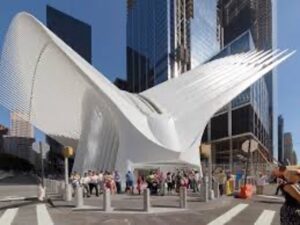
The “Oculus” by Santiago Calatrava, opened to the public March 3, 2016
We also visited St. Nicholas Greek Orthodox Church (an architectural stunner, having been designed by the same architect that did the “Oculus”), which is both a working church and a monument to the Greek Orthodox religion.
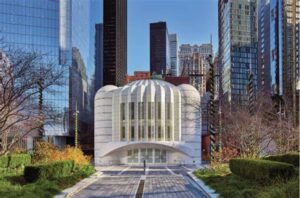
St. Nicholas Greek Orthodox Church by Santiago Calatrava, 2022
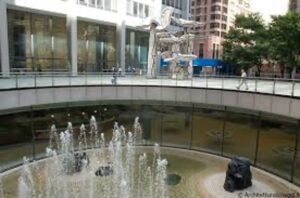
And we spent some time admiring these two monumental sculptures…
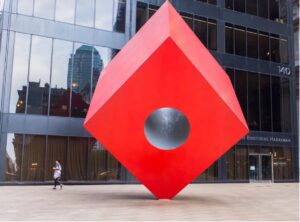
“Red Cube” by Isamu Noguchi, 1968
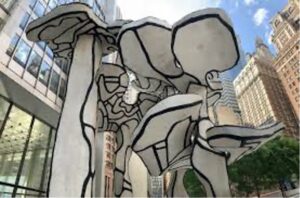
“Group of Four Trees” by Jean Dubuffet, 1972
But what really floored me – and why this didn’t happen when I was here before I don’t know – was the dozens and dozens of astonishingly massive and beautiful buildings that were designed and built during the two boom periods of the Industrial Revolution, and particularly during the “second” revolution from about 1870 to 1930, when NYC became not only the financial and trade center of the United States, but of the entire world.
Looking at these buildings this time, I could see, in the use of materials and the level of craftsmanship, the impact of that immense economic transition – the greatest expansion of wealth (for all economic classes) in history.
I could also see a reverence for the ancient roots of Greek and Roman architecture and art, as well as affection for the neoclassical reinterpretation of those roots that spread all over the world in the second half of the 19th century.
I was in awe – swept away by the same sort of emotional reaction I have had when touring places like the Roman Coliseum, Vatican City, and, when I was much younger, the mansions of Andrew Carnegie, Cornelius Vanderbilt II, Henry Clay Frick, and even Vizcaya, James Deering’s estate in Miami.
I’m writing this at The Wall Street Hotel bar, loosened up by a double Milagro Reposado on the rocks and still inspired. I was looking around all afternoon, gob-smacked and thinking, “What an amazing place this must have been to live in when those buildings were built.” The world was in the throes of the greatest spurt of wealth creation in human history, and the financial heart of it was right here in this square mile of New York City.
I actually wondered if America could be that great again!