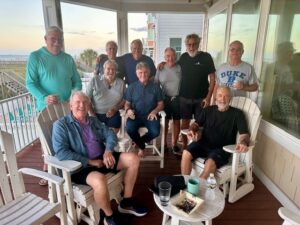
I’m back from a week in Myrtle Beach, golfing with nine of my high school friends. Well… that’s not true. I hardly golfed at all. Just nine holes on Wednesday morning. That left me plenty of time to catch up on the news.

And boy, there was a lot of big and/or interesting news last week – beginning, of course, with what could very well be an end to the decades-long (centuries-long?) Arab-Israeli conflict.

What Golfers Talk About When We Aren’t Talking About Golf 

I was in Myrtle Beach last week for a get-together with nine of my high-school friends. We’ve been meeting there every October for about the last 30 years. The ostensible purpose is to play golf. The true purpose is conversation. And the purpose of our conversations is to maintain those ties that bind.

Apart from reminiscing about bygone days, the topics have been mostly about our families and our careers.

In the first decade, when we were in our 30s, we talked a good deal about how we fell into our careers, what they required of us, and whether we believed we had made the right choices. We also talked about the challenges of being good husbands and good dads.

In our 40s, the career conversations were about the extra hours, the effort to be recognized, the doubts, disappointments, and triumphs that were teaching us lessons we wished we’d learned earlier. Family conversations were mostly about the disappointments and triumphs of our teenage children.

In our 50s, well along in our careers, we talked less about the work we did and more about what we did when we weren’t working – vacations, hobbies, books and movies, etc. Our children were now in their late teens or early 20s, Occasionally, we talked about the future of our relationships with our wives.

During our 60s, we talked about our prospects for retirement and what those of us who had retired were doing with their non-working hours. I was especially interested in these conversations because, by that time, I had retired and then had gone back to work three times. I was sure there were retirement lifestyles that would be right for me, but I’d never found one.

Now we are in our mid-70s and, statistically speaking, likely to be in the final 10 years of our lives. We continue to talk about our kids (and grandkids), but an increasingly large percentage of our time is taken up with recounting stories of the good ol’ days.

We also talk about our bodies…

All of us were athletes during our high school years. Some of us played sports in college. For the first 20 years, I remember a lot of talk about the sprained ankles, knee and shoulder surgeries, and occasional broken ribs we had incurred.

That changed as we moved into our 50s. Golf trip after golf trip, we were admitting to health “issues” we had never even imagined earlier on. Admissions about getting up at night to pee (benign prostate enlargement), pain in almost every joint (arthritis), and even, occasionally, the diminishment of our formerly impressive performances in the bedroom. Less embarrassing topics included gaining weight, losing strength, and the increasing difficulty of just about every physical activity.

In our early Myrtle Beach days, it wasn’t unusual for some of us to golf twice a day. For most of us, that part of our get-togethers tailed off fairly quickly. And sometime around my 69th birthday, I retired from the game (almost) entirely.

I enjoyed golf when I played it. No, that’s not true. I liked golf in theory but I hated playing it because 90% of the time when I was playing, I hated myself. (If you golf, you understand this. If not, I recommend watching the bit by Robin Williams in today’s “Postscript,” below.)

I’m often asked by active golfers what I miss about it. The range of proper answers includes statements about the beauty of nature and the healthful benefits of spending a half-day outdoors.

I can’t claim to miss those things, and it’s not because I don’t value them. But for me, golf offered very little in terms of being in the great outdoors because most of the time I was looking at the golf ball beneath my feet or trying to avoid the hazards that were put in place to thwart me – the streams and lakes and tall grasses and clusters of trees. (The conventional wisdom for how to avoid them is “Don’t even look at them,” which I heeded.)

I do, however, enjoy the camaraderie of male bonding, and that is the reason I come to Myrtle Beach every year. But I find that the best of that is had in conversations at dinner or in the evenings, sitting on the porch, drinking tequila, and smoking cigars.

Is It Possible? Do We Have an End to the Arab-Israeli War? 
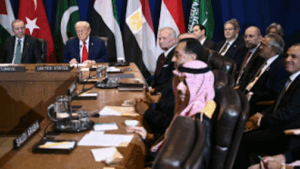
“If Trump pulls off this peace treaty, will you say he did a great thing?” I asked.

He knew, and I knew, that he could not. TDS is a malady that attacks the logic systems in the neocortical brain. The syllogism goes like this: Trump is bad. Therefore, anything he does must be bad, too.

“So?” I repeated.

I could almost see that portion of his brain lighting up. Logically, he couldn’t say “no.” But since his logic system was short-circuited, he said the only thing he could: “Let’s see how long this peace treaty lasts.”

It was the only safe square available to him. And it was a good one. There have been ceasefires and peace agreements before. None of them lasted very long because, in each case, before the ink on the agreement was dry, the group representing the “Palestinian” people went back to attacking Israel.

But on Monday, we woke to find that the initial stage of this agreement had been completed. Israel released nearly 2000 political prisoners and detainees and Hamas released 20 hostages.

As I’m writing this, there are still plenty of foreseeable situations that could derail this ceasefire and peace treaty. And most of them have something to do with the fact that Hamas is a genocidal terrorist group. Yes, Hamas. Not Israel. Hamas is textbook genocidal. Their mission statement says so. They teach their children that Jews are evil and they all deserve to die. (This is not an exaggeration. Look it up.)

But there is one good reason to have hope – and that is the 21-point plan that Trump and his team put together to get the ceasefire in the first place.

Unlike prior ceasefire agreements and peace accords, this one includes terms that make it very difficult for Hamas to use the ceasefire to arm up and launch another assault. If you read it, you can see that it was written based on mistakes in the past – serious mistakes that resulted in the subsequent murders of thousands of Israelis.

It’s also unique in its approach to the governance of Palestine in the future. Instead of giving “the people of Palestine” the right to self-governance with oversight by Israel, Palestine will be governed by locals but under the supervision of a half-dozen Mideastern countries, all but one of which are Arab countries.

The genius of this is that Hamas will be able to say that it achieved peace without giving up its territory, Israel will have accomplished its goals of getting its hostages returned and disarming and effectively abolishing Hamas, and the primary enforcers of the peace agreement going forward will be Arab countries that are almost as interested in ending the war and deactivating Hamas as Israel is.

This is far from over and this peace is far from carved in stone. But for the first time since the Abraham Accords in 2020, we have a coalition of states whose interests coincide with rather than contradict those of Israel and the United States.


Our Blue Cities Are Becoming Safe Again 

Another feather in Big Orange’s cap: Since August, when the National Guard was sent into DC in response to several grisly murders, the capital city has been miraculously transformed from one of the most violent cities in the country (about one murder per day) to one of the safest.

And the same thing is happening in Los Angeles and Baltimore and Chicago, whose murder and violent crime record is not only the worst in the US, but among the worst in the world, including Venezuela, South Africa, and Afghanistan.


The Little Fight Against Big Food & Drugs Continues 
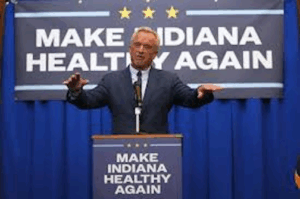
RFK Jr. continues his efforts to battle the Food & Drug Industrial Complex by, among other things, getting Trump to open up the dialog on how unhealthy the US diet is and how ineffective and dangerous many of the most commonly prescribed drugs are by uncovering and publishing hundreds of studies that support his longstanding “conspiracy theories” about vaccines and acetaminophen. (See below.)

There is no doubt in my mind – regardless of what you think about the man – that Trump is the most “impactful” (as they say) president we have had in office since Lyndon Johnson.


Is Tylenol Really Dangerous for Pregnant Women? 

Donald Trump is well practiced in saying surprising things, and when he declared that Tylenol was dangerous for pregnant women, the mainstream media jumped on it, thinking this would be another “Haitians steal dogs for dinner.”

It turns out that the statement is not as crazy as it sounds. According to a just-released report from the Department of Health and Human Services (HHS):

There are numerous prenatal drugs and substances that have been associated with increased risk of childhood neuropsychiatric or neurodevelopmental disorders (such as autism spectrum disorder, ADHD, intellectual disability, anxiety, depression, behavioral problems, or cognitive deficits) in the scientific literature. Based on a synthesis of peer-reviewed sources (including systematic reviews, cohort studies, and meta-analyses from PubMed, JAMA, BMJ, and other databases), at least 30 specific drugs have been associated with these risks to varying degrees.

For example:

* Anticonvulsants/Antiseizure Medications (5+ drugs) – These are commonly linked to neurodevelopmental risks, especially autism and intellectual disability, due to interference with brain development.

* Antidepressants (15+ drugs) – Prenatal exposure, especially in the first trimester, has been linked to ASD, ADHD, altered brain development, and behavioral issues.

* Antipsychotics (7+ drugs) – Associated with neurodevelopmental disorders and learning difficulties.

* Opioids (4+ drugs) – Linked to lower cognitive/motor skills, ADHD, and behavioral disorders.

And one of those 30+ drugs is – you guessed it – acetaminophen (as in Tylenol).


Holy Moley! I Can’t Believe This Happened! 

Bari Weiss, the former award-winning NYT and WSJ reporter who, in 2021, founded The Free Press, has been named the editor-in-chief of CBS News.

CBS News, perhaps the most distinguished of the legacy news channels, was recently taken over by David Ellison’s Paramount Skydance. And one of the first decisions Ellison made was to buy The Free Press and hire Weiss.

This is big news. I don’t know whether it’s good or bad at this point, but it’s big. CBS News was a staunchly pro-Biden, anti-Trump establishment company. The Free Press is a renegade start-up whose political, social, and economic views range across the ideological divide but settle, at least in Weiss’s view, in the center. In fact, when she quit the NYT’s editorial staff in 2020, she accused the company of being hostile to her unwillingness to toe the establishment line.

The Free Press – which I’ve been a subscriber to and a fan of since its inception – had an impressive start. As of April, the site had a reported 1.25 million readers and 155,000 paid subscribers. Critics argue that Weiss, who built a career largely in newspaper-based op-ed roles, lacks experience in broadcast journalism.

The question on my mind – and I’m sure thousands of others – is whether her move to the news company that once employed Walter Cronkite will change her great accomplishment of putting out news and views that are not filtered through an ideological lens, or whether she can make CBS a news source that people can trust.


What Is Elon Musk Doing in Memphis? 

You don’t have to be a fan of Elon Musk to know that once he sets his mind to doing something, he pursues it intelligently but also megalomaniacally, and that results in a very high probability of accomplishment.

According to a colleague of mine, Musk is currently hyper-busy on what my colleague believes is his next multibillion-dollar adventure. He is building a huge data center – something called “Colossus” – in Memphis.

You can find out more about it here.

This poem was written by Oliver Baez Bendroff, the author of three poetry collections, including Consider the Rooster, a finalist for the 2024 National Book Critics Circle Award in poetry. It sounds like it was written by AI. But even if it had been, you shouldn’t judge any work by who made it or how it was made, but by its usefulness and beauty.

T4T
 By Oliver Baez Bendroff

And I think he must be drunk, from the sweet way he.
Brother. I think about his XX all the time. It’s like a joke,
that we’ll start dreaming of men once we. My favorite
version is the one where we. We ate citrus on river rock
while others swam out. Stern lady cop found us out-of-
towners naked, our clothes scattered around pine root.
Dampened for days. But he. Inclination surges
through window screen – that wind, you’d think
we’d found ourselves in beach town.
If I had the chance, I’d go right to the root of  him.
Shouldn’t I out of anyone feel it with my main medium.
I think there’s something happy and right about us mating.
That night how you. Chest flying. Tonight my house creaks.
Somewhere swings open a gate we all know we all want.

Acting Counts: Lackluster… to Not Bad… to Spine-Tingling 

I’ve made three movies. One was so bad I destroyed it after I showed it to my 12-year-old son and his two cousins and they trashed it. The next was almost good because it was written and directed by a cult film maker who was famous for making bad movies. The third actually won some awards, including a “best” at a film festival in Liverpool. It wasn’t good. But I like to think that it wasn’t bad either.

I spent a silly amount of money trying to be a “film maker.” I would have gone broke trying except that K made me agree not to fund another one unless I miraculously made a profit on the other three. (That’s coming along… I’m earning about $120 a month on them. I’ll be in the black in about 3,248 years.)

I did, however, learn some things about making movies, including something that contradicted a prejudice I had adopted from reading a few books on its history. My prejudice (which, by the way, was held by the director of bad movies I mentioned above) came from the auteur school of film criticism, which I believe was born in France. And it was that the quality of a film is 90% the result of the director and that the effect of the acting is itself a product of good direction.

I discovered that was not at all true. I discovered that a good actor can make a bad script work and a bad actor can ruin the best script.

In this video, Tristan Spohn takes a scene from Brokeback Mountain and compares three pairs of actors playing it. First, two people that have had no training in acting. Next, two people that had about two years of training. And finally, the two actors that played the role.

The difference is big. Big as in lackluster… to not bad… to spine-tingling!

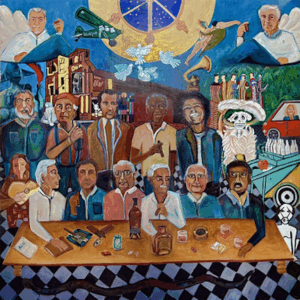
Hint: It’s on the outside of the building where I have my main office. It was inspired a bit by Diego Rivera’s mural “Dream of a Sunday Afternoon in the Alameda Central.”

Answer: It’s a mural of the most important Central American modernist painters. I commissioned it from one of my favorite contemporary Central American artists, Allan Arguello, who tragically died halfway through painting it. Fortunately, his daughter, who is also an excellent artist, was able to finish it. I am very happy with the results. And, yes, that’s me in the upper righthand corner.

The Man Who Invented Golf 

If you want to know why so many perfectly good athletes are never happy with their golf scores and are frequently seen throwing their clubs into ponds, this bit by Robin Williams as the Scotsman who invented golf will make it clear to you.