
Waiting for the Barbarians
By J.M. Coetzee
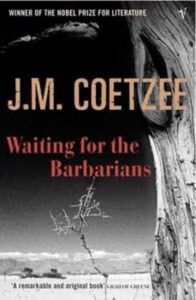
192 pages
Publication Date: April, 1982
Waiting for the Barbarians, written during the apartheid regime in South Africa, examines and questions the legitimacy of colonialism through the eyes of its protagonist, an unnamed Magistrate who governs a province that borders lands inhabited by a population of so-called barbarians.
Amazon describes it as “an allegory of the war between oppressor and oppressed. The Magistrate is not simply a man living through a crisis of conscience in an obscure place in remote times, his situation is that of all men living in unbearable complicity with regimes that elevate their own survival above justice and decency.”
Most of my fellow Mules gave it very high ratings, but a few of us were more critical.
What it was lacking was a compelling plot line. The actions – such as there are – take place in an unnamed desert outpost of an unnamed colonial power whose ostensible purpose is to “protect” the empire from the barbarians. But, as one might expect from the set up so far (and the good reviews it got from the leftist press), the barbarians behave like Rousseau-like innocents and most of the colonial soldiers behave like… yes, you guessed it, barbarians.
Most of what happens in the story happens within the mind of the Magistrate, the outpost commander who, in contrast to Colonel Joll, a bureaucrat sent by the central government to try to wipe out the encroachment by the barbarians, has a conscience, which fuels his constant and actually incessant worrying about the treatment of the barbarians, and a heart, which he used to develop some sort of emotional attraction to a female barbarian that he keeps in his bedroom as a sort of pretend-lover and anthropological subject.
What I Liked About It
The interior monologue is well written, as are the external monologues and the descriptive passages. This is where Coetzee shows his skill set. There’s no denying he is a master of diction and a skillful assembler of sentences.
What I Didn’t Like So Much
But as to the development of his characters, I was disappointed. Apart from the protagonist, the players in this drama are more types than flesh-and-blood people with all the complications that flesh-and-blood Homo sapiens have.
On top of that – and this might be me – it was difficult to read this book as an existential novel, which is what I think Coetzee meant it to be, because of all the parallels and associations in the plot and characterization that whisper (if not shout) “Apartheid South Africa.”
So, would I recommend Waiting for the Barbarians?
Before I answer that…
A Few Words About the Way I Evaluate the Books (Fiction) That I Review Here
My approach to every serious novel that I read (and my contributions to the Mules’ discussions) is guided by a very helpful lesson about how to understand and appreciate modern drama that I learned in graduate school from Robert W. Corrigan, a visiting professor for whom I served as a teaching assistant and from whom I learned more than I ever expected to. (See “Notes From My Journal,” above.)
Here’s the gist of it:
In Professor Corrigan’s view, modern theater could be understood best by looking at it from the perspective of Aristotle’s Poetics. In that treatise, the greatest philosopher of all time identified six elements of drama: plot, character, thought, diction, song, and spectacle – basically in that order of importance.
Writing a great plot, Aristotle understood, is the most difficult of the dramatist’s challenges because a great plot is much more than one-thing-led-to-another. It is a very detailed and delicate fabric that, if not woven together by a master, will unravel faster than a ribbon in a windstorm.
Next in line is character. And then thought. (Let’s call it the psychology of the characters.) Then diction and song (the poetry of the drama). And, finally, spectacle (costumes, scenery, visual and sound effects, etc.).
What modern dramatists do, Corrigan argued, is reverse the importance of these elements, prioritizing diction, song, and spectacle while diminishing the attention given to plot, character, and thought. The clearest example of this is Samuel Beckett’s Waiting for Godot.
But it’s not just modern drama that has been affected by this inversion. It’s also poetry, fiction, and – this may surprise you – art.
The inversion in aesthetic values that took place in modern art in the second half of the 20th century paralleled what happened in drama and literature. The three core elements of traditional art – draftsmanship, perspective, and story – were abandoned and replace by their opposites: abstraction, expression, and thought. (I just made that up. But it’s pretty good!)
So how does all of this apply to Waiting for the Barbarians?
What I see in that novel is a gifted writer who prides himself on his poetic skills and recognizes that if he can create the right sort of socio-political scenes and write the dialogue and descriptions beautifully he will win praise from post-modern illuminati, even if the plot is boring and the characters are cardboard thin.
Coetzee gifted us with well-chosen words, artfully crafted sentences, knowingly selected metaphors, poetic density, and rhythm – and that’s a lot. But I felt that it was not enough to compensate for an anemic plot, thin characters, and thought content that borders on a Morality Play.
Bottom Line
Yes, it’s a good book. Maybe even a very good book. But not by any means a great book.
Which brings me back to the question: Would I recommend Waiting for the Barbarians?
The answer: Well, maybe. I will say this, though, I do intend to read another of Coetzee’s novels.
About the Author

John Maxwell Coetzee is a South African and Australian novelist, essayist, linguist, and translator. The recipient of the 2003 Nobel Prize in Literature, Coetzee is one of the most critically acclaimed and decorated authors in the English language.
