Education, Gratitude, and Literary Connections

“I really appreciated your piece on education in the Dec. 2 issue…” 

“It’s both sickening and appalling to see how the government has dismantled what was once a strong system. As a kid, I remember the very real fear of flunking a grade and being held back. Watching classmates separated from their group, their tribe, was harsh, but it came with warnings throughout the year and reasons that, in my eyes, were necessary. I made sure that would never happen to me and, thankfully, the bar was low enough to clear.

“There’s no question the education system needs fixing. I can’t claim to have studied it in depth, but I do believe it requires a total and uncompromising disruption.” – JS

Why I Do What I Do 

“Your book Ready, Fire, Aim has completely transformed my approach to business. I am forever grateful to have found your work. I have read it three times in the last month. I learn more with each pass through.” – MA

“Thanks for your help and for sending your books of poetry. My brother is a big fan of Mary Oliver. One of his favorites is Moles. Do you know it?” – AD

My Response: Yes, I know it. It’s one of her best-known poems and also a poem that I liked immediately and still do… without any second thoughts.

Moles 
By Mary Oliver
Under the leaves, under
the first loose
levels of earth
they’re there – quick
as beetles, blind
as bats, shy
as hares but seen
less than these –
traveling
among the pale girders
of appleroot,
rockshelf, nests
of insects and black
pastures of bulbs
peppery and packed full
of the sweetest food:
spring flowers.
Field after field
you can see the traceries
of their long
lonely walks, then
the rains blur
even this frail hint of them –
so excitable,
so plush,
so willing to continue
generation after generation
accomplishing nothing
but their brief physical lives
as they live and die,
pushing and shoving
with their stubborn muzzles against
the whole earth,
finding it
delicious.

“Speedoo” by Speedo & The Cadillacs 

“Speedoo” was a big hit during my high school years. I still remember the lyrics, but I never saw it performed until a friend sent this link a few weeks ago.

What is especially interesting about the song is how little content it has. This is pretty much all there is to it: “Well now, they call me Speedoo / But my real name is Mr. Earl.”

A Bold Vision for AI-Driven Higher Education

Investing in a New Education System for Colleges and Universities

The week before we went down to Nicaragua last month, I attended an advisory board meeting for the English Department of a local university in Florida. Among the topics discussed was the school’s system of teacher evaluations. (Once a year, teachers are rated by their students, their colleagues, and their departments.)

I asked about the carrots and the sticks. The benefits for the teachers were as expected: the satisfaction of being highly rated and the potential for greater raises in their salaries. The sticks were presumably the opposite. But the emotional sanctions were blunted by the fact that the ratings were not published. And when I asked about the maximum differential in dollar terms between receiving the best rating and the worst, I was shocked to discover it was only 2%.

“2%?” I repeated. “2%!”

I’ve always been interested in methods to improve employee performance. Over the years, I’ve read more books, essays, and opinion pieces than I can count. Whatever ideas I gleaned from them were processed through many earnest efforts at testing them. The conclusion that I finally came to was that there are only three truly effective ways to improve the overall performance of professional workers.

1. Every year, fire 10% to 15% of the worst-performing employees. (This was one of Jack Welch’s rules when he was running GE.)

2. Give large incentives (financial and otherwise) to the best-performing 10% to 15% of employees.

3. Push the most productive employees to be even more productive.

A college or university has two products to sell: its public reputation and the value of its courses. And the rating system the English Department is using now for its teachers (with a maximum financial benefit of 2%) will not improve either one.

The school can improve enrollment in certain classes by designing them to be more appealing to students. But many college teachers and administrators object to doing that because they believe – correctly, in my opinion – that the value of individual courses can’t be merely on their popularity. In terms of a general education (as well as a career orientation), some courses are definitely more valuable than others.

On my plane ride from Miami to Managua, I conjured up a new education system tailormade for the age of AI and all the life challenges that young people will be facing.

Here are some my ideas so far…

Education will be partitioned into three categories: specific knowledge; general knowledge and theory; and, for some subjects, performance.

Specific knowledge (the acquisition of facts and figures) will be taught entirely through AI systems to students on an individual basis. Specific knowledge grading will be done with proctored tests.

General knowledge and theory will be taught in lecture form by scholars incentivized by their enrollment numbers. General knowledge grading will be done with three oral examinations administered by practitioners trained to assess each student’s grasp of general knowledge and ability to convey it.

In addition to the lecturers and testers and graders, there will be a cadre of “student coaches” whose job will be to pay attention to any problems individual students may be having.

The big salaries, along with the big bonuses, will go to the lecturers, who will be paid a percentage of the “gate” they bring in. Seven-figure compensation for popular lecturers will be the norm.

To insert some top-down judgement into the curriculum, course credits will be decided by the faculty, with more points allotted to courses that are considered essential or important to a future career.

And finally, there will be no degrees. Just a hierarchy of certificates of accomplishment for each field of study.

It’s still a little foggy in my mind, but every day that fog seems to be lifting a bit. The way I’m feeling right now, I’m confident that the system I’m proposing here – or something very much like it – will be standard operating procedure for colleges and universities in America.

College Education Has Been Getting Worse for Years

Today, It’s a Hugely Expensive and Demonstrably Provable Failure 

The idea that education in America is bad and/or broken is not new. More than 100 years ago, theorists were criticizing the system for abandoning the classical emphasis on reason, rhetoric, and character in favor of catering to the exploding demand for unskilled, semi-skilled, and clerically skilled workers as a result of the Industrial Revolution.

This may have been good for the temporary needs of the economy, these critics argued, but it was making the population as a whole less educated in the ideas that matter (i.e., the great ideas of the past) and more comfortable with the mostly thoughtless and mind-numbingly repetitive jobs that would be dominant in the first half of the 20th century.

And while this was going on with traditionalist, conservative critics, a separate criticism was being developed in Europe by what are called “post-modern” thinkers – mostly from Europe – who were arguing against the traditional notions of objective truth and even science in favor of relativism, intersectionality, intertextuality, gender theory, critical race theory, and the idea that all perspectives, and indeed all cultures, are equal in terms of their value. All truth, they believe, is merely the preferred perspectives of those in power.

By the time I was attending high school and college (in the late 1960s and early 1970s), the worst of these “revolutionary” ideas had resulted in a widespread conviction that the purpose of education was no longer to produce graduates useful to the greater economy, but to produce graduates who could “think creatively” and “come to their own conclusions” about truth and falsity, beauty and ugliness, good and bad.

That was certainly my experience, and it was an education that I felt was good for me. I had developed three or four skills that I now believe were essential to the success I had after college. First and foremost, I had become pretty good at critical analysis. I could look at a big, complex problem, identify its parts, and then figure out a way to solve it. I had also learned the art of rhetoric – how to research and assemble a persuasive argument (a skill that I’d go on to use profitably on a nearly daily basis for the next 50 years). And finally, I had learned – from several of the teachers I befriended – the importance of loyalty and gratitude, and how necessary those characteristics are for moving up in a competitive world.

But when I got into the investment newsletter business in the mid-1980s, I was surprised to discover that some of the best thinkers in that industry – including many economists and highly successful investment analysts – didn’t share my positive view of US education. In particular, I remember listening to bestselling author Doug Casey denounce American education and predict that it would likely get much worse in the future.

He was right. By every perspective I can think of, US college education is worse today than it was when I was a student. With a few exceptions, colleges are producing graduates who have very strong views on social and political issues, but little to no ability to articulate them.

In the 1950s, many of the good colleges still had Latin or Greek requirements. Today, almost every one of them is introducing remedial English and language arts classes for incoming freshmen who did not learn the basics in high school.

In the 1950s, the normal high school graduate could parse a sentence. Today’s average college English major would be hard-pressed to identify a gerund or participle.

But it’s actually worse than that.

Take a look at this.

And this.

I’ve seen so many videos like these in the past six months that I’m fully convinced that what you see here – the amazing level of ignorance of basic facts among college students – is the rule, not the exception.

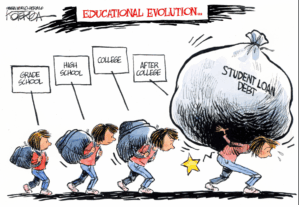
And from the perspective of the investment made – tens of thousands of dollars times four years – the value of a college degree is diminishing fast. According to Labor Department statistics, college costs have risen 188% since 1998, while real hourly wages for grads have increased by only 26%.

In this video, Shane Hummus, who got himself a doctorate degree, identifies seven college majors – very popular majors – that lead to careers that, from an economic and job-satisfaction perspective, are not worth the money they cost to acquire.

But from at least one point of view – dollars in vs. dollars out – a college degree is still a decent investment. The median bachelor’s degree offers a net ROI of approximately $306,000. The median annual return on investment (internal rate of return) for a college degree is about 12.5%, outperforming the historical returns of traditional stock and bond investments.

All of which brings me to the two “Worth Reading” recommendations I have for you today – two ways to approach America’s higher education problem.

Reinventing Education for the Real World

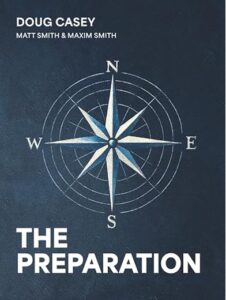
The Preparation
By Doug Casey, Matt Smith, and Maxim Smith 

298 pages
Published August 2025

One of the most interesting ways to deal with the failure of the American education system arrived in my inbox last month. It was an early edition of The Preparation, the product of three generations of thinkers: legendary investor and bestselling author Doug Casey (who I mentioned above), entrepreneur Matt Smith, and 20‑year‑old “beta tester” Maxim Smith. It distills their hard‑won wisdom into a 16‑cycle program.

It’s not really a book. I would describe it as a treatise and a curriculum and a personal story wrapped into 298 pages of wisdom, common sense, and advice that anyone interested in an educational option for young men and women would be smart to read.

The first thing that struck me about The Preparation was the one similarity it has with US college education today: It is structured as a four-year program.

That’s it. The rest is different. And thought-provoking.

It’s an invitation to an amazing adventure that takes the student all over the country and even abroad, where they can have fun developing and even mastering essential mental and physical skills that will prepare them for whatever their future holds.

As one critic put it, “The Preparation is a field manual for young men (and the parents who love them) who know the old college formula is broken and want a roadmap that actually forges competence, confidence, and real‑world value.”

Here is some of what you will discover in The Preparation:

* The 16 themed cycles – Medic, Cowboy, Pilot, Fighter, Hacker, Maker, and more – each built around a hands‑on “Anchor Course” that forces you to learn by doing, not by cramming.

* An earn‑while‑you‑learn design that shows you exactly how to pay your way through each cycle and graduate debt‑free.

* The cost: roughly one year of tuition – yet it delivers four years of marketable skills, global travel, and a network of do‑ers, not talkers.

* A foundational philosophy rooted in Stoicism and Renaissance thinking, so you don’t just master tasks – you master yourself.

* A bullet‑proof curriculum: step‑by‑step schedules, book lists, online courses, and locations for every skill, so you’re never guessing what to do next.

* Battle‑tested results – Maxim Smith used the program to rack up EMT shifts on Oregon wildfires, fly solo over the Rockies, ranch in Uruguay, and sail the Strait of Magellan before he turned 20.

But wait… there’s more!

The education provided by The Preparation is a smart financial move. College now averages $140,000+ and often delivers little more than ideology, debt, and obsolete credentials. The Preparation compresses that money and time into a crucible that turns raw potential into a modern‑day Renaissance Man – one who can protect, build, heal, sell, and lead in a world being up‑ended by AI and economic turmoil.

Check out this interview by Glenn Beck with Matt and Maxim Smith about this alternative to a college education.


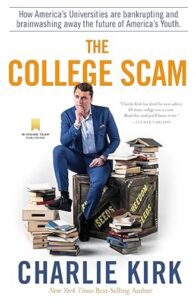
The College Scam
By Charlie Kirk 

288 pages
Published July 2022

One of the things that made Charlie Kirk loved and hated in the US college environment was his claim that most colleges and college education is a scam.

In this video, he presents his argument in simple economic terms.

And in this one, he gives an example of how he thinks colleges should work.

Kirk goes into much more detail in his book, The College Scam, putting the industry on trial with a 10-count indictment of why academia has lost all credibility. He asks: Why do we send our kids to college? Why do we spend hundreds of thousands of dollars on a useless degree? Why do we let our children get indoctrinated by those who fundamentally disagree with America’s greatness? In The College Scam, he builds his case against the four-year degree, answering all of these questions and more.

Record-Breaking Kahlo

Hint: It was sold Nov. 21 by Sotheby’s for $54.7 million – the highest ever paid at auction for the work of a female artist, surpassing the previous record ($44.4 million) set by Georgia O’Keeffe’s Jimson Weed/ White Flower No. 1.

Answer: El Sueño (La Cama) – Spanish for The Dream (The Bed) – a 1940 self-portrait by the Mexican surrealist Frida Kahlo.

Reader Reactions: On Entitlement and Gratitude

Re my piece on entitlement in the Nov. 23 issue:

“The piece on entitlement was spot on.” – KK

“Your article about ungrateful people is so true. It’s an awful but common trait and has happened to me as I’m sure you in all kinds of circumstances.” – PL

“The video of the woman who only had 16 dollars for the rest of the month poorly represented the plight of so many people. We were those people at some point in our lives. The difference: We were strong, unwilling to depend on charity, and too uninformed to know how to get it. How quickly we forget.” – AS