

It’s a question that comes up almost every time one gets into a discussion about the virtues of “Socialism.” Libertarians, Free Market advocates, and others who understand economics and know the history of Communism in the 20th century (like yours truly) often take the position that there is no difference. And if one wants to push the argument (that they are the same), one could say, correctly, that Karl Marx used the terms interchangeably.
But in looking at the history of this debate since Marx, one has to concede that three useful (two lucid, one somewhat fuzzy) distinctions have emerged:
1. In terms of property rights, Socialism advocates for the collective ownership of major industries, but individuals can own personal property. Communism advocates for complete communal ownership. No private property at all.
2. In terms of wealth distribution, Socialism advocates for the redistribution of wealth by government ownership and/or management of all industries involved in “the means of production” and government control over all social, legal, and bureaucratic activates that affect “quality of living,” including housing, transportation, education, and health care.
3. In terms of achieving political change, Communism explicitly supports the establishment of a central government through violent revolution, whereas Socialism (or rather Socialists) often advocates change through political and legal means and social activism, which can include violent protest.
Just the Facts
The Idea of Communism
Communism is an economic and political concept that was more-or-less invented by Karl Marx and Friedrich Engels, who made the case that the world would be a better place for everyone if class structures, and particularly economic structures, were eliminated.
The Reality of Communism
In the 20th century, it became a system of state power following revolutions in Russia, China, Cuba, and several African states. In every case, Communist governments centralized economic, legal, political, military, and policing institutions. They then proceeded to eliminate personal liberties, including the freedom of speech and other forms of individual expression (e.g., art, music, and theater).
What About Those Nordic States?
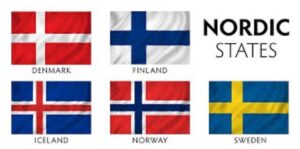
It is often claimed that the Nordic countries are Socialist. But as their own leaders have repeatedly explained, they operate largely Free Market economies, with strong protections for private property and privately owned industries. In Denmark and Sweden, for example, the vast majority of businesses – including banks, manufacturers, retailers, and exporters – are privately owned, not state run. Government ownership is limited and far smaller than in classical Socialist systems.
Sweden’s corporate tax is 20.6%, and Denmark’s is 22%. That’s right in the middle of the US corporate tax rate, which is 21%.
Capital gains and inheritance taxes in Denmark are moderate – lower in most cases than they are in the US. And Sweden abolished its wealth tax (in 2007) and inheritance tax (in 2005).
Meanwhile, these countries provide good social services – in some (but just some) cases, providing more coverage than the US provides. And they have done that without racking up trillions of dollars of debt!
How do they do that?
This is another thing that would make people who claim Nordic countries are Socialist gag if they knew it. The tax systems in Sweden and Denmark work not because they are super-progressive (i.e., super-high taxes for rich people), but because their tax systems are broadly based. Their welfare programs are funded through flat or mildly progressive income taxes and high consumption taxes (VAT around 25%).
Translation: Middle- and working-class citizens – not just the rich – pay a substantial share of the overall taxes, unlike highly progressive tax models often associated with Socialism.
