It’s been ages since I graced you with a book review, and I know you must be champing at the bit to find out what I’ve been reading all these weeks. As busy as I’ve been, I’ve somehow managed to keep up with my read-a-book-a-week mandate – mostly by “reading” the fiction as audio recordings and reading the nonfiction “purposefully” (skimming for the good ideas and discarding the rest).
Below, you’ll find somewhat truncated reviews of four of the eight books that I feel I “owe” you. Two novels, one which I rated highly and the other which I trashed, as well as two books of nonfiction, both of which I very much enjoyed.
And below that, I’ve given you links to three disturbing articles I read recently on the decline of American education, despite all the spending American taxpayers put out for it.
The Last Painting of Sara de Vos
By Dominic Smith

Published: 2016
Pages: 304
Summary: The Last Painting of Sara de Vos is a historical fiction novel that connects three timelines through a single 17th-century Dutch painting. The story follows (1) Sara de Vos, the artist who painted it, (2) the Manhattan lawyer who inherits it in 1957, and (3) Ellie Shipley, an Australian art historian who forges the painting as a student and later must confront her past when both versions of the work are set to be exhibited in 2000. The novel explores themes of art, forgery, identity, and the lives of women artists across centuries. (Source: Google AI)
What I Liked About It:
* Technically well written; very good descriptive passages
* Interesting details about historical periods, the art market, and the techniques of forgery
* Asks several philosophically sound questions: At what point does imitation make the artwork inauthentic? Where is the value in making art? Is it technique? Originality? Economics?
What I Didn’t Like: Telling three stories in one novel is clever, and it mostly works here – but at the cost of taking a good deal of tension away from the plot.
Interesting: Sara is Dominic Smith’s creation, as is the life he invents for her. But she is based on a real artist of the Dutch Golden Age, Sara van Baalbergen, who, in 1631, was the first woman ever to be admitted to the Haarlem Guild of St. Luke, which controlled all aspects of an artist’s professional life.
In this video, Smith talks about how the book came to his imagination and why he structured it as he did.
Critical Reception: The Last Painting of Sara de Vos was a New York Times bestseller and a New York Times Book Review Editors’ Choice. It was named a best book of the year by Slate, the San Francisco Chronicle, and Kirkus Reviews.
My Rating: 8.2 out of 10
Overall, a cleverly conceived, well-written, and interesting read, although it was stronger vertically than horizontally.
About the Author: Dominic Smith is the author of six novels, including The Last Painting of Sara de Vos. His writing has appeared in The Atlantic, Texas Monthly, the Chicago Tribune, The New York Times, and The Australian, among other publications. He grew up in Sydney, Australia, and now lives in Seattle, Washington. (Source: Amazon)
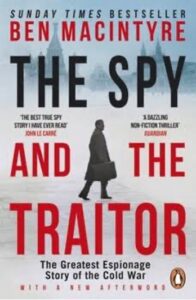
The Spy and the Traitor
By Ben Macintyre
Published: 2018
Pages: 384
Summary: The Spy and the Traitor is a nonfiction book about Oleg Gordievsky, a high-ranking KGB officer who became a double agent for British intelligence during the Cold War, providing crucial information that helped hasten its end. The book details his disillusionment with the Soviet system, his recruitment by MI6, and his daring escape from Moscow.
What I Liked About It:
* Technically well written
* A strong plot, tense with anticipation; a page turner
* Lots of details about the spy game
* Lots of facts about the Cold War
Interesting: Despite being the KGB’s London station chief, Gordievsky was simultaneously providing high-level secrets to British intelligence for over a decade. His intelligence was so critical that it helped convince Ronald Reagan and Margaret Thatcher that the Soviet Union was not planning an imminent nuclear strike.
In this video, Macintyre tells Gordievsky’s true-life story.
Critical Reception: New York Times bestseller, named a Best Book of the Year by The Economist, shortlisted for the Bailie Giffords Prize in Nonfiction
My Rating: 8.5 out of 10
I’ve not read many military or spy books, but thanks to the Mules, I happily read this one.
About the Author: Ben Macintyre is a bestselling author and a writer-at-large for The Times of London. He has also written and presented BBC documentaries of his work. (Source: Amazon)
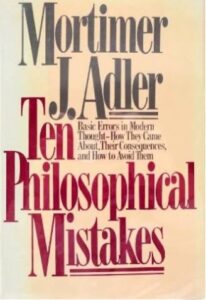
Ten Philosophical Mistakes
By Mortimer J. Adler
Published: 1985
Pages: 224
Summary: Adler identifies 10 errors in modern thought that have led to serious consequences, negatively affecting everyday life and understanding. His basic argument is that these errors stem from a 17th-century departure from classical philosophy, and he aims to correct them by returning to a more traditional philosophical framework.
Pat Flynn, host of “Philosophy for the People,” gives an entertaining summary and review of the book in this live vlog.
What I Liked About It:
* A great concise review of modern thinking – in particular, post-modern thinking – that is more in need of understanding and condemnation now than when Adler wrote this book in 1985.
* Adler covers a broad range of interesting and important questions on topics like consciousness, the intellect vs. senses, words and meanings, knowledge vs. opinion, moral values, happiness, free will, human nature, society, and existence.
What I Didn’t Like:
* My understanding of the philosophical arguments that Adler calls “mistakes” is limited, so there were moments when I wasn’t sure if I agreed with him.
* His writing style is precise and concise. Both are virtues. But when combined in a discussion of big and complicated ideas, it makes for a good deal of rereading passages two and three times.
My Rating: 9.0 out of 10
Notwithstanding the sentences and sometimes paragraphs that were beyond my understanding, I found Ten Philosophical Mistakes to be a pleasure. It’s one of those books that, after reading it once, I want to read it again – and I did read this one again. Reading it this second time was pure enjoyment. More enjoyable than the first time because I was better prepared. If you told me I had to read it again starting tomorrow, I’d have no problem with that.
About the Author: Mortimer Jerome Adler (1902–2001) was an American philosopher, educator, and popular author. He served as Chairman of the Board of the Encyclopedia Britannica, Director of the Institute for Philosophical Research, Honorary Trustee of the Aspen Institute, and authored more than 50 books. (Source: Amazon)
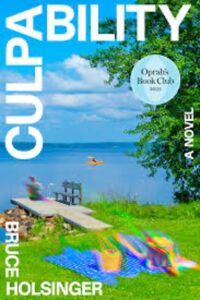
Culpability
By Bruce Holsinger
Published: 2025
Pages: 350
Summary: When the Cassidy-Shaws’ autonomous minivan collides with an oncoming car, 17-year-old Charlie is in the driver’s seat, with his father, Noah, riding shotgun. In the back seat, tweens Alice and Izzy are on their phones, while their mother, Lorelei, a world leader in the field of artificial intelligence, is absorbed in her work. Yet each family member harbors a secret, implicating them all in the tragic accident. (Source: Amazon)
What I Liked About It:
* It was a quick read.
* Holsinger did a good job of pacing the action scenes – e.g., the car crash that sets the theme of the story, chasing after his son, running into his billionaire neighbor, etc.
What I Didn’t Like:
* The philosophical exploration of the ethical quandaries of artificial intelligence was not satisfying. It asked the obvious questions, but provided no insights that were anything but superficial.
* The presentation of the characters was also superficial. None of the characters felt real to me.
* The dialog didn’t help matters. I found none of the conversations the slightest bit interesting. It was a series of politically correct cartoon people saying politically predictable things to one another.
* The narrators’ interior monologues felt not only fake, but offensively so. Listen to the thinking of an evolved man who makes organic food for his family, has second thoughts about all the money he makes working for Big Pharma, and hates his billionaire neighbor because – well, like they say, “Who needs billionaires?” Far from a three-dimensional character in which one could see the surprises and contradictions of being human, Noah is a caricature of the contemporary American view of the non-toxic man.
* Of course, the protagonist is named Noah. Of course, the billionaire’s beautiful daughter is named Eurydice. Of course, the family name is hyphenated. Of course, they drink soy milk.
Critical Reception: Oprah’s Book Club Pick, New Yorker Best Books of 2025, 2026 Aspen Words Literary Prize Longlist, Kirkus Best Books of 2025, Real Simple Best Books of 2025, Washington Post Notable Fiction 2025, NPR’s 2025 “Books We Love”
My Rating: 3.0 out of 10
The book jacket describes Culpability as a “literary thriller.” It’s neither literary nor a thriller. Before reading it, when I saw that it was an Oprah Book Club Pick, I suspected that I was in for a pedantic TV show of a novel. And despite some passages that worked as narratives, that’s what I found it to be. No. It is worse than that. It’s more like a politically correct soap opera for the upper-middle class and proudly Woke Boomer generation. Ugh!
About the Author: Bruce Holsinger is an American author, academic, and literary scholar. He has written for the New York Review of Books, The Washington Post, and op-eds for The New York Times. Culpability was his fifth novel. He is currently professor of English at the University of Virginia. (Source: Wikipedia)