10 Personality Types

You Need to Make Your Start-Up Business Soar

Forty-plus years of starting and growing (and starting and abandoning, and starting and selling) upstart businesses – as well as watching others do the same – has given me lots of ideas about why and how entrepreneurial businesses succeed and fail.

I’ve written books about entrepreneurship before, and I am generally happy with them –especially Ready, Fire, Aim. But I still have at least one book on that topic inside me that wants to come out. It’s something I’ve been thinking about for a long time, and I’m finally getting it done.

It’s related to a thesis I have written about before: that there are basically two kinds of business leaders – those that have the personalities and skills to grow new businesses, and those that have the personalities and skills to manage businesses once they have reached a certain size.

Since putting that thesis out there in speeches, essays, and in business meetings, I have expanded my thesis to include eight more personality types.

The successful founders and business leaders I know usually possess not just one, but two or three or even more of these traits. Moreover, they have the ability to recognize these traits in others – and they do everything they can to seek out and be surrounded by partners and key employees who have them, especially the ones that they themselves lack.

That’s the idea that I’m trying to turn into a book.

As I move along with this project, I’ll be publishing sections of it here to solicit your feedback. Today, I’d like to start with an outline of the 10 personality types I’ve identified. I’ve organized them into four groups, based on how important they are to the business and how hard they are to find.

Please take a look and let me know what you think.

Group One: Extremely Rare and Absolutely Essential 
Percent of the working population: 1 out of 50

1. Starters

Starters have the very unusual trait of thoroughly enjoying the challenge of, well, starting from scratch! Part of that is an almost unnatural amount of self-confidence. Part of it is an immunity to the fear of failure. And some of it, I sometimes think, is a kind of mental mishap – a missing emotional bolt in the part of the brain that is designed for common sense. (I say that without a drop of condescension or disrespect. I don’t have the Starter gene, and I’m not happy about it. My best business launches and non-business projects were either started by someone else before I hooked up with them or were “started” by me only after finding someone smart and ambitious with the Starter gene to take on that part of the job.)

Notable characteristics: Alertness, enthusiasm, eagerness, a natural (not necessarily earned) sense of self-confidence, and a generally upbeat personality.

2. Growers

Growers are inspired by the ambition of growing the business. And once they get moving, they are relentless in pushing for expansion, no matter how much work is involved. They are willing to work long hours – nights, weekends, vacations – and they quietly expect their colleagues and subordinates to do the same. 
 
Growers understand that growth creates disruption and disruption leaves behind a mess. They recognize that someone has to clean up the messes they create, but they believe – correctly – that the business is better served when they keep pushing forward and let others handle the cleanup.
 
Growers also understand that there are basically three ways to grow a business: By increasing the number of customers. By increasing the number of products that customers purchase. And by increasing the amount of money that customers spend on those products. Thus, Growers see their job through the screen of marketing, sales, and product development. 
 
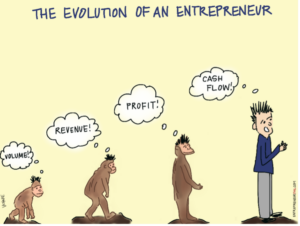
Though their primary motivation is revenue growth, Growers understand that unless that growth comes with a healthy profit margin, its value may be an illusion. 
 
The ideal combination for profitable growth is to have, at the helm of the company, equal stress on growth and profitability. The happiest situation is when the founder or CEO has the characteristics for both, but that is rare. A much more likely situation is to have two personalities who respect and appreciate one another working together towards the combined objective.
 
Notable characteristics: Passion, intensity and drive, an almost super-human energy for growth showing itself as single-mindedness, relentlessness, and a very low tolerance for doubts and details that threaten to slow growth.
 
Group Two: Rare and Extremely Helpful
Percent of the working population: 1 out of 20
 
3. Bottom Liners

Bottom Liners are motivated almost entirely by profits. Put differently, they care much more about the bottom line than the top line. However, the best ones, like the best Growers, recognize that the primary goal of the business is profitability, so they work cooperatively with Starters and Growers to find a healthy balance between profit margins and growth.

Bottom Liners are often the ones who turn a fast-growing business into a sustainably profitable one. Once they take responsibility for a business or division, they begin looking for inefficiencies everywhere – pricing, costs, terms, staffing, and capital allocation. They negotiate hard, cut intelligently, and make decisions based on financial reality rather than optimism.

Like Growers, Bottom Liners are willing to make tough decisions. And like the best Growers, the best Bottom Liners possess the rare skill of knowing how to execute difficult decisions fairly and deliver bad news gracefully.
Notable characteristics: Meticulous in thinking, hard driving in their work habits, willing to do whatever it takes to produce a healthy bottom line. Bottom Liners are smart in just about every possible way. They are comfortable thinking about the big picture, but just as comfortable dissecting details to come up with solutions for recurring problems miles away from the central offices. They are smart emotionally, too, knowing how to get their job done, which includes cutting budgets, eliminating non-essential workers, and reducing benefits and privileges. They are motivated almost exclusively by seeing the net income grow from year to year because they understand that without profit growth, the business is always a year away from disaster.

4. Pushers

All of the personality types discussed so far can push. The reason I list Pushers separately is that their motivation is not tied to some metric of performance such as revenue or profit growth. What charges them up is just getting things done. And that means they are happy to apply their superpower to whatever job they are assigned to lead.

It’s for that reason that you will find Pushers in leadership roles throughout any well-functioning and fast-growing business. Whether it is accounting, customer service, production, data entry, fulfillment, etc., the larger the company grows, the more important it is for each of these non-marketing functions to work well.

Pushers will push for hitting or exceeding production goals, meeting or beating deadlines, and demanding accountability from everyone. Good Pushers get the job done, come hell or high water, regardless of the human cost. They do so because they see themselves as working for the business and not for anyone or everyone else. If they must stub a few toes or hurt a few feelings to accomplish the goal, they are willing to have it happen. The best Pushers, however, possess the magical ability to get people to work longer and harder than they are inclined to or even want to without making them feel like they are being pushed.

Notable characteristics: Relentlessness, drive, the ability to focus intently on a goal, persistence, the ability to convey urgency and purpose, and a low tolerance for any sort of behavior that unnecessarily slows down the job.

5. Inventors

Inventors understand marketing and sales at a master level, but they have an extra superpower: They take pride in being able to predict what new products or product variants will be successful and which ones won’t. They can do that because they understand that what motivates prospects to buy is almost always more complicated and more subtle than the product’s obvious qualities.

This ability is, obviously, not common. And since it is more a product of the limbic brain (rather than the rational brain), it’s not a skill that can be easily taught or learned. That uniqueness gives Inventors the ability to help the business grow in a way that Growers and Drivers can’t.

Inventors are always thinking about the next thing to sell. They understand that when a customer buys something, what they are most likely to want next is some version of that same thing – an upgrade, a variation for a different use, or something that feels more valuable because it is scarcer, better designed, or more prestigious. So, they focus on creating “one-step-removed” products – keeping the essential elements the same while changing one key feature. And they are eager to test quickly because they assume – correctly – that competitors are watching and working on their own versions of the same idea.

Notable characteristics: Inventors feel a constant pressure to stay one step ahead. Their value to the business comes not from radical innovation, but from consistently feeding the business with new offerings.

Group Three: Available and Essential
Percent of the working population: 1 out of 10

6. Persuaders

Persuaders are essential for not just growth, but survival. They not only add value to the health and well-being of the business by leading or assisting in important negotiations, they include all the people on the revenue side of the ledger. They are marketing directors and sales managers and the copywriters who write the scripts that salespeople use to make and close their presentations.

The best Persuaders enjoy their work because they have a genuine feeling that completing the sale is not only good for the business, but good for the customer, too. Their superpower is the ability to read and respond to the thoughts and feelings of their customers, moment by moment, throughout the sales process. When they sense hesitation, confusion, or resistance, they make adjustments – changing their language, their tone, or their approach in real time and keeping the sale alive when a less perceptive salesperson would lose it.

Persuaders are enormously valuable to the business they work for because the difference in selling performance is not incremental, it’s substantial. They turn interest into revenue, and they do it consistently.

Without good Persuaders, revenues flatten and eventually fall – and soon after that, profits are reduced to zero.

Notable characteristics: Smart. Inventive. Self-confident. Good with words. Some persuaders sell in person, some on the phone, and some, the copywriters, without any direct contact at all. But they all know why and how people make decisions, especially buying decisions, and they use that understanding to sell them things.

7. Strategists

Strategists look at business challenges in terms of cause and effect and like to solve problems by analyzing data. They are quick and proficient learners when it comes to understanding market dynamics, competitive positioning, and how different parts of the sales and marketing apparatus of a business fit together. Thus, they are not just planners, but capable of developing coherent approaches to marketing, product development, customer service, and operations.

Strategists tend to step back from the day-to-day activity of the business and think about direction – what markets to pursue, how to position the product, how to allocate resources, and how to improve efficiency across functions. They are good at seeing patterns and connecting dots that others miss.

A good Strategist can be immensely valuable to a growing business – and, relative to the other personality types, they are easier to find. There are many smart, well-educated people in the job market who understand business strategy in theory and can speak intelligently about it across multiple domains.

Notable characteristics: Better than average intelligence, analytical ability, and the ability to break down challenges into component features and then reinvent marketing systems by fixing the broken features while preserving those that still work.

Group Four: Available and Necessary
Percent of the working population: 1 out of 5 (for the good ones)

8. Soldiers

Soldiers prefer working within a defined mission rather than creating one themselves. Thus, they are not just willing but dependable in carrying out plans designed by Starters, Growers, and Inventors. 
 
Once assigned a role, Soldiers focus on doing their job well and supporting the objectives of the team. They are not interested in being on top or running everything. They know that they don’t have the appetite – or, in many cases, the skills – for that kind of responsibility, and they are perfectly fine with it. They take satisfaction in being the right-hand person to someone important in the business and often derive a sense of purpose and status from that relationship. 
 
Soldiers are very good at bringing order to chaos. When things get messy – and they always do after the Starters, Growers, and Inventors have done their thing – Soldiers step in and make sure the work actually gets done. They follow through, execute the plan, and keep the machine moving. They take pride in being the ones who can be counted on when things would otherwise start to fall apart.
 
Notable characteristics: Enthusiasm, reliability, discipline, and respect for hierarchies. They are also honest, hardworking, and grateful for any and all opportunities they come across.
 
9. Solvers

Solvers have analytical, problem-oriented personalities – i.e., they enjoy confronting difficult problems and figuring out workable solutions. Thus, they are not just reactive troubleshooters, but often the people others turn to when something breaks, stalls, or stops working altogether.

Once a problem is identified, Solvers dig into the details, isolate the cause, and work methodically until it is resolved. They are not trying to run the business. They know their strength lies in solving problems, and they are most comfortable when given something specific to fix.

Like Soldiers, they are especially valuable in fast-growing companies, where problems multiply quickly. They take pride in being called in when something has gone wrong because they know that without someone fixing those problems, the business would eventually grind to a halt.

Notable characteristics: Solvers are smart, analytical, mentally flexible, and disciplined and tenacious when given problems to solve. They are motivated by the ego gratification they feel when fixing problems others have given up on.

10. Tenders

Tenders have stabilizing, maintenance-oriented personalities – i.e., they are attentive to the ongoing health of the organization and the systems that keep it functioning. Thus, they are not just cleaners of messes, but caretakers of processes, relationships, and standards that would otherwise deteriorate over time.

Tenders are inspired by solving problems and minimizing mistakes. They work instinctively and persistently toward that end. Once in position, they focus on keeping things running smoothly – cleaning up after disruption, maintaining order, and preventing small issues from becoming large ones. They are not driven to be in charge. They understand their role, and they value it.

Notable characteristics: Conscientiousness, patience, organization, and a preference for predictability.


Three Things That I Learned About Negotiating

 – and One That I Made Up 

Once every several weeks, I do a live webcast for our Japanese subscribers. It’s a bit of an improv. They ask me anything they want. I answer their questions as well as I can. I like it because (a) I don’t have to prepare for it, and (b) often the questions prompt me to reconsider or expand upon ideas that I felt were safely stashed in the “Complete-and-Final Material, Do Not Alter or Emend” file cabinet of my brain.

This happened last week. Someone asked, “What do I need to do to become a really good negotiator?”

I had a Complete-and-Final answer ready. It was a story about what I’d learned about negotiating from JSN and BB, two of a half-dozen men and women that most influenced my values and my thinking today.

I’ve told this story before. (It’s filed under “The Tale of Two Negotiators” in that file cabinet in my brain.)

What I learned from JSN – probably the most accomplished (and feared) negotiator I ever knew – was six crazy-powerful techniques that you can use in any kind of negotiation. And what I learned from BB – probably the least scary negotiator I know – was the secret of anti-negotiating, which is the only strategy you should use in your most important negotiations. (Do you remember this one? It’s about the difference between transactional and relationship negotiations.)

In any case, as I was about to recite “The Tale of Two Negotiators,” another story popped into my head. It was about LW, who, I realized, was also a major mentor of mine, even though what I’d learned from him was mostly about what not to do in business.

So, I went off script and talked about how, when I was working for him, LW coerced me to try to get a major car company to pay him for the cost of repairing damage to the engine of one of his cars – even though the warranty had expired and LW had caused the damage by running the car for months without any oil in the engine. It is an arduous story of irrational intentions and willful neglect of common sense. It took me from a nice young woman in the customer service department of our local dealership to the VP of a Fortune 500 corporation.

I realized in telling that story that the negative lesson I’d learned from that experience was as real and, in many ways, as valuable as the lessons I’d learned from JSN and BB. So, I backed up a bit and said what was logically demanded at that moment: i.e., that there are many ways to negotiate and none of them are suitable for every type of negotiation.

“Think of it,” I said, still extemporizing. “We start negotiating as infants. We negotiate when we are hungry, or in pain, or sitting in dirty diapers. At that stage, we have only one tactic to get what we want. We cry. If crying doesn’t work, we cry harder. And if that doesn’t work, we cry even harder.”

That sounded pretty good, I thought. So I continued with the analogy.

“There are at least three kinds of negotiating,” I said, “each of which we learn to use at different stages of our lives.” And I explained it like this…

Stage One: Negotiating Like an Infant

In infants, the prefrontal cortex of the brain is not sufficiently developed to engage in any conscious form of negotiating. But luckily, the reptilian brain is fully prepared to do what it’s programmed to do – which is to giggle, smile, cry, and/or scream. You might not think of these as negotiating tactics, but they are. Very good ones. (I’m guessing you know, from your own experience, how effective they can be.)

Stage Two: Negotiating Like a Child

Children acquire a second negotiating technique – one that can express itself through the prefrontal cortex but is deeply rooted in the limbic brain, the seat of our emotional intelligence. It’s the negotiating technique of bartering – i.e., “I’ll give you this if you give me that.” A more complicated strategy than the reptilian one used by infants, it involves conscious deliberation on the value of each bartered item to each bartering partner. It’s not very sophisticated. Nevertheless, it is a strategy that some people use throughout their lives because it’s the only tool in their toolboxes.

Stage Three: Negotiating Like a Teenager

As teenagers and young adults, we develop a third negotiating skill, which, for the purpose of my analogy, I call countertrading. Think of countertrading as an advanced form of bartering in that it involves persuading the negotiating partner that the item up for exchange is worth more or less than it would objectively seem. This is done through a complex series of stated and unstated (mostly) psychological rewards and punishments. For most people, this is considered the highest form of negotiating. It encompasses the tricks and techniques covered in 95% of the books and courses on how to negotiate.

Step Four: Negotiating Like an Adult

As mature adults, we can, if we are lucky, discover an entirely different and significantly better form of negotiating. I’m referring to BB’s “zen” strategy – negotiating by not negotiating. It’s about how to achieve the very best outcome with very little or no bartering at all. And its power is that it can make all future negotiations and all future experiences with the person you’re dealing with simpler, easier, and increasingly more beneficial.

There you have it. Consider this to be Part 1 of a multi-part series of short (less than five-minute) essays on how to be a master negotiator. I’m excited about this idea, because it feels like it’s going to be fun and useful. But of course, you’ll be the judge of that.

From Experience to Income: Launching the Monthly Money Report

Today’s issue is the first of what I intend to be a regular monthly issue. I’m calling it my “Monthly Money Report” because its contents will be limited to topics related to money: entrepreneurship, business, marketing, investing, etc.

These are subjects I spent 60+ years learning about by doing them, not reading about them. They are also subjects I’ve been writing about for the last 25 years.

If you’re a longtime reader, you know that I don’t often include these topics in my regular issues, even though all my bestselling books are very much about increasing personal income and growing wealth.

The reason for that is because I’ve always thought of this as a kind of journal in which I’d write about anything that interests me personally, rather than about what my partners and publishers want. Nevertheless, I have continued to write about wealth and wealth building for my Japanese publishers, with whom SM, one of my publishing partners, and I head up to publishing franchises.

Recently, we were approached to publish those services in the US and other English-speaking countries. After thoughtfully discussing all the reasons we shouldn’t, we said, “Yeah! Let’s do it!”

His beat will be stocks, bonds, options, and trades. Mine will be business building and wealth strategies I learned from years and years of personal experience, starting with nothing. No money. No connections. No financial or business education. And no idea what an interesting and rewarding path I was on.

Which is to say I’ll be thinking about such things more than usual in the future than I have in the past. And when I think about things, I like to write about them.

If you haven’t read any of my stuff on building wealth, don’t expect to be wowed by lengthy technical analysis or deep thoughts about long cycles or modern economic theory. My approach has always been to admit (to myself and my readers) that although there are lots of games to play in the more-money carnival, I stay away from those about which I don’t have “inside knowledge” and those about which I have no control.

So what you will see in this issue and in my future “Monthly Money Reports” are two kinds of essays: (1) those I’ve written, which means I have a high level of confidence in the advice I’m giving, and (2) those written on subjects I have little experience with, but always by experts I’ve known and worked with for at least a dozen years.

Let’s get to it…

The Loyalty Question 

Since we are all reasonably well-read and unreasonably self-assured, my Sunday evening Zoom conversations with my brothers tend to be burnished with references to such luminaries as Aristotle, Thomas Aquinas, Confucius, John Locke, and Jean Paul Sartre, to name a few.

This time, the conversation once again drifted to the idea of virtue – to whether it is something that can be universally defined and understood (as many of the great philosophers and theologians have said) or whether its meaning differs depending on social, cultural, and economic circumstances.

To keep it from moving into the usual highfalutin slugfest of esoterica (at which I tend to be at a disadvantage), I tried to redirect the conversation.

“I believe there are all kinds and manners of virtue,” I said. “High virtues and low virtues, survival virtues and abundance virtues, business virtues and personal virtues, etc. Let’s talk about loyalty, for example. I think we can all agree that loyalty is a virtue.”

They agreed, and I continued.

“A dictionary might define loyalty as faithfulness to a person, group, cause, or ideal. But that doesn’t explain the many ways one can show loyalty. One way is to be faithful in marriage. Penelope was faithful to her husband Odysseus for 20 years, despite entreaties by wealthy and generous suitors almost every day.

“Another definition of loyalty might be having an allegiance to a cause, idea, or ideal – such as defending one’s country or equal rights or Communism. Of course, this kind of loyalty is a two-edged sword, for it must eschew judgement, and evenhandedness, and sometimes even the truth. When I swore to the cops that that tall guy hit Mike P. first, I was being loyal, but I wasn’t telling the truth. One could also argue that a mother turning in her kids to the cops might be practicing a form of loyalty – loyalty to the idea that truth is the ultimate ethic.”

We had some fun with that idea for a while, but it wasn’t anything we could sink our teeth into. So I did what I usually do in such situations: I doubled down on my argument by making it even more extreme.

I took a moment to take a long, slow draw on my Padron Aniversario Churchill.

“There are two major distinctions that must be made when talking about virtues,” I said, not quite sure where I was going with this.

“Which are?” one of them asked.

“Although some virtues can be said to be ‘human virtues’ because they apply to everyone, there are some that apply only to one group or another.”

“For example?”

“For example,” I said, “some virtues are masculine. And some are feminine.”

“As in only men have this virtue and only women have that one?”

“No, not like that,” I said, shaking my head.

I thought for a moment.

Then I said, “Since we’ve been talking about loyalty, let me use that as my example. Consistency and reciprocity are forms of loyalty – virtues that can (and should, depending on the context) be practiced by both sexes and in all situations. But I see consistency as being essential in creating love and harmony in personal and social relationships. So for that reason, I’m going to call it a feminine virtue. And I see reciprocity as being essential in maintaining goodwill and cooperation in economic and business relationships, which makes it a masculine virtue.”

Then I said something like this:

“The primary social contracts in our personal lives are between husband and wife and between parent and child. Virtue in this context means being faithful to the core requirement of social relationships. And that means doing what you promised to do and sticking around for as long as you promised and are needed. In traditional marriages, the tenure of the spousal promise is until death does the parting. In traditional parenting, the tenure is until the child can survive and prosper on its own.

“The primary social contract in business and wealth building is reciprocity – the free exchange of one type of value for another. The most obvious example is the buying and selling of goods and services. But this principle also holds true for other sorts of exchanges. For example, the salary the manager pays for the work of the employee. It holds true also for the relationship between CEOs and company shareholders. And between wholesale and retail exchanges. The list goes on and on.

“There is another kind of value exchange in business where the rules of reciprocity are not so clear. I’m thinking of mentorship – the free exchange of knowledge and skills, which provides the recipient with an invisible ticket on an invisible train that will take him up the corporate ladder and allow him to become wealthy and powerful if he plays it smart.

“The opposite of consistency is abandonment. The opposite of reciprocity is defaulting on an IOU. We can try to rationalize abandonment and default if we feel we need to. But we can never escape the guilt of those two evils because their virtuousness is deeply threaded into our DNA.”

Since my bailiwick is business and wealth building, I’m going to continue here with my thoughts on the virtue of reciprocity. And I’m going to define it as the foundational moral contract between people engaged in business and commerce. It is the sometimes unspoken but always existent agreement between employers and employees, companies and their customers, corporate management and shareholders, etc., to treat one another fairly.

It means that each party agrees that in the mutual transactions of business there exists an ethical obligation to pay one’s debts – whether they are stated or not. And that the term of such obligations is until they are paid.

The Anthropology of Reciprocity 

The idea of reciprocity wasn’t invented in a boardroom, just as the idea of consistency wasn’t started in a medieval court. It started much earlier – back when dinner could swim away or outrun you.

In hunter-gatherer societies, survival depended on skills that took years, often decades, to master. Hunting large game. Reading the weather. Finding fish when the rivers ran thin. These weren’t things you figured out with a YouTube tutorial. You learned them from someone older, someone who’d already made all the expensive mistakes.

Anthropologists call this kind of know-how “embodied capital” – i.e., wisdom stored in muscle memory and scars.

According to Nigel, research on foraging societies shows that people continue to develop subsistence and survival skills into their 30s and 40s. But they don’t wait till they are done producing to pass along those skills to the next generation. They start mentoring the young when they are in their late teens and 20s, which begs the question: Why would an expert train his replacement?

The answer, some anthropologists say, is a deal as old as humans: I’ll teach you how to survive now. And when I slow down, you’ll make sure I still eat.

I asked Nigel to give me some back up on this, and here is what he said:

Food sharing among hunter-gatherers wasn’t an occasional act of charity; it was constant and extensive. Among the Aché of Paraguay, anthropologists Kim Hill and Hillard Kaplan found that hunters shared a large majority of what they caught far beyond their immediate families.

And crucially, this sharing wasn’t always immediate or equal. It often worked on delayed reciprocity: You give now, trusting that the group – and specific people within it – will give later.

In Inuit societies, for example, ethnographic and oral-history accounts describe younger hunters routinely provisioning elders, especially parents, as a matter of obligation and respect. Food circulated through kin networks not because people were nice, but because everyone understood the math: Someday, you’d be the one with slower legs and shakier hands.

Modern economists might miss this because they look for explicit contracts. But the virtue of reciprocity doesn’t need paperwork. It needs memory. You remembered who taught you. Who helped you when you were helpless. Who mentored you when you were unskilled and ignorant. You remember those who showed you where the fish truly were – not where they were supposed to be.

Seen this way, loyalty isn’t some Victorian moral ideal. It’s a sophisticated and fundamental survival technology. A way to stretch the benefits of skill across lifetimes. Knowledge flowing forward. Caretaking flowing back. And the gene pool enduring.

What to Do When Your “Quid” Is Not “Pro-Quo’d” 

But what do you do when someone you’ve helped succeed in business is disloyal to you?

I’m not talking about minor acts of disloyalty, such as not giving credit where credit is due. I’m talking about people stealing from the hand that once fed them. Or even biting it just to see it bleed.

This sort of disloyalty doesn’t happen very often. In my personal experience, it happens rarely. But it has happened to me. And when it happened, my immediate response was – as you might expect – shock followed by outrage followed by thoughts of punishment and revenge.

But those are thoughts that need to be vanquished. I learned long ago that indulging such emotions – even a little bit – almost always takes the relationship (and one’s peace of mind) from bad to worse.

One of my lifelong friends who is familiar with the way I do business once asked me why I am so loyal to others even when they are disloyal to me. I told him that I had decided that there were some thoughts and feelings that, however spontaneous or common they were, had a negative effect on my character.

The desire for retribution and revenge are two of them. So are jealousy, resentment, and envy. I see them as symptoms of weakness. The emotional responses to injury or imagined injury of weak-minded people. Allowing them space is distracting. Dwelling on them is hobbling. Indulging in them crippling and counter-productive.

I’ve had this perspective for many years now and it has found roots in my limbic brain. Whenever I encounter acts of disloyalty from people who should be grateful to me, my first response is no longer anger. It’s more like resigned disappointment, followed by, “How can I minimize this or make it disappear?”

I see it as not only a grace that calms my nerves, but as a super-valuable skill that allows me to sometimes turn water into wine.

I don’t often talk about this to people I’m coaching or mentoring. What I do talk about – a lot – is the power of reciprocation and how it compounds over time. I tell these young people that if they train themselves to appreciate the gifts that others give them and never fail to reciprocate –abundantly, not just in kind – the path ahead of them will get straighter and smoother with every passing year.

I say it because I know it to be true.

How to Build a Million-Dollar Business… That Lasts! 

RT was telling me about a new BJJ dojo he was opening about six miles from his main facility. The story of how he got this new business rolling is straight out of Ready, Fire, Aim, which he tells me he’s read two or three times.

But that’s a story for another day.

Today, I want to share with you something I came up with to explain the fundamentals of sales and marketing. I wanted it to be comprehensive but simple and easy to remember. And I think I have it. For the time being, I’m calling it:

Six Absolutely Necessary Steps to Building a Lifelong Seven-Figure Business

The first three steps are essential for getting any business off the ground. The second three steps are essential for keeping a profitable business going over time. If you fail at any of them, there is a good chance that your business will wither and die. (In my experience, the failure usually takes place in the first three to seven years.)

To start a profitable business, you must know how to:
1. Attract attention.
2. Create a desire.
3. Offer a unique solution.

To keep your business profitable, you must know how to:
4. Turn that solution into a behavior.
5. Turn that behavior into a habit.
6. Turn that habit into an addiction.

New Talent, Big Wins, and the Future of Business

I’m writing this while I’m in Baltimore for an end-of-year review of Agora’s seven domestic and six international publishing groups, which will be followed by their annual holiday party.

This year’s reviews are much better than they’ve been since 2021. The success that’s been achieved in moving through the slough and rebuilding our business is more than I expected. And that, I’m happy to say, is due to a new generation of creatives and executives who understand the business better than we did when we grew it from $8 million to more than a billion.

Listening to these youngsters has me thinking about our possibilities for the future. And for the moment, that has inspired me to put together this issue about how to grow and regrow successful businesses.

Choosing the Right Personalities to Grow Your Business 

Growers and Tenders, Alphas and Betas 
Choosing the Right Personalities to Grow Your Business 

Many years ago, I came up with what I believe may be one of the better insights into the question of how entrepreneurial businesses grow.

My thesis was that there are basically two kinds of business leaders – those that have the personalities and skills to start and grow small businesses, and those that have the personalities and skills to manage businesses once they become large.

I named the first type “Growers” and the second type “Tenders.”

A new concept I’ve come up is that there is another way to describe executive leadership styles – one that is related to Growers and Tenders, but only indirectly.

The idea is that there are two distinct kinds of managers: Alphas and Betas.

Alpha managers are just what you’d think – confident, commanding, and assertive, sometimes to the point of coming across as overbearing.

Beta managers are in many ways the opposite – careful, cooperative, and agreeable, sometimes to the point of being overly compliant.

Alpha managers pursue objectives forthrightly and deliberately. They lead with confidence in the value of the goal in order to motivate their colleagues and subordinates to work confidently, too. And they do that even when their own confidence is limited.

Beta managers pursue objectives cautiously, seeking feedback from their colleagues and subordinates to achieve a common consensus about the worthiness of the goal (even if it is a company mandate) and the best strategy to achieve it.

Alpha managers lead like warriors. Beta managers lead like den mothers.

Now here’s the interesting thing about the difference between Growers/Tenders and Alphas/Betas. Although they generally overlap in terms of attitude, work ethic, and leadership style, the overlap is not 100%.

Growers are all Alphas because the psychological characteristics of Growers are 100% Alpha. Tenders, however, can be Alphas or Betas – and some tending roles are better handled by Alphas, while others are better handled by Betas.

The most obvious example of a tending role that is better handled by a Beta is the executive assistant – especially the assistant to an Alpha Grower.

The reason for that is simple. An Alpha Grower cannot function well if he is not supported by a Beta Tender to attend to the disorder that inevitably follows when he moves ahead with his mission, unconcerned with the operational and moral debris that almost always comes from the changes he is rapidly and determinedly making.

What cannot work ever in an entrepreneurial business, or even a mature company determined to achieve further growth, is a Beta executive in any department that is a part of any of the business’s revenue generating functions. That would include COOs and directors of departments engaged in product development, sales, and marketing. Because despite their natural ability to solve problems and boost morale, Betas do not have the harder leadership skills required to make a business grow.

What they do have is the ability to make their boss feel like everything is moving ahead in a positive direction – to soothe the fears of the founder/CEO who is concerned about the lack of growth and convince him that no changes are necessary.

What’s even worse for founders/CEOs who have Beta executives reporting to them in growth-oriented positions is that a Beta executive will almost never hire an Alpha executive for any job, including a growth job, because Betas see Alphas as inherently dangerous and destructive.

The takeaway: For management positions that are not directly involved in product or revenue growth, Betas may be appropriate. But to lead departments whose function is to support growth, only Alphas should be chosen.
Want to Grow Your Company’s Revenues? 
It’s Not Complicated 

It must have been 30 years ago when I heard Jay Abraham tell a room full of young entrepreneurs, “There are basically only three ways to grow your business. You can increase the base of your customers. You can increase the average number of purchases your customers make. And you can sell them products at higher prices.”

I remember thinking at the time, “Only three ways? That’s too simple. It can’t possibly be right.” But I’ve thought about it at least a hundred times in all the years that followed, in countless brainstorming sessions on that very topic, and I never discovered another way.

This particular bit of advice has been very useful to me whenever I was starting a new business about which I had no significant experience. It has also been helpful when I’ve been consulting with entrepreneurs looking for ways to grow their new businesses.

So why doesn’t every entrepreneur take advantage of these revenue-building strategies? Because, as easy as they are to implement, most entrepreneurs aren’t even aware that they exist.

In future issues, I’ll give you some examples of how you can put each of these strategies to work for you to see your revenues double, triple, or even quadruple in a surprisingly short amount of time.

Three Universal Marketing Truths 

1. The customer most likely to buy a product or service is one who has bought similar products or services in the past.

2. The best time to make that second sale is soon after or in some cases immediately after the customer made his first purchase.

3. To achieve the highest percentage of conversions on that second sale, price the second product at two to three times greater than the price the customer paid for the first one.

“Hell, Yes!” – or Maybe Not 

When a recent visitor to Paradise Palms wrote to the website asking if she could book a big event there, my reaction was, “Hell, yes!” The garden is amazing. I have zero doubt that anyone who had an event there would be anything less than thrilled – and it would help pay for the $600,000 a year it costs in upkeep.

Then came another opinion: “We are not ready to handle big events. We need a professional event organizer at the very least. We’ve discussed this with you before. We’ve outlined the problems.”

It reminded me of a course I took in “leadership styles.” We learned that some people are directors, some people are analysts, some people are counselors, and some people are communicators.

I’m a director. And the greatest pleasure directors get from their work comes from seeing the work get done.

The person that disagreed with me is an analyst. And the greatest pleasure analysts get from their work comes from solving problems, getting the machine running smoothly, and making workers happy.

Both personalities are important to a new business. But because analysts spend so much time trying to fix problems they foresee before the business even gets launched, nothing gets done unless a director is in charge.

I wrote a book about starting and building multimillion-dollar businesses: Ready, Fire, Aim. It was a bestseller. And it continues to generate at least one email a week from folks who have used it as an instruction manual.

In Ready Fire Aim, I laid out my thesis that there are four stages of development and that every stage has one primary challenge and one primary opportunity. In Stage One (the stage we are in with Paradise Palms), the challenge is initiating positive cash flow before you run out of money, ideas, faith, and endurance. The opportunity (the way to solve the problem) is to discover what I call the OSS (Optimum Selling Strategy).

Here’s the thing: You will never know if your business idea works until you are making sales and bringing in new customers. And even then, you are working against two timeclocks: One is about how much capital you have to spend before you are cash positive. The other is about how much faith and energy you have to keep going.

And here’s the question: Do I have what it takes for Paradise Palms?

Why Is It That So Few People Get Rich? 

Robert Frank, a columnist for The New York Times, has argued for some time that the key difference between the “haves” and the “have nots” in this country is not talent, hard work, and persistence but luck.

That sort of analysis sticks in my craw for two reasons: It is born from jealousy. It is absolutely not true.

It is true that many highly successful people, when asked for the secret to their success, cite luck as the reason. As I’ve said many times in previous essays, this is ingenuous. One need only read their autobiographies (or biographies written about them) or speak to anyone who has worked for them to know that it was a combination of personal strengths and disciplined habits.

They default to luck as an explanation for two reasons: Because it makes them seem modest and therefore likeable. And because when one looks back on a successful career, it often seems like it was a matter of luck.

In my case, it never seemed like luck. It seemed much more like decades of difficult challenges, frequent heart-crushing mistakes, and countless 12-hour days.

Alex Green (see today’s main essay, above), recently wrote about Dr. Bob Rotella, a leading sports psychologist whose views are diametrically opposed to Robert Frank’s, and summarized some of Rotella’s most important findings from his book How Champions Think:

No. 1: Intense Optimism – It’s tough to achieve great goals without an unwavering conviction that you will achieve them. Exceptional people generally do this through intense, purposeful visualization. Optimism keeps them juiced, excited about their prospects and willing to work harder than others. Optimism alone doesn’t guarantee anything, of course. But it is an essential ingredient. There is an almost perfect correlation between negative thinking and failure.

No. 2: A Confident Self-Image – We all construct a mental picture of ourselves. To a great extent, that self-image determines what we become in life. Champions view themselves as winners. And they devote their lives to making that image a reality.

No. 3: Habits of Excellence – Exceptional people follow strict habits that make success almost inevitable. Commitments are a dime a dozen. But unwavering perseverance is a virtue in short supply.

No. 4: An Unwavering Commitment to Process – Exceptional people don’t just pursue a dream. They fall in love with the process that makes it come true. They don’t just work longer and harder. They work smarter.

No. 5: Single-Mindedness – Champions don’t generally live well-rounded lives. They know they cannot be great business leaders, great parents, great athletes, great socializers, and tireless contributors to their communities. They have a passion for one thing and pursue it with the zeal of the newly converted.

No. 6: Honest Evaluation – Many people set high standards for themselves. But then they go easy on the self-evaluations. Average achievers tend to overestimate how hard they work. Champions don’t. They define excellence in specific terms and commit themselves to the most rigorous standards.

No. 7: Resilience – Failure is inevitable in business and in life. But exceptional people don’t let it define them. They find something to cling to, some hope for the future. Each setback comes with some lesson to be learned.