Watching this will make you nervous…

Watching this will make you nervous…
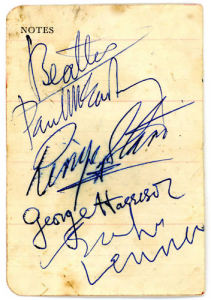
Only 6% of the autographs in circulation from members of the Beatles are estimated to be real.
“Seattle Is Dying”.- When I was in my 20s, New York City was a shit hole. Except for a few uptown neighborhoods, you couldn’t walk for 10 minutes without stepping over a bum or being accosted by someone demanding money. Alleys smelled like urine. Eventually, the voters got tired of it and elected a mayor that hired a team of people that got tough on misdemeanors. Lots of tenderhearted people objected. You can’t arrest people for being crazy or homeless, they argued. Live and let be. Tough love was administered and the city gradually pulled itself out of its trough. Nowadays, NYC has one of the lowest crime rates per capita of any big city in the USA.
San Francisco used to be a beautiful city. About 15 years ago, things started to change. The last time I went there was about 5 years ago. It was such a dangerous place, I vowed I’d never go back again.
Next to San Francisco, Seattle is the city with the highest crime rate per capita, the filthiest streets, and the most homeless. And like San Francisco, Seattle’s policy of compassion towards the homeless is the principal cause. LINK
To burn off the calories in one M&M, you’d have to run the equivalent of a football field.
“Entrepreneur vs. Employee: How to Make the Best of Both”.- A very smart discussion between James Altucher and Steve Cohen…
The first interracial kiss on TV took place in a 1968 “Star Trek” episode when Captain Kirk kissed Lt. Uhura.
The creative power of misfits | WorkLife with Adam Grant from TED Talks Daily in Podcasts.- One of the challenges of success is that the habits that got you there are hard to break. If it ain’t broke, why fix it? Because nothing stays exactly the same. New rules are created. Old pathways are closed. Environments change. Competition evolves. What worked perfectly 10 or 20 years ago may not work at all today.
In The Innovator’s Dilemma, Clayton Christensen explains how this happens in business. Large, “incumbent” businesses are practically programmed to service large existing customer bases with modest innovations to already good products. They don’t have the capacity for substantial change. And that’s why disruptive innovation usually comes from smaller companies.
I’ve made the case that large and successful businesses can also create disruptive innovations. But to do so, they need to create a separate micro-culture of innovators and (as Adam Grant calls them) misfits to do the thinking that the employees of the incumbent company cannot.
This probably won’t change anyone’s mind, but it’s a true explanation of how progressive taxation works in the USA and it illustrates the disturbingly widespread level of ignorance about it.
McDonald’s sells 75 hamburgers every second.
What can I say? This has to be the best dance video I’ve ever seen.