The Charlie Kirk assassination was front-page news this week. The coverage ignited a set of incendiary arguments on both sides of America’s ideological/cultural/political divide.

Conservatives, Libertarians, and free speech advocates are outraged and brokenhearted. The response of Liberals and Progressives has been more varied, from what seems to be genuine sympathy and concern to jubilant celebration.

I asked one Kamala Harris voter, whom I very much like, what she thought of the assassination. She said she barely knew Charlie Kirk. That the only thing she knew about him was that he said Martin Luther King was a “bad person.” (Which is not exactly true. Although Kirk often praised MLK, there was a moment when he criticized not him, but the way he was lionized as if he was not a sinner.)

My reaction to Charlie’s murder was first shock and then outrage. Lit up by that anger, my thoughts ranged from joining a right-wing paramilitary group, to disassociating from everyone I knew that I suspected might be celebrating it, to moving to a remote piece of property I own overseas and spending the rest of my life in isolation.

What I did instead was start an argument with K, which I regretted as soon as she left the room, leaving me with the very awkward job of whimpering and pleading my way back into her good graces and the difficult job of thinking about whether there is some better direction to channel this anger that I’m quite sure will not leave me any time soon.

I called Gio and had her cancel the two meetings I had scheduled for the day, as well as my two workouts. Then I went to my office, this office in the corner of a warehouse I built last year, where I am writing this.

Everything You Should Know About 9/11 in 5 Minutes

I’ve mentioned Brett, my barber, in previous issues. I’ve told you that one of the reasons I enjoy patronizing him is that he provides, along with an excellent haircut and relaxing shave, an in-depth monthly update on all the hottest conspiracy theories currently in discussion on what I presume is the Dark Web.

This morning, he was giving me the lowdown on 9/11, with which I thought my knowledge was au courant. But no. As usual, he explained to me that the truth is much stranger and scarier than all the strange and scary facts I knew. I didn’t know, for example, that the film footage we had of two planes crashing into the buildings was obviously doctored. And that, in fact, the planes were flown to an undisclosed place in the wilderness where the occupants were gassed. And that the buildings collapsed from bombs that had been planted there days before.

I make it a practice to consider Brett’s theories with the greatest respect, because I don’t want him to think I’m another one of those people that don’t understand how the world really works, which could very well result in being denied access to the astonishing facts I’d be learning during my next appointment.

In this case, I just said, “I always found it difficult to believe that a single plane crashing into each of those buildings could bring both of them down to their foundations.” And that was true.

I won’t tell you the rest of what I learned from Brett because it’s confidential and he’d probably have to kill me if I did.

But when I came across this video from The Corbett Report this afternoon – which promised to explain 9/11 in five minutes – I watched it. It was well and wittily written, so it was fun. But it also made me consider again how many highly unlikely “facts” surrounded that “highly improbable” event.

Now, let’s get to the book I’ve just read and am recommending…

NYC Is One of the Best Cities in the World – as Long as You Are in the Right Zip Code! 

After the wedding guests had departed, K and I spent four days in the city, doing what we always do when we are there: going to the theater, visiting museums, strolling in the parks, people watching in downtown cafés, and window shopping on Madison and Fifth Avenues. Or, if K is watching a tournament at the Billie Jean King National Tennis Center, I spend my time seated comfortably in one of the plush leather chairs at our hotel, sipping espresso, working on my laptop, and smoking a world-class Nicaraguan cigar.

The weather was good throughout our time there – bright sun, warm temperatures, cloudless skies, and what seemed like genuinely fresh air. Plus, the streets were mostly clean, the buildings mostly unsullied by graffiti, and the subways mostly untainted by the smell of urine.

That got me into a positive mood and, as always happens when I’m feeling good in NYC, Paris, or Rome, I begin to think about buying a pied-à-terre there – in this case, in Manhattan.

If all I knew of New York City was what I’ve seen on social media recently – reports on the insane numbers of murders, robberies, and other violent crimes that supposedly take place each year in NYC and most of the other “Big Blue Cities” – I wouldn’t have even considered such a proposition. But if you go there as a tourist and spend your time in the parts of the city that are frequented by tourists, you will have the impression that Trump is wrong about its “crime problem,” and that maybe he’s “creating a problem that doesn’t exist” as some Big Blue City mayors have recently accused him of doing. (You might think that – but if you did, you’d be wrong. See “Just the Facts,” below.)

Notwithstanding how much I enjoyed all the outdoor activities K “exposed me to” in the city, the best times I had, on a per-hour basis, were spent indoors at three museums: The Whitney, The Frick Collection, and the Metropolitan Museum of Art.

This is not surprising. Spending time in art museums has always been my favorite thing to do as a tourist. And so it was this trip.

The Whitney Museum of American Art 

The Whitney has a massive and impressive collection of modern and contemporary American art.

The Exhibition We Saw: All Day All Night

This is a retrospective of the work of Christine Sun Kim, an artist who is – IMHO – too young to be given a retrospective.

Well, no. That’s not right. In theory, at 45, she could have been producing art professionally and voluminously since she was 10. But she hasn’t. She’s been on the art scene now for barely 15 years.

So, what’s this about?

Is it about her being a woman? An Asian woman? An Asian woman from LA? No. But it could be about the fact that Christine Sun Kim is deaf.

Is Sun Kim just another affirmative-action artist, exploited by a museum wanting to be au courant with the zeitgeist of Woke Culture? My first impression of her work had me thinking, “Yes.”
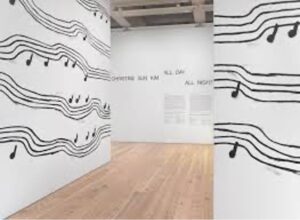
I changed my mind after about 10 minutes of looking at it carefully. Sun Kim is not someone hoping to cash in on her victimhood. There is nothing about her drawings that says she thinks her deafness makes her special or worth any special consideration.

On the contrary, what you discover when you look at the development of her work from the sound experiments she was doing in the 2010s to the graphic work and installations she is doing now – for example, a mural she created last year called Ghost(ed) Notes, which covers multiple walls on the eighth floor – it is nothing like what you might expect from an artist who is focused on her handicap and her minority status. She is not preaching or protesting. Rather, she’s doing something more revolutionary: trying to close the gap between the deaf and the hearing world modestly (almost shyly) with humor and an approachability that feels entirely authentic.

The Frick Collection at the Frick Mansion 

The Frick Collection is housed in the Gilded Age mansion that was originally the home of Henry Clay Frick. When he died in 1919, as specified in his will, steps were taken to transform the building into a museum, which was opened to the public in 1935. (His will even provided a $15 million endowment for maintenance.)

The permanent collection includes works of art that Frick had assembled over a span of 40 years, and is comprised of 16 individual collections – dozens upon dozens of Old Master paintings and European sculptures that integrate Italian, French, and Spanish works, which makes it a great place to compare different schools of art from multiple regions and time periods. Which is, I’ve read, the way Henry enjoyed viewing art.

This was the first museum I ever visited. I was on my way to Sunday mass with my mother when she decided we should spend the day in the city – and our time at the Frick Mansion was, for me, the most memorable part of that day.

The Exhibition We Saw: Vermeer’s Love Letters

This exhibition is unlike any I’ve ever seen. Most are either massive retrospectives of a single artist or wide-angle perspectives of a movement or school. This one featured only three paintings.

Vermeer (1632-1675) was a meticulous artist. It has been estimated that it took him three to four months to finish a single piece, and his entire oeuvre may have consisted of only about 50 or 60 paintings. Today, only 35 or 36 Vermeers are known to exist. What’s even more curious (at least, to me) is that no drawings or etchings by him are known.

When K and I were last in Holland, we visited several museums in Amsterdam, including the Rijksmuseum, where we had the opportunity to see about a dozen of Vermeer’s paintings, as well as many more by Rembrandt, Frans Hals, and other painters from what is known as the Dutch Golden Age, a period of time roughly spanning the 17th century.

I’m a huge fan of the Dutch Golden Age painters because of the craftsmanship and technical near perfection of their compositions and their ability to create scenes that suggest that something dramatic is going on beyond the scene itself. Vermeer, IMHO, was the best of them.

If you see the exhibit, take a look at what a master he was at depicting every kind of material in exactitude – marble and concrete and wood, porcelain and glass, pewter and silk and cotton and wool. I can’t think of another artist that does it so well.

The Metropolitan Museum of Art  
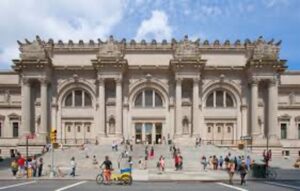
The Metropolitan Museum of Art, commonly referred to as The Met, is huge. By floor area, it is the third-largest museum in the world and the largest art museum in the Americas. Its collection spans the globe and the ages, with art and artifacts from Mesopotamia and ancient Egypt to Greece and Rome, from the Middle Ages, the Renaissance, the Romantic period, the Impressionists, and the Expressionists to the full range of modern art.

You could visit every day for a month, and you would not have scratched the surface of what The Met has to offer. And that is why, every time I’m in New York, I stop by to revisit favorite exhibits and to see what’s new.

The Exhibition We Saw: Superfine: Tailoring Black Style

K and I spent an hour revisiting the French Impressionists and the American Modernists, but then headed to see this exhibit that I was eager to check out.

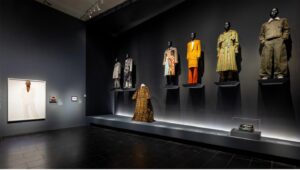
Curated by the museum’s Costume Institute, the exhibition presents a cultural and historical look at “Black style” over 300 years through the lens of what the catalog calls “Black dandyism.”

From the catalog: “Black dandyism, by and large engaged with by men, sprung from the intersection of African and European traditions of dress and adornment. Its history – from Enlightenment England to the contemporary art and fashion worlds of Paris, London, and New York – reflects the ways in which Black people have used dress and fashion to transform their identities, proposing new ways of embodying political and social possibilities.”

I have to say, the clothing on display was beautifully and precisely tailored as well as flamboyant in presentation.

I’ve been to fewer than a half-dozen museum-centered exhibitions of fashion and have always found that they give me more than I expected. The best one I’ve seen so far was in 2011 – “Savage Beauty,” a retrospective of the work of Alexander McQueen. It was phenomenal. I saw it twice. This one is not quite at that level – primarily because it is mostly men’s fashion – but was nonetheless worth a look.

Boy, Was I Wrong About the NBA! 

The Only Thing I Knew About the WNBA

The only reason I knew anything about the WNBA (Women’s National Basketball Association) was because I had been following the controversy over Caitlin Clark, the rookie sensation who, despite making and breaking records on the court (including points and assists per game) – not to mention the fact that her rising popularity was breaking attendance records and boosting revenues for the league, every franchise in the league, and every player – was being disparaged and bullied by some of her opponents, discouraged by her coaches, and ghosted by WNBA management.

It’s a fascinating story – even for someone like me, who doesn’t follow sports – because it provides a dramatic perspective on how the economic and social dynamics of professional sports (as well as just about everything else) have changed in the last several decades.

An Unwelcome Invitation

So when, last week, MM, an old friend who lives in NYC, invited me to spend an evening with him attending a WNBA game, I was not at all eager to go. But when he upped the invitation with dinner at Evalina’s, a restaurant near the stadium that JF, one of my nephews, worked at, I accepted.

He must have sensed my initial reluctance because he promised me – several times – that I would enjoy the game. “I’m sure I will,” I said, making a mental note to prove him wrong.

Softened Up by Food and Drink

Our meal at Evalina’s was delicious. The cocktails, made by JF, were ambrosial. After the first one, I could feel my crankiness ebbing. After the second, I was moving into the mid-7s along my mood scale. With game time approaching, I couldn’t finish the third one, but I didn’t need to. I was happily in Zone 8, which pried open my firmly closed mind about the possibility of enjoying the game.

A good meal (and cocktails) at Evalina’s


The Stadium

Barclays Center in Brooklyn is home to the New York Liberty, founded in 1997 and one of the eight original franchises of the league. The team is owned by Joe Tsai and Clara Wu Tsai, the majority owners of the NBA’s Brooklyn Nets. I presume the team is named after the Statue of Liberty.

Approaching the stadium, I was surprised by how new (2012) and large (nearly 700,000 square feet) the building was. Entering, I was impressed by the size of the arena (with a seating capacity of almost 18,000 for basketball games), as well as the variety and quality of the restaurants, retail shops, and other amenities inside. (On a par with the Miami Heat arena, but newer and a bit cleaner.)

The Fan Base

The demographics of the crowd were diverse – the same range of ages, races, and (if you can judge from the attire) economic classes that I was accustomed to seeing at Heat games. However, there did seem to be a larger population of women, including lots of small groups of only women, which was both understandable and also different. At Heat games, when you see small groups of same-sex fans, they are mostly men.

When the teams entered the arena, they erupted in shouts and cheers with a level of excitement that reminded me of Heat game finals or when they were playing against arch enemies like the Chicago Bulls or New York Knicks.

The Players

The players themselves looked pretty much as I expected them to look – long and lean, but, at least from where we were sitting, not like members of a different species of humans, the way NBA players look. And there seemed to be a higher percentage of White players on the court (like maybe 40%) than I was accustomed to seeing with NBA teams.

In short, My First Impressions

* Stadium: equal to NBA stadiums
* Age profile of the crowd: roughly the same
* Racial profile of the crowd: roughly the same
* Gender profile: a higher percentage of women
* Initial demeanor of the crowd: more enthusiastic

The Game

That night, the Liberty were playing the Connecticut Sun. The Sun has been a strong team since the beginning, qualifying for the playoffs in 15 of their 21 seasons in Connecticut.

It would be silly to pretend that the level of athleticism of WNBA players compares to their male counterparts. The difference in size and strength is just too great. Nor did these women play with the same quickness or speed. I was surprised, although I probably shouldn’t have been, that throughout the entire game, I didn’t see any breathtaking blocked shots or a single dunk.

On the other hand, the rebounding was strongly contested, and the passing and the shooting looked just as good as I remembered from watching the men. And the game itself was just as hard fought, with the Liberty maintaining a lead in the first half, the Suns coming back strongly in the second quarter, and then a final quarter that stayed close until the Liberty pulled out an 82/79 victory in the last two minutes.

The Best Part

The crowd was fantastic – super-supportive of not just the team but the cheerleaders, the Timeless Torches (middle-aged cheerleaders), and the half-time entertainment. And boy, did they make a lot of noise!

A Necessary Confession

Notwithstanding the lack of connection I had to either team, my appreciation and enjoyment of the game was equal to what I experienced at the best NBA games I’d watched. Leaving the arena, I had to admit to MM that I was wrong!

The Controversy About Caitlin Clark 

IMHO, the “controversy” surrounding Caitlin Clark in the WNBA is about four things:

She is very good. As a college player, she was the NCAA single-season and all-time scoring leader as well as all-time assist leader. In her rookie years, she set WNBA records for the most points (769) and assists (337) in a rookie season. She also made 100 three-pointers and a record 400 points and 200 assists faster than any player in WNBA history.

She is fearlessly competitive. Clark doesn’t talk smack about other players, like some of her WNBA rivals do about her. She prefers to shut them up by outplaying them on the court, which she does almost every time.

She makes a ton of money. Clark’s salary is basement-level at $85,000 a year. (About a third of what the three highest-paid WNBA players – Kelsey Mitchell, Arike Ogunbowale, and Jewell Lloyd – make, at $250,000 each.) But her commercial endorsements are phenomenal. Her current contracts exceed $11 million, which puts her at the top of the WNBA ladder and in the #10 spot of all professional female athletes in the US.

She is White. The NBA is dominated by Black athletes, and until Caitlin Clark arrived, the WNBA was, too. Her remarkable success as a rookie surprised everyone, even many who knew of her performance in the NCAA. Her limitations were supposed to come to light as a pro. Instead, she won Rookie of the Year. This, not surprisingly, bothered lots of people, including some of her fellow players and some in the WNBA management who saw her rising popularity as bad for PR. As her profile extended beyond the WNBA into early celebrity status, the only people on TV defending her were Black former NBA players.

Bottom Line: Caitlin Clark did in the world of basketball what Tiger Woods did in the world of golf and what the Williams sisters did in the world of tennis. By being very good at playing her sport, very smart in how she handled herself with the media, and naturally photogenic, she became not just one of the top players in her rookie year, but one of the most popular and highest paid professional athletes of her generation.

Like Woods and the Williams sisters, Clark was not only making bank for herself, she was making her sport exponentially more popular and profitable – for the franchises, the teams, and the individual players.

During a time when we are supposed to believe in White privilege and systemic racism, having a White athlete break through the color line has made a small number of Black athletes and a whole lot of White NBA executives, managers, coaches, and media commentators jealous and/or upset.

One of my trainers is an officer in the Navy Reserve, but he’s done two tours abroad, both times in connection to the Navy SEALs, the first in Iraq and the second in Afghanistan

Like me, his political views range from conservative to Libertarian. Unlike me, he’s had direct experience with US conflicts overseas.

His respect for and attachment to his fellow soldiers is very strong, but the belief he once had in the purpose and integrity of US foreign policy was severely fractured by what he saw with his own eyes.

I thought of him when I was putting together this issue.

Gob-Smacked in NYC 

I’m in NYC for a week to attend the wedding of one of my nine beautiful, intelligent, and talented nieces. K and I have been holed up in The Wall Street Hotel, which is – interestingly enough – on Wall Street. It’s my first time here, and I wasn’t sure what to expect since the nightly rate is less than $350 (which is hostel-level pricing in the Big Apple). But it’s quite nice – comfortable, clean, well designed and decorated, and with a great vintage-looking bar staffed by bartenders that know what a “double” really means.

Later this week, we’ll move to The Fifth Avenue Hotel (which is… well I bet you guessed where it is located). We’ve stayed there “many times before,” according to K, but nowadays my long-term memory is about 45 seconds, so I’ll be interested to see if it’s as nice as The Wall Street Hotel.

We spent yesterday afternoon with G, K’s sister, and G, her main man, touring the neighborhood, which included a stop at “Ground Zero,” the 9/11 Memorial – two enormous square craters occupying what used to be the footprint of the Twin Towers.

I’ve visited this memorial before, and I remember being impressed by it – by its size and the way the names of the dead were arranged, in no discernible way, along the bronze-plated parapet that encloses it. But this time I had an additional response it – to the depth of the granite walls and the way the water streamed down their sides to a smaller square opening at the center, whose bottom cannot be seen, giving the impression that the water is falling into an endless black abyss. It was not a sentimental response to the human tragedy of 9/11. It was a gut reaction to the genius of the monument’s design, to the aesthetic and intellectual brilliance of it. It felt almost perfect.

I’m trying to think of any American memorial I’ve seen that has had this powerful of an effect on me. Not the Washington Monument. Not the Lincoln Memorial. Not even the Statue of Liberty, although if I were sentimental about the history of American immigration, Lady Liberty might come close.

About a dozen years ago, I was finishing a book and needed several weeks of semi-isolation to get it done. It was summer and K had plans for us to spend time in NYC, so we decided to book a hotel in Battery Park for six weeks. It was close to Downtown and Brooklyn, where we had friends and children, and it was isolated enough to give me the seclusion I needed.

Battery Park borders on the Financial District, which was – except during work hours on work days – a ghost city of granite, steel, and glass buildings so high that you could walk for blocks on a sunny day in the shade. It felt vacant and impersonal. I left thinking I’d never stay there again.

But here we were. And this time, the vibe was very different.

Most notably, there were lots of human beings moving about – not just during working hours, but in the evening and on the weekend. Most of them were tourists, like we were, but some of them looked local. (There is a reason for that. After 9/11, the city made the area very livable by putting in many pathways and small parks along the Hudson River, and more than a few former buildings that had held banks and insurance companies were converted to apartment buildings.)

In a single afternoon, we saw not only the 9/11 Memorial and the four towers of the new World Trade Center Complex, but the “Oculus,” the largest, the most elaborate, and the most elegant train station I have ever seen. (It is also, quite probably, the most expensive. I read that the architect, Santiago Calatrava, was given a $2 billion budget to get it done, and he finished it 12 years later, well past the deadline, for a total of $4 billion.)

The “Oculus” by Santiago Calatrava, opened to the public March 3, 2016

We also visited St. Nicholas Greek Orthodox Church (an architectural stunner, having been designed by the same architect that did the “Oculus”), which is both a working church and a monument to the Greek Orthodox religion.

St. Nicholas Greek Orthodox Church by Santiago Calatrava, 2022

And we spent some time admiring these two monumental sculptures…

“Red Cube” by Isamu Noguchi, 1968

“Group of Four Trees” by Jean Dubuffet, 1972

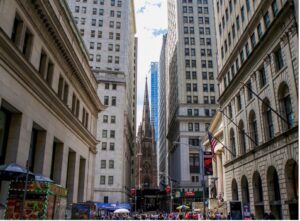
But what really floored me – and why this didn’t happen when I was here before I don’t know – was the dozens and dozens of astonishingly massive and beautiful buildings that were designed and built during the two boom periods of the Industrial Revolution, and particularly during the “second” revolution from about 1870 to 1930, when NYC became not only the financial and trade center of the United States, but of the entire world.

Looking at these buildings this time, I could see, in the use of materials and the level of craftsmanship, the impact of that immense economic transition – the greatest expansion of wealth (for all economic classes) in history.

I could also see a reverence for the ancient roots of Greek and Roman architecture and art, as well as affection for the neoclassical reinterpretation of those roots that spread all over the world in the second half of the 19th century.

I was in awe – swept away by the same sort of emotional reaction I have had when touring places like the Roman Coliseum, Vatican City, and, when I was much younger, the mansions of Andrew Carnegie, Cornelius Vanderbilt II, Henry Clay Frick, and even Vizcaya, James Deering’s estate in Miami.

I’m writing this at The Wall Street Hotel bar, loosened up by a double Milagro Reposado on the rocks and still inspired. I was looking around all afternoon, gob-smacked and thinking, “What an amazing place this must have been to live in when those buildings were built.” The world was in the throes of the greatest spurt of wealth creation in human history, and the financial heart of it was right here in this square mile of New York City.

I actually wondered if America could be that great again!

True Story: The Mugging of My Wife 

We lived on 15th and Corcoran, a pretty safe neighborhood, but a block from 14th Avenue, which was the dividing line between the White population and the Black population and also a street on which hookers were still standing on corners in the early morning.

The story I want to tell you is this: We had just picked up our toddler from his daytime nanny’s house and parked our car a half-block from our place. K started to fold up his stroller while I carried him to the house. She did not join me at the front door a minute later, as I expected, so I walked back to the car and found her sprawled out on the sidewalk. Someone had mugged her – had taken not just her money but her wedding ring.

“He had a gun,” she said.

I asked her what he looked like and which way he went. Then I got in our little Honda Civic and drove in that direction. As I approached 14th, I saw a man who matched her description sitting on a bench. I stopped the car and rolled down my window. Foolhardy, I know, but I was hoping to talk him into giving me the ring.

“Hey,” I called.

He looked up, put his hand into the pocket of his raincoat and stared menacingly at me.

So I kept driving, knowing that there was often a cop car parked at the next corner since it was just a block from a local donut shop. (I’m not making that up.)

Sure enough, the car was there, with two cops inside drinking coffee and eating donuts. I walked over to the driver’s side and tapped on the window. The officer at the wheel obliged me and rolled it down.

“What?” he said.

“My wife just got robbed at gunpoint,” I said. “And the guy that robbed her is sitting on a bench right back there.” (I pointed.)

The officer looked at me for a second, then looked back at his half-eaten donut.

“Dial 911,” he said, and rolled his window back up.

That’s my story.

Now, here’s that article by James Freeman in the WSJ…


Trump’s Not the Only One Seeing an Emergency in DC
By James Freeman 

Media folk still can’t resist rebutting the president when they should be covering him.

Now he’s got them pretending DC is safe. Even months into Donald Trump’s second term as US president, too many media folk still feel compelled to oppose him rather than report on him. One must either laugh or cry at the results as various Washingtonians in the press corps turn down yet another opportunity to practice journalism.

Kristine Parks reports for Fox News: MSNBC host Joe Scarborough suggested that some liberal media figures blasting President Donald Trump’s federal takeover of Washington, DC, were not being entirely honest about their concerns over crime in the nation’s capital, on Tuesday’s “Morning Joe.”

Scarborough said he found it “interesting” that some reporters critically covering the Trump takeover have privately expressed concerns about their own safety.

“This is interesting,” Scarborough said. “I actually heard from a reporter when this happened, going, ‘Well, you know, if he doesn’t overreach, this could actually be a good thing for quality of life,’ etc., because in DC right now, I had this happen to my family and I had that, and they go down the list. And then I saw him tweet something completely different.”

The Journal’s Faith Bottum notes: There’s no doubt that Washington is terribly run. Its most recent peak of violence, in 2023, saw the overall crime rate climb to more than double the national average, with the violent crime rate more than three times as high. It had the fifth-highest murder rate among big US cities and the highest rate of car theft.

But since the elected official currently calling attention to violence in DC is Donald J. Trump, the media urge to issue “fact checks” of factual comments has again proved irresistible.

David Klepper of the Associated Press writes: TRUMP: “The murder rate in Washington today is higher than that of Bogota, Colombia, and Mexico City. Some of the places that you hear about as being the worst places on Earth, much higher. This is much higher.”

THE FACTS: It’s true, but Trump isn’t telling the whole story. Washington does have a higher homicide rate than many other global cities, including some that have historically been considered unsafe by many Americans. But Trump is leaving out important context: the US in general sees higher violent crime rates than many other countries.

While Washington is one of America’s most dangerous big cities, others have higher crime rates.

On X, crypto investor Nic Carter satirizes the AP report: “It’s true, but it needs more context. The context is that we don’t like that particular fact.” Thanks for this fact check AP. Excellent work.

Also on X, New York Times correspondent Peter Baker opined this week: Citing a nonexistent crime crisis, Trump plans to take over the Washington DC police and put troops in the streets of the nation’s capital.

Fox’s Brit Hume responded: If the crime crisis is nonexistent, why is the city under an overnight curfew for kids 17 and under?

The website of Washington’s Metropolitan Police Department helpfully notes the recent history that occurred prior to this week’s media-enraging Trump press conference:

The Juvenile Curfew Emergency Amendment Act of 2025 took effect on July 7, 2025. An 11:00 p.m. curfew is now in effect citywide every night for all persons age 17 and under through August 31, 2025…
 
The Juvenile Curfew Emergency Amendment Act of 2025 states that persons age 17 or younger cannot remain in any public place or on the premises of any establishment within the District of Columbia during curfew hours, unless they are involved in certain exempted activities.

The law gives the Chief of Police the authority to establish Extended Juvenile Curfew Zones and allows the Mayor of the District of Columbia to authorize an Emergency Juvenile Curfew.

A press release from the DC government noted in June: Today, Mayor Muriel Bowser, working with Ward 2 Councilmember and Chairwoman of the Committee on the Judiciary and Public Safety Brooke Pinto, announced the Juvenile Curfew Emergency Amendment Act of 2025, emergency legislation to strengthen and enhance enforcement and accountability tools for juveniles, with a specific focus on a stronger and more flexible curfew program.

“Most of our young people are doing the right thing, but unfortunately, we continue to see troubling trends in how groups of young people are gathering in the community – in ways that too often lead to violence and other unlawful behaviors,” said Mayor Bowser. 

“And when we see patterns of unsafe or unlawful behavior that put young people and the community at risk, we have to act. This emergency legislation gives us stronger, more flexible tools to prevent violence and disorder before it starts and to keep our community safe.”

A May press release from the mayor’s office had described the effort to update the city’s curfew law and noted “recent disturbances involving juveniles in commercial areas across the District.” The release continued:

“We want our young people to be able to socialize safely and appropriately. But we are seeing some very concerning trends and concerning behaviors, and these changes in behavior require changes to our public safety posture,” said Mayor Bowser.

The last of the cousin-campers departed for various destinations around the world on Saturday afternoon. That evening, K and I had dinner at the eatery nearest to the hotel, which turned out to be a very good restaurant – maybe the best one we ate at during the trip.

How can I describe how I was feeling? Two portmanteau words of my own invention come to mind: exlated and elausted– the feeling I often get after a Cousin Camp. After a week to 10 days of excitement and elation, the bottled-up exhaustion begins to take hold of the body and mind.

Looking back on our time in Portugal, there are a few things that keep coming to mind – the good, the bad, and the “meh.”

The Wine: The Portuguese are known for making port wine, but their dinner wines – from fruity whites to densely aromatic reds – are very, very good. I suppose, had I done any preparatory reading on this, I wouldn’t have been surprised by their quality. But I was. In fact, I didn’t have a glass of any wine I thought was “not good” during the entire trip.

The Food: I was disappointed with the food – especially the food we were served at Cousin Camp. (Though I should say that, as a group of 40, we were eating catering-style – ordering from a limited menu and expecting the kitchen to try to make all of our meals in about half an hour.) The fish dishes that I tasted ranged from oversalted to bland to ordinary. And the meat was worse. Most of it was tough and overcooked. I had only one good meat dish – a tender scallop of veal in a pool of tasty brown sauce.

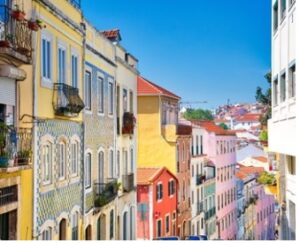
The Architecture: I’m not sure how to describe it. It goes, in vintage, from the 16th century to the 1970s. The mainstay in terms of style is Spanish Renaissance, but there are touches of Italian Baroque here and there, and a fair amount of Moorish influence in the design of the parapets and windows.

The Statuary: I saw at least a thousand statues in Porto and Lisbon, and I could count the number of marble statues on the fingers of one hand. Most of them were carved from wood. And there is something about wooden sculpture – and maybe this is just me – that makes it seem less impressive and imposing. And since wooden statues were generally produced by the dozens in artisan factories, you don’t get the fun of discovering, in the apse of an out-of-the-way chapel somewhere in Rome, a singular statue carved by Bernini or Borromini

K and I are in Lisbon. We’ve been here for two days getting ready for the incoming tide of 40+ Fords and Fitzgeralds that will all be here with us – if their flights go as scheduled – by the end of today.

I’ve managed so far to stick to my policy of working only six hours a day when I’m on vacation, thanks to K’s indulgence. But she’s had me putting in at least 10,000 steps a day seeing the sights, visiting the museums, and enjoying the neighborhoods and parks.

I’m happy to say that, given the limited time I’ve been here, I’ve managed to come up with two gross generalizations about Portugal and the Portuguese, which I believe with all my heart, as well as an observation about the power of paintings in museums when they are placed among other forms of art. At this point, I can’t say that I believe this one with all my heart, but I’d like to.

Gross Generalization #1:
The Portuguese Are Aggressive Drivers 

Every taxi and Uber driver that drove us in Porto and Lison drove at least 50% over the speed limit. Our first Uber driver, taking us from the Porto airport to our hotel downtown, was literally doubling the speed limit at every point along the way. He was especially happy speeding around a twisty section of road, thrusting the car back and forth. At first, it felt like we were racing along on two wheels. But as the minutes passed, I began to realize that he wasn’t a crazy driver. Like taxi drivers in Korea, China, and Nigeria (to name a few), he was skillful, like a race car driver, and I could see that he took pride in his skill. Maybe it’s a thing in Portugal, a remnant of some tradition that lingers.

Gross Generalization #2: 
The Portuguese Are Musically Inept and Un-Cool

Live music is standard fare in the tourist haunts of Porto and Lisbon, and most of it is US and UK rock and roll. You will be entertained by it almost anywhere you go – in bars, restaurants, nightclubs, on subways, at amusement parks, and on sidewalks along every road from one tourist attraction to another. What’s remarkable about it is how bad it is. The singing. The playing. And worst of all, the interpretation. I must have passed at least 50 street musicians during my time here, and I don’t think I heard one competent musician or one song sung on key.

By the way, I’m not saying the Portuguese are the only people who can’t sing our songs. The French are just as bad. I don’t know why. Let me know if you have a theory.

Observation About Art: Paintings Still Rule

“Traditional” two-dimensional painting is, to me, the most compelling visual art. In a museum, sculpture can take me in. But in a room with sculpture and painting, I’ll be putting most of my attention to the paintings. Monumental sculpture will absorb me – but outside, where it belongs. There’s no competition with painting there… nor is there competition with video art. That is its own thing. But in a large room with all sorts of installations and kinetic art and other media, a single painting, on its own, in a corner, will draw me to it.

That’s all I’ve got from my Journal today, and it may be all I will have till the 10th, when we fly back to Florida.

Até a próxima semana!

Greetings from Portugal! 

K and I are in Portugal for 12 days. The first five days by ourselves to check out Porto, which K tells me we’ve never visited before. And next week in Lisbon, where we will be meeting with 40 Ford and Fitzgerald family members for our 19th biannual Cousin Camp.

We hosted the first Cousin Camp in a beach house on Martha’s Vineyard in 1989. Back then, the “cousins” were toddlers and young children. Now, half of them are married-with-children, and the eldest is 45. They will be traveling here from both coasts of the US, and from Canada, France, and the UK.

The reason we call these things “Cousin Camps” rather than “Family Reunions” is because our initial reason for doing them was about not just getting together with our own siblings, but giving our three boys the opportunity to know and form friendships with their cousins – something I didn’t have growing up because all my cousins lived in Colorado, which, from a travel-cost consideration, might have been on Mars.

And forgive me if you’ve heard this before, but of the many significant investments I’ve made in my life, the Cousin Camps are certainly one of the best. When I hear that one of my French-American nieces is spending her holidays with her British cousins in London, or that two of my nieces, one a cryptocurrency millionaire and the other a Broadway star, are “besties,” or when I see how relaxed the ball-breaking bantering is between my boys and my nephews, I think, “Now that’s a good ROI!”

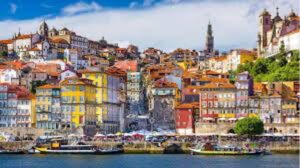
In Porto, we are staying in the Gaia district, on the shady side of the Douro River, where the country’s wines and ports are grown and stored. We’re at the Tivoli Hotel, which was built around the centuries-old port wine cellars of Kopke, the oldest port wine house in the world. The hotel building, like almost all buildings on this side of the river, looks like a 19th century warehouse with a facelift, which is probably exactly what it is.

But the inside is contemporary, clean, and minimalist, with accents of exotic woods and fine fabrics, muted lighting, and an astounding collection of artwork in abundance, indoors and outdoors, including a suite of large crayon illustrations by Jean Claude Basquiat in the spa.

Taking a tour of the facilities when we came in, we were casually escorted past at least 100 pieces worth, by my rough calculation, at least $50 million. The combination of art, interior architecture, and décor reminds me of Benesse House in Naoshima, Japan, which I wrote about when I was there last year.

I’m writing this in the late afternoon at the pool bar, recovering from a six-hour march up and down the steep stone streets of the city on both sides of the river.

Suzana, our guide, recommended by friends who were here earlier in the year, is impressively knowledgeable about all things that matter (i.e., history, architecture, culture, art), proud of her country, and yet unafraid to answer delicate questions. She’s everything I look for in a tour guide in a foreign country, especially one about which I know very little. And that’s all I can reasonably expect. But Suzana has two other qualities – frosting on the cake, as far as I’m concerned: She is completely ignorant about economics, which makes her social and political commentary adorably quaint. And she has a full set of opinions about the virtues and shortcomings of every nationality on Earth, which she is happy to discuss with you in conspiratorial tones.

Self-Aggrandizing Travel Note: After 60+ years of seeking out conversations on such matters as largesse in tipping servers, voice control in restaurants, and courtesy in moving through crowds, I consider myself a world-class expert. And, yes, since you were going to ask, I would consider – given the right multimillion-dollar offer – publishing my notes in book form someday.)