The Geriatric Language of Lov

“We are born crying, live complaining, and die disappointed.” – Thomas Fuller

You Just Don’t Understand was considered groundbreaking in its day. It was on the NYT bestseller list for nearly four years, eight months at #1, and was translated into 31 languages.

But in recent years, as you can imagine, it has been criticized for its unwokeness. A typical comment was made by someone named Alice Freed who grumbled that it “simultaneously perpetuates negative stereotypes of women, excuses men their interactive failings, and distorts by omission the accumulated knowledge of our discipline.”

As I said above, the book’s thesis is that, from childhood, boys and girls learn different approaches to language that result in communication problems when they get older.

One of those many problems concerns how and why men and women complain. Women, Tannen says, often complain to establish rapport and to seek understanding, which they get from other women. Men are generally reluctant to complain because they see it as an admission of failure. But when they do complain, they are generally asking for solutions. And that is exactly what they get when they complain to other men.

But when men and women complain to one another, things go awry. When women complain to men, men assume they are looking for answers. So, they give them answers – which is pretty much the opposite of what the women want.

There is a wonderful little video on this, which shows the dichotomy succinctly and hilariously:

Over the years, I’ve tried to remind myself that sometimes sympathies are more wanted than solutions. It’s not an easy thing to remember and a tougher thing to do. I try, but I’m thinking: “What bloody good is this nodding and comforting doing? I know the damn solution. Why can’t I just say it and save us both some precious time?!”

That was then. This is now.

As I reluctantly edge into my seventies, I’ve noticed a surprising change – at least in my personal life.

As my body descends ever so gradually into incapacity (on its way to dust), I find myself complaining to all who will listen about the many symptoms of this decrepitude that bother me so. I want to talk about my painful knees, my arthritic fingers and toes, the steady, almost daily, ebbing of physical and mental energy, etc.

My coevals seem to enjoy these conversations, too. And when we have our bitch fests, we do it like men. Each complainer is allowed about 2 minutes of whining for which he must endure about 10 minutes of mansplaining how his problems can be solved. And I’m fine with that. In fact, it’s quite good, because the various solutions offered are often contradictory, which offers an opportunity for a third stage of vigorous testosterone pumping or dumping debate.

But I’ve noticed that when I make these same complaints to K and she gives me much of the same advice (“Stop eating ice cream… Stop wrestling… Get more rest…” etc.), I am not pleased at all.

K’s advice is every bit as solid and sensible as the advice I get from my male friends. But I find that I don’t want it. I want what I used to believe only women want: words and gestures of sympathy, expressed with a bit of cooing and petting. Nothing less. And certainly nothing more.

I’m sure, if Deborah Tannen were my counselor, she’d tell me to simply explain what I want (need?) from K and that everything then would be alright.

In fact, I’ve tried that. But the conversations have usually gone like this:

Me: [Complaining…]

K: [Giving me advice…]

Me: “I know that. But I really just want…”

K: “Well, if you know what to do, then do it. Or stop complaining!”

3 Surprising Facts About the Border Crisis 

* US Customs and Border Protection agents apprehended 172,000 illegal aliens along the border in March, the largest surge ever. (National Border Patrol Council)

* Of those, 19,798 were unaccompanied minors. (Mostly teenagers.) That is the largest number ever recorded.

* The average cost to care for each child in a temporary facility is $290 per day. That rises to $775 for children in temporary facilities, according to HHS officials. The total cost per week now: $60 million.


3 Scary Facts About the US Economy 

* In March, US debt passed the $28 trillion mark, an increase of $4.7 trillion over 13 months. (The Washington Post)

* The US economy (measured by GDP) is growing again since some of the shutdown measures were relaxed and/or removed. Still, GDP growth rates are about half what they were in the 1970s and 1980s.

* The global share of US-dollar-denominated exchange reserves (Treasury securities, US corporate bonds, US mortgage-backed securities, US Commercial Mortgage-Backed Securities, etc. held by foreign central banks) dropped to 59% in the fourth quarter, according to IMF’s COFER data released at the end of March. This matched the 25-year low of 1995.


 6 Random but Revealing Facts 

* 2020 marked the largest year-to-year increase in murders in the history of the country.

In Minneapolis alone, the murder rate doubled.

* The cannabis industry created 77,000 new jobs in 2020, and sales hit $18.3 billion.

* There are more trees on Earth than there are stars in the Milky Way. Every year, we lose 18 million acres of forest – an area the size of Panama. Since trees are a major carbon sink, deforestation also accounts for 15% of total annual greenhouse gas emissions.

* The US population grew by only 7.4% over the past decade, the smallest increase since the 1930s. The biggest cause of the population slowdown is the declining birthrate. (US Census Bureau)

* Nearly three-quarters of Americans agree that voters should show photo ID before being allowed to vote, according to an AP poll.

* “Beethoven became more original and brilliant as a composer in inverse proportion to his ability to hear his own – and others’ – music. But maybe it isn’t so surprising. As his hearing deteriorated, he was less influenced by the prevailing compositional fashions, and more by the musical structures forming inside his own head. His early work is pleasantly reminiscent of his early instructor, the hugely popular Josef Haydn. Beethoven’s later work became so original that he was, and is, regarded as the father of music’s romantic period. … Deafness freed Beethoven as a composer because he no longer had society’s soundtrack in his ears.” (Tune Out to Tune In)


5 Passing Thoughts I’m Chewing On 

* Somebody who says lots of wise things recently wrote: “It’s almost always better to learn from peers who are 2 years ahead of you than mentors who are 20 years ahead of you. Life evolves and most insights get outdated.” I say: Advice from those that are 2 years ahead of you will be useful in moving your business forward in the moment, but if you want to be in business in 20 years, listen to the old guys too.

* When you build the business around your own talents, its growth potential is limited to who and what you are.

* Entertainment is the surest way to weaken the human mind and diminish the human soul.

* Politics is based on power. Capitalism is based on wealth. The way you rise in politics is by acquiring more power. The way you rise as an entrepreneur is to acquire more wealth. The difference between the two is the nature of the currency.

* Next to Shakespeare, Vladimir Nabokov may be the greatest writer of tragedy since the Greeks. He is that very rare writer who is a master of the five Aristotelian elements of tragedy (which are still applicable to modern tragedies of all kinds, including novels). Nabokov is a master when it comes to plot, which, Aristotle correctly pointed out, is the most important of the five elements. But he is also a master of characterization, of diction (verbal expression), of thought, of song, and of spectacle.


 7 Statements I Want to Quote 

* “Joy is not in things. It is in us.” – Charles Wagner

* “I don’t want to get to the end of my life and find that I lived just the length of it. I want to have lived the width of it as well.” – Diane Ackerman

* “He who has peace of mind disturbs neither himself nor another.” – Epicurus

* “The lowest form of popular culture – lack of information, misinformation, disinformation, and a contempt for the truth or the reality of most people’s lives – has overrun real journalism. Today, ordinary Americans are being stuffed with garbage.” – Carl Bernstein

* “At any given moment, public opinion is a chaos of superstition, misinformation, and prejudice.” – Gore Vidal

* “Coming back to where you started is not the same thing as never leaving.” – Sir Terry Pratchett

* “In order to enjoy life, we should not enjoy it too much.” – Vladimir Nabokov


 9 Worthy Words I’m Going to Work Into Conversations

* exegesis: I heard or read this word at least 100 times during my graduate school years. I always thought it sounded impressive. I knew, from context, it was something that scholars did. But what exactly that was, I never took the time to find out. I came across it recently again and looked it up. It turns out it’s an academic synonym for “explanation.” Example: “If you think biblical exegesis is difficult, try explaining the US Tax Code.”

* heuristic: Another word I remember from graduate school but never used. It means “enabling one to learn something for himself.” It’s from the Greek word heuriskein for “find.” Example: “The pottery professor’s heuristic technique helped students discover their own sculpting style.”

* forfend: Forfend, a word that was first used in the 14th century, is still used, though nowadays it bears an antiquated patina. It means to forbid, to ward off or to prevent. Example: “All too often, the selfie is looked down upon with condescension, viewed as the narcissist’s calling card, treated with scorn and disdain. But why? Heaven forfend we show evidence of loving ourselves.” (Rachel Thompson)

* digerati: This word is de rigueur in conversation today. It refers to people that work with or teach information technology. Example: “Betty had complete faith that if she couldn’t fix her computer, the company’s digerati could.” Interesting… I could find no singular form of this word in any of the dictionaries I looked at. I suggest digeratum.

* holus-bolus: Here’s a fun word for you. Holus-bolus means all at once, as in “The guests arrived holus-bolus.” The derivation is uncertain, but it might have come from the Greek hólos bôlos (“clump of earth”).

* leitmotif: Another academic term. It means theme, as in “The futility of action was a leitmotif the author returned to over and over again.”

* inosculate: To join together in an intricate way. Example: “The toymakers shaped the product so that the pieces would inosculate while stored.”

* trenchant: Sharp; intense; forceful. Trenchant is often used to describe commentary or criticism. If you have a trenchant delivery, you’re known for your biting wit. You’ll be in good company with the likes of Oscar Wilde, Joan Rivers, and Jon Stewart. Example: “The professor’s trenchant critique discouraged her so much she considered dropping the class.”

* sprezzatura: Nonchalance; being (or feigning being) in a calm or relaxed state; studied carelessness, especially in the arts. Example: “At first glance, the mural seems unfinished, but it’s actually a lovely example of sprezzatura.”

After reading my comments about this year’s Oscar winners, my friend A.S. wrote to say:

Your blog today motivated me to give you my opinion of the movies this year.

I am so sick of movies that make me want to take my own life. Nomadland! Everything you said was true except it was boring. You wait and wait for something to happen, but it doesn’t.

Black Messiah was terrific, unbelievable! I agree that both supporting actors, which I thought were lead roles, were superb. The happenings in the movie were current events to us. We had sideline views of it all. Mayor Daley, Chicago, Mayor Rizzo, Philadelphia, were fascists that were viewed by many as good leaders at the time, the norm. What a country, huh?

I don’t know if you saw Promising Young Woman. I thought it was as good as the winner, Nomadland, but more entertaining. However, I thought the best movie of the year was Better Days. It was nominated for best foreign film but didn’t win. The maker of Another Round, the winner, lost his daughter just before filming. She was supposed to have a part in the movie. The Academy had to know about it and surely there was a sympathy vote.

I’m just sayin’…

I agree with A.S. on all counts.

And yes, I saw Promising Young Woman and Better Days.

I didn’t like the premise of Promising Young Woman… a revenge film for the MeToo movement. (Of course, we’ve had plenty of revenge films for white males… Charles Bronson and Michael Douglas come to mind…) I thought it was entertaining but not a good movie in the sense that it changed me in any way.

Better Days, though, was very good…

After the Shutdown Ends

With Biden and Harris in the White House and the Democrats fast on their way to controlling politics for the foreseeable future, the mainstream media has abandoned its narrative of fear and is pushing hope and prosperity instead. That, and Biden & Company’s willingness to spend trillions of dollars it doesn’t have, spells a new take on COVID-19: It’s time to party again.

The virus will continue to do its thing. This is as obvious today as it was 13 months ago, when I first started writing about it. The difference is that we will be treating it like the common flu. Except for the COVID Cards.

That’s what’s happening now. But what will the future look like? With the shutdowns on their way out, how much and how quickly will the economy recover?

A few of my colleagues are predicting a Financial Armageddon. These unpaid bills will have to be repaid, and it will not come from just the top 1%, as advertised. It will come mostly, as it always does, from the working and middle classes.

But I don’t think it’s going to happen this year. My guess is that we will see a strong stock market for at least the next few years as a result of the multitrillion-dollar government giveaway (checks that will eventually bounce). But the comeback will not be universal. Some business sectors, and even some industries as a whole, will never regain their former share of the country’s GDP. And some are likely to die completely.


THE CASUALTIES 


Movie Theaters 

In a recent poll by Deloitte, 35% of participants said they prefer seeing movies in theaters and probably would return when the restrictions lift. 52% said they were comfortable watching movies at home or on mobile devices and probably would not patronize theaters.

Prediction: Specialized, hyper-luxurious (and hyper-expensive) theaters will be tested, and might succeed if they can make the experience less about watching a movie and more about something else. But the big theater industry is doomed.


Shopping Malls 

Bloomberg reported a 60% drop (about $4 billion) in shopping mall values in 2020.

Prediction: Like movie theaters, there may be a small niche industry of specialized shopping malls in the future. But the large, multi-acre suburban and rural shopping malls of the past will be gone.


Large Bookstores 

Print book sales rose 8.2% in 2020 vs. 2019, according to NPD BookScan. But bookstore sales dropped 28.3%, according to preliminary estimates from the US Census Bureau.

Prediction: Large bookstores are going the way of the dinosaurs, but the extinction will take a decade or two to complete. The early casualties will be mainstream bookstores that are selling books and other products one can get more easily and sometimes more cheaply through Amazon. Smaller bookstores that offer comfortable seating, good coffee, and a soothing environment will be around for a while. Specialty bookstores – e.g., those that sell rare and limited-edition books – will survive.


In-person Adult Education 

Fall 2020 and Spring 2021 saw a 7% increase in enrollment at primarily online institutions, compared to a 5% increase in Spring 2020, according to EducationData. The online learning industry is projected to exceed $370 billion by 2026.

Prediction: Overall, online college, university, and professional education will continue to rise, even among Ivy League schools. This will happen gradually, as people discover that most traditional educational programs are costly and inefficient.


In-person Business Meetings 

Business meetings on Zoom are undeniably much more efficient than in-person meetings. They are more likely to begin with agendas, more likely to stick to those agendas, and highly likely to serve their purpose in half the time. And that’s to say nothing of the very significant savings in terms of time and money that travel used to account for.

Prediction: Many of my colleagues disagree with me on this, but they are wrong. We have seen the end of the in-person business meeting.

In-person Seminars, Conferences 

Multiple sources suggest that with smaller budgets, crowd anxiety, and available tech, a full return to the once $235 billion conference industry is unlikely.

Prediction: Information and promotional events – such as book tours, business seminars, and even some celebrity events – will lose their appeal as digital versions become more sophisticated and exciting.


Supermarkets, Grocery Stores 

According to Statistica Research, foot traffic fell dramatically during the pandemic. And between August 2019 and June 2020, the number of online grocery shoppers increased from 16 million to 45 million.

Prediction: The supermarket business won’t disappear entirely, but it will be radically transformed. In the next 5 years, expect to see many supermarkets being converted to Amazon distribution centers, with some allowance in some neighborhoods for personal shopping. But it will be considerably less than what exists today.


Big Box Stores 

Best Buy’s digital sales made up 43% of all its holiday sales in 2020, according to Bloomberg, a 25% increase over the previous year. Along with several other big box stores, they have announced that they will be converting some retail outlets to e-commerce fulfillment warehouses.

Prediction: Big box stores will do worse than supermarkets. This particular sector of the mega-market economy is in for a total wipeout.


Commercial Office Space 

An increasing number of accounting and law firms report that they will be investing in additional technology to make it possible for their employees to work remotely. (37% of accountants, for example, according to Accounting Today, are expected to work remotely in 2021.) Meanwhile, as working remotely increases, businesses are leasing less and less space. According to JLL Research, Q4 2020 saw a loss of 40 million square feet of occupancy.

Prediction: Professional office space use, which dropped by about 70% during the lockdown, will come back, but only to about 50% to 60% of its former size.


THE SURVIVORS 

There are many industries and industry sectors that will recover 100%. My guess is that they will be the businesses that sell, among other things, ambiance.

Here is my list:

* Restaurants and coffee shops

* Parks and beaches

* Resorts and cruise ships

* Sports stadiums

* Gyms

* Residential real estate (apartments, condos, single-family homes)

* Construction trades


THE SUPER-SURVIVORS 

There are some businesses that will not just come back 100%, but grow much larger because of the shutdown. Pfizer, Moderna, and Johnson & Johnson are obvious. But I’m betting that the biggest corporate beneficiaries will be those that service the digital economy, including business, education, news, and entertainment.

Here are five of them:

* Amazon may benefit the most, as tens of millions of Americans have habituated themselves to shopping digitally.

* Apple, not an obvious choice, has a fast track in the news and information sectors.

* Netflix, like Hulu and other streaming services, will soak up the business that won’t be returning to movie theaters.

* Zoom has become the go-to brand for business conference services, and has good potential servicing the consumer market as well.

* Google and Microsoft benefit from all of the above.

“Every great film should seem new every time you see it.” – Roger Ebert

Before You Start Your Academy Award “To-Watch” List…

Nomadland (2020)

Directed by Chloé Zhao

Starring Frances McDormand and David Strathairn

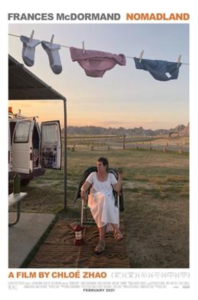
Nomadland was the big winner last Sunday night. It snagged Oscars for Best Picture, Best Director, and Best Actress.

I watched this with K on her recommendation. It is the story of a woman (Frances McDormand, in another impressive performance) that spends the later part of her life “traveling houseless but not homeless” in her van.

It is, as my old friend Ken Danz used to say, GSD (Grim, Stark, and Depressing) – in other words, it has what he considered to be all the best qualities. There is very little music. The photography is a big part of it (scenes from Nevada and the Western coastline). It is slow-moving at first, but then it takes hold of you. It is a critique of America, but vague enough not to insult the viewer’s intelligence.

And it’s a good movie. The characters are engaging. The acting is strong. The dialogue is believable. Like the best movies, it gives you a glimpse into a world that you’d otherwise never know.

It’s interesting to note that:

* Aside from Frances McDormand and David Strathairn, the cast is made up of regular local folk and actual, real-life nomads that go by their real names in the movie.

* For authenticity, Frances McDormand actually lived the “nomad” lifestyle in a van for months while making the film. At one point, she was even offered a job at Target by one of the locals.

 You can watch the trailer here.


Soul (2020)

Pixar, Walt Disney Pictures

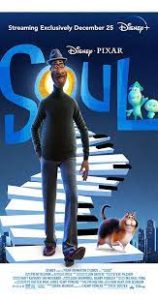
Soul, the first Pixar film to feature an African-American protagonist, won two Oscars: Best Animated Film and Best Original Score.

The film deserves the awards. The animation and musical score, which were integrated, were great. (One of the many impressive aspects of the animation was the close-up shots of the protagonist – Joe Gardner – playing the piano. These were done by matching video recorded data of the music being played by jazz musicians with the animated hand of Gardner, so that the keys being played on the piano matched exactly with the notes.) The story and the acting were predictable but good. And the imaginary landscapes were probably the best part of it.

This is not a movie for toddlers. But because the animated characters are friendly looking and because the story is (predictably) compelling, it could hold the interest of kids as young as six.

You can watch the trailer here.


Judas and the Black Messiah (2021)

Starring Daniel Kaluuya and Lakeith Stanfield

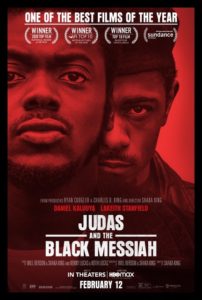
Much to my surprise, Judas and the Black Messiah won only two Oscars: Best Supporting Actor (Daniel Kaluuya) and Best Original Song.

I reviewed this movie at length on April 24. Some of my comments:

Judas and the Black Messiah  was good in many ways and very good in the most important way: It disturbed me and challenged some of my thoughts about police violence and racism. That was, of course, what it was meant to do. But I wasn’t an easy target. I could easily have dismissed it as weak, woke propaganda.

But some of the scenes of police brutality towards African-Americans reminded me of things I know from experience. That was the best thing about Judas and the Black Messiah. The next best thing was the acting. The two main actors – Daniel Kaluuya and Lakeith Stanfield – were phenomenal. Oddly, the awards have gone to Kaluuya. That, I don’t agree with. They both had very challenging roles – complex personalities that had to evince wide ranges of sometimes contradictory behaviors in convincing ways. But Stanfield’s acting was every bit as good and his role was more demanding. When you see the film, you can judge for yourself.

The secondary actors were just as good. And the movie had a plot with steady tension and well-paced forward momentum, quirky but effective editing, an experimental but successful sound track, and lots of interesting historical tidbits power-packed with ironies to wonder about. (Just think: You are watching a movie about BLM whose timeframe took place 50 years ago.)

Overall, it was gripping, compelling, and moving. In my opinion, it was possibly the best of the Oscar contenders.

You can watch the trailer here.


Another Round (2020)

Directed by Thomas Vinterberg

Starring Mads Mikkelsen, Magnus Millang, Lars Ranthe, and Thomas Bo Larsen

Another Round won the Oscar for Best International Feature. I reviewed this movie at length on April 10. Some of my comments:

Another Round is a Danish movie about four middle-aged school teachers who decide, as a sort of mid-life-crisis experiment, to start drinking “scientifically” to see if it might somehow improve their dreary lives.

The premise of the experiment is adorable: Some Danish philosopher suggests that the human animal is operating with a blood alcohol level that is 0.05 lower than it should be. The only way to operate at peak capacity, the four friends reason, is to drink enough in the morning, and continue tippling during the day, to achieve that level of non-sobriety.

Much of the movie is what happens when they do. Their teaching becomes more animated, their ideas more creative, and their personal relationships more passionate. And this is all fun to watch, as you might imagine.

But since it’s a Danish film, and not an American film, existential reality sets in. The dénouement is still sweet and uplifting, but also (as my old friend Ken would say) GSD.

I don’t remember having any thoughts about the production values, good or bad. I suppose that’s a good thing. I do remember thinking that the characterization of the four main characters and the performances of this ensemble cast were all excellent.

You can watch the trailer here.


My Octopus Teacher (2020)

A Netflix Original documentary

Directed by Pippa Ehrlich and James Reed

My Octopus Teacher won the Oscar for Best Documentary. I reviewed it very briefly back in October. This is what I said then:

If you are looking for something to divert you from the ugliness of US politics and inspire you to… well, not hang yourself, this little documentary is worth watching.

Directed by Pippa Ehrlich and James Reed, the film presents a magical year in the life of filmmaker Craig Foster. In 2010, Foster began free diving near his home in South Africa. While exploring a cold-water kelp forest, he came across a young octopus that exhibited an interest in this human creature. Very gradually, the two formed a relationship – a relationship of trust and curiosity that will astound you. It takes Jane Goodall and her experience with gorillas a whole step farther.

You can watch the trailer here.

The US is experiencing a hunger crisis, the NYT tells us, and the Biden administration is addressing this by “accelerating a vast campaign of hunger relief that will temporarily increase assistance by tens of billions of dollars and set the stage for what officials envision as lasting expansions of aid.”

“A hunger crisis?” I thought.

Where are the skeletal frames and bloated children’s bellies? That type of problem – for most of my life – has been located in Africa and Asia and is almost always caused by war and displacement.

But here in the USA? Could it be possible?

I was surprised by the Chauvin verdict.

As I said on April 1, I thought there was a good chance that he would not be convicted of all three, if any, of the charges against him.

I don’t know what was in Chauvin’s heart when he put his knee down on George Floyd’s neck. Was he hateful? Was he racist? Was he scared?

What I feel more certain about is that if he had been exonerated of all three charges, it would have lit a fire among BLM and Antifa activists and supporters.

So now we this high profile conviction, which will surely give many police officers pause. If I were a cop, I’d definitely think about it. But what will come of it? Will cops, in the execution of arrests, no longer feel that they are immune to charges of brutality and even murder? That would be a good thing.

Will there be less thuggishness in the treatment of the public? And in the treatment of Black Americans in particular?

Will it change policing generally?

And if so, how?


3 Facts About Police Killings in the US 

* Since 2005, there have been about 1,000 fatal police shootings each year.

* During that same time period, a total of 139 police officers were arrested for murder or manslaughter due to an on-duty killing. That = about 9 per year or an arrest record of about 1%.

* Of those 139 cases, 42 are still pending. Of those adjudicated 44 were convicted. So that’s 44 convictions out of 98 cases. That is a conviction rate of about 45%.

What I Believe 

* It’s not easy to succeed. That’s because success is defined as achieving that which is difficult for most people to do.

* Some people fail despite great effort. But most people fail to succeed simply because they aren’t willing to put in the effort required.

* Success is not directly correlated to happiness. In fact, striving for success is a primary cause of unhappiness.

The Rising Cost of the COVID Shutdown 

COVID-19 has so far killed 3 million people. Including 566,000 Americans. That tells us something about the virility and lethality of the disease, but not nearly enough to form an opinion about the efficacy of the government shutdowns.

For one thing, although there is no doubt that certain measures (such as social distancing and wearing masks) slowed the spread of the disease, we cannot know how many lives were saved by the lockdown. Equally important, when we look at the number of deaths attributed to COVID, it tells us nothing about how many years those people could have been expected to live.

[Although putting a value on a given human life is impossible, economists have developed the technique of valuing “statistical lives” – that is, measuring how much it is worth to people to reduce their risk of mortality or morbidity. This approach has been used as a standard in US regulatory policy and in discussions of global health policy.

There is lengthy economic literature assessing the value of a statistical life – for example, in environmental and health regulation. Although no single number is universally accepted, ranges are often used. In environmental and health policy, for example, a statistical life is assumed to be worth $10 million. With a more conservative value of $7 million per life, the economic cost of premature deaths expected through the next year is estimated at $4.4 trillion.]

Sometimes, the solution to a problem can be worse than the problem itself. Which was clearly the case with some of the most extreme and senseless measures that were taken. I said that several times with regard to, for example, the shutting down of beaches in California and Florida. The response I got was always a look of utter disgust and a reminder that “Every life is precious.”

Every life may indeed be precious, but every life is not equally valuable in terms of the public at large. (There is a difference between the death of an 80-year-old and a 20-year-old or an infant. Younger deaths are more costly in many ways.) That is why public health professionals have always measured the cost of preventive measures in terms of years of life lost (YLL) due to premature mortality for a given population, not for individuals.

The reason is so obvious I can’t bring myself to explain it.

But now that, thanks to the availability of vaccines and the fact that tens of millions of Americans developed natural antibodies by having the illness, we are nearing herd immunity. (A term that was verboten prior to the election.) And the data on the cost of the shutdown, in terms of all sorts of things, including ancillary deaths, is starting to come in.

This is only a fraction of the total data and therefore only a fraction of the costs that will eventually be tallied. But here is a sampling of what is available now…


Extreme Poverty 

More than 100 million people fell into extreme poverty in 2020. That is expected to rise to 150 million this year.

Why you haven’t heard of it: Virtually all of these people were in developing countries.


Hunger and Malnourishment 

The rate of food insecurity from 2018 to mid-2020 more than doubled (14% to 32%) for households with children. (The Brookings Institute). The number of undernourished individuals in the world increased to more than 700 million, including about 70 million children, since the pandemic began. (WHO)

Why you haven’t heard of it: Virtually all of these people were in developing countries.


Other Lethal Diseases 

Tens of millions of people in the US, Europe, and Canada could not get scheduled cancer operations. In the US, between April and October 2020, emergency visits related to mental health increased by 24% for 5- to 11-year-olds, and by 31% for 12- to 17-year-olds, compared to 2019. (CDC)


Drug Overdoses 

Drug overdoses skyrocketed throughout the US, Canada, and Europe. The US, for example, had more than 81,000 overdose deaths in the 12 months ending in May 2020, the highest number ever recorded in a 12-month period. That increase has not abated. (CDC)


Mental Illness 

Reported symptoms of anxiety and depression increased by 300% to 400% respectively. Of US adults surveyed, 10.7% had thoughts of suicide compared to 4.3% in 2018. (CDC)


Education 

About 24 million children may drop out of school next year as a result of the lockdown’s economic impact.

And how about this: Based on evidence that students that are deprived of educational opportunities live shorter lives, the closing of primary schools during the lockdown eventually may be associated with an estimated 5.53 million potential years of life lost (YLL). (JAMA)


Economic Losses 

There is no question: the cost of COVID-19 and the shutdown was huge. And it’s still growing.

The Congressional Budget Office projects that the cost to the US will be $7.6 trillion in lost output during the next decade.

 Worldwide, the toll is considerably larger. According to the semi-annual Global Economic Prospects report released recently by the World Bank, the world economy shrank by 4.3% in 2020. That may not sound like much, but it’s huge. It’s an economic setback matched only by the Depression and the two world wars.

But this figure still understates the total cost because it measures the world economy’s fall from where it was before the pandemic, not from where it would have been had the virus not spread. Calculating the figure that way, with a conservative expectation of 2.5% GDP growth in 2020, you would have a total loss of $86 trillion!

Among many, the fear of COVID-19 is great and the solution – universal vaccinations to achieve herd immunity – is incontestable. Some are calling for vaccination IDs, and even mandatory vaccinations.

Would that be constitutional?
In 1901, a smallpox epidemic prompted the Boston and Cambridge boards of health to order vaccinations of all its residents.

One of them, a Swedish-born pastor named Henning Jacobson, refused and was fined. He then took his case all the way to the US Supreme Court.

I wondered: How did the nation’s top justices rule? This is what I found.