Ram Jam, Thank You Ma’am: The Story of “Black Betty” 

I’m thinking of producing a documentary about “Black Betty,” a song that is often attributed to Huddie “Lead Belly” Ledbetter.

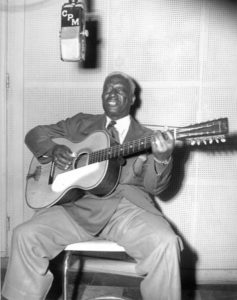
Lead Belly’s 1939 version is short – just one stanza – and simple. He sang it adagio and a capella – almost mournfully. Earlier versions, also sung a capella by chain gangs, suggest that it might have been a song from slavery days that he had adapted.

In 1977, the rock band Ram Jam recorded their own version, with two additional stanzas. It was fast-paced, with a strong bass and amazing guitar licks. It was, really, an entirely different song.

Ram Jam’s version was an instant hit, reaching number 18 on the singles charts in the US, and in the top 10 in the UK and Australia.

Then all kinds of hell broke out. Ram Jam was sued by the NAACP for copyright violation, and there was some objection to it in the media. (Expropriation and all that.) The net result was that the band was denied any royalties for their rendition. (Highly unusual.)

And then… what may be the most interesting part of the story. Ram Jam’s lead singer sort of disappeared, ala Searching for Sugar Man.

There is a YouTube rabbit hole you can go down that roughly documents some of this story. I’ve provided some of the videos below. (If you don’t have time to watch them all, just check out the 1939 Lead Belly performance and Ram Jam’s take on it 38 years later.)

Okay, here are the videos…

Lead Belly’s 1939 performance:

An earlier (1933) version:

The 1977 Ram Jam version:


For some of the story behind the song:

And here are people reacting to the Ram Jam version:

 “It’s not as though you feel satisfied after collecting a certain amount of stuff. Instead, you keep thinking about what you’re missing.” – Fumio Sasaki

 A Good Day at the Races 

One of the great pleasures of collecting art is bidding for it at auction. If you’ve ever participated in a competitive auction, you know how thrilling it can be. It’s exciting enough just to be in the action, but to come away with something you’ve wanted – and at the right price – that’s a feeling you won’t forget easily. I can compare it to being at the racetrack and seeing your horse come in.

If I were a mentally healthy person, I’d be spending most of my retirement buying and selling art. But since I have ADD, my art business/hobby is just one of a dozen activities I am involved in. I don’t have the time to bid at auction. When I see a piece I like in an auction catalog (I get them every day), I notify Suzanne, my partner in the art business and curator of one of my collections, and she gets the fun of doing the auction.

Because I’m a conservative investor, and because the art market is generally on fire, it’s rare for us to win anything these days. But sometimes we do. Yesterday, she told me we had won two pieces.

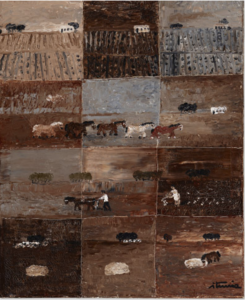
The first one is by Ignacio Iturria, a Uruguayan, one of my favorite Latin American artists.

Iturria was in commercial art and graphic design before turning to painting full time. Since then, it’s been pretty much all uphill for him.

He is not only a prolific artist, he has the talent to produce quality in volume. He is, as one critic put it, “generous with oil paint, building up lush textures on surfaces ranging from traditional (canvas) to unconventional (corrugated cardboard). His palette is dominated by muddy browns and earth tones that reflect the colors of the Platte River.

His work – quirky interpretations of dreams and memories – is considered Surrealist by some. I think that’s a fair categorization. To me, his landscapes look like Hieronymus Bosch meets iSpy.

After I bought this piece, Number Three Son (who is also a collector) wrote to ask me if I intended to keep it for my own collection.

I have no idea how he knew I won it. And now he’s put me in a difficult position. It is a really good piece at a very good price. Will I give it/sell it to him?

Stay tuned.

Oddly, the same auction had two Howard Finster oils up for sale – and I got one of them!

I’ve been a fan of Reverend Finster since I first saw one of his imaginary illustrations on the cover of Little Creatures by Talking Heads.

Finster believed that he was spreading God’s word through his work (he published religious songs and poetry and even hosted a radio prayer show in the 30s and 40s) and his art. His most famous work of art is Paradise Garden, a massive outdoor “museum” consisting of multiple walkways and buildings that he constructed out of… well, junk – broken glass, concrete, discarded objects, etc.  After his death in 2001, Paradise Garden, which is located in swampy Chattooga County, GA, began to decay.  It was acquired by the county, and ultimately turned over to the Paradise Garden Foundation with a 50-year lease for $1. The Foundation has not only maintained the property, it’s turned it into a profitable tourist attraction, providing tours and accommodations (a bed & breakfast) for visitors.

I have several pieces by Reverend Finster, part of a small collection of naïve and outsider art. This one will be a nice addition.

I’m actually shocked that I was able to get these two pieces for what I paid for them. Everything I’ve been bidding on for the last several years has gotten more expensive month by month. Why these two artists, whose work is superb in so many ways, are trading at these prices… I just can’t explain. But I’m not complaining.

Iran? Iraq?

Something I try to do every day: learn something interesting, useful, or in some other way worth remembering. This morning, during a conversation about I don’t know what, someone said, “Iran. Iraq. What’s the difference?”

The only difference I knew was that in 2003 we (the US) invaded Iraq. Not Iran. What else did I know? That was it!

So I spent a half-hour reading and took these notes:

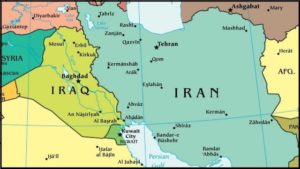
* Iran and Iraq share a 900-mile border and three-quarters of their names. However, the two countries have different histories and cultures, influenced by shared and unique invaders, emperors, and foreign rulers.

* Iran (pronounced ee-RON) was formerly Persia. Iraq (pronounced ee-ROCK) was formerly Mesopotamia.

* Iran means “land of the Arians.” Iraq means “city.

* Tehran is the capital city of Iran. Baghdad is the capital city of Iraq.

* Iran is 3 times larger than Iraq.

* Iran is a religious state (The Islamic Republic of Iran). Iraq is a constitutional democracy.

* The US invaded Iraq in 2003, and reformed its government. But not Iran.

* Iran is 90% Shia and less than 10% Sunni. Iraq is 60% Shia and almost 40% Sunni. These two Islamic sects have been fighting since the 600s.

* Both countries are major suppliers of crude oil, producing more than 4 billion barrels per day.

“Inside of every problem lies an opportunity.” – Robert Kiyosaki

 Where to Invest in Real Estate in 2021 and 2022? 

Back in June, I said that my partners and I had put a hold on plans for a $14 million company-occupied office building. Though I wasn’t concerned about the future of that kind of real estate, we wanted to see what would happen with the economy before committing to construction.

That was then. Here’s what I’m thinking now…

Office space will never recover fully. Those of us that own commercial office properties will be lucky if rental income climbs back up to 70% of where it was.

So where is the opportunity in real estate going to be in 2021 and 2022?

And what should my partners and I do with all these damn office buildings we own that will now be less than fully occupied?

In a recent issue of Empire Financial Daily, Whitney Tilson had this to say…

[In June] people were fleeing urban apartments and seeking more room for home offices along with private outdoor space.

Even that early in the pandemic, it was clear that the nature of work could be permanently altered – with less time in the office likely an enduring reality for many folks – supporting the possibility that temporary relocations could become permanent.

In October, I said pretty much the same thing, and noted an email I had received from a tenant in one of our buildings. They were not renewing their lease because “Our employees have told us that they like working at home and, as you’ve noticed from the monthly reports, the business hasn’t suffered in terms of revenues or profits. This will save us more than $100,000 next year.”

Whitney again:

What I didn’t appreciate at the time – and what has become a key tailwind for strength in housing prices – is how constructive the supply side of the equation has proven to be…. [T]ight supply is proving far more persistent than what a few weeks of building shutdowns would create.

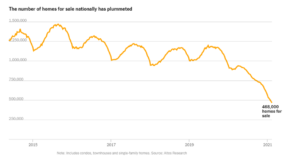
Put into hard numbers, there were nearly 500,000 fewer homes available for sale in February 2021 versus February 2020. You can see the dramatic decline in inventory in this chart from The New York Times

What’s driving the supply shortages?

Whitney has several theories:

* Some retirement-age people are putting off selling their homes until the COVID scare is over. “The idea of having a bunch of strangers traipse through the house you live in is off-putting in the best of times, and the past year held risks that went beyond mere inconvenience.”

* The supply of new housing builds “never recovered to the levels seen before the industry crash of 2008 and 2009. In classic feast-to-famine mode, the homebuilding industry may have overcorrected.”

* Low interest rates (which have been in place for nearly 13 years now) “have incentivized people to get into the landlord business.” (In fact, the number of homes for rent – not sale – has surged while the supply of new houses has dipped.)

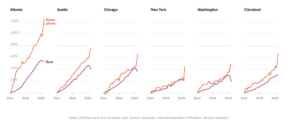
All of this suggests that the smart money should be directed into the residential housing market. But there is one caveat, which Whitney notes. For the last 8 years or so, the cost of new housing and new construction has been going up, but average rental income is falling.

From Whitney:

As this chart from the [NYT] article shows, it’s happening in nearly every major metro area…

That is, of course, the opposite of what you’d want if you were going to invest your money into building rental housing.

But Whitney is not deterred by this. He says:

At the risk of uttering the most dangerous words in finance, I would suggest that this time may in fact be different.

Rents are falling because renters still overwhelmingly live in apartments. According to a 2016 Harvard study, 61% of the US rental stock is multifamily (apartments), and only about 28% of rental properties are detached homes. (The remainder consists of attached homes, mobile homes, and RVs.)

Additionally, 46% of rental units are in cities, with 42% in suburbs and 12% in rural areas.

Moreover, notwithstanding the 30-year mortgage rate recently hitting 3% for the first time since July, rates still remain quite low on an absolute basis. Prior to July 2020, rates hadn’t been below 3% at any point in the 50 years people had been keeping track. Three percent is still a fantastic mortgage rate.

Whitney again:

I think this housing boom has legs and should be supportive of the homebuilders and building-products suppliers for several quarters to come. Many of the factors for a strong housing market – such as low interest rates, improving employment, and stable to improving consumer confidence – are firmly in place, and now a supply shortage has been layered on top of these macro factors.

So, what about all those buildings we have – that are now 90% vacant? What are we going to do with them?

I don’t know. My partners and I are having discussions about whether we should demand that all our employees return to their desks once the fear of the pandemic has abated. Some argue that we must, that physical proximity is the only way to optimize communication and to initiate new employees into the existing corporate culture. I don’t agree. I believe that many, if not most, of our employees have realized that there is no reason for them to commute to their jobs, and spend 8 or more hours inside a box inside a bigger box. They will want to continue to work as they have been working, from home or from a coffee shop or from a park. And I believe we will all work more efficiently with less physical contact.

What we do agree on is that we should let the CEOs that have been running these businesses successfully these past 12 months make their own decisions. And my guess is that will result in a decreased need for office space by at least 30%.

We are going to have to sit and see what happens for the rest of this year. In the meantime, I’m going to be thinking about converting some of that space into residential apartments!

A Surprising Benefit of the Lockdowns

I came down here at the end of March to check on some improvements we’ve been making at FunLimon. (FunLimon is the community development center my family and I have been developing across the street from Rancho Santana.) K joined me a week later. For 20 years, my/our sojourns in Nicaragua lasted a week to 10 days. There were always reasons to be back in the States or at some office in Europe or Asia or elsewhere.

But that all, suddenly and amazingly, changed in 2020. The lockdowns forced us to have our business meetings digitally and, notwithstanding predictions to the contrary, it worked out surprisingly well. We meet more often, spend less time in redundant conversations, arrive at decisions faster, and – speaking for myself at least – feel much more connected than before, when I was spending, on average, two months a year on planes and in hotel rooms.

And that is why we were able to spend so much time here this time. There was no reason not to stay longer.

I am grateful for that, and optimistic about how the Zoom environment is changing business. That’s a subject I’ll be talking about in a future posting. Today, as K and I are preparing to fly home, I wanted to share some photos and thoughts with you about why we are always happy to spend extra time in Nicaragua.

Progress at FunLimon!

Last week we inaugurated FunLimon’s new and improved facilities.

Among the improvements was a renovated gymnasium.

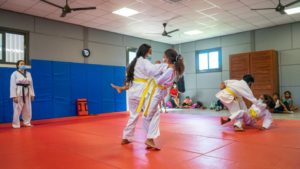
The gym now has new equipment, a room for group classes, a remodeled martial arts center, and AC for all. (But only when it’s above 80 degrees!)

We rebuilt the building in which we host English language, Spanish literacy, and computer classes.

We modernized the trade school building to allow for more students and more trades.

We built a brand-new building to accommodate the expanding personnel that work in management, and attached to that a suite of dorm rooms for visiting teachers’ volunteers.

We created a new service entrance and parking lot for our employees, and created a “quad” for students and visitors to rest in between classes.

Next on the agenda: expanding and improving the kids’ playground, and enlarging the soccer/rugby field to meet international standards. (One of Rancho Santana’s sponsored soccer teams has made its way up to Division B status.)

This next photo was taken at the Major League Players Association Clinic that is held at FunLimon every November. It is attended by 200 to 300 young adults and children.

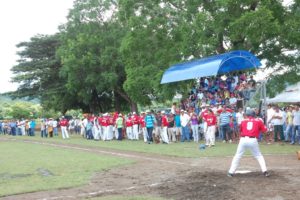
And this one is from a baseball game with the local men’s league…

Finally, here’s a photo of something we’re especially proud of – a recent graduation ceremony for people who have completed our various educational programs…


The Chauvin Trial

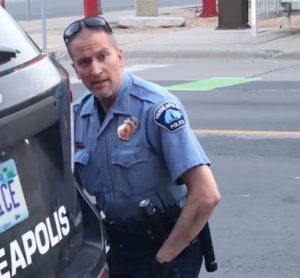
Get ready. There is a reasonably good chance that Derek Chauvin will be exonerated from at least one and possibly all three of the murder charges against him in the death of George Floyd.

And if he is, who knows what will happen. A lot depends on how much of what is presented at court is made public.

When video footage of the incident went viral, there was almost universal agreement that Floyd had been willfully and cruelly murdered by Chauvin. For nine horrific minutes, we witnessed the scene. An armed policeman, squatting next to a handcuffed black man lying on the ground, casually putting his weight on his knee on the back of Floyd’s neck, while the latter cries out, repeatedly, that he cannot breathe. This despite witnesses shouting that the man in custody was losing consciousness.

The death sparked outrage, which led to months of protests and violence and to the deaths of more than a dozen people and the destruction of millions of dollars in property.

And now the trial is here. And everyone is watching.

Based on the video, there seems to be little doubt that this incident was, at the very least, a case of second-degree (involuntary manslaughter) murder. But when you consider the fact that the cop was White and the victim was Black, you would have to ask yourself: If Floyd were White, would he be alive now?

I think it’s fair to say that the great majority – probably 90+% – of Americans expect Chauvin to be convicted of all three counts. And that’s because 90+% – of Americans know nothing more about the incident than what was shown on the video.

Chauvin has been charged with 3 crimes: unintentional, second-degree murder… third-degree murder… and second-degree manslaughter.

But the prosecution has a problem. Two problems:

  1. The autopsy revealed that Floyd’s death was due to an extremely lethal dose of fentanyl that he’d injected just before the arrest.
  2. And as horrible and irresponsible as it appeared, Chauvin and his fellow police officers were exactly following the protocols they were required to follow.

Neither of these two facts makes George Floyd’s death less terrible. Just the idea that he was detained and handcuffed for passing a counterfeit $20 bill is ridiculous. And the fact that, despite the fact that he was telling the truth about his claustrophobia, the arresting officers tried to force him in the car and then put him on the ground, face down with his hands cuffed behind his back… that is, in IMHO, completely inexcusable.

There are those and many other facts about this matter that demand a response in terms of policing. But as to the specific charges against Chauvin – I don’t see how he can be convicted.

If the defense can provide good evidence that the cause of Floyd’s death was primarily due to a mental and physical overreaction to the lethal amount of fentanyl in his system, I don’t see how the case can go any further. But even if the prosecution convinces the jury that the primary cause was not the drug but the restraint he was under, there is still the problem of making the case that Chauvin was “culpably responsible.” Because, as I said, he was following police procedure.

My feeling is that the legislature of Minnesota is guilty for allowing people to be arrested for non-violent misdemeanors, and that the Minneapolis police department is guilty of perpetuating outdated and dangerous strategies for dealing with people that resist arrest. And I think that the fact that Chauvin continued to follow “protocol” while it was evident that he might be endangering Floyd’s life makes him guilty of something he should get time for. But I don’t think that what he did meets the definition of any of the murder charges he is being tried for.

We’ll have to see what happens. But if there is any hope of avoiding another summer of outrage and violence, the major media will have to start reporting the truth – the whole truth and nothing but the truth – throughout the trial.

“Some people dream of success, while other people get up every morning and make it happen.” – Wayne Huizenga


Tryptic 

  1. Enrique 

Anna Julia asks me if I’ve seen Enrique. I tell her I saw him yesterday. We talk about how much he’s amejorando since his drunken, lawless days. I say it’s rare to see someone make such a positive and apparently lasting change in midlife. She agrees. I think but don’t say that I’m also proud of Enrique for weaning himself off my enabling charity. (I used to think of him as my bad son. That somehow made his dependence easier to accept.)

Twenty years ago, when he was 19, Enrique came to work for us as a gardener. He has a winning smile and a gentle demeanor. He is also bright. He began with just the most basic gardening skills, but as the years passed he became a very capable jack of many trades.

Impressed with his intelligence and good nature, I encouraged him to take classes in various trades offered at Fun Limon. Eventually, I put him into business repairing bicycles and motorcycles. I was optimistic about his future.

Everything was fine, except for Enrique’s drinking problem – which eventually affected his work. He was fired by the management company for coming to work drunk (and armed with a gun).

For the next several years, I would give him money and a pep talk whenever I happened to see him, and hope for the best. All that free help, like almost all free help, was useless. He could not hold a job, and became not just dependent on my largesse, but felt entitled to it.

About three years ago, for the first time, I refused his attempt to sweet talk me into another handout. But I told him that I would pay him five dollars for every day that he remained sober. At the end of two weeks, the day before we were due to go back to the US, he came to me and told me he had lived up to our deal. He looked sober, so I gave him his $70. And I told him that I’d continue the deal, but at the reduced rate of three dollars a day, until I saw him again on my next trip.

I didn’t expect him to stay sober, but he did. I gave him a part-time job working as a gardener at Fun Limon. And about a year after that, I discovered that he was back with his estranged wife and was making money on the side by fishing in the ocean in his spare time. Hopeful again, I encouraged him to turn his side hustle (as they call it today) into a real business. He did. And thereafter, every time I visited, he was at my house first thing the following morning with a basketful of mackerel, lobster, and whatever else he had caught.

I once again encouraged him to start his own fishing business. But this time, I didn’t give him any free money. I lent it to him, made him sign a formal loan, and had him repay me weekly.

He not only paid back the loan in full, he saved enough money to buy himself an old truck for $1,800. (Which I’m sure is the largest sum of money he has ever had at any one time in his life.)

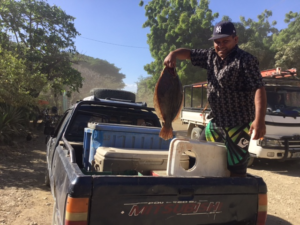
Here he is in the back of his truck, holding up… I don’t know what.


  1. Anna Julia 

Anna Julia tells me that when she is finished working at Rancho Santana, she wants to open her own little tienda. I tell her that she cannot retire from RS until she is my age. She laughs.

Anna Julia has a great laugh. It is completely unaffected. What I love about her is that she is not cowed in any way by me, her gringo boss. Quite the contrary, she likes to tease me (and K) and loves to correct my many solecisms in Spanish. I love that, too.

Anna Julia’s strong sense of self-esteem cannot be dismissed easily. There is a gulf between us – money, education, social status, skin color – that is tangible and ineluctable.  It is also something that neither of us can pretend doesn’t exist. Nor is it something that I can exorcise by treating her as my equal. That is the common vanity of the foreign interloper in all poor countries. You can convince yourself that your relationship is equal, but it’s equal only if the local person decides it is. It’s not up to you.

I don’t know how Anna Julia does what she does. I don’t understand how she is able to bridge that gap when so many others can’t. Her mien is agreeably independent. (She reminds me of K in that regard.) If you express a thought she disagrees with, she doesn’t even consider it. She laughs at you. In her world, which is the real world, you have just said something that is obviously absurd.

Having her own tienda is no guarantee that Anna Julia would make more money than she does now – as a domestic working for RS, plus the extra money I give her when we are here and the tips she gets from the people that rent our house. As is the case in every corner of the world, starting a successful business is a big challenge. Many are called, but few are chosen.


  1. Yessenia 

Our last housekeeper also wanted to start her own tienda – which I encouraged and funded. She had an idea for the business that made sense to me. Her tienda would sell clothing for children, something that was in demand but had no supply in the local area.

Yessenia wisely didn’t quit her housekeeping job. She took my advice and had an unemployed relative run the tienda while she was at work. The business grew slowly but steadily. About a year or two later, feeling upset by some change in her work schedule as a housekeeper, she quit and became a full-time entrepreneur.

The business was very solid for several years as Nicaragua’s economy grew, year after year. Unemployment dropped and wages went up. That meant her customers, mostly working moms, had more money for luxuries. (New clothes for children is still a luxury for most of Nicaragua’s working poor.)

Then, in early 2018, the tourist industry in Nicaragua suddenly collapsed after reports of government crackdowns and violence against protesters erupted in Managua and many other cities. Just as things were settling down from that, the COVID Crisis appeared. Gringo travel to Nicaragua dried up almost completely, and with it more than half of the employment that was related to the tourist industry, which, in this part of the country, was more than 50%.

Yessenia lost her business, just like millions of American business owners lost their businesses during the lockdown last year. There was no realistic hope of keeping her business open. There was no market for her wares. So, I asked Bismarck, our director at Fun Limon to give her a job, doing whatever he needed. She took the job, but not enthusiastically. Somehow, the disappointment Yessenia suffered when the business failed broke her self-esteem, which, unlike Anna Julia’s, was never particularly strong.

Today, Yessenia works like she always did – not energetically, but with resolve. The little spark that was there when she launched her business is gone. When I see her now, we hug and exchange warm words, but there is something unsaid between us – that gap again – that is sad.

Entrepreneurship is not for everyone. It is only for those that have the strength of character to fail and fail again. Yessenia had hope and she had trust, but she did not have that sort of strength. She had the dream and for a while she had the passion, but vision and passion are not sufficient for success.

Which is why now, as Anna Julia tells me that she’s going to start a side business, I resist the urge to urge to urge her on. I ask questions. I give her some counsel. But I don’t push.

But then I think: Anna Julia is not like Enrique or Yessenia. She has no discernable demons to derail her ambitions. And she is not fragile. Nor is she naïve. She’s worked hard and done without and suffered plenty in her life. Her strength is evident. Her spirit is strong. Her heart is brave. Her view of life is stoic and ironic, which seems just about exactly what it should be for a budding entrepreneur.

The national economy is soft, but the local economy is gradually coming back, thanks to Rancho Santana and a few of our neighboring resorts.

Employment in Anna Julia’s town, which is adjacent to RS, is relatively high right now. So, from that perspective – the demand side – starting a busines could have potential for her. On the supply side, however, there’s a question. If her idea is to open an ordinary tienda, she’ll be competing with a hundred small tiendas in the hamlets within five miles of the resort. Most of them are selling the same things. One admires their ambition, but worries about the chances.
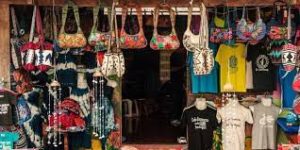
Anna Julia has thought of that. Her store will provide specialty items. She gives me examples, but because of her habit of speaking to me as if I am a native Spanish speaker, I can only understand about a third of what she’s saying. She will sell a certain type of shoe that is apparently in great demand, a certain kind of food that you can’t get anywhere but Managua, a certain type of something else that…

“Okay,” I say. “It sounds like you know what you are doing.” I tell her I will speak to Bismarck about enrolling her in our entrepreneurship program, which includes the opportunity for loans and investment if the business plan is strong.

I feel like she will be very happy and grateful for this offer, but she laughs at me instead.

What did I say that’s so funny?” I ask.

It’s not what you said,” she laughs. “It’s how you said it.” And once again, she corrects my Spanish.

A dollar isn’t much these days…

So, when you hear that our government is in the middle of spending $6 trillion that it doesn’t have, you might wonder: How much is a trillion dollars?

Here’s one way to get a sense of it (from Tom G):

1 million seconds = 11.57 days
1 billion seconds = 31.7 years
1 trillion seconds = 31,700 years

“The art of living is more like wrestling than dancing.” – Marcus Aurelius

What’s the Toughest High School Sport?

A Reader Remembers His 2 Weeks as a Wrestler 

From Joe M:

I was a basketball player in high school, but I tried wrestling senior year after I failed to make the team. (Last one cut.)

I thought I could learn a thing or two from the sport. An additional incentive was that two of my friends were wrestlers. It would be a chance to make new friends and enjoy the comradery of a team of wrestlers.

There was indeed comradery on the team, and I enjoyed that. What I learned was that wrestling is a team sport, but only secondarily.

The primary fact about the sport of wrestling is that, although you may be part of a team during practice, when match time comes, it’s just you and your opponent, out to beat the other, in front of everybody else.

I didn’t have the physical toughness back then to endure the hours of hard-core training. Nor did I have the mental toughness to endure the humiliation of defeat. Eventually, I had to accept what I had done – quit on myself. I promised myself I wouldn’t do that again.


My Non-Experience as a High School Wrestler 

I never joined the high school wrestling team, and I’ve always wondered why. Back then, I got into a lot of scraps – like two or three a week – and always considered myself a good grappler.

I did try out. During that tryout, I was tested against a kid that had been sectional champion the year before. He was a better athlete – quicker, stronger, and better coordinated – but I had a 10-pound advantage. I beat him easily, but illegally. The coach wanted me to join the team, but by the time we finished a “sample” practice I had decided, like Joe M, that it was far more work than I was willing to put up with.

I always regretted that decision, and I think for the same reason Joe M did.

I’ve never thought about it before, but I think wrestling may be the most challenging high school sport.

The physical challenge is enormous. You spend several hours every day, sometimes twice a day, training very, very hard in a hot and stinky room.

Sure, you train hard for team sports. But with team sports (think basketball, baseball, soccer, etc.), the athlete doesn’t have to go at 100% nearly 100% of the time. In fact, that’s counterproductive. With team sports, you learn the skill of intermittent effort: sprinting, then standing, then moving at a moderate pace, and then sprinting again.

With solo sports like tennis, you train hard, too. But again, you don’t have to go full out for the entire match. As with team sports, pacing yourself is key.

But with wrestling, there’s no such thing as a comfort zone, because the wrestler does not dictate the pace he must keep. His opponent does.

I came to understand the physical challenge of wrestling, when, at 47, I began practicing Brazilian Jiu Jitsu. And it has been responsible for keeping me in relatively good shape all these years (notwithstanding time out for three surgeries and many other injuries).  It’s just you and another person engaged in the most rudimentary competition – one person attempting to physically dominate and submit another person, in front of an audience that is rooting for or against you.

But the biggest challenge was, and is, the mental challenge of allowing yourself to fail and lose, over and over again, in a public arena.

Try it. You might like it.

Me, at 58, 12 years ago… after winning two firsts in NAGA (North American Grappling Association). I have selected this photo from several that were more relevant because I wanted to show you how I looked then. I’m 23 pounds heavier now, but I like to think that somewhere underneath the gentle slopes of my current body’s fat this old musculature remains.