Note: In response to numerous requests, I’m going to be touching on wealth building and investing every week, something I wrote about for years. I’m going to keep it short and simple. Two or three observations or ideas that (a) are not difficult to understand, (b) have obvious wealth-building implications, and (c) might help you avoid unnecessary financial losses and build your net worth carefully and steadily like I did for 40 years.


Clip of the Week: Buffett Is Hoarding Cash

Warren Buffett, generally considered the best stock investor of all time, is cashing in his stock in some of America’s biggest companies and moving into cash. According to Porter Stansberry, writing in The Big Secret on Wall Street, the total cash hoard is approaching $160 billion.

Buffett’s company, Berkshire Hathaway (BRKA), hit this record cash balance after selling off shares of three major American businesses, Proctor & Gamble (PG), Johnson & Johnson (JNJ), and General Motors (GM).

“Buffett purchased GM in 2012 shortly after it emerged from a government-engineered pseudo-bankruptcy. The unions were paid out about $0.90 of what they were owed, received a slew of preferred shares, and got board seats. The company’s creditors got robbed. They received about $0.10 on the dollar in newly issued equity that sat below the union’s preferred stock in the capital structure.

“Thus, today’s GM is a company born out of a crime. It’s since become a real-time litmus test of modern management theory – the idea that ‘diversity’ is an attribute in corporate boards.

“Today a majority of GM’s board members are women. I’d be willing to bet $100,000 that none of them can change the oil in their cars. Meanwhile, every member of GM’s board (according to the proxy statement) has expertise in ESG issues – the popular acronym for environmental, social, and governance. But only one board member (out of 13) has any automotive-industry experience – and that’s Jonathan McNeill.”

Continue reading Stansberry’s analysis here.


Chart of the Week: Will 2024 Be a Good Year for Stocks? 

I’ve heard it said that the stock market does well during election years. I shy away from generalized observations like that because every time I have researched them in the past, the data doesn’t support the claim.

Yet, there is something about such very simple ideas that is attractive.

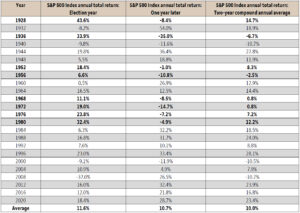
I found this chart from Wells Fargo. It shows that since 1928 the average return of the stock market has been 10%, while the average return in election years is 11.6%. That’s something. But now look at the range of returns for election years over time: from +43.6% to -37%!
 

Economic Craziness of the Week: Taxing Plastic Bags?

“Baltimore County, MD, is the first county in the state to implement a plastic bag tax at grocery and retail stores,” notes Garrett Baldwin in a recent installment of Postcards from the Florida Republic. “It’s not going over well. The radio hosts are complaining. The cashiers are apologizing.” (And Baldwin reminds us that Baltimore County is the same jurisdiction that enacted a “flush” tax not long ago to save Chesapeake Bay, with a $5 per month fee on sewer bills and a $60 a year fee for septic tank owners.)

The idea of a tax on plastic bags is to reduce the use of fossil fuels by forcing consumers to switch to reusable bags. (It’s estimated that about 12 million barrels of petroleum a year are used in the manufacture of plastic bags in the US.) But if it’s going to have any effect at all, it’s going to be minimal, experts say, because the petroleum used to make a half-ounce plastic bag is only a fraction of the petroleum used to produce the three to five pounds of purchased products those reusable bags usually contain.

In the same article, Baldwin mentioned a fact about oil and gas taxes that I’d never heard before. It helped me understand why federal, state, and even local governments like them so much. According to him, Maryland has a gas tax of 47 cents per gallon, 100% of which flows into the state coffers, while the oil industry, after locating, extracting, refining, and delivering that gas to Maryland, nets about 10 cents.

Why Housing Inflation Can Be the Worst Kind

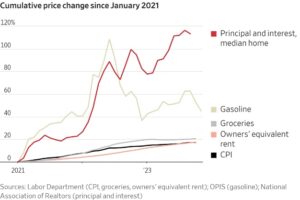
It seems like every other casual conversation I have these days drifts into the subject of the rising cost of living. In particular, the crazy cost of housing.

In this essay published recently by the WSJ, Greg Ip explains how unaffordable homes are undercutting the American dream even more than high gasoline and food prices.

The Politics of Crime 

No doubt about it. The increase in retail theft and the growth of other forms of crime in the last few years has had a devastating effect on local businesses in every major city in the US. How bad is it? Click here and here for a few studies that take a look at the issue.

Money: The Ultimate Incentive

“One of the greatest ironies of the modern world,” my friend Porter Stansberry wrote in a recent post on his website,” is how few people who enjoy the cornucopia of capitalism and free markets understand even the most basic elements of what creates wealth.”

In his masterwork An Inquiry into the Nature of Causes of the Wealth of Nations, Adam Smith, the father of modern economics, introduced the idea of “the price mechanism,” a “powerful, positive force of self-interest” that allows wealth to build rapidly among the entire population of a free economy.

By allowing thousands or even millions of individual actors to negotiate the price for things and services they want to buy and sell, Stansberry explains, a natural value is established for those things and services. That value rises and falls according to economic factors, such as supply and demand. And this, he argues, “allows farmers to know what to plant… industrialists to know what to produce… and capital markets to know what to finance and at what rates.”

“Absent this mechanism for communication and for rewarding production,” Stansberry says “an economy quickly falls apart. Instead of creating abundance and opportunity, society is soon rendered into competing tribes, each organizing only for their benefit. The result is poverty, anomie, violence, and desperation. And these changes happen fast – within only a decade or so.”

ADUs Are Hot

If you don’t know what an ADU is, you are in need of some emergency investment education.

ADUs (accessory dwelling units) are miniature houses the size of a large tool shed that are outfitted as complete residences. They are sometimes converted attics, basements, or garages. But they can also be freestanding.

They are a fast-growing trend across the US, and that makes sense. In an economy with high house prices, rising interest rates, and dollar-damaging inflation, having an extra dwelling on your property that can bring in extra cash each month is nothing but a good idea.

ADUs are also good for municipalities that are looking to increase real estate tax revenues. And they’re a boon to young couples and other new homebuyers that can’t afford $300,000 for a “start-up” home.

When a new business or economic trend benefits every constituent in the market, it’s a pretty safe bet that the trend will accelerate. That’s how I see the emerging ADU industry.

(By the way, I’m not talking about “tiny homes” here, which are very different than ADUs and IMHO a passing trend that I would not invest in.)

Click here.

Will Boomers Save the Economy?

Rates Rising = Less Spending = Looming Recession. Right?

That’s what I expected. I’ve been puzzled by how the Fed’s rate increases haven’t significantly reduced consumer spending. I mean I was not surprised at the level of spending that was going on after the COVID Cash Boondoggle. But by the beginning of this year, I figured (and had read) that most of that cash was back in circulation. Not to mention that job growth has been slowing and student-debt loan repayments have begun again.

A recent piece by Gwynn Guilford in the WSJ shed light on the conundrum. It’s about the spending habits of my generation. Baby Boomers, 65 and older.

In August, 17.7% of the population was 65 or older, according to the US Census Bureau. That was, Guilford noted, “the highest on record going back to 1920 and up sharply from 13% in 2010.”

“The elderly aren’t just more numerous,” she wrote. “Their finances are relatively healthy, and they have less need to borrow (such as to buy a house) and are less at risk of layoffs than other consumers.”

Added to that, they have less debt than their children and fewer big purchases in their futures – like new homes or college funds – to spend money on.

And listen to this: As a group, they are sitting on $771 trillion in wealth!

Read more here.

Alarm. Then Complacency.

Addison Wiggin, bestselling author and founder of Agora Financial 

At 2:20 EST on Wednesday, Oct. 4, every cellphone in America went off. Did you notice? It was a mass message from the Federal Emergency Management Agency (FEMA). The purpose, they claimed, was to be sure they can “effectively warn the public about emergencies, particularly those on the national level.”

“Spooky,” my friend Addison Wiggin’s son Henry wrote to his dad from his seat on an Amtrak train. “The government is tapped into all our devices!”

Henry described the experience on the train as mass concern and confusion, but just for a moment. “Then, within moments,” he said, “everyone settled back into a weird complacency.”

First confusion. Then complacency. That’s a pattern Addison sees happening in the financial markets today. Read his analysis here. 

Office Buildings Are Still Half-Empty

More than three years after the COVID Lockdown began and employees began working from home, the sentiment among CEOs about remote working has become increasingly negative. Almost every CEO I know is nudging (if not demanding) employees to resume five-day-a-week office hours. But they are telling me that even their best employees are resisting.

When I wrote about this issue on August 12, I predicted that, except for some obvious jobs that require physical presence (the service industry, retail, and much of manufacturing), most workers would resist going back to the old routine. But employers have been increasing the pressure, offering rewards and penalties – in some cases, making full-time, in-office work mandatory. This last weekend, I had a conversation with one of my nieces and her husband, who work in NYC and are facing this pressure from their employers. They say they are willing to make concessions, but they won’t return to their pre-COVID office hours.

Despite the widespread resistance, the WSJ reports that in mid-September, return-to-office rates were at their highest level since the onset of the pandemic. And yet, office buildings in the city are still half-empty.

It’s too early to know for sure, but I’m still betting that the new get-tough measures will not get more than half of the office desks and cubicles occupied with flesh-and-blood people. Which is why I continue to have confidence in my decision to cancel my plans to build a large office building in my hometown of Delray Beach, Florida.

But there is some good news for office landlords. Click here.

Is Florida Real Estate – Any Real Estate – a Buy?

Real estate has always been my favorite investment category. That’s primarily because the long-term trend has always been up. But it’s also because, at base, real estate is not complicated. And if you do the kind of real estate investing I do (rental properties), it is reasonably easy to avoid stupid mistakes.

Recently, there has been a surge in property values across America, and especially in states like Florida and Texas. In fact, from the first quarter of 2021 to the first quarter of 2023, the appreciation rate in Florida stood at an impressive 44.36%. This growth far exceeded the national average (by 20.15%).

But unlike a steady two-year climb in other assets, this two-year-plus rise in real estate values doesn’t tempt me to buy more. That’s primarily because, unlike stocks and bonds and many other asset classes, real estate investing – the way I do it – is relatively straightforward. You don’t need to understand 100-line-item balance sheets or 40-page P&Ls to understand what a particular piece of property is worth. Nor what sort of income you can expect from it. That information, which is super-important, can be easily researched by looking at public records or speaking to local brokers. As for the value trends and price fluctuations, if you put your money in rentals, and follow a few very simple rules, you don’t have to worry about being caught with a highly overvalued piece of property. The ROI questions you will have will not be if and when profits will go up but simply by how much.

Billionaires: The More the Merrier!

The number of billionaires in the world is shrinking. Not a good thing. Globally, billionaire wealth last year dropped by $500 billion. But in the US, the outlook is better. In 2022, the US added 55 new billionaires, going from 720 to 775.

I’m always curious about which industries are creating the big wealth. According to the research I did, finance, investing, and technology were the top billionaire producers last year, followed closely by food and beverage, fashion, and retail.

And where are these billionaires?

As you can see from the link below, the lion’s share of the super-rich live in just four states: California, New York, Texas, and Florida.

But things are changing. California and New York have been losing their super-rich residents in the last half-dozen years, while Texas and Florida are gaining (or creating) more of them. This is not a fluke. And for California and New York, it is a very bad thing. These state economies are huge, but their spending is insane. That means more debt that must be fueled by the only income state governments have: taxes.

But when your richest people are leaving your tax jurisdiction, you lose not only the huge taxes they pay, but also (very often) the huger taxes paid by their businesses if they, too, leave the state. Which is what is happening.

Click here.

JH Gives Me the Inside Scoop of Self-Storage

After reading my post in the Aug. 15 issue, my friend Jon Herring sent this in. Good, useful information for anyone who, like me, is looking at the potential of self-storage as an option for growing assets and increasing income.

Self-Storage as an Investment

By Jon Herring

My initial interest in self-storage stemmed from conversations with a longtime family friend who owns facilities in Georgia. He described it as the ultimate semi-passive real estate investment. Much lower maintenance compared to traditional rentals. And lower complexity on the operations and human resources side.

In recent years, I have been following a guy named Nick Huber. He started with the purchase of one or two existing self-storage facilities, where he would go in and:

* Do a cosmetic facelift on everything.

* Perform any deferred maintenance.

* Add automation wherever possible to reduce human resource requirements, improve renter experience, and increase security.

* Implement the latest technology for accounting, billing, communications, and security systems and procedures.

* Outsource rote, repetitive computer tasks to virtual assistants in the Philippines to reduce labor costs.

* Roll up any operational and management roles that were not absolutely required by a person at the location to a central operations group, so that multiple facilities could be managed by one team.

* Raise rents, especially in facilities with 100% occupancy. He would raise rents until enough tenants moved out to reach a market equilibrium of about 90% occupancy. (The basic idea is that 100% occupancy means you are not charging enough.)

* Add buildings/ additional units on properties where the real estate footprint permitted expansion and add outdoor storage for boats and RVs where permissible.

These improvements led to revenue increases, greater operational efficiency, lower overhead, and increased profitability. Which in turn led to increased valuations. (A rising real estate market helped.) Then after a few years, he would refinance at the higher valuation, take out his original investment, reinvest in another property, and repeat. And now he takes on limited partners in his deals, so he’s expanding that way as well.

Self-storage flew under the radar for a long time because it’s not a sexy business. It doesn’t have the “cool factor” of vacation rentals or rehab-and-rent real estate, for example. However, it is a GREAT business. It can be very profitable, with reliable revenues, high occupancy, low complexity, and low maintenance.

But here’s the thing… the secret is out.

There are a LOT more investors getting into the market. They are building new and hitting up every aging existing property with offers, driving up valuations.

But there is a niche with significant demand that I believe is more overlooked: contractor garages.

I’m sure you’re familiar with these facilities. The units are larger than self-storage, but smaller than an industrial warehouse. The space is about 1,500 square feet per unit, with a main door, large overhead garage door, half bathroom, and sometimes a small office.

These spaces are rented by builders, plumbers, electricians, artists, e-commerce companies, car collectors, etc.

From what I understand, this asset class has five times the demand of self-storage and less competition from investors and operators.

You mentioned that you wanted to learn more about this business, so I wanted to pass this along. I hope it’s helpful.