Slight Uptick in GDP, but Pink Slips Are Up, Too! 

There has been a bit of positive news on the economy recently. GDP is up slightly. And inflation is slightly down. Neither is significant. It feels temporary to me. On the negative side, US companies continue layoffs. I listed about a dozen examples on Nov. 22. Here are some more:

* Meta is backing out of a major New York office deal as it prepares to cut budgets across the company.

* DoorDash will lay off 1,250 employees.

* Crypto firm Kraken is letting go of 30% of its workforce.

* The mainstream media is doing it, too. CNN slashed more than 200 jobs, Gannett (owner of USA Today and dozens of local newspapers) cut 6% of its news staff, Paramount Global laid off 30 employees, and NPR is cutting more than $10 million from its budget and freezing hiring.

More Layoffs: A Sign of… What? 

As you know if you’ve been reading this blog for any length of time, I’m pessimistic about the economy. American GDP is down. Inflation is up. And rising crime and taxes are driving big companies and wealthy taxpayers from our major cities.

One of the bright spots has been employment. Starting with the COVID shutdowns and accelerating with the government bailouts, the number of Americans looking for work dwindled. That created a workers’ market, with two openings for every person looking for a job.

During that time, most of the businesses in which I’m involved were finding it challenging to hire and retain good employees. Many of their CEOs told me that their biggest worry was about losing those good employees. I told them that I didn’t feel that way. I felt that the imbalance was temporary. That the job-seeker/ job-opportunity pendulum would swing to the other side. And before long, millions of Americans would be looking for work.

As I mentioned here many times during those years, I believed the US was moving into a deep and extended recession. One reason for my pessimism was the fact that when sales ebb in the financial information industry, it’s an indicator that sales in the larger industry of corporate and personal finance will tend to drop soon thereafter. This has been the case for pretty much every economic downturn since I got into this business 40 years ago. And about two years ago, I began to see sales slowing down.

So, there was that. Then, as the months passed, I began to hear similar stories of declining revenues and profits from CEO friends in other industries. And recently, I began hearing the same story from the commercial and residential real estate markets.

It was all anecdotal and hearsay. But when the economic data alert re inflation and GDP began flashing early this year, I began to feel more certain about my worries. The assurances that these trends were temporary from the Biden administration’s economic captains, Janet Yellen and Jerome Powell, didn’t make me feel any better. No, I thought. Higher inflation and lower GDP aren’t going to be temporary. What is going to be temporary is the low unemployment numbers – the only positive economic data they had.

I’m not pretending that this is a solid economic argument. Consider it an update on a gut feeling. Take it or leave it. But since the feeling is strong, I’m going to be giving you news that serves to support or refute it.

Here’s an example – data gathered by Charlie Bilello, and published by Bonner Private Research:

* Twitter is cutting 50% of its workforce (3,700 jobs).

* Facebook is cutting 13% of its staff (11,000 jobs), its largest round of layoffs ever.

* Snap is cutting 20% of its workforce (1,200 jobs).

* Shopify is cutting 10% of its workforce (1,000 jobs).

* Netflix cut 450 jobs in two rounds of layoffs.

* Microsoft is cutting <1% of its workforce (1,000 jobs).

* Salesforce is cutting 1,000 jobs.

* Robinhood is cutting 31% of its workforce.

* Tesla is cutting 10% of its salaried workforce.

* Lyft is cutting 13% of its workforce (700 jobs).

* Redfin is cutting 13% of its workforce.

* Coinbase is cutting 18% of its workforce (1,100 jobs).

* Stripe is cutting 14% of its workforce (1,000 jobs).

There may be a way to put a positive spin on these facts. But to me, right now, it feels like recession.

The $32 Billion Crypto Scammer 

If you’ve heard about this crypto scammer but want to wait for Michael Lewis to finish his book or wait for the movie that will be made from it, here’s a good, short review of the story of Sam Bankman-Fried, who was hailed as the next Warren Buffett until his empire collapsed. Read it here.

How Ben Caballero Reinvented Real Estate Sales 

A typical agent in the US closes on 10 homes in a year, according to Mark Dent, writing in The Hustle. One 83-year-old in Texas does better than that every day. Check out this fascinating profile of Ben Caballero here.

 Backyard Rental Income 

Airbnb co-founder Joe Gebbia is launching Samara, a new venture that sells factory-produced apartments to rent out in your backyard. Click here.

Would You Ask This Question? If Asked, Could You Answer It? 

If I were in charge, nobody would be allowed to become an employee until he/she had spent some time running a business. And nobody would be allowed to run a business until he/she had spent some time as an employee.

Also, nobody would be allowed to voice an opinion about socialism unless they had lived in a socialist economy. And nobody would be allowed to say anything about capitalism unless they had lived in a capitalist country.

I know. That is illogical. Still, it’s how things should be.

I’m saying this in response to the video below. Here, you have a bright kid from a good university asking Milton Friedman what he believes is a “gotcha” question, only to learn how dumb a question it is.

It is evident that the hosts are not aware of these simple business measurement tactics. Don Lemon’s comment about Flay’s observation that we are in a bad economy (“They say we are…”) is almost mind numbing in its dumbness.

Job Growth in October Was Stronger Than Expected

Does That Mean the Economy Is Stronger Than I’ve Been Saying?

The Biden administration is telling us that the US is not in a recession. In fact, they say, the economy is “very healthy.”

Those are the very words Biden’s script doctors have put down in the binder that White House Press Secretary Karine Jean-Pierre reads from several times a week. When I see her at the podium, reciting these phrases, I have nothing but sympathy. Who thought it was a good idea to put this young woman in that job?

She knows nothing about finance or economics. And that was fine during her first few months, when the mainstream press threw her only the softest of softballs. But now that inflation is over 8% and America’s middle class, including those that watch the mainstream media, are worried, the questions she’s getting are a bit tougher.

She seems like a nice, bright, good-natured person. The kind of person you’d want as a neighbor or a book-club friend. But she’s not up to what she’s being asked to do – i.e., defending the economic policies of the Biden administration by denying that the economy is in serious trouble.

One thing they could have done, when the negative data began to emerge, was craft a message similar to the one Clinton used. Recognize past failures and chart a new direction. But they didn’t do that. Either because they didn’t believe it was necessary or because Biden was committed to his FDR delusion.

Instead, they argued that inflation was temporary, and then that it wasn’t all that big or important, and then that the economy wasn’t really in a recession, even though we had two consecutive quarters of negative GDP growth.

Every time Jean-Pierre is asked a tough question about the economy, she must flip through her binder, hoping to find some new, believable talking point. Alas, there is only one: job growth.

As she keeps pointing out, the supply of jobs in the US is growing. In fact, non-farm payrolls grew by 261,000 in October, which was significantly stronger than the Dow Jones estimate of 205,000.

So… What?

I’ve been saying that I think we are headed into a massive, long-term recession that will include, among other tribulations, the failure of tens of thousands of businesses and the unemployment of millions of Americans that are currently working.

So, how do I explain the growth in jobs?

It’s simple. For one thing, most of the job growth we’ve seen in the past year has nothing to do with the growth of our economy. It is, instead, a reflection of the millions of job openings that popped up after the government abandoned its hysterical COVID protocols and businesses were allowed to reopen. It is also a reflection of the millions of Americans that “retired” when they received government bailouts, and have now gone through most of that money and need to return to work. And though the October number was better than expected, it was still the slowest pace of job gains since December 2020.

Tom Porcelli, Chief US Economist at RBC Capital Markets, seems to agree with me. He points out that job growth is a backward-looking data point. The broader picture is “of a slowly deteriorating labor market.”

“This thing doesn’t fall of a cliff,” he says. “It’s a grind into a slower backdrop. It works this way every time. So the fact that people want to hang their hat on this lagging indicator to determine where we are going is sort of laughable.”

Some negative indicators:

* Apple recently announced it will be freezing new hires except for research and development.

* Amazon said it is “pausing” hiring for retail jobs and its corporate workforce.

* Lyft announced it will be laying off 14% of its employees.

* And, of course, Elon just laid off half of the twits at Twitter.

Speaking of Major Cities… Can You Afford to Live in One?

K and I are in LA this week, visiting four of our five grandkids. LA is a sprawling collection of little cities and towns, some of which are very nice, and most of which are ordinary and even depressing. But it is bordered by the Pacific Ocean on one side, mountains and foothills on another, and desert on the east. It also has fantastic wealth. And, of course, it has Hollywood.

One thing LA doesn’t have, however, is affordable housing. If you are in the top 1% of income earners, you can live well there. If you are in the top 10%, you can live comfortably. If you are in the bottom 90%, it’s going to be a struggle.

For example, a very modest, two-bedroom house in a modest neighborhood anywhere in the city proper will cost you at least $1.5 million. Which is why so many people, including Number Two Son, are relegated to renting. But rents have been steadily rising since my boys came here nearly 20 years ago. A recent survey by SmartAssets.com ranked LA as the third most expensive city in the US, according to rental rates.

Here are the most expensive US cities, from a cost-of-rent perspective.


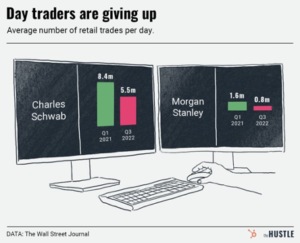
Market Update: Young Investors Are Fleeing the Trading Platforms

2020 and 2021 were big years for get-rich-quick strategies. Stimulus checks, meme stocks, crypto and NFT mania, and a bullish market in stocks brought in millions of new players. And many of these traders did well. According to the WSJ, 2.5 million became millionaires.

This year is a different story. Inflation is high. We are two-quarters into a recession. The stock market is floundering. And the Johnny-Come-Laters are running for the exits.

Cryptos have crashed and Robinhood, the app where most of the meme stock trading took place, has seen declining activity since the middle of the summer.


Alas! The Trillionaires Are Now Mere Billionaires!

Three of the biggest digital companies in the world – Meta, Alphabet, and Microsoft – lost value after they reported disappointing earnings last week. The worst hit was Meta (formerly Facebook), which is now worth a paltry $270 billion, compared to its one-time valuation of $1.1 trillion.

Meta employees are worried. According to a source that spoke to the New York Post, Zuck told his employees, “You have three months to prove your worth, put in 200% effort, or you can resign now if you don’t like it.”

But as pointed out by Joel Bowman of Bonner Private Research, you’ve got to feel especially sorry for Zuck himself, who saw $100 billion of his personal net worth disappear (from $142 billion to a “mere” $38 billion).

Feeling a Bit Better…

That’s odd. Writing about the recent death of two friends somehow improved my mood. I have the mental energy now to get back to the gloomy subject of my last two blog posts.

Last week, I told you what I think about the state of the US economy. And I made some predictions, none of which were good. I predicted:

* Higher inflation

* A deeper recession

* Deflation of real estate

* The collapse of NFTs and most cryptocurrencies

* At least one more major stock market plunge – as much as an additional 30%

* And, possibly, the end of the dollar as the world’s reserve currency

The CPI index, which is now 8%, will move towards double digits next year. The negative GDP growth we’ve experienced over the last two quarters will continue. And those “robust” job reports that the Biden administration has been touting – they will soon be inverted into massive layoffs and record-breaking unemployment.

The stock market will drop at least another 30%, bringing investor assets down to half of what they were a year earlier. Government bonds and savings accounts will offer paltry returns of less than 5%, while inflation passes 10%. Gold might go up. Some commodities might go up. Energy stocks might do well. But none of that seems certain.

What does feel certain is that, because of the size of the problem this time, the US economy is not going to spring back to pre-2022 levels in a year or two, as it did in past corrections.

It’s foolish to try to predict both the level and the timing of a future economic event. But I’m going to go out on a limb and say that the stock market (and other financial markets) will not regain the losses they will be suffering in 2023 for at least five, and possibly as many as 10, years.

And that will all happen even if the dollar somehow manages to hold its place as the world’s reserve currency. But there are many reasons it may be toppled this time. And if that happens, things may get even worse than the grim picture I’ve just painted.

Why trust me? 

You shouldn’t take what I’m saying here as gospel. But you should take it seriously. Because if I’m right, it’s going to affect your life in a very substantial way. It’s not as though I’m an economic analyst who has won a Nobel Prize. (See last week’s bit on Bernanke.) I did predict the last big market crash prior to 2008. And I have been able to manage my investments in such a way that they have always gone up. But I could be wrong going forward. Keep that in mind as you read on.

As you probably know, I’ve been in the investment publishing business for 40 years. During those four decades, I’ve had a catbird’s seat to watch all the major corrections. I was watching and writing about the stock market on Black Monday in 1987. I was managing a crew of market analysts during the eight-month drop that took place three years later. I was supervising a larger group of analysts during the dot.com crash of 2000.

I was also there when the sub-prime bubble burst at the end of 2007 and ushered in the Great Recession. That led to the $10 trillion sell-off of 2015 and 2016, the cryptocurrency crash of 2018, and the 20+% correction (so far) this year.

If you were reading my thoughts about the economy and investing during that time, you know that my position has always been to leave the money I already had in stocks in stocks. There were some minor positions I had in speculative companies. But for 90+% of my stock portfolio, my position was to hold on and wait.

There is, by the way, a ton of research that supports that position. Investors that diversify their stocks and hold onto them through down periods have always done much better than investors that have tried to sell high and buy low.

And until now, I’ve felt the same way. For good reason…

Since the stock market was created in 1792, the US economy has been in a state of non-stop growth. We’ve had recessions, and even the Great Depression. But the economy has always bounced back from every downturn and then gone on to achieve new heights. The stock market has followed suit. Despite minor corrections every two years or so, and major corrections every eight to 10 years, the overall trend has been upwards for 230 years.

So, yes, the US stock market has always recovered from its dozens and dozens of crashes and corrections. And there are good reasons to believe that it will recover from the current correction. The question is: When? How long will it take?

This time, things just may be different. The big problems we are facing – in terms of federal debt, private debt, and corporate debt, combined with so many negative political issues, such as the war on fossil fuels, the cost of mass immigration, the likelihood that the US will get even more involved in Ukraine or Taiwan (or elsewhere) – loom large. And the very real possibility that the dollar will be abandoned in favor of national digital currencies could mean we won’t recover as before.

These challenges could be how things are for another five to 10 years. Maybe longer. So, here is how I’m changing the advice I’ve been giving for anyone that expects to tap into their stock account inside the next 10 years. If you are counting on the value of your stock portfolio to stay, more or less, at its current level into the 2030s, you should seriously consider converting some of your stock positions to financial assets that will not be diminished by falling stock prices.

Click here for an article by John Csiszar that identifies eight places you can put your money that will keep it safe from stock market dips and crashes: Treasury bills, CDs (Certificates of Deposit), high-yield savings accounts, TIPs (Treasury Inflation-Protected Securities), fixed annuities, money market accounts, high-dividend stocks, and preferred stocks.

More on the Long, Hard Road Ahead

We received a lot of responses to Tuesday’s essay about the seriously bad state of the US economy. Most were versions of “I think you’re right! What can I do about it?” But a few were along the lines of “What do you know?” and “Why should l listen to you?”

I will give you my thoughts on “What to do” next week. Today, I want to tell you what I know and why you should, or shouldn’t, listen to me.

First, I am not an economist or investment analyst. In fact, I have no academic interest in either discipline. But since I began making an above-average income, I’ve been very much interested in understanding enough about the economy and the financial markets to build my wealth.

It started in the early 1980s, when my partner (at the time) and I began to sell financial newsletters. We built a sizable business selling the advice of the analysts and economists that wrote for us. But I noticed that their success in making money year after year fluctuated for many reasons.

And then I read that, although the stock market has returned, on average, about 9% to 10% over 100 years, individual investors that tried to beat the market (by taking advice from experts like those that worked for us) fared much worse than that. Trying to outsmart the market, it turned out, was a risky game.

Eventually, I developed my own investment philosophy. Rather than hoping to outsmart the market, I would find the safest way possible to get each submarket’s average historical rate of return. And by weighting the assets I invested in according to their historical volatility patterns, I was able to increase my family’s wealth, without a single down year, for more than 40 years.

It wasn’t rocket science. It was quite the opposite. I stuck to a few simple rules that the world’s most successful investors had recommended. And I did not deviate from them when I got scared or greedy.

That’s how I’ve always explained it. And that’s what I always believed. But a friend of mine, an autodidact economist, said something to me recently that challenged my confidence. He pointed out that my track record, however impressive, was only 40 years long. I began investing in earnest in 1982, when I started making an above-average income. It was the year that Paul Volcker broke the back of the stagflation that the US had been suffering from during the prior decade, and the beginning of the biggest bull market in equities in history.

That was then. This is now. Will my investment strategy continue to work? Or could the economy have changed in some fundamental way?

Back then, the federal debt was one trillion dollars. We had Ronald Reagan in the White House and Paul Volcker as head of the Fed. Today, the federal debt is an unbelievable $31 trillion. Our president is Joe Biden and the head of the Fed in James Powell.

As I said Tuesday, I’m preparing for a long, tough road ahead – with double-digit inflation and low-to-negative economic growth. I’m expecting rising unemployment and a larger gap between personal income and inflation. I’m expecting the stock market to take another serious dive and stay down for many years. I’m expecting to see many areas of the real estate market decline. I’m expecting cryptocurrencies to be outlawed in favor of the digital dollar, which will guarantee the continuance of both higher income taxes and inflation.

I could go on. You get the picture.

And I think it’s all going to happen very soon. In fact, I think it’s already begun.

I had a conversation with one of my builders last week. This is a man I’ve worked with for 30 years. He’s been continually employed doing multimillion-dollar projects since the day I met him. He always had much more work than he could handle. It was always hard to persuade him to take on another one of my projects. Last week, he asked me if I had anything for him. I didn’t.

What am I going to do? I’m not 100% sure. But I’ll try to have a definite answer for you next week.

Buckle Up – It’s Going to Be a Long, Hard Ride 

The Republicans are grousing about inflation. It’s higher than it’s been in 40 years, they point out. It’s hurting working-class and even middle-class Americans. And it’s all Biden’s fault.

The Biden administration originally denied the complaints about the rising consumer price index (CPI). They said it was temporary. The result of the supply-chain problem, which was clearing up. Then, when the rise persisted, they said it was nothing to worry about. We have good employment numbers. Wages are going up. The economy is healthy. Even their top fiscal and monetary appointees, Treasury Secretary Janet Yellen and Fed Chairman Jerome Powell, discounted the early CPI data as a serious economic threat, just as they disputed the data that showed that the US had slid into a recession.

Republicans are implying that if they take control of the House and Senate in the mid-term elections, they will bring inflation down by reversing Democratic policies. That’s not true, Biden is saying. If the Republicans get control of Congress, inflation will go up!

If you’re younger than 50, you were just a kid the last time the US economy had multiple years of high inflation. It may be hard to imagine what a sustained period of double-digit CPI numbers, combined with a sluggish economy, feels like. But if you were working in the 1970s and early 80s, when US economy experienced an extended period of high (double-digit) inflation, you would be alarmed.

Right now, the CPI is at 8%, while wages, on average, have gone up only 3%. That leaves a 5% gap. Five percent is not good, but the reality is even worse. There was a time when the CPI was a reliable indicator. Now, it’s skewed. The calculation no longer includes the cost of food and energy. And food and energy have gone up considerably more than 8%. For the average American, for whom food and energy represent a significant portion of the family income, the effective inflation rate is more like 12% to 15%, depending on how you do the math. That means the gap – the actual loss of buying power – is more like 9% to 12%. In other words, double-digit inflation.

Those of us that were supporting families in the 1970s and early 80s remember the effect of double-digit inflation over several years. It’s very, very significant. If your income isn’t increasing rapidly, you can feel yourself getting poorer, almost by the week.

Consider this: Four years of 12% inflation means your purchasing power drops by more than half.

The ABCs of Inflation 

Inflation is caused by deficit spending – i.e., governments spending money that they don’t have. They do this by some form of borrowing. The US does it by selling (and sometimes buying) Treasury bonds.

All responsible parents understand and teach their children that deficit spending is wrong. And children learn that they can’t have everything they want, just because they want it. Begging and pleading isn’t the right way to get it. They must earn it. Or, if they want to borrow it, they must be sure they can pay it back.

When it comes to government spending, many people seem to believe that this fundamental rule of economy (and ethics) does not apply. The politicians that vote for programs that require deficit spending, and the people that vote for those politicians, seem to believe that the same fundamental laws do not apply when it comes to the government. I’m sure some of them believe that what they are doing in ratcheting up US debt is for the greater good. If someone points out that they are spending money irresponsibly, they see such criticism as mean-spirited.

And that’s because most of them, along with most of the people that vote for them, haven’t the slightest understanding of what they are actually doing. Deficit spending and federal debt are abstractions to them. They tell themselves that what they are doing is good, that they are not interested in the theoretical warnings of the complainers. They are interested in the real world. And in helping real people by passing programs that will really help.

What they don’t know, because they don’t understand the ABCs of fiscal and monetary reality, is that the money they are spending is not real. It is IOU dollars, created out of thin air, that, one way or another, will one day be paid back.

In the meantime, they keep spending.

The programs that politicians spend money on depends on their political preferences. Historically, Democrats liked to spend money on social welfare programs. Republicans liked to spend it on warfare.

What’s happened in the last 20 years or so is that both parties have gradually widened their willingness to spend money. Democrats like war spending as much as or more than Republicans. And Republicans are happy to spend money on social programs so long as it gets them votes.

What We Should Expect 

There are many similarities to what is happening now and what was happening in the 1970s prior to the bouts of double-digit inflation we had then.

For one thing, each of those inflationary periods was triggered by Mideast energy crises (OPEC and Iran). We have an energy crisis today.

Those energy crises were triggers. But they were not causal. The cause was an accumulation of federal debt. In 1981, the debt was about $1 trillion. That was enough back then. And $1 trillion 40 years ago might be, say, $10 trillion today. But the federal debt is now $31 trillion. In absolute terms, that is 31 times more. Even in relative terms, it’s greater by 300%.

How can anyone possibly think that the US can pull itself out of this enormous level of debt without either a sustained period of double-digit inflation or a sustained recession, or both?

Inflation is here and it is likely to get worse. It was caused not just by the Biden administration, but by the Obama and Trump administrations, as well. Spending money you don’t have, pols believe, is how you get and stay elected. When the pandemic came along, the spending skyrocketed.

The only way to keep the US economy from moving into double-digit inflation is by raising the cost of money at the federal level. By making money more expensive, the supply of it and the velocity of it is reduced. Less money in circulation means lower inflation.

Jerome Powell has been pushing back against inflation by raising the federal lending rate. It was basically zero when he took office. He’s raised it four times. It’s currently 3% to 3.4%. That is a lot better than zero, but it’s not nearly enough. To defeat inflation, he’d have to do what Paul Volcker did during Ronald Reagan’s administration. Volcker realized that the only way to beat inflation was to raise the federal lending rate to 20% in June of 1981. That broke inflation’s back. By 1983, the inflation rate was down to 3%.

I don’t think Powell has the courage to do what Volcker did. Nor do I think that the Biden administration, even with a Republican majority in Congress, will have the courage to push him to do it.

I think what we will see is some tough talk on raising rates and then a capitulation. The Fed, the administration, and the Congress will continue to spend money they don’t have, while telling their constituents that it’s the other party’s fault… and hope that somehow the time bomb of federal debt will not explode while they are still in office.

What We Can Learn from the Bond Rate 
Anyone whose financial comfort is dependent to some degree on the US economy (i.e., everyone in the world) should be praying that the Federal Reserve is making the right moves to keep it from slipping off the rails.

It’s a big, complicated job. With dozens of external forces at work. The problem: The Fed has a tool kit with only three tools:

  1. It can buy US Treasury bonds.
  2. It can sell US Treasury bonds.
  3. It can raise or lower the interest rate on them.

When the dollar was pegged to the price of gold, the interest rate was set automatically and the buying and selling happened naturally. But since President Nixon untied the dollar from the value of gold in 1971, managing the economy has been increasingly difficult. For the last three presidencies, the Fed has added to its burden by trying to keep the economy afloat through stimulation – i.e., borrowing and spending trillions of dollars the government doesn’t have. This worked – sort of – by transferring middle-class wealth to Wall Street. But borrowed money must be repaid, either through recession, inflation, or both.

And that is what we have today.

Here’s a concise and clear summary of the situation from Bonner Private Research:

700-Year Drop 

Bonds – and the interest rates they reveal – tell us which way the strong undercurrents are running. They measure (indirectly) how much capital is available and (directly) how much it costs. A place like Switzerland, with abundant savings and reliable borrowers, typically enjoys low interest rates. A West Baltimore “payday loan” joint or a poor country such as Haiti or Burkina Faso will have much higher rates, because there is less capital available… and borrowers might not pay it back. And generally, as the world grew richer, interest rates went down….

But the Fed got up to mischief 20 years ago – dropping its key rate from above 6% to below 1%. Was the country suddenly richer? Were savings more abundant?

Of course not. The Fed was giving out a lie. What is important about interest rates is not that they are high or low, but that they are honest. And the Fed was manipulating credit prices in order to give the impression that we were richer than we really were. The idea was to boost stock prices, increase spending, and stimulate the economy. Then in 2008, it repeated the scam, this time pushing rates down to “effectively zero.” In real terms, adjusted for inflation, the Fed Funds rate stayed below zero for more than a decade – where it remains still.

No wonder speculators acted as though money had no value – bidding up prices of meme stocks and cryptos to preposterous levels. No wonder businesses borrowed to buy back their overpriced shares. And no wonder the US government spent trillions on unwinnable wars abroad and jackass boondoggles at home.

And no wonder the country now has $90 trillion of debt – public and private… so much that the pain of reducing inflation will now be likely more than the elite can stand. In order to stop inflation, the Fed must raise interest rates. And every 1% increase – if applied to the whole debt load – would add $900 billion in extra expense annually.

What to do? 

Yeah. It’s bad. Our debt has never been this high. And now we have energy shortages, rising inflation, and more government spending on the horizon. The Fed has the power to put a halt to extreme inflation if it is willing to continue to raise interest rates. But when it raises interest rates, the economy stalls and begins to shrink. And we experience recession.

Whenever I find myself between a rock and a hard place, I do something I call “making friends with the enemy.” The enemy is the worst-case scenario. “Making friends” means finding a way to imagine myself being “okay” with that scenario. Or even benefitting from it.

So, what are the bad- and worse-case scenarios for the US economy.

There are three:

  1. More inflation – getting poorer due to the loss of purchasing power.
  2. A deepening recession – getting poorer because the value of assets is going down (i.e., asset deflation).
  3. Both – getting poorer because the value of our financial wealth is shrinking at the same time as the purchasing power of our cash.

Of the three, inflation is probably the scariest. Because inflation can lead to hyperinflation. And hyperinflation will destroy the economy completely. Jerome Powell understands this. That’s why he just increased the Fed interest rate by 75 basis points. And it’s why he’s talking tough about another increase.

If he hangs tough, he can fend off higher inflation. But he knows that doing so will put the economy into a deeper recession. The Democrats and the Biden administration don’t want that to happen, because it will mean all the economic numbers (besides inflation) will be getting worse fast. So, to keep the effects of our shrinking economy to an amount they can explain away or blame on other factors, they will put pressure on Powell to ease off.

It will be interesting to see what the Fed does in the coming year. And by the way, there’s no guarantee that if the Republicans gain control of the House and Senate in the midterms, they will be brave enough to do what we should have done in the first place: Stop spending money we don’t have and balance the budget.

What to expect? 

As I said, I like to hope for the best but make friends with the worst.

The worst of the scenarios would be hyperinflation. I think it’s highly unlikely, given the fact that the Fed is independent and our politicians, however economically ignorant some of them are, won’t be able to take over the Fed and start reinflating the economy. Nevertheless, if hyperinflation happens, the only defense one can have against it is real property and hard assets like gold and silver. I have enough of that to become my own warlord in the post-Apocalyptic version of Armageddon that runs through my mind.

The other two scenarios are considerably less terrible, but they are, nevertheless, bad. And they are, in my opinion, very likely.

A sustained period of moderate inflation of 8% to 15% is possible. So is a sustained period of lower inflation (trending down from 8% to a healthy 2%) but with a considerable shrinkage of the US economy.

How do you prepare for these two scenarios? 

To offset the damage of 8% to 15% inflation over the next so many years, you should own assets that do well during inflationary periods.

Gold and Other Precious Metals: The most obvious of these is gold and silver. About 4% of my net worth is in bullion and rare coins. It’s not a large percentage, but it’s enough to keep my family afloat if the economy goes to hell.

Stocks: You might not think of stocks as an asset class that is resistant to inflation. And that’s because many of them are not. But there are some companies that are able to sustain themselves during inflationary periods because they can increase their prices along with inflation. Traditional brand name consumer companies like Nestle and Coca-Cola are examples. And new ones like Apple and Amazon should be okay. My stock portfolio is made up of businesses like these that have the size and strength to endure through recessions and even depressions. (I call them Legacy companies.) So, if the stock market continues to go down – and even if it crashes – I’m not going to be selling. I’m not worried about what the share value is right now, but whether the business itself can stay profitable until the market recovers.

If I had another sort of stock portfolio – one that was heavy in speculative and/or growth stocks – I would make a change. Likewise, if I were making money trading stocks, I’d stop and wait till the smoke clears.

Debt Instruments: I still have a stash of longer-term municipal bonds that are paying between 3% and 4% tax free. (That’s about 5% to 6%.) I’ve been selling them as they come due, and then putting the money into other debt instruments – mostly private mortgages and loans. These have been giving me decent returns over the years, about 8% on average. But now that inflation is at 8%, I will have to charge interest, which I may be able to do. If not, I’ll move my money into the asset class where I have the largest percentage of my wealth: income-producing real estate.

Real Estate: Real estate has always been the largest part of my portfolio. And it will continue to be so in the coming years. When you invest in rental properties, you get richer two ways: from the rental income and from the appreciation in value. Given the economic situation we find ourselves in now, I’m feeling cautious about building rental apartments. But I’m still in the market for properties that can give me a cash-on-cash return of 8% to 10%, which means a return of 12% to 16% with a bank loan.

I also have a fair amount of raw land that I’ve been holding for years. Some is here in the States, and some of is overseas. Prices are very high right now. And since I’m pretty sure things will get worse before they get better, I’m selling off some of these properties and putting the money into endowing my non-profit projects.

Other Hard Assets: I have about 6% of my net worth in art and other collectibles. About two-thirds of that is designated for a museum I’m developing, so I won’t be selling any of it. The other third I will hold onto as a sort of emergency fund. If, for whatever reason, I need extra cash, I can sell off pieces one at a time.

That’s it. As you can see, I’m not making any big changes. If I had my wealth in other, more speculative asset classes, I’d be thinking seriously about rebalancing my portfolio. I hope this helps with your own planning.