Should I Build That Apartment Building?

(It’s All About Supply and Demand)

I’m back in the office today. I am determined to work diligently. With purpose, but without attachment. I sit down, close my eyes, and think good thoughts. I’m happy to be here. I’m lucky to be here.

I open my eyes. There is a pile of paper in front of me about nine inches high. Gio brings in a cup of tea. (She apparently thinks tea is better for me than coffee.) She sees the stack of paper and looks sad. “It piled up while you were in the hospital,” she says.

“No problem,” I assure her. “I’m going to do one thing at a time. I’m only going to worry about what I have to worry about today.”

She smiles. I don’t know what that means.

On the top of the stack is a report from an architect I hired to give me an estimate for converting my office space in Delray Beach to rental apartments. I’ve mentioned before that I’ve been looking into doing this because, since the pandemic began, the demand for office space has been dropping, while the demand for rental space has surged.

In South Florida, for example, rental prices are crazy high. A modest two-bedroom apartment in a middle-class neighborhood in Broward County will cost you at least $2,300. In Miami, the same apartment could be another $1,000.

And it’s not just Florida. Rental prices are high in most major cities along both coasts, spurring a surge of apartment building construction. In Delray Beach, there must be at least two dozen going up. Six of them are within a half-mile of where I’m thinking of building mine.

What This Means: The real estate market is cyclical, and prices adjust cyclically. But if you are in the business of buying and selling, or even buying and renting, existing properties, there are relatively safe ways to make sure you don’t get in trouble. (I’ve written about this many times.)

When you get into the supply side of the cycle (by building rental units), however, you take on an extra level of risk – the volatility that can occur during the two or three years it typically takes to build an apartment building of any size.

Right now, there is a strong demand for rental units. And it’s going to continue to be strong for – my guess – another two to three years. I don’t see this additional demand being negatively affected by recession. It could be stimulated. But the ability of renters to pay more than they are paying now, or even as much… that may disappear.

The Bottom Line: Demand is strong And supply is limited, but it is filling up fast. For me, this means my window of opportunity will close soon. I’m going to have to get started or sit back and wait for the next opportunity to build.

I don’t want to get myself crazy about this. I’m not going to send out a flurry of emails, trying to push this project forward. I make friends with the enemy: my fear of missing out on this opportunity to develop a big, profitable residential building. I imagine the opportunity flying away. I see my life going on happily without it.

I will act purposefully, but without attachment. I’ll send out one text to the architect, asking for answers to any questions I have after reading his report. But I won’t worry about it.

Learn more about the rental market here.

Why We Need a Recession

Inflation is up. Not just a little. A lot. And according to the standard definition, the US is in a recession.

Working- and middle-class Americans have noticed. Everything from milk to toilet paper to automobiles and airline tickets are going up fast. And they are looking for someone or some thing to be angry with.

The conservative media are blaming the Biden administration and the Green New Deal for the state of the economy. And it’s going to worse, they say, because of the insane levels of unfunded spending by the Democrats to shore up their chances of doing well in the mid-terms. They cite the trillions spent during the first year of Biden’s presidency. And they are lambasting the Orwellian-named Inflation Reduction Act, pointing out that it will add at least another $600 billion of fuel to the inflation fire.

The Biden administration and the mainstream media are disputing both points. As to inflation, they point out that July’s numbers were down slightly from June’s. (About one-half of one percent.) And they are denying we are actually in a recession.

The standard definition of a recession is two consecutive quarters of lower GDP. This, in fact, did happen from January to June this year. But the Biden administration and the mainstream media and their pundits are noting that official unemployment rates are very low. How can we be in a recession when there are two jobs waiting for everyone that wants one?

It’s confusing. Doubly so because it is so political.

My take: Inflation is here to stay. But it’s not the fault of the Biden administration or the Democrats. Or rather, it’s not solely their doing. Inflation is the natural and inevitable response to what our government has been doing since Nixon unhooked the value of the dollar to the price of gold bullion in 1971. Since then, every administration, Democrat or Republican, has continued to print heaps of fake dollars. The only thing one can fairly and accurately state about this is that the overspending has accelerated drastically since 2008. Today, federal debt exceeds $30 trillion.

What most people don’t realize is that the government can’t magically make that debt disappear. It has to “balance” its books by finding money to pay off the interest on it. It does so by selling Treasury bills. To attract buyers for those bills, it has to offer an attractive interest rate by raising the federal lending rate. Which the Fed is currently doing.

The problem is that when you raise the federal interest rate, you make it more expensive for everyone – banks, businesses, and even the government – to do their business. That means charging more for loans, products, and services, which has to be paid for by taxpayers. Both commercial taxpayers and working people. Those rising costs result in less business growth and less consumer spending. And that, my friends, leads to continuing higher prices, lower economic growth, and higher unemployment.

That’s the bind the US finds itself in now. There is no magic cure. The fiddler must be paid. And it’s done in two ways: inflation and/or recession.

That’s how I see it. In a future issue, I’ll tell you what I’ve done (and am still doing) to protect myself and my family from what seems inevitable.

Meanwhile, I found what I thought was a very clear and simple explanation of all this by Ramin Nakisa from PensionCraft. He believes that the Fed will continue to battle inflation by raising interest rates. That will prolong and possibly deepen the current recession. But he also believes that a moderate amount of inflation is not such a bad thing.

You can hear his argument here.


How College Broke the American Dream

For decades, a college degree has been considered the ticket to a better life. And for decades, quality-of-life studies verified that idea. College-educated kids not only earned a good deal more money than their less-educated peers, they lived better, had better health, and lived longer. So did their children. And so, for decades, parents and students willingly went into debt to achieve those advantages.

As the years passed, however, the costs of a higher education increased at rates well above inflation. Today, the total student loan debt is at $1.8 trillion! That’s not good for the economy.

First-year college-educated kids still earn a good deal more than kids with a high-school diploma. But do they earn enough over their careers to take on a six-figure level of debt? Parents are worried. And rightly so. Recent studies have shown that some degrees – e.g., in engineering and medicine – are still financially justified. But as for kids that go on to become teachers and social workers and speech therapists, the numbers look grim

Click here to read a CNBC article on the subject.

And click here to watch Charles Mizrahi interview Will Bunch, the author of How College Broke the American Dream and Blew Up Our Politics.

Tipping Is Going Up: What Gives?

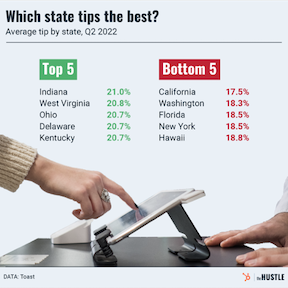
This chart was derived from a study by Toast, a point-of-sale (POS) platform that restaurants and other retail food services use to cash out customers.

The study found that…

* The average tip in full-service restaurants was 19.6%, compared to 16.9% for fast-food places.

* Tips rose 10% year-over-year, compared to 7.6% for food costs.

Well, that’s encouraging. Tips are at least meeting the cost of inflation. Is that because customers are feeling compassionate? Not according to the digital news site Hustle. They note, “POS platforms like Toast have ushered in the rise of ‘iPad tipping,’ leading many to tip when they normally wouldn’t to avoid looking stingy in front of the cashier.”

I’m sure you’ve had a lot of these “complete your transaction” experiences lately. I have. And they nudge me to tip higher than I usually would.

Here’s a funny video clip that explains what may be going on.

A New Take on “Who’s on First?”

COSTELLO: I want to talk about the unemployment rate in America.

ABBOTT: Good subject. It’s 3.6%.

COSTELLO: That many people are out of work?

ABBOTT: No, that’s 23%.

COSTELLO: You just said 3.6%.

ABBOTT: 3.6% unemployed.

COSTELLO: Right. 3.6% out of work.

ABBOTT: No, that’s 23%.

COSTELLO: Okay, so it’s 23% unemployed.

ABBOTT: No, that’s 3.6%.

COSTELLO: WAIT A MINUTE. Is it 3.6% or 23%?

ABBOTT: 3.6% are unemployed. 23% are out of work.

COSTELLO: If you are out of work, you are unemployed.

ABBOTT: You can’t count the “out of work” as unemployed. You have to look for work to be unemployed.

COSTELLO: BUT THEY ARE OUT OF WORK!!!

ABBOTT: No, you miss the point.

COSTELLO: What point?

ABBOTT: Someone who doesn’t look for work can’t be counted with those who look for work. It wouldn’t be fair.

COSTELLO: To whom?

ABBOTT: The unemployed.

COSTELLO: But ALL of them are out of work.

ABBOTT: No, the unemployed are actively looking for work. Those who are out of work gave up looking. And if you give up, you are no longer in the ranks of the unemployed.

COSTELLO: So if you’re off the unemployment rolls, that would count as less unemployment?

ABBOTT: Unemployment would go down. Absolutely!

COSTELLO: The unemployment just goes down because you don’t look for work?

ABBOTT: Absolutely it goes down. That’s how it gets to 3.6%. Otherwise it would be 23%.

COSTELLO: Wait, I got a question for you. That means there are two ways to bring down the unemployment number?

ABBOTT: Two ways is correct.

COSTELLO: Unemployment can go down if someone gets a job?

ABBOTT: Correct.

COSTELLO: And unemployment can also go down if you stop looking for a job?

ABBOTT: Bingo.

COSTELLO: So there are two ways to bring unemployment down, and the easier of the two is to have people stop looking for work.

About the Inflation Reduction Act 

What a wonderfully Orwellian world we live in. Congress has just passed a bill called the Inflation Reduction Act (IRA) that, as far as I can tell, is practically designed to increase inflation.

Its supporters claim that, in addition to reducing inflation, it will increase GDP by increasing taxes and adding regulations and doubling the size of the IRS. Again, these are policies that are almost certain to lower GDP.

The bill won’t raise taxes – we were assured – on anyone making less than $400,000 a year. But that claim has already been refuted by the government’s own budgetary office.

I’ll talk more about this in future issues as we see how the provisions of this bill take hold in the economy. But for the moment, I want to highlight what I thought was the oddest aspect of the advertising campaign for the bill’s passage: its specificity.

As reported by Yahoo!News:

“The IRA provisions could also generate enormous public health and jobs benefits” [according to a study from the think tank Energy Innovations]. In addition to preventing between 3,700 and 3,900 premature deaths from air pollution in 2030, Energy Innovation found it would lead to a net increase of up to 1.5 million jobs in 2030 and increase the United States’ gross domestic product by 0.84% to 0.88% in 2030.

I believe Bill Bonner had it right when he said this in the August 4 edition of Bonner Private Research:

“This grab bag of boondoggles will increase US GDP by 0.84% eight years from now? It will save 3,700 to 3,900 lives? Really? The technocratic precision is breathtakingly absurd. There is no way on Earth to predict the effect of this collection of robbery, flimflam and jackassery on our $24 trillion economy… eight years in the future. And to two decimal points!”

Real Estate: A Time to Buy. A Time to Sell.

In April and May, housing prices in the US were at all-time highs. In some areas, they are higher than they were at the early 2007 peak, right before the real estate industry began melting down before collapsing in 2008.

Could we be in for a repeat of that?

As I’m sure you remember, when the real estate bubble burst, it sent the US economy (and the rest of the world) into what became known as The Great Recession. In less than three years, it wiped out trillions of dollars’ worth of wealth – mostly from working- and middle -class homebuyers. Thanks to the government bailout, a good deal of that money was transferred to the financial upper classes, through the conduit of Wall Street, bankers, brokers, and insurance companies.

Media pundits and Wall Street CEOs called the crash “unprecedented” and “unpredictable.” That was balderdash, Americans learned later, when books and movies about the collapse started hitting the bestseller and top-rated film lists.

I was heavily invested in real estate prior to 2006. I started pulling back in 2007, and was out entirely before the crash. My investments had been in rental houses and apartments, not in REITs or other real-estate dependent stocks. So, I wasn’t listening to CNN or reading the NYT to find out what was going on with real estate. I was looking at the local markets, and making my buy/sell decisions accordingly.

My goal back then was to make an 8% return on my investment, cash on cash, and at least 12% with leverage (a mortgage). When prices got so high that I couldn’t make those numbers, I stopped buying. It was as simple as that.

When my friends, colleagues, and Jiu Jitsu buddies that were gobbling up properties like syrup-slathered pancakes asked me why I had stopped buying, I explained it another way. I told them that I was bothered by the discrepancy between the average income of first-time homebuyers and the average cost of a starter home.

I had always heard that a healthy ratio of household income-to-house price was about 1:5 (20%). In other words, a family with an income of $50,000 should be able to buy a house priced at up to $250,000. But in 2007, the average startup houses where I was looking in South Florida were selling for $400,000 to $500,000. And the average income for first-time homebuyers was just $60,000 to $70,000.

The numbers didn’t work. Still, banks were giving mortgages to anyone and everyone that had a pulse. And then packaging that “sub-prime” paper in bundles and selling them to huge financial institutions. You know, the ones that the government later bailed out, leaving millions of middle- and working-class Americans with debt they could not possibly repay.

Today, housing prices in South Florida – and up and down the coasts – are as high (or higher) as they were back then. Household income has risen, but not as much. In terms of household income and starter-home prices, the ratio is just as bad as it was in 2007. There is a difference, however, that is important. Banks are not handing out mortgages as freely as they did back then.

What this means to me: I am not expecting another real estate collapse like the one we had 14 years ago. I’m expecting to see prices come down to a sustainable level, and, in fact, it’s already started to happen. With interest rates going up, I’m expecting them to come down a good deal more in the coming six to 18 months.

As a direct investor in real estate, that doesn’t worry me terribly. That’s because I haven’t been buying property for several years. (And won’t again till prices move into buying territory.) However, I am keeping my eye on rental rates in the areas where I own property. If those rates go down significantly, so will my future ROIs.

I’m also wondering what to do with the cash I’ve been collecting from selling off some of my properties – particularly office buildings in cities (like Baltimore) that are seeing corporate flight due to high taxes and rising crime.

I’ve been looking around in states like Texas and Nevada that are benefitting from the emigration out of California. There are some pockets of hope there. I’ve toyed with the idea of investing in REITs, but given the way the economy looks generally, and rising interest rates, I’m not sanguine about any real estate-related stocks.

More on this in an upcoming issue.

Meanwhile, here’s an interesting chart that shows the average home prices in various cities around the US and the average yearly income it would take to buy one at the 1:5 ratio. Click here.


The Ups and Downs of Airfare 

In the Aug. 2 issue,  I said that while inflation is likely to continue rising overall, there will likely be pockets of deflation among industries that are both competitive and cater to the working and middle classes. (Like starter real estate. See above.)

And although you wouldn’t know it if you’ve been flying lately (and experienced the crowded airports and constantly cancelled and delayed flights), domestic air travel in the US is lower than many expected this year. This may be due, at least in part, to the feeling most Americans have of being financially strapped. Click here.

The Latest Example of What We Can Look Forward To

Robinhood, the stock trading app that was so hot a year ago, announced that it is laying off around 23% of its workforce. This is its second significant layoff. The first was 9%. The layoffs will be primarily in operations, marketing, and program management. They blamed “deterioration of the macro environment, with inflation at 40-year highs accompanied by a broad crypto market crash.”

Why does that matter? As I said in Tuesday’s blog post, the financial advisory market has a history of shrinking months before recessions and subsequent market downturns. Robinhood is not in the financial information business, like we are, but it’s Fintech, which is close.

I see this as another indication of what’s to come. Click here.

If you lost money investing in Robinhood, you should have been reading the advice of my friend and colleague Charles Mizrahi, who pointed out the company’s weaknesses last year. In this short article, he explains why it was a bad “play” to begin with, click here. [LINK]


More Bad Economic News

US household debt increased by 2% to $16.2 trillion at the end of June. Given 123 million households, this means the average family debt grew by nearly $10,000 last year. That’s significant.

Also worrying: Debt delinquencies are up. The biggest factors are mortgages, auto-loans, and credit card balances. (Credit card balances jumped by 13%, the largest increase in more than 20 years.) Add to that the fact that the Fed has finally begun to raise rates, which will make repaying current debts more difficult.

What that means: The combination of higher household debt and higher interest rates on mortgages means that sensible people will be spending less on all discretionary expenditures, and senseless people will be quickly spending their way into bankruptcy. Both of these trends will make it more difficult for us to stop our currently shrinking GDP.


The Recession of 2022: How Bad and Long Will It Get

It’s official. The US is in a recession. According to a report issued last week by the Bureau of Economic Analysis, the real GDP (gross domestic product) decreased in the second quarter of the year by 0.9%. It decreased in the first quarter by 1.6%. (The Bureau of Economic Analysis, an agency of the US Department of Commerce, has been the government’s official tracker of GDP and other economic indicators since 1972.)

You can read the report here.

Biden officials and most of the mainstream economic experts, including Treasury Secretary Janet Yellen, have been telling us for six months that there wasn’t going to be a recession, and that the spike of inflation we saw earlier this year was only temporary. They were wrong. But they were also wrong about the Great Recession that followed the 2007/2008 real estate meltdown. And every other economic downturn, big and small, for the last 50 years.

This should not surprise you. High profile and highly paid economists, whether they work for the mainstream media, Wall Street, Big Tech, or big government, are essentially paid to ignore or deny bad economic news – to promote optimism and push federal spending, in hopes of pumping up the economy and thus keeping incumbents in office and encouraging business borrowing, consumer and business spending, and sales.

Right now, in a desperate attempt to keep the American working- and middle-classes from despairing our country’s economic future, they are denying the fact that we are in a recession by redefining the term.

Until now, economists agreed on a simple criterion. Two consecutive quarters of negative GDP growth = a recession. And that, as I said above, is what we have had this year. I won’t bother you with their argument. It’s laughably wrong. And it’s not fooling anybody – at least not anyone that has noticed the rising cost of milk, bread, dishwashers, cars, diapers, and gasoline. Or anyone that works in manufacturing, housing, or construction that has noticed that iron and steel and shingles and plywood are more expensive than they’ve ever been. They are fooling only the portion of the population that is too wealthy to be affected by these 10% to 30% price increases. Including the mainstream media pundits that repeat their talking points. (And also including RF, my brother-in-law, who has bet me that the recession will be over in a matter of months.)

I’m going with the Bureau of Economic Analysis’s 50-year-old definition of recession. And my prediction is that it will get worse, and stay worse, for at least the next few years.

One reason I feel that way is based on my personal experience in my current business. That business – publishing information and advice about investing – has traditionally been a bellwether of economic trends. Months before folks pull back on buying cars and TVs because of economic uncertainty, they pull back on buying investment advice. This has happened prior to every recession, big and small, since I’ve been in this business. That’s 40 years. And something like 16 quarterly downturns and a half dozen serious recessions.

About 18 months ago, we began to see a slowdown in our industry. Prospective customers and even existing customers were reluctant to buy more investment services. Since the beginning of the year, our sales are down by more than a third. That means cutbacks and layoffs and, most importantly, reduced spending on recruiting new readers and subscribers.

The principal talking point of those that are predicting a quick return to positive growth has been the unemployment statistics, which were at all-time lows a few months ago. You couldn’t find a restaurant or grocery store that didn’t have a help-wanted sign in their window. But if our industry is once again indicative of the future economy, we’ll be seeing unemployment surging in the next six to 12 months.

It will happen because of the “wage-price spiral” I mentioned in Saturday’s issue. The higher wages that companies are paying now will become more difficult to support as inflation ratchets up every other cost of business. That means thousands, maybe tens of thousands, of businesses, large and small, will be laying off employees and, in some cases, shutting down.

So, that’s what I’m going to be looking at in the coming months. In the meantime, I’m recommending significant cutbacks to the companies I own and/or consult with. Fewer products, simpler systems, and fewer (but better) employees.

I’m also making a few changes in my investment portfolio. (More on that in a coming issue.)


This Doesn’t Bode Well for My Brother-in-Law 

The Bureau of Economic Analysis’s bad news about the GDP (above) came a day after the Federal Reserve raised interest rates by 0.75 percentage points, the fourth raise this year. The goal, of course, is to try to stop any further inflation, which is, at 9.1%, at a 40-year high. (You can check out our annual inflation rate here.)

What does this mean? It means that it will cost businesses and consumers more to borrow more. There will be deflation in some areas of the economy – industries that sell optional products for middle- and working-class people. But inflation for everything else. And “everything else” is the lion’s share of the economy. That’s not good.


And It’s Not Just Here… 

I’ve been reporting on America’s economic troubles regularly. Inflation, runaway government spending, and the Cold War with Russia have significantly curtailed US GDP and made middle-class Americans poorer. But things are just as bad for China and Russia and most of our European allies. It’s no surprise, then, that the International Monetary Fund lowered its growth projections for the world economy to 3.2% for this year and going down to 2.9% next year.

Click here.


Need a Low Paying Job? Walmart Wants You!

Because of the particular nature of the economy today, the general rise in unemployment that I’m predicting is likely to hit hardest among the higher paying jobs. But if you are willing to work for minimum-wage (or thereabouts), there will be opportunities. Walmart, for example, is looking to hire. Click here.


What Is the “Wage-Price Spiral” – and Why Is It a Problem?

Prices are going up. And real incomes (nominal income minus inflation) are going down. (Wages up 5%; Inflation up 9%)

From Bonner Private Research:

“Workers will, of course, push employers for wage increases to keep up with inflation. But [thanks to years of Fed-induced malinvestment] productivity is sagging… so the only way employers can pay more is by passing along the costs to consumers – further pushing up prices. This is the ‘wage-price spiral’ that troubles central bankers’ sleep. Wages go up to keep the working stiffs from losing ground. Then, the extra labor costs force up prices. The higher prices cause workers to plead for higher wages. Wages tend to be ‘sticky,’ say economists. Once a raise is given, it is hard to take it away. So, wage-driven price increases ratchet upwards with no easy way to bring them down.”

Another Way That Inflation Is Slowing Growth

Walmart shares slid 10% after the company reduced its profit expectations as a result of changes in consumer spending habits. Shares of other big retailers, including Target and Amazon, also fell. Inflation, Walmart noted, is causing shoppers to spend more on necessities such as food and less on items like clothing and electronics. As a result, inventory of merchandise that customers don’t want is piling up, and retailers are being forced to aggressively mark it down. Click here

And Yet, Yacht Sales Are Booming

Discount retailers like Walmart are seeing the impact of inflation. The same is true with just about every business that sells commodity products to middle-class and working-class consumers. But the luxury market – or at least the upper end of it – exists in its own economic sphere.

For example, last year, 887 “super yachts” were purchased, twice as many as were sold in 2020, according to The New Yorker. Super yachts are just what they sound like. Super-sized (over 100 feet) and super-luxurious, costing upwards of $100 million. Why the jump in sales? The simplest reason is a growth in the number of  super-rich people. Since 1990, the number of US billionaires jumped from 66 to more than 700, while the median hourly wage increased only 20%. The number of gigayachts (yachts over 250 feet) jumped from under 10 to more than 170 during the same time

Are Psychedelics the Next Pot Stocks? 

Even in bear markets, there are businesses, and even industries, that experience growth. And that makes for opportunities for shrewd investors. One such industry that I’ve been following for several years lives in between the health and recreation industries. I’m speaking of psychedelics.

Since the beginning of decriminalization, the marijuana business has grown the US economy by about $20 billion. It looks like we are going through the same thing with psychedelic drugs. It’s early in legalizing them, but by some estimates the industry will be at about $5 billion in the next five years.

About the Future of America…

Once the Digital Dollar Is Put Into Circulation!

We’ve all been deluged recently with reports on the rise of inflation and the risk of an extended economic recession. And for the past year or so, I’ve been writing about the likelihood that the US will one day adopt a digital dollar and the possible repercussions of that.

I suspect that the economy will get worse before it gets better. And that this will accelerate the move to the digital dollar. The floundering (soon to be foundering) economy should not be a reason to rush towards a digital dollar, but it does provide rationales for pushing it forward by our elected officials that understand how it will increase their ability to have more control over the populace. And they come from both sides of the aisle.

Today, I want to try to accelerate your interest in this topic by giving you some scary but entirely possible outcomes if (when) this happens.

I’ll start with this: The digital dollar will be presented as a solution to three significant problems that – from the government’s perspective – are making it near impossible to balance the budget and build back America’s economy better:

  1. Institutional favoritism to big companies, including pork barrel legislation, federal regulation, and deregulation. (Remember, this will come from both Republicans and Democrats.)
  1. Wealth and income inequality.
  1. Tax avoidance and evasion by the one percent of the richest US companies and individuals.

My theory is that the digital dollar will not solve those problems. It will, instead, make them worse. And it could also result in the destruction of the values that made the US the world’s largest and strongest economy. Those values include free enterprise, individual liberty, entrepreneurship, states’ rights, financial privacy, personal privacy, and democracy itself.

Here is an admittedly sensational way to put it. But since I think it’s within the realm of possibility, and feeling less extreme and more likely the more I dig into it, I’m going to give it to you the way I presented it to a colleague that is producing a documentary about the danger.

I said:

This is the story of the digital dollar being used as a government tool to monitor and record every move its citizens make. Calling it a digital dollar, as if its purpose were a simplified substitute for the dollar, is a ruse. It will become a digital monitoring and control technology that will be connected to every other digital tool we use. It will be on the blockchain, so the activity will be permanently recorded and available, but only to the government. They will track, not just every purchase every person (citizen, non-citizen, visitor, etc.) makes, but every place they go, every publication they subscribe to, every cause they contribute to, every person they do business with, etc.

And it will be married, as the Chinese have already done, to a social reputation score that will determine our ability to purchase the products and services we want. No more things that are “bad” for us, including “unhealthy” foods; “dangerous” herbs and medicines; “subversive” books, magazines, and e-publications; access to “disreputable” chat rooms, clubs, and other social groups. Not to mention our ability to purchase firearms, sell our houses, rent second homes, travel, etc.

The technology will make tax avoidance extinct, as well as any sort of business activity that the government deems unwise or improper. And it will reward us by raising our personal social reputation score when we report on any questionable conduct by our family, friends, and neighbors. (Which most Chinese citizens say they enjoy doing!)

The transition to a digital dollar is already underway in this country. All the powers that be – big government, big tech, and mainstream media – are fully behind it. As will be the majority of Americans when the information campaign to support it reaches its peak.

And it is all going to happen in the next 10 years, if things don’t change.

So, there you have it. Is this madness? A delusion? The paranoid perspective of someone that’s been reading too much fake news? You will have to judge for yourself. In the meantime, when new facts emerge, I’ll tell you about them and how I think they fit into this movie.