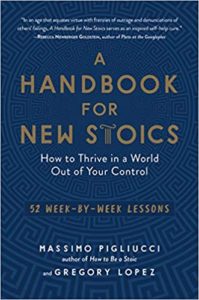
A Handbook for New Stoics 

By Massimo Pigliucci and Gregory Lopez

336 pages

Published May 14, 2019, by The Experiment

I’ve read essays by Seneca, discourses by Epictetus, and Marcus Aurelius’s Meditations several times. I’ve written essays about how I’ve tried to incorporate Stoicism into various aspects of my life. But until I read this “handbook,” I didn’t appreciate the depth and range of the Stoic philosophy.

Stoicism has emerged as one of the defining philosophies of the new millennium. Not at the universities, which are neck deep in name-and-blame ideologies (Stoicism’s polar opposite), but among thought leaders in the digital self-improvement communities.

A core tenet of Stoicism – and the idea that is most commonly associated with it – is accepting the fact that there is much in the world over which we have little or no control. Rather than stress over those things, the Stoic deploys his attention on things he can change. The most significant of those things are his thoughts and feelings.

That was my core view of Stoicism, and it was more than enough for me. But it turns out that there is much more to it than this. A Handbook for New Stoics helped me understand that Stoicism is actually a moral philosophy. It is not just about how to live the least stressful and most productive life. It is also about developing a mindset that is just and can make just decisions.

What I Liked About It:

* It broadened my understanding of Stoicism.

* It was a quick study in some Stoic writings I had never read.

* The writing was readable.

* The ideas were easily accessible.

What I Didn’t Like:

Nothing that I can think of.

A few examples of what you will learn in this book:

* Why we must accept the nature of human nature

* Three things we must recognize as impermanent: life, possessions, and circumstances

* Why we should “let go of” the good as well as the bad

* The 3 core disciplines of Stoicism: Desire, Action, and Assent

* The 9 exercises you can do to achieve them

A Handbook for New Stoics is a guide to not just understanding but also practicing Stoicism. Which makes it well worth a read in today’s confusing political and social environment.

Critical Reception 

* “In an age that equates virtue with frenzies of outrage and denunciations of others’ failings, A Handbook for New Stoics serves as an inspired self-help cure that, with insight and sympathy, will nudge you in the direction of the happiness and equanimity born of strength of character and wisdom.” (Rebecca Newberger Goldstein, author of Plato at the Googleplex)

* “A wonderfully simple approach to the core concepts and techniques of Stoicism…. Pigliucci and Lopez have managed to make Stoicism accessible to anyone.” (Donald Robertson, cognitive-behavioral psychotherapist and author of How to Think Like a Roman Emperor)

* “A wonderful and potentially life-altering way to encounter the wisdom of the Stoics.” (Professor William B. Irvine, author of A Guide to the Good Life)

* “A great hands-on introduction to Stoic philosophy and practice…. Well-researched and carefully structured.” (Gregory Sadler, editor of Stoicism Today)
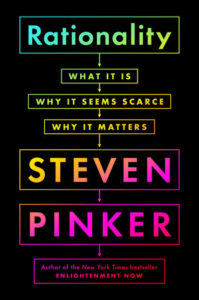
Rationality: What It Is, Why It Seems Scarce, Why It Matters 

By Steven Pinker

432 pages

Published Sept. 28, 2021 by Viking

His name kept coming up in conversations. Good conversations.

“I’ve never read him,” I admitted.

I’d get that “Are-you-kidding-me?” look.

I googled.

Turns out that Steven Pinker is a professor of psychology at Harvard University. He’s also a member of the National Academy of Sciences and a two-time Pulitzer Prize finalist. He was named one of Time’s 100 Most Influential People, and one of Foreign Policy’s 100 Leading Global Thinkers.

His books include The Blank Slate, The Stuff of ThoughtThe Better Angels of Our NatureThe Sense of Style, Enlightenment Now, and Rationality. I started with the newest one, the full title of which is Rationality: What It Is, Why It Seems Scarce, Why It Matters.

Given Pinker’s impressive intellectual credentials, I was prepared for a tough read. But the book begins quite gently, with a review of some of the better-known probability puzzles.

Like this one (known as “The Monty Hall Problem”):

A contestant is faced with three doors. Behind one of them is a sleek new car. Behind the other two are goats. The contestant picks a door – say, Door #1. To build suspense, Monty opens one of the other two doors – say, Door #3 – revealing a goat. To build the suspense still further, he gives the contestant an opportunity either to stick with the original choice or switch to the unopened door. You are the contestant. What should you do?

Correct answer: You should open another door. It’s a game show, silly. It’s designed to keep up the suspense.

And this one:

Linda is 31 years old, single, outspoken, and very bright. She majored in philosophy. As a student, she was deeply concerned with issues of discrimination and social justice, and also participated in anti-nuclear demonstrations. Which is more probable? 1, Linda is a bank teller. Or, 2, Linda is a bank teller and is active in the feminist movement.

Correct answer: She is a bank teller. (Most people pick 2, even though it’s mathematically impossible for it to be more probable.)

I was pretty sure I knew the “rational” answers to all of the puzzles, since I’d encountered them before. Instead, either because I’d forgotten or because I’d never double-checked my answers, I was wrong about every one.

Pinker’s explanations of the correct answers were lucid and enlightening and fun. After that, I was all in. And to my delight, he then took his talent for connecting reason to common sense and applied it to all sorts of contemporary issues, including Critical Race Theory and other intellectual constructs of Woke Culture.

I haven’t finished the book yet, but here are some examples of what I’ve found so far that I thought not just smart but brave:

 In 2020 the brutal murder of George Floyd, an unarmed African-American man, by a white police officer led to massive protests and the sudden adoption of a radical academic doctrine, Critical Race Theory, by universities, newspapers, and corporations. These upheavals were driven by the impression that African-Americans are at serious risk of being killed by the police. Yet as with terrorism and school shootings, the numbers are surprising. A total of 65 unarmed Americans of all races are killed by the police in an average year, of which 23 are African-American, which is around three-tenths of one percent of the 7,500 African-American homicide victims.

   ….

A second sphere in which we cannot rationally forbid base rates is the understanding of social phenomena. If the sex ratio in a professional field is not 50-50, does that prove its gatekeepers are trying to keep women out, or might there be a difference in the base rate of women trying to get in? If mortgage lenders turn down minority applicants at higher rates, are they racist, or might they… be using base rates for defaulting from different neighborhoods that just happen to correlate with race?

A recurring theme of Rationality is that when it comes to difficult conversations, facts must be the common material, and logic must be the guiding rule. Unfortunately, Pinker says, these core elements of rationality have been all but abandoned at most US universities.

A major reason for the mistrust is the universities’ suffocating left-wing monoculture, with its punishment of students and professors who question dogmas on gender, race, culture, genetics, colonialism, and sexual identity and orientation. Universities have turned themselves into laughingstocks for their assaults on common sense.

Reasoned argument, Pinker asserts, has been replaced by sophistry riddled with the most basic logical fallacies.

* Ad hominem: “You don’t know because you are a privileged white man.”

* Genetic: “I can’t believe you because your facts came from Fox News.”

* Affective: “What you are saying is wrong because it hurts my feelings.”

Sometimes, Pinker says, the ad hominem and genetic fallacies are combined to forge chains of guilt by association. He gives this example: “Williams’ theory must be repudiated because he spoke at a conference organized by someone who published a volume containing a chapter written by someone who said something racist.”

As I said, I haven’t finished the book – but so far, I’m liking it. It’s engaging. It’s knowledgeable. And it makes sense.

Actually, I’m amazed that this book was published in the first place and that Pinker is still holding a job.


Critical Reception 

* “An impassioned and zippy introduction to the tools of rational thought…. Punchy, funny, and invigorating.” (The [London] Times)
* “Pinker competes with venerable thinkers like Noam Chomsky, Jared Diamond, Charles Murray, Thomas Sowell, Francis Fukuyama, and so forth for the mythical title of America’s Top Public Intellectual.” (Steve Sailor in Taki’s Magazine)

“Erudite, lucid, funny, and dense with fascinating material.” (The Washington Post)

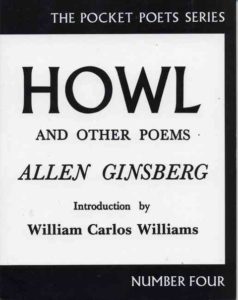
Howl and Other Poems 

By Allen Ginsberg

57 pages

Originally published by Lawrence Ferlinghetti (City Lights Books) in 1956

After church service, but before we were allowed to go out on Sundays, my mother required us to recite a poem she had given us the previous morning. In my early years, I memorized such poems as “The Owl and the Pussy Cat.” In my adolescent years, I was able to choose what I put to memory. They tended to be poems like “The Highwayman”by Alfred Noyes and “Richard Cory” by Edwin Arlington Robinson.

It was not until I was in college that I first read a “modern” poem. And the first one I read, Allen Ginsberg’s “Howl,” was a life changer.

I try to read a book a week. Last week, I didn’t have time to start and finish another one. But while browsing through a bookshelf in K’s office, I came across the very copy of “Howl” that I first read in 1969. And I was delighted to discover that it had marginalia and lines that I had starred or underlined.

So you can get a feel for this poem, in case you’ve never read it, here are a few of the passages that I had highlighted…

From Part I

I saw the best minds of my generation destroyed by madness,

starving hysterical naked,

for an angry fix,

angelheaded hipsters burning for the ancient heavenly

connection to the starry dynamo in the machinery of night,

who poverty and tatters and hollow-eyed and high sat up

smoking in the supernatural darkness of cold-water flats

floating across the tops of cities contemplating jazz…

… who broke down crying in white gymnasiums naked and

trembling before the machinery of other skeletons,

who bit detectives in the neck and shrieked with delight in

policecars for committing no crime but their own wild

cooking pederasty and intoxication,

who howled on their knees in the subway and were dragged off

the roof waving genitals and manuscripts,

who let themselves be fucked in the ass by saintly motorcyclists,

and screamed with joy,

who blew and were blown by those human seraphim, the sailors,

caresses of Atlantic and Caribbean love…


From Part II 

What sphinx of cement and aluminum bashed open their skulls

and ate up their brains and imagination?

Moloch! Solitude! Filth! Ugliness! Ashcans and unobtainable

dollars! Children screaming under the stairways! Boys sobbing

in armies! Old men weeping in the parks!

Moloch! Moloch! Nightmare of Moloch! Moloch the loveless!

Mental Moloch! Moloch the heavy judger of men!

Moloch the incomprehensible prison! Moloch the crossbone

soulless jailhouse and Congress of sorrows! Moloch whose

buildings are judgment! Moloch the vast stone of war!

Moloch the stunned governments!

Moloch whose mind is pure machinery! Moloch whose blood is

running money! Moloch whose fingers are ten armies!

Moloch whose breast is a cannibal dynamo! Moloch whose

ear is a smoking tomb!…dragging themselves through the negro streets at dawn looking

As you may have gathered from the above excerpts, “Howl” is a bit of a confessional poem. It brims with details that are now nostalgic of Ginsberg’s life as a key figure of the Beat Generation.

He first presented “Howl” at a poetry reading at Six Gallery bookstore in San Francisco. In the audience was Lawrence Ferlinghetti, a fellow writer and co-founder of City Lights Bookstore, who went on to publish “Howl” in a small paperback. Less than two years later, Ferlinghetti was arrested for publishing and selling copies of the poem, which had been deemed obscene. Though the case was widely publicized, a judge ultimately ruled that the poem displayed “redeeming social importance,” and Ferlinghetti was found not guilty. Today, it’s considered a seminal work of American literature.

I agree!

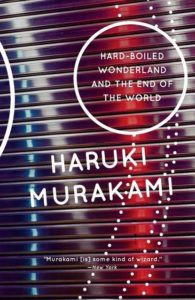
Hard-Boiled Wonderland and the End of the World

By Haruki Murakami

416 pages

Paperback published in 1993 by Knopf Doubleday Publishing Group

This was my book club’s book for October. I’d heard of the author. And Suzanne, my partner in my art business, is a fan. Still, I probably wouldn’t have read it were it not October’s selection. (There are probably 600 titles on my “must-read” list. If I get to half of them before I die, it will be a miracle.)

There are two plots in the book – one in the even chapters, the other in the odd chapters. The first takes place in the Hard-Boiled Wonderland; the second in the End of the World. Usually, this sort of narrative device is made obvious through the chapter titles or at least the characters’ names. But here, it was obfuscated, since each story is told by an unnamed narrator. It took me several chapters to figure it out.

In the Hard-Boiled Wonderland, the narrator describes himself as a Calcutec, someone trained to do computer-complex data encoding, which he encrypts through his subconscious mind. In the End of the World, the narrator is being trained as a dreamreader, someone that reads residual memories from the skulls of unicorns… or something like that.

If that has you thinking “far out,” you should know that the stories also include a mad scientist working on “sound removal,” his chubby and flirtatious granddaughter, a rapacious librarian, a pair of incompetent mobsters, an underground labyrinth, subterranean monsters, living shadows, a gatekeeper that guards them, and a miniature accordion that is the key to the End of the World.


What I Liked 

Notwithstanding the complexity of the action and the opacity of themes, both narratives are engaging and fun to read. As a whole, the book has the pace and forward momentum of a page-turner.  Also, the narrator of the Hard-Boiled Wonderland plot is infatuated with Western culture, which allows the author to pepper the narrative with familiar Western references. The plot and dialogue seem to be influenced by paperback detective stories, in the mode of Raymond Chandler. The End of the World plot is fantasy fiction along the lines of Kafka.


What I Didn’t Like 

The novel is promoted as a “deep dive into the very nature of consciousness,” and several critics praise it for that reason. I didn’t find anything deep in the sections that talked about consciousness. Instead, I found the sort of ideas you’d expect to find in a 1950s science fiction movie or a comic book.


The Takeaway 

If you like fantasy fiction, whodunits, or even magical realism, you may like this book very much. If, like me, you don’t, you may still enjoy the book, but probably not as much.


Critical Reception 

The novel has received critical acclaim both domestically and internationally. Here are some examples:

* “Murakami’s bold willingness to go straight over the top [is] a signal indication of his genius… a world-class writer who has both eyes open and takes big risks.” (The Washington Post Book World)

* “Rich in action, suspense, odd characters, and unexpected trifles… [a] provocative work.” (The Atlantic)

* “Murakami’s gift is for ironic observations that hint at something graver…. He is wry, absurd, and desolate.” (Los Angeles Times Book Review)

* “Off the wall… hilariously bizarre… splendid… a remarkable book.” (The [London] Times)

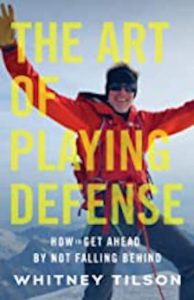
The Art of Playing Defense: How to Get Ahead by Not Falling Behind 

236 pages

Published May 18, 2021 by Lioncrest Publishing

In The Art of Playing Defense, Whitney Tilson talks about what it takes to have a full and rewarding life.

From the introduction:

To be successful and enjoy a happy life, it’s important to do all the right things: Become well-educated and wise, develop a strong work ethic, always act with integrity, and treat others well.

What’s equally important (but widely overlooked) is avoiding the calamities that can cause you to suffer, go back to square one, or worst of all, die a premature death.

I’m a fan of Whitney Tilson. Ever since he began writing for one of my client companies several years ago, I’ve been enjoying his blog posts on the economy, the pandemic, and finance. He’s smart. He’s knowledgeable.  He’s experienced. But most impressive to me, he’s not a conventional thinker. His views on topics ranging from investing to politics to physical fitness are often very different from mine.

And that’s what I’m liking about The Art of Playing Defense. When he states something that I agree with, it makes me feel smart. When he says something I disagree with, I feel even smarter.


Critical Reception: 

I couldn’t find any “official” reviews for this book, but here are a few reviews posted by readers on Amazon:

* “Tilson efficiently packs a ton of wisdom about risk taking and intelligently avoiding preventable disaster…. Highly recommended!”

* “Whitney gives great practical advice on how NOT TO MESS UP your life by controlling what you can control. Quick read, definitely worth it for the less conventional wisdom that you don’t often read.”

* “I enjoyed the numerous insights Tilson provided – from the importance of judgement often coming from ‘your worst 1%’ to how to find, engage, and build a long-term relationship with a mentor to the benefits of becoming a learning machine. Great advice, and definitely worth a read!”

And from Alison Tilson, the author’s 25-year-old daughter: “My dad’s ‘12 Questions to Ask Before You Marry Someone’ list has helped me boil down the most important qualities to look for in a life partner. He has instilled in me that picking the right person is critical to my happiness in life. I know that his list will help me make that all-important decision someday!”

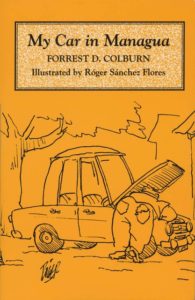
My Car in Managua 

By Forrest D. Colburn

135 pages

Published in 1991 by University of Texas Press

My Car in Nicaragua was recommended by a friend and board member of FunLimon, our community development center in Nicaragua. It’s a small book, but it’s big on insights and observations about life in Nicaragua during the Sandinista revolution.

Forrest Colburn is an academic. This book is derived partly from dissertation work he did at Cornell on revolutionary Nicaragua. I expected it to be academic (dull & pompous). But it wasn’t. It was brilliant, insightful, and a pleasure to read. The approach to his subject and his prose is much closer to Bill Bryson than it is to Harold Bloom.

Except for the final chapter, Colburn’s thesis on the Sandinista revolution is told indirectly through anecdotes, many of which, as the title suggests, pertain to an old Fiat he bought while he was living there.

In one of many wonderful examples, he talks about the “adjustments” that a McDonald’s had to make:

McDonald’s Managua has responded to the difficulties with creativity and good humor. As one of McDonald’s managers explained, “When we don’t have yellow cheese, we use white cheese. When we don’t have lettuce, we use cabbage. And when we don’t have french fries, we sell deep-fried cassava.” Of course, there are occasional stopgap measures that do not work. For a while McDonald’s tried using Russian wrapping paper for its Big Macs. But by the time customers walked to their tables, the paper gave the Big Macs the odor of “wet cardboard.” The managers of McDonald’s Managua astutely quit using the wrapping paper.


Critical Reception 

I couldn’t find any “official” reviews for this book, but here are a few excerpts of reviews posted by readers on GoodReads:

* “The affection that the author feels for this impoverished, exhausted country is obvious. For a commonsense view of 1980s Nicaragua that is enjoyable, well-written, and insightful, you cannot do better than this book.”

*  “I’d read a much more political account of the Nicaraguan revolution before that showed what happened behind closed doors at the highest levels, but this shared sketches of a more personal nature, demonstrating how the revolution affected the day-to-day lives of normal people.”

* “Colburn is even-handed and remarkably non-judgmental: He notes the material shortages and inflation under the piecemeal socialism of the Sandinistas with the same disinterested clarity used when he describes the widespread jokes about former dictator Anastasio Somoza.”

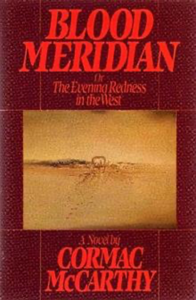
Blood Meridian – or The Evening Redness in the West

By Cormac McCarthy

337 pages

Published in April 1985 by Random House

I’m writing this review two hours before we meet to discuss the book. At this point, I’ve read about half of it. Normally, I’d feel uncertain about commenting on a novel I’d only half read, but not in this case. I’m quite certain that what’s ahead for me is more of what I’ve already experienced.

There isn’t much of a plot to Blood Meridian. It’s more like a travelogue – taking the reader through the seven circles of Cormac McCarthy’s vision of hell. There are four or five principal characters, but none can be described as a protagonist – not even “the kid.”

There is no character development to speak of. No anagnorisis. No peripetia. No denouement. But there is the kid’s tragic journey through a bleak and brutal landscape, described in language that is verbally lush, syntactically challenging – and always poetic. In fact, I have come to think of this book more as a prose poem than a novel.

Blood Meridian follows the kid, a teenage orphan with a penchant for violence, as he gets hooked up with a series of even more violent people while seeking his fortune in the US/Mexico borderland in the middle of the 19th century.

Some of the plot and at least two of the characters are based on historical accounts. One of them is John Glanton, the leader of a gang of thieves and murderers that, among other atrocities, randomly massacred indigenous Americans and Mexicans in 1949 and 1950. Another is Judge Holden, a character one could reasonably suppose to be a hybrid of Ahab, Kurtz, and Mephistopheles, but who was, in fact, a real person.

If Blood Meridian is verbally a prose poem, it is visually an orgy of charred and bludgeoned human bodies, broken skulls, bloody scalps, raped women, and hung and dismembered babies. Instead of a plot, the reader is delivered a litany of human cruelty, betrayal, and evil. These actions continue, almost unbroken, for 337 pages. You can open the book to any page, put your finger on any sentence, and you will be within 20 words of something that is ugly and/or violent and/or terrifying.

But the prose… It is the reason you want to keep on reading.

Blood Meridian is a literary achievement. It is Heart of Darkness played out on the Western Frontier, spare in sentimentality and brimming with Peckinpah-level carnage.

I’m eager to discover what my fellow Mules will say about it. I know at least one of them put the book down without finishing it. But Harold Bloom himself put it down twice before reading it through a third time and declaring it a masterpiece.

As I said, I am about halfway through the book. And so far, I’m not sure I’d rate Blood Meridian as highly as Bloom did. (Not that he would have needed my confirmation.) But I am certain that I will finish it – because even if it fails as a novel in some ways, it succeeds magnificently in so many others.


Critical Reception  

* “Blood Meridian comes at the reader like a slap in the face, an affront that asks us to endure a vision of [hell]…. But while Cormac McCarthy’s fifth novel is hard to get through, it is harder to ignore. Any page of his work reveals his originality, a passionate voice given equally to ugliness and lyricism.”  (Caryn James, New York Times, April 28, 1985)

* “McCarthy’s style is a pastiche of bad Faulkner, and his vocabulary is apparently drawn from Jacobean tragedies and translations of Beowulf…. The narrative is littered with portentous phrases like ‘Gods years’ and ‘lies by God lies.’ These… pronouncements, after a while, become irksomely hollow and pretentious…. Blood Meridian is certainly bold and disturbing – but does that make it a masterpiece?”  (Allen Boyer, Detroit Free Press, March 24, 1985)

* “[Cormac McCarthy] is the writer all American writers have to measure themselves against.” (David Vann, The Guardian, Nov. 13, 2009)

Astrophysics for People in a Hurry

By Neil deGrasse Tyson

244 pages

Published in 2017 by W.W. Norton & Co.

“I’m in a hurry,” I thought.

“Astrophysics? I’ve been trying to teach myself physics – Newtonian physics, relativity, quantum mechanics – for decades, with only marginal success. Maybe this book will give me another foothold on the subject. And maybe, as a bonus, I could develop an opinion about the Big Bang theory and black holes.”

I’m halfway through the book as I write this. I’m reading and listening to it, as I’ve become accustomed to doing. Professor Tyson himself does the reading. And he does a nice job of it. Warm, friendly, funny.

All the big issues are here: space, time, how the universe began, how we fit into it.

What I like about it: Pretty much everything so far. I especially like that the chapters are broken into small, digestible pieces.

What I don’t like about it: Despite his clarity, Tyson leaves me behind in almost every chapter. I’m getting the bigger points, but I’m still in the fog on the trickier stuff. If I’m going to really learn from this book, I’m probably going to have to read it more than once. But that’s a price I’m willing to pay.


Critical Reception 

* “Tyson is a master of streamlining and simplification… taking mind-bogglingly complex ideas, stripping them down to their nuts and bolts, padding them with colorful allegories and dorky jokes, and making them accessible to the layperson.” (Salon)

* “Tyson manifests science brilliantly… [his] insights are valuable for any leader, teacher, scientist, or educator.” (Forbes)

*  “The book is not quite astrophysics for dummies; while it is simplified, it is not simple. It is more a collection of the best and most thrilling moments; astrophysics’ greatest hits.” (The Guardian)

* “DeGrasse Tyson has a talent for making very complicated concepts seem simple, and the amount of content squeezed into one short volume is impressive. He certainly knows his stuff. It takes no time at all to romp through a chapter as the book is written with humour and his descriptions verge on the poetic.” (Chemistry World)

Talent Is Overrated

By Geoff Colvin

228 pages

Originally published in 2008

If I were to list the 100 best non-fiction books I’ve ever read, Talent Is Overrated would not be included. Not because it’s a bad book, but because it presents an argument about achievement and personal excellence that I was already quite familiar with.

In fact, I developed a nearly identical thesis in postings I wrote for Early to Rise more than 20 years ago. But there’s been a lot more research into the subject since then. And in Talent Is Overrated, Geoff Colvin does a good job of summing it all up. Which is to say, if you have ever wondered why some people develop mastery in certain areas while most lag far behind, this is a book I would recommend.

In the fall of 2000, I was thinking about skill development – what it takes to get better at complex skills, such as writing or playing chess or competing in martial arts – and wondering (perhaps because I was frustrated by my own pace of learning) why some people develop faster and farther than others.

There were quite a few interesting studies that I could have looked at. Instead, I did what I often did back then: I allowed myself to believe that my own experience was more than enough to answer my own questions.

I did some retroactive calculations on how long it took me to learn how to speak passable French, to write a successful sales letter, and to earn my black belt in Jiu Jitsu. And I measured the time in hours…

To begin the process of improving yourself, you must accept the fact that you are less than you want to be. As beginners in practicing a skill, we are almost all incompetent. If you aren’t humble enough to acknowledge that, you will resist taking the baby steps you need to take to eventually rise to a level of competence and then mastery.

In addition to humility, you need persistence, the willingness to put in the hours it takes to achieve whatever level of skill you are aspiring to. Based on my experience, it takes about 1,000 hours of practice to become competent in a complex skill, and 5,000 hours to achieve mastery. (With a teacher to guide you, maybe less.)

But practice doesn’t mean simply repeating a skill over and over again. It means doing it with awareness and attention. If all you are doing is going through the motions, your chances of improving are small.

When I wrote this 20 years ago, I believed I was introducing a brand-new idea into the marketplace of such ideas. In fact, as I said, that field of inquiry had already been studied at some length. And there was a Swedish psychologist, Anders Ericsson, that had come to a conclusion that was similar to mine. (He postulated 10,000 hours for “world class mastery,” a somewhat higher standard than I had in mind.)

Geoff Colvin serves up the same idea in Talent Is Overrated – but with a slightly different timespan, lots of additional backup, and some interesting thoughts and speculations. His prose is clean, his examples are entertaining, and the argument overall is convincing.

Here are a few nuggets I highlighted as I read:

* “Many people not only fail to become outstandingly good at what they do, no matter how many years they spend doing it, they frequently don’t even get any better than they were when they started.”

* “Being good at whatever we want to do is among the deepest sources of fulfillment we will ever know.”

* “IQ is a decent predictor of performance on an unfamiliar task, but once a person has been at a job for a few years, IQ predicts little or nothing about performance.”

* “In math, science, musical composition, swimming, X-ray diagnosis, tennis, literature – no one, not even the most “talented” performers, became great without at least 10 years of very hard preparation.”

“Deliberate practice,” Colvin says, is the key to achieving world-class performance. And he points out that this is usually done with a teacher’s help. (“Anyone who thinks they’ve outgrown the benefits of a teacher’s help should at least question that view.”)

“The great performers isolate remarkably specific aspects of what they do and focus on just those things until they are improved,” he says, “then it’s on to the next aspect. Only by choosing activities in the learning zone can one make progress. That’s the location of skills and abilities that are just out of reach…. Identifying the learning zone, which is not simple, and then forcing oneself to stay continually in it as it changes, which is even harder – these are the first and most important characteristics of deliberate practice.”

Not surprisingly…

It is hard work.

It does not feel like fun.


Critical Reviews 

A few of the comments posted by readers on the GoodReads website:

* “One of, if not THE best book I read this year. Some of this book supported theories I’ve read in other books… yet Colvin presented the ideas backed with more research. This book reinforced my beliefs on the benefits of coaching. Colvin also pointed out specific ways to apply this knowledge to business.”

* “This book is overrated. After meandering for several chapters through what does NOT lead to high performance, Colvin finally gets around to arguing that the secret is ‘deliberate practice.’”

* “There are numerous good points about this book: good information based on solid scientific research; pretty good writing (not master level but close); cogent argument, and so on. That being said, this book leaves several threads hanging.”

Click here to watch a promotional video for the book by the author.

A Sport and a Pastime

by James Salter

204 pages

Originally published in 1967

Paperback published in 2006 by Farrar, Straus and Giroux

A Sport and a Pastime – another Mules Book Club selection – is a short novel. Just 200-something pages. I bought an old paperback copy that I read in bed, and an audio version that I listened to while driving.

I enjoy consuming a book this way. It’s efficient, and it’s multidimensional. Sometimes, when the reader is especially good, I prefer the audiobook. Other times, when I like the voice in my head better than the reader’s, I favor the print. In this case, although the reader did a good job with the dialog, I was less than happy with his reading of the many poetic passages. I wanted him to savor them. He chewed them up.

A Sport and a Pastime is considered by most critics to be a modern classic. And its author, James Salter, has been canonized among America’s great late-20th century novelists, along with Philip Roth, John Updike, and Norman Mailer. When the book was recommended, I thought, “Well, another book I’ve read before.” With the opening paragraph, I realized I hadn’t. And that I was in for a treat:

September. It seems these luminous days will never end. The city, which was almost empty during August, now is filling up again. It is being replenished. The restaurants are all reopening, the shops. People are coming back from the country, the sea, from trips on roads all jammed with cars. The station is very crowded. There are children, dogs, families with old pieces of luggage bound by straps. I make my way among them. It’s like being in a tunnel. Finally I emerge onto the brilliance of the quai, beneath a roof of glass panels which seems to magnify the light.


The Story

A Sport and a Pastime is the story of a summer romance between Philip Dean, an American middle-class college dropout, and Anne-Marie, a French girl. It is told by a highly intelligent, highly self-conscious, and ultimately unreliable narrator (who is unnamed).

The plot – well, it doesn’t have a plot. Unless you think this is a plot… Chapter One: Wake, walk, talk, eat, drink, fuck. Chapter Two: Wake, fuck, eat, walk, go to the movies, drink, fuck. Other chapters: The same, but in a slightly different order.

If that sounds like a condemnation, it’s not. Not entirely. For many good reasons, A Sport and a Pastime deserves its literary status. Salter’s prose is engaging and seductive. The dialog is natural and efficient. The sex scenes are not (as many critics have said) pornographic, but erotic. Erotic in a sparse and almost clinical way. And that renders them believable – which, one realizes in reading them, is a significant literary accomplishment.

Lacking the typical arc of a conventional plot, the narrative gets its forward motion by the elegance of the prose and the mystery of the narrator. He presents himself as a friend of Dean, the protagonist. But he admits to his unreliability from the very first chapter and continues to remind the reader that the narration, though it flows like a memoir, is entirely a product of fiction. In fact, I had the notion that Dean and the narrator were one. Dean being the imagined Alpha of the narrator, or – perhaps more interestingly – the narrator being the imagined Nick Carraway to the author’s actual self.


Critical Reception

A Sport and a Pastime is, as I said, considered a modern classic. But only I and one other Mule felt it deserved that reputation. The rest panned it severely. Most didn’t even finish it. “It’s like Dick and Jane Have Sex,” one said. “Sixteen times in sixteen chapters.”

I was shocked. Most of the time, there is general agreement about the books we read. But A Sport and a Pastime may be the least-liked book we’ve read since we began meeting 10 years ago. Hell, sophomoric, pseudo-literary novels like The Kite Runner, The Underground Railroad, and Where the Crawdads Sing got better reviews.

Reynolds Price, in The New York Times Book Review, wrote: “Of living novelists, none has produced a novel I admire more than A Sport and a Pastime… it’s as nearly perfect as any American fiction I know.”

And as recently as 2017, Sarah Hall, writing for The Guardian, had this to say: “Since its publication in 1967, during the decade of sexual revolution, A Sport and a Pastime has set the standard not only for eroticism in fiction, but for the principal organ of literature – the imagination. What appears at first to be a short, tragic novel about a love affair in France is in fact an ambitious, refractive inquiry into the nature and meaning of storytelling, and the reasons we are compelled to invent, in particular, romances. That such a feat occurs across a mere 200 pages is breathtaking, and though its narrative choreography seems simple, the novel is anything but minor.”


Note: If, after reading A Sport and a Pastime, you want to know more about James Salter, there’s a 54-minute documentary (available on Amazon Prime) that explains his “love affair” with France and his place in modern American fiction. It includes plenty of snippets of his writing, which will give you a feel for the terse beauty of his prose style.

You can watch the trailer here.