“A Cold Email Got Me My Job” 

“Everyone says networking is the route to success,” writes Olivia Reingold in The Free Press. “But I’ve always been a strong believer that any door can open if you score the right invitation. My advice? Don’t ever ask to ‘pick’ someone’s brain. The trick is to get inside their brain. Start by googling them, or rereading or relistening to their work. Why do you like it? Tell them that. Make them know they matter.”

I made essentially the same argument many years ago in my book Automatic Wealth for Grads.
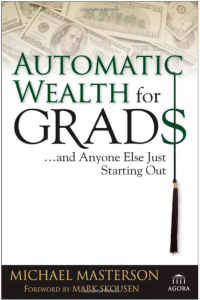
Here’s the gist of some of what I said in the chapter about how to write a great job application letter:

The most important thing you need to realize about getting a job is this: The people who will be reading your letter are not really interested in you.

If they’re not interested in you, then what are they interested in?

I’ll tell you: They’re interested in themselves.

Think of getting a job as a direct-marketing challenge. The direct marketer knows that, to make a sale, everything he writes must be focused on the prospect’s problems and how much better his life will be after he’s bought the product.

When seeking a job, the prospect is the person you want to work for and you are the product.

So, the number one job of any sales pitch to that prospect (a letter, phone call, or personal meeting) is NOT to sell yourself as smart and well educated, but as someone smart and knowledgeable enough to solve his problems.

And to do that, you have to do a good deal of research. To begin with, you should research the industry to understand its problems and challenges. Then research the company itself and find out everything you possibly can about it. Is it growing, in limbo, or losing revenue? What are the main factors affecting that? And then, finally, dig up what you can about the person you are going to be working for. What kind of boss is he?

If your first effort is a letter, make it as specific and personalized as you possibly can. Don’t make it sound like you’ve been snooping around, but make it clear that you (1) understand how the business works, (2) have some idea of what the primary challenges are in terms of profit growth, and (3) are interested in helping this particular person accomplish more with less stress because you will be there to take responsibility for whatever he needs.

   Click here to read Olivia’s article.

And if you’d like a copy of Automatic Wealth for Grads – for yourself or as a gift to a young person just starting out – you can order it directly from us. List price is $22.95. But for readers of this blog, the price is $15 (which includes free shipping).

To order your copy:

* Send a check for $15.

* Make the check payable to Cap & Bells Press, LLC. (No cash, please.)

* Include your name and mailing address and mail it to:

Cap & Bells Press

Attn: GKoo

290 SE 2nd Ave.

Delray Beach, FL 33444
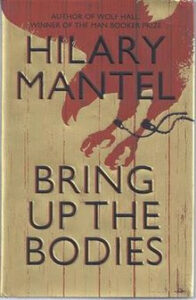
Bring Up the Bodies 

By Hilary Mantel

432 pages

Published May 8, 2012

For the month of August, the Elder Mules selected Hilary Mantel’s Bring Up the Bodies.

Mantel’s name was familiar to me, but I knew nothing about her books. I worried that this one might be one of those novels that is better suited for the book clubs that our spouses belong to. So, I googled it. Turns out it’s a historical novel – and a good one. It’s the second book in a trilogy charting the rise and fall of Thomas Cromwell, the powerful minister in the court of King Henry VIII. The other two books in the trilogy are Wolf Hall (2009) and The Mirror and the Light(2020). Both Wolf Hall and Bring Up the Bodies won the Man Booker Prize.

I’ve always been interested in the story of Henry VIII and his eight wives, one of whom, Anne Boleyn, was famously beheaded. What brought about her downfall? And what did Thomas Cromwell have to do with it? Bring Up the Bodies does a detailed and entertaining job of explaining all that.

Critical Reception 

* “Bring Up the Bodies (the title refers to the four men executed for supposedly sleeping with Anne) isn’t nostalgic, exactly, but it’s astringent and purifying, stripping away the cobwebs and varnish of history, the antique formulations and brocaded sentimentality of costume-drama novels, so that the English past comes to seem like something vivid, strange, and brand new.” (Charles McGrath)

* “Historical fiction has many pitfalls, multiple characters and plausible underwear being only two of them. How should people talk?… How much detail – clothes, furnishings, appliances – to supply without clogging up the page and slowing down the story?… Mantel sometimes overshares, but literary invention does not fail her: She’s as deft and verbally adroit as ever.” (Margaret Atwood)

* “[The book’s] ironic ending will be no cliffhanger for anyone even remotely familiar with Henry VIII’s trail of carnage. But in Bring Up the Bodies it works as one. The wonder of Ms. Mantel’s retelling is that she makes these events fresh and terrifying all over again.” (Janet Maslin) 

“I Keep Writing the Same Poptimism Piece Because Nothing Ever Changes” 

An interesting article by Freddie deBoer on the political popularity of Taylor Swift and how it represents another regrettable stage in the morbidity of American culture. Click here.

How Lewis Strauss Orchestrated Robert Oppenheimer’s Downfall 

Oppenheimer, the movie, was, as I said above, a good movie, but not a great one. It suggested all sorts of historical and scientific questions it didn’t even try to answer. But one question it did answer was about the increasingly antagonistic relationship between Oppenheimer, the quantum physics genius, and Lewis Strauss, an amateur physicist who used his fortune and influence to become one of America’s most important atomic-energy advisors during the Cold War.

Click here for the whole story.

AOC Is Just a Regular Democrat Now

An insightful essay by Freddie DeBoer, my favorite Communist, on AOC’s disappointing (to him) failure to support the leftist ideas she associated herself with in the early months of her political career. Click here.

“Welcome to the MAGA Hamptons!”

“Every summer, the haute bourgeoisie of Middle America descend on Lake of the Ozarks to jet ski, barbecue ribs, and (until 2023) drink a shit-ton of Budweiser,” writes Max Meyer, in The Free Press.

Click here to read more.

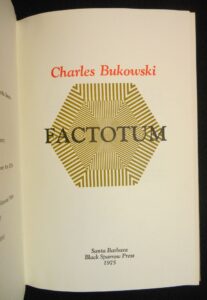
Factotum 

By Charles Bukowski

208 pages

Originally published Jan. 1, 1975

Factotum was one of three books the Mules read for our mid-July meeting at the Cigar Club. A semi-autobiographical novel about a wannabe writer and drunk, it is outside of the sorts of books our members enjoy reading, so I was surprised by the recommendation.

The Plot 

Henry Chinaski roams around from one fleabag hotel and city to another, barely understanding what is going on while attempting to support himself through mindless, poorly paid jobs. (Chinaski is Bukowski’s alter-ego. The character appears in five of his novels.)

There’s lots of drinking, smoking, and foul language, but there is virtually no forward movement among the characters. Still, I would recommend this book to anyone that hasn’t read Bukowski and to anyone that wanted to understand American prose in modern times.

What I Liked About It 

Bukowski’s prose. I’m a big fan of Hemingway. And I liked the way Bukowski takes Hem’s terseness and directness even farther… probably as far as prose can go while still retaining some poetic vibration.

What I Didn’t Like So Much 

Having to vicariously live the life of Henry Chinaski. This isn’t a fault of the story. Nor of Bukowski’s imagination. He wants the reader to live in that depressing, boring, unredeemable world in order to show him the little glints of light. But it’s viscerally uncomfortable.

About Charles Bukowski 

Charles Bukowski (1920-1994) 

Charles Bukowski was born in Germany. When he was three, the family moved to the US.

As a struggling writer, he worked a wide range of jobs, including dishwasher, truck driver and loader, mail carrier, guard, gas station attendant, stock boy, warehouse worker, shipping clerk, post office clerk, parking lot attendant, Red Cross orderly, and elevator operator. He also worked in a dog biscuit factory, a slaughterhouse, a cake and cookie factory, and he hung posters in New York City subways.

His writing often featured a depraved metropolitan environment, downtrodden members of American society, direct language, violence, and sexual imagery. His first book of poetry was published in 1959. He went on to publish more than forty-five books of poetry and prose. (Source: Poets.org)

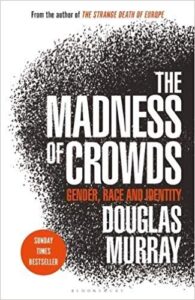
The Madness of Crowds: Gender, Race and Identity 

By Douglas Murray

288 pages

Originally published Sept. 17, 2019

I’ve heard Douglas Murray on the BBC. I’ve seen him in a few debates. And I’ve had The Madness of Crowds recommended to me by friends and colleagues. But until last week, I didn’t realize that Murray was the author. It was time to check it out. So, I ordered it on my audio app and began listening.

I’ve read (listened to) about half of it so far, and I’m feeling like it’s a well-spent investment of time. The Madness of Crowds is about, among other things, some of the extreme ideas that leftists are promoting about gender and sex. And yet, in Chapter One, I learned that Douglas Murray is a homosexual.

That has given his book an extra layer of interest for me. I want to find out how he deals with the gap between his political and social conservatism and the expectations that leftists have of him as a gay man.

It’s basically the same challenge that Black conservatives have when they talk about race or any topic that has racial associations, which is basically every topic today.

The Madness of Crowds is divided into four main sections, each a look at an identity group: Gay, Women, Race, and Trans. Murray makes a strong case that contemporary ideas about and attitudes towards each group have not been good – either for the groups themselves or for the community at large. He warns that the current practices of vitriol, cancellation, doxing (a form of cyberbullying), and other forms of and ideological persecution are fueled by identity politics. And they are growing fast. In a world gone mad with tribalism, he says, and with each tribe getting its information and inspiration from different sources, we must relearn how to accept and forgive.

Douglas Murray is smart and funny in a way that I associate with my old-fashioned view of things. His arguments are, to my mind, solid. But they are delivered, as one critic put it, with such lively, razor-sharp prose that I would want to believe them even if I didn’t.

Critical Reception 

The Madness of Crowds was a bestseller and “book of the year” for The Times and The Sunday Times in the UK, but it received varying reviews from critics.

Tim Stanley in The Daily Telegraph praised the book, calling Murray “a superbly perceptive guide through the age of the social justice warrior.” Katie Law in the Evening Standard said that Murray “tackled another necessary and provocative subject with wit and bravery.” Writing for the Financial Times, Eric Kaufmann said that he “performs a great service in exposing the excesses of the left-modernist faith.”

Conversely, William Davies in The Guardian was highly critical, describing the book as “the bizarre fantasies of a rightwing provocateur, blind to oppression.” And in The Times Literary Supplement, Terry Eagleton likened it to “a history of conservatism which views it almost entirely through the lens of upper-class louts smashing up Oxford restaurants.”

About Douglas Murray 

Douglas Kear Murray is a British author and political commentator. He has been a contributor to The Spectator since 2000 and has been Associate Editor at the magazine since 2012. He published his first book, a biography of Lord Alfred Douglas (the lover of Oscar Wilde), at the age of 19, while he was an undergraduate at Oxford. Since then, he has published three more books on politics, history, and current affairs, including the award-winning bestseller The Strange Death of Europe: Immigration, Identity, Islam.

Here’s a clip of him talking about the connection between post-modern theory and woke thinking today.

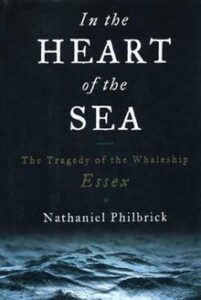
In the Heart of the Sea:

The Tragedy of the Whaleship Essex 

By Nathaniel Philbrick

302 pages

Originally published May 8, 2000

Storytellers have used real-life events as inspiration going back to the beginning of history. Herman Melville’s classic 1851 novel about an elusive and dangerous whale, for example, was partly based on a real-life Sperm Whale: Mocha Dick. Named for the island of Mocha in Chile, where it was first spotted, it eluded whalers for decades before being killed in 1839. A first-person account of Mocha Dick’s demise was published in 1839 in The Knickerbocker (a literary magazine). Subtitled “The White Whale of the Pacific,” it was a story that Melville almost certainly read. Click here.

Another source that Melville drew upon was the tragic story of the whaleship Essex, chronicled by Nathaniel Philbrick in his book In the Heart of the Sea.

It was the book of the month for the Mules, recommended by founding members BS and CA. (The two of them are probably responsible for more book recommendations than all the other members put together. We don’t formally acknowledge that because we like to believe that the club is equitable and inclusive. But I suspect that, like every other social and political organization, the Mules is secretly run by a Deep State, of which these two are deeply ensconced.)

It was quite a good recommendation. Full of information about whales and the whaling life. But it was also a book that made you stop and think every several pages about the possibilities and limits of human courage and endurance. It is hard to read it without having to confront the fact that we are all much softer than men and women were back then.

The Story 

In 1820, the whaleship Essex is rammed and eventually sunk by what appears to be an angry Sperm Whale. As the ship sinks, the captain and crew desperately provision three small whaleboats for what will turn out to be 90 terrible days at sea.

Widely reported and discussed in the media at the time, the wreck of the Essex was, for the 19th century, as big a story as was the sinking of the Titanic a century later.

Critical Reception 

In the Heart of the Sea was on the NYT bestseller list for 40 weeks. It won the National Book Award for Nonfiction in 2000.

* “Scrupulously researched and elegantly written, In the Heart of the Sea is a masterpiece of maritime history. It would have earned Melville’s admiration.” (W. Jeffrey Bolster, New York Times)

* “One of our country’s great adventure stories.” (Wall Street Journal)

* “[Told] with verve and authenticity… a classic tale of the sea.” (San Francisco Chronicle)

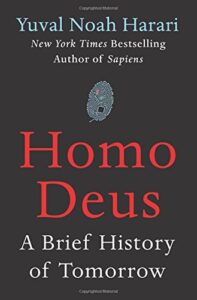
Homo Deus: A Brief History of Tomorrow 

By Yuval Noah Harari

448 pages

Originally published in 2015

The first book of Harari’s that I read was Sapiens. I loved it. It’s one of those books that gives pleasure on almost every page. And there are 448 pages. In it, Harari takes readers on a tour of the history of Homo sapiens (intelligent humans), divided into four periods:

  1. The Cognitive Revolution (c. 70,000 BCE, when imagination evolved in Homo sapiens)
  2. The Agricultural Revolution (c. 10,000 BCE, the development of agriculture)
  3. The Unification of Humankind (c. 34 CE, the gradual consolidation of political organizations towards one global empire)
  4. The Scientific Revolution (c. 1543 CE, the emergence of objective science)

I next read Harari’s 21 Lessons for the 21st Century, which seems to be a collection of clever but somewhat random ideas he had about the state of the world that he wanted to get down on paper. That book was solid, but not great.

With Homo Deus, Harari is back to his strength. As the subtitle cleverly suggests, it is a wide-ranging commentary about all the amazing things that are happening today, with a brief history of how they came about (mostly taken from Sapiens) and a look at what they will look like in the future. And “the future,” as he reminds us, could be next month.

His central argument is that it took millions of years for apes to evolve into Homo sapiens via the tedious mechanism of evolution through natural selection, and that has changed. Natural selection is being replaced by machine learning, AI, and other forms of intelligent design that are much faster (and become geometrically faster every year). Homo sapiens’ next stage of development – the “Homo deus” of the title – will be taking on the characteristics that traditional societies attributed to gods.

With the recent developments in AI technology, this book couldn’t be a more timely read. A question it is trying to answer: What effect will it have on the world?

For example:

* What will happen to democracy when Google and Facebook come to know our likes and our political preferences better than we know them ourselves?

* What will happen to the welfare state when computers push humans out of the job market and create a massive new “useless class”?

* Will Silicon Valley end up producing new religions, rather than just novel gadgets?

Critical Reception 

I didn’t know this when I read Sapiens, but Harari is generally thought poorly of in academic circles. In preparing this review, I read a few such critiques and they were sort of obnoxiously dismissive.

For example, from Christopher Robert Halpike on Sapiens in 2020: “One has often had to point out how surprisingly little [Harari] seems to have read on quite a number of essential topics. It would be fair to say that whenever his facts are broadly correct they are not new, and whenever he tries to strike out on his own he often gets things wrong, sometimes seriously.”

And on July 22, 2022, Current Affairs published “The Dangerous Populist Science of Yuval Noah Harari,” an article arguing that his books were short on scientific proof: “The bestselling author is a gifted storyteller and popular speaker. But he sacrifices science for sensationalism, and his work is riddled with error.”

Here’s What I Think 

Academics don’t like Harari because he understands and exposes their game of branding ideas that don’t support their leftist views as unscientific and factually inaccurate. What they really mean is: “Don’t even bother to read Harari. You may find him interesting, but his books will damage you. And you and your children will stop believing in all the bullshit we’ve been paid to teach and write about.”

About Yuval Noah Harari 

Yuval Noah Harari is a historian, philosopher, and bestselling author. (His books have sold 45 million copies in 65 languages.) Currently a professor in the Department of History at the Hebrew University of Jerusalem, he is considered one of the world’s most influential public intellectuals.

Click here to watch him speaking about Homo Deus.