A Sad Day for Boomers Reflections from Japan

I had a substantial issue planned for you, including an essay on the No Kings Day protests and why it struck me as a sad day for my fellow Baby Boomers. That is what you should be getting today had I finished it before I left the States on Sunday.

But I didn’t. Not quite. So, here it is Wednesday and I’m in Japan again, preparing for a week of speeches and interviews and meetings with my Japanese partners.

Tokyo’s skyline

K and I are also doing a bit of touristing. Yesterday, we saw two fantastic art exhibitions – the first one a retrospective of the paintings (really billboards) of one of my favorite Japanese Edo-period (1603-1868) painters, and the second one an exhibition of Art Deco-period haut couture clothing.

Those activities took precedence over finishing the issue on the protests. So what I’ve done instead is “share” with you a draft of something I wrote for my Japanese readers about what I want to do (but often don’t) with my spare time.

If you are an ambitious sort, you will probably recognize a good deal of familiar thoughts and feelings in that draft. What I’d like to know is if you care about it – i.e., whether it bothers you when you spend an hour or several hours doing nothing or less than nothing. And if not, why not?

And since we’re talking about things we do in our spare time, I’m including some (lukewarm) recommendations for books and movies later in this issue that you might want to check out.

My Never-Ending Battle to Conquer the Biggest Productivity Killer in My Life 

When I began writing about success and productivity 25 years ago, I was quick to criticize television, urging my readers to watch as little of it as possible.

My reasoning was simple: Most of what I saw on TV was bad – mediocre, at best – and I almost always came away feeling disappointed. Worse, every hour in front of the “boob tube” was an hour I could have spent doing something more meaningful.

But television has changed dramatically. Today, there are perhaps a hundred times more movies and episodic series being produced, and with that explosion has come an equally dramatic increase in quality.

I no longer feel confined to mediocrity when I turn on the TV or open my laptop. Quite the opposite: I’m struck by how much truly good content is available at any moment.

That realization cancels my first objection to watching TV. Yet my second objection – that it eats into “productive time” – has only grown stronger, because the temptation to watch is greater than ever.

With so many worthwhile options across cable and streaming platforms, I could easily spend six or eight hours a day absorbed in documentaries, dramas, films, investigative series, and even the occasional sporting event. At the end of such a day, I could honestly say, “That was time well spent. I learned some things. I was entertained.”

But given the limited amount of spare time we have in a day, should I? Of course not.

This is not the first time I’ve pondered the question of how to make the best use of those precious hours. Today’s main essay is my latest attempt to come up with a definitive answer.

So Little Time… So Many Enticing Ways to Waste It
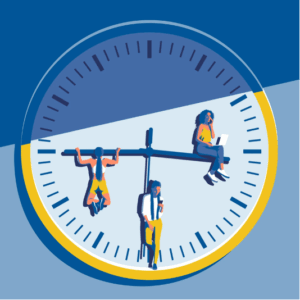
Many years ago, I wrote a series of essays in Early to Rise about the many activities that compete for our spare time.

I began with the obvious point: Since the hours of genuine “free time” we have each day are so limited, it would be foolish to fill them with whatever random diversion happens to appear. Having squandered so much of my own time in the past, I resolved not to let chance – or worse, habit – determine the value of those hours. They were mine, a precious resource, and I had both the ability and the responsibility to choose wisely.

To deal with this challenge, I developed a theory and a method for optimizing the value and pleasure of my spare time.

It began with a simple realization: After any given activity, I would almost always feel one of three ways.

* I felt good about how I’d spent the time.
* I felt nothing at all.
* I felt bad about it.

It didn’t take long to see the obvious conclusion: I needed a system to select spare-time activities that would leave me feeling good and never feeling bad. The next step was to figure out the qualities or characteristics of the activates that left me feeling one way or the other.

That wasn’t difficult either. I kept a simple ledger of what I was doing and how it felt. Within a month, the pattern was clear.

Among the activities that left me feeling good were these:

* Writing books and essays
* Exercising – strength training and hard cardio
* Giving speeches to large audiences
* Running workshops for sharp, ambitious people
* Mentoring young professionals in my industry
* Reading a good book
* Watching a great film
* Watching an edifying documentary
* Developing Paradise Palms, my botanical garden
* Running Fun Limón, our family’s community center in Nicaragua
* Expanding my collection of Central American modern art
* Planning a museum for that art
* Spending time in museums – especially art museums
* Having stimulating conversations
* Learning about art, music, or any subject I cared about
* Practicing jiu jitsu
* Listening to good music
* Enjoying food and drink
* Spending time with my kids and grandkids

Among the activities that left me feeling bad were these:

* Watching bad or mediocre movies or TV
* Reading mediocre books
* Eating junk food or overeating
* Getting drunk
* Playing solitaire
* Gossiping
* Giving unsolicited advice
* Consuming salacious or depressing news

From there, I sorted my spare-time activities into three categories:

* Those that improved me
* Those that damaged me
* Those that did neither but left me with the hollow sense that I’d wasted my time

I then gave names to the three categories: Golden Choices, Vaporous Choices, and Acidic Choices. Mixed metaphors though they were, I felt they captured the essence of why some options leave us nourished, others leave us empty, and still others corrode us from within.

As I laid all this out again recently, it struck me how closely this hierarchy mirrored one I had already developed for my working hours. In earlier essays and in one of my books, I had argued that the best way to maximize the value of your work is to discipline yourself to spend the first hours of the day on the highest-value, most difficult tasks – the ones that move you forward – and push the lower-value, routine tasks to later in the day when your focus and energy are diminished.

I realized the same principle applies to leisure. If I wanted to get the most satisfaction from my spare hours, I needed to rank activities by the value they brought me, and then commit to choosing the higher-value, higher-pleasure options whenever I had a choice.

My Golden Choices 

My best experiences come from activities that are both intellectually challenging and emotionally engaging – the work that I believe is truly necessary and important. That includes writing books, producing films, and building my nonprofit foundations. It also means investing in and sustaining strong personal relationships.

These are the things that matter most to me – the things I think of when someone asks, “How do you want to be remembered?” But they are rarely easy. They demand focus, discipline, and energy. When I’m tired, I tend to avoid them. I have to push myself to begin.

Yet once I start, the resistance fades. Progress breeds hope. I begin to feel the worth of the effort and the value it will have when it’s complete. The work itself becomes energizing. Even inspiring. And when I finally step away at the end of the day, I feel satisfied, not just with what I accomplished but with how I chose to spend my time.

My Vaporous Choices

Welcome to the Vapor Zone. This is where I go when I don’t feel like working hard, but I don’t feel like completely wasting my time either.

Vaporous activities are easy to slip into. They’re also easy to spend hours doing. These are the activities that feel like fun while you’re in them and leave you feeling sort of okay when you’re done and move on to something else. Not good. Not bad either. Just… okay.

We treat them as acceptable choices when we don’t feel like making choices at all – e.g., the neutral, happy world of poker, sitcoms, and gossip.

When I’m ready for some relaxation, my first impulse is to reach for a Vaporous activity. Having “worked hard all day,” I want something simple and mindless so I can gear down. Getting into the Vapor Zone is easy. Staying there is easier still.

The problem with Vaporous activities – and this is a very big problem for me – is that they leave me feeling enervated rather than energized. And empty. Like Vaporous foods (comfort foods), they fill me up, but they wear me out.

My Acidic Choices 

Everybody has vices. And while I haven’t had all of them, I’ve done plenty to destroy, reduce, or disable myself.

Why I do these things, I can only guess. Sometimes I think I need the challenge of surviving self-imposed obstacles. Whatever the reason, the result is almost always the same.

I get a dull pleasure, tinged with a faint trace of pain. Even when the pleasure feels intense, it comes through a foggy brain. It feels like I’m having a great time… but I’m never quite sure. And if the experience of Acidic activities is muddled, the feeling afterward is anything but. It is bad.

The interesting thing about Acidic activities is how seductive they are. Nobody would claim they’re good choices. We pick them because we’re too weak to pick anything else, and then we use what little mind we have left to rationalize our own self-destruction.

A Closer Look at the Three Categories 

As a rule, the easiest choices are rarely the best ones. Bad habits (Acidic choices) are easy precisely because they’re habits. Vaporous choices are easy, too, because they require no fortitude and almost no energy. It’s the Golden choices that are hardest, because they demand effort and focus.

When we are at our best – confident, rested, full of energy – we can easily choose Golden activities. When we’re just okay, we usually have the strength to reject Acidic temptations, but not quite enough to reach for Golden. And when we’re at our worst – tired, discouraged, doubtful – that’s when Acidic choices look most appealing.

I’ve also been thinking about these categories from another angle: through the lens of what I call sustainable pleasures.

Sustainable pleasures are activities that give us genuine satisfaction every time we do them – no matter how many times we repeat them. And, as with spare time, there’s a hierarchy here, too.

In my early writing on this, I broke it down into three sustainable pleasures:

* Working on something you care about
* Learning something you believe has value
* Sharing the benefits of what you’ve gained from that work and learning

Underneath those distinctions is a simple truth: The more importance you attach to the work or learning itself, the deeper and longer-lasting the pleasure you get from it.

You may not agree with every item on my list. And that’s fine. Think of it as a template, a way to establish your own hierarchy of choices.

In creating your list, consider the following:

The Characteristics of Golden Experiences… 

* The activity/experience is intellectually challenging. It teaches you something worth knowing or develops a skill worth having.

* It is emotionally deepening. It helps you understand something you hadn’t understood before and/or makes you sympathetic to situations you had previously closed yourself off to.

* It is energizing. The experience itself charges you spiritually, emotionally, and intellectually. You have greater strength and more endurance because of it.

* It leaves you happy with your choice. During the experience and afterward, you have a strong sense that you are doing the right thing.

* It builds confidence. Because you know that you are improving yourself, choosing Golden activities makes you feel better able to make wise choices in the future.

The Characteristics of Vaporous Experiences… 

* The activity/experience is intellectually and emotionally easy. It feels comfortable and comfortably enjoyable. You’ve done it before, it amused you, and you expect it will amuse you again.

* It is usually passive rather than active. It is watching TV rather than going to a stage play. It is getting a massage rather than practicing yoga. It is chugging a brewsky rather than savoring a good wine.

* It tends to be habit forming. Because it feels good (in a medium-energy sort of way) and is so easy to do, you find yourself doing it again and again.

* Whether it’s eating starch and fat or sitting on the couch and staring at the TV screen, a little doesn’t hurt. But too much leaves you with the unpleasant feeling that you’ve wasted your time.

The Characteristics of Acidic Experiences… 

* The activity/experience is physically or mentally damaging. Often, it kills brain cells. Sometimes, it gives you cancer.

* Although it is bad for you, it is alluring. There is something about the way the experience takes you out of yourself that you find attractive.

* It attracts bad company. Since most healthy people don’t approve, you end up doing it with a different set of friends. Eventually, you reject the ones who don’t “get it.” They’re too straitlaced or lame to understand, so you figure you don’t need them in your life.

* It disables you intellectually, emotionally, and physically. In the moment, you are less capable of performing complex skills or handling complex issues. If you engage in acidic activities often, your overall capacity for peak performance declines.

* It has an ever-rising threshold. What excites you at first is never enough later. You fall into the mistaken belief that more is always better.

Applying the Formula to Your Spare Time 

If you’d like to apply this formula to improve your own experiences of your own spare time, here are some suggestions to help you do it:

1. Don’t let your spare time happen by happenstance.

Unless you take a few extra minutes each day to consider your options, you’ll keep ending up with the same bland – or negative – feelings about how you used your hours.

2. Plan your spare time.

It may seem finicky, and maybe it is, but I’ve found that my leisure is always better when I plan it in advance. After I block out my workday – by the hour or half-hour – I look at what’s left: my spare-time hours.

3. Review your options. 

You don’t need to list your Vaporous or Acidic choices. They’re always right there, clamoring for attention. Focus on your higher-value options. Go for the Gold!


We read two books at the last meeting of The Mules, both of them pop-philosophical takes on how to age well. You’d think that would be right up my alley.

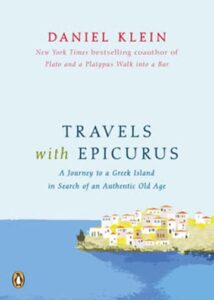
Travels with Epicurus 
By Daniel Klein 

Publication Date: Oct. 2012
176 pages

A Brief Summary of the Book: With a suitcase full of philosophy books, Daniel Klein journeys to the Greek island Hydra to discover the secrets of aging happily. Drawing on the lives of his Greek friends, as well as philosophers ranging from Epicurus to Sartre, he learns to appreciate old age as a distinct and extraordinarily valuable stage of life. He uncovers simple pleasures that are uniquely available late in life, as well as headier pleasures that only a mature mind can fully appreciate. A travel book, a witty and accessible meditation, and an optimistic guide to living well. (Source: GoodReads)

My Thoughts: How to live a fulfilling life when you are over the hill should have been something I’d be interested in reading about. But I found the book surprisingly shallow. As someone named “Tim” said on the GoodReads website:

“Pleasant enough, but basically in the vein of ‘chicken soup for the soul’, cab-driver philosophy. Really: it amounts to more or less this: Wow! life is cosmic, know what I mean? Bummer to be old, but then again, mellow. Don’t care that I can’t score; that’s a relief. Philosophy, that’s some heavy-ass shit, know what I mean? Heidegger… I mean, c’mon! But then again – maybe he was deep? More retsina! Greece is nice. It’s quaint and picturesque. Epicurus, Epictetus, Seneca, Sartre… all these guys… pretty deep really. You should go to Hydra sometime, but if you don’t that’s okay, just be glad you’re alive.

“Oh and here’s the hook: If you’re old, go with it – don’t try to cling pathetically to pre-old life. In a way I agree with this, in another way I think it’s a false framing of the challenge of not being young.

“I give it 3 stars, because I think what he offers is not nonsense. I just dock 2 stars for its total sloppiness & lack of ambition to think. But I truly wish him a happy old age, and me too before long.”

About the Author 

Daniel Martin Klein is an American writer of fiction, non-fiction, and humor. His most notable work is Plato and a Platypus Walk into a Bar, co-written with Thomas Cathcart. He graduated from Harvard College with a BA in philosophy. After a brief career in television comedy, he began writing books, ranging from thrillers and mysteries to humorous books about philosophy. When not enjoying the slow life on the Greek islands, he lives in Great Barrington, MA, with his wife, Freke Vuijst, American correspondent for the Dutch newsweekly Vrij Nederland.


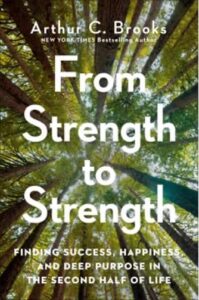
From Strength to Strength 
By Arthur C. Brooks 

270 pages
Publication Date: Feb. 2022

A Brief Summary of the Book: Drawing on social science, philosophy, biography, theology, and eastern wisdom, as well as dozens of interviews with everyday men and women, Brooks shows us that true life success is well within our reach. By refocusing on certain priorities and habits that anyone can learn, such as deep wisdom, detachment from empty rewards, connection and service to others, and spiritual progress, we can set ourselves up for increased happiness. (Source: Amazon)

My Thoughts: Like Travels with Epicurus, this is a book about how to have a meaningful fourth quarter of life. I’m grateful to my book club brethren for suggesting it, because it is a subject we should be talking about. but I have to admit – unhappily – that this one was even more disappointing. I have nothing against reading books about philosophical, ethical, and intellectual issues from a layperson’s perspective. But I need some content that takes me beyond conventional thinking.

In From Strength to Strength, Brooks seems to be excitedly recounting how, in his late middle age, he discovered Emerson and Zen Buddhism. And like Daniel Klein in Travels with Epicurus, he covers the basic groundwork of the popular chill philosophies, but without any new insights or applications that would have made the book more interesting.

I’ve several times reviewed books that attempt to do much the same thing – i.e., explain an important philosophical concept in terms I can understand, supported by factual information that is relevant. I’m reading a good one right now. I’ll review it for you in an upcoming issue.

About the Author

Arthur C. Brooks is an American social scientist, the William Henry Bloomberg Professor of the Practice of Public Leadership at the Harvard Kennedy School, and Professor of Management Practice at the Harvard Business School. He was the president of the American Enterprise Institute for 10 years, where he held the Beth and Ravenel Curry Chair in Free Enterprise. He has authored 11 books, including the bestsellers Love Your Enemies and The Conservative Heart, and writes the “How to Build a Life” column at The Atlantic. He is also the host of the podcast “The Art of Happiness with Arthur Brooks.”

The 10 Most Glamorous Horror Movies of All Time

In the spirit of Halloween, I offer this list from Far Out Magazine.

I’ve never been a huge horror movie fan, so I wasn’t surprised to note that I had already seen only two of the films on the list: Bram Stoker’s Dracula (Francis Ford Coppola, 1992) and The Hunger (Tony Scott, 1983). Those were, in fairness to Lucy Harbron, who compiled the list, both good movies and satisfyingly glamorous. Of the other eight, there were several whose trailers prompted me to add them to my to-watch list (now nearing 50), including Carrie (Brian De Palma, 1976), which, I’m embarrassed/proud to say, I’ve never seen.

I’ve watched very few movies and very little TV in the past several months. I’ve been very busy with the outputs and taking in too little, except for my YouTube habit (which I talked about in the Sept. 16 issue). But today, in this “Worth Watching” issue, I have many recommendations for you, starting with two movies (one from the past to watch now and one to watch when it’s released), as well as a new Netflix series and a bunch of videos.

And I’m kicking it off with a little story about my brush with movie stardom.

But first, let me say thanks to the readers who picked up on the typo in the last post. I am NOT in my 80s, as readers who do not know me might have thought when they read that I had given up golf sometime around my 79th birthday.

Stop! Don’t tell me! Let me guess!

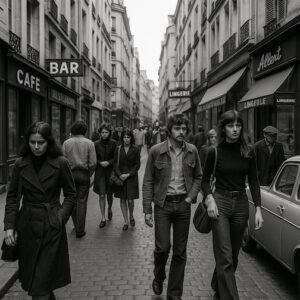
The year was 1988. K and I were in Paris, walking down some street whose name had several silent vowels in the some-number arrondissement, on our way to some place or event K had undoubtedly decided we should see, when I noticed a familiar figure walking in the opposite direction on the other side of the street.

“I know that person!” I said, excited at the prospect of running into someone I knew in an such an unlikely place.

“No, you don’t,” K said, confidently.

She must have sensed some change in my body language because she grabbed me by the elbow and said, “Stay here.”

It was too late. The grip was too tentative. Thirty seconds later, I was standing in the middle of the sidewalk facing this person, eager to discover in the next few seconds our mutual connection.

When he was a few yards away some part of my brain that is somehow related to my ready-fire-aim history of moving myself through the world took over. I raised my hands in a friendly way, grinned widely, and said, “Stop! Don’t tell me! Let me guess!”

He stopped. His eyes widened just a bit. The smallest smile animated his face. I took that to mean that he remembered exactly what our common kinship was and was amused that I couldn’t put a finger on it. But it was also clear that he was happy to see me again and would therefore be willing to indulge me in a game of “Ten Guesses.”

“Do we know each other from business? Did we meet at a direct marketing convention?”

He shook his head, still smiling, still amused that I couldn’t guess how I knew him.

“Okay, so maybe we’ve never met. Maybe I know you because I’ve seen photographs of you.”

He opened his mouth as if he were going to spill the secret.

“No! Don’t tell me!” I was happily shouting now. “Let me guess!”

He relaxed his posture as if to say, “Go ahead. Give it a try.”

“I’ve seen your photo in magazines. Maybe you are… No, you’re not a politician. I wouldn’t have a good feeling about you if you were.” And then looking him up and down, I said, “And you’re not an athlete.”

His smile widened.

“You’re an actor!” I said. “Is that it?”

He nodded his head and began to speak.

“No! Don’t tell me!”

I hit him with a few more qualifying questions – an actor on the stage or in movies, a dramatic actor or a character actor. (I was quite sure he wasn’t a leading man.)

With each question, his interest in our game was diminishing. I could see him looking over my shoulder and past me as if he was looking at whatever it was he was headed to.

“Can I give you a hint?” he said.

Feeling his impatience, I agreed.

“I won an Academy Award for Places in the Heart.”

I thought about it. I’d seen the movie several years earlier. I remembered that it was sad. And that Sally Field had starred in it. But I couldn’t remember this guy.

“Okay,” I said. “I give up.”

My name is John Malkovich,” he said.

He could see that I didn’t recognize the name.

“So, what are you doing in Paris?” I said.

“I’m making another movie.”

“Oh,” I said. “Interesting. What’s it called.”

Now he was looking over my shoulder more urgently.

“It’s called Dangerous Liaisons – and I’m afraid if I don’t get going, I’ll be late.”

“Oh,” I said, snapping out of whatever it was that had taken over my mind. “Oh, yes. I didn’t mean to…”

“That’s fine,” he said. “It was fun. But I have to go.”

“Right,” I said, coming fully into consciousness and feeling a tidal wave of embarrassment.

That was the moment to let him go. But somehow, I couldn’t do it. My mouth started moving again and a sentence came out.

“Do you know John Savage?” I heard myself saying.

His eyes narrowed. “Yes, I know John.”

I nodded my head as if I’d finally figured it out and could finally make my new friend John Malkovich feel he had not wasted his time.

“Yeah, I was hanging out with him last month at the China Club in Manhattan.”

He nodded. “Oh, great. Well, say hello to him for me next time you see him,” he said. And he rushed off.

Had he stayed he could have heard about how it happened that I ended up hanging out with John Savage.

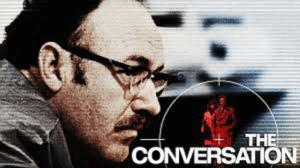
Movie: The Conversation 

Directed by Francis Ford Coppola 
Starring Gene Hackman and John Cazale
Released: 1974
Run Time: 113 min. 

I’ve watched this film at least a half-dozen times since it was released in 1974. Watching it again last week did not disappoint my high expectations. On the contrary, it reconfirmed my great admiration for it. If I had a Top Ten Movies of All Time list, The Conversation would be on it – perhaps in the top five.

The Story: A masterpiece of 1970s paranoia, The Conversation features Gene Hackman as a surveillance expert who finds himself helplessly enmeshed in a murder plot when he is hired to record a conversation between two people.

What I Liked About It 

Everything!

* It stars Gene Hackman, one of my favorite actors, who plays the role of Harry Caul, a private, almost paranoid surveillance expert who nearly loses his mind in the course of discovering the details of an otherwise mundane case. Hackman makes his character and the entire movie work.

* It costars John Cazale, who plays Stan, Caul’s assistant. A character that is the perfect foil for Hackman’s character.

* It has an intriguing plot intensified through the brilliant directing of Francis Ford Coppola, one that gripped me from beginning to end.

Interesting 

Coppola said he based Harry Caul on Harry Haller, the protagonist of Hermann Hesse’s novel Steppenwolf, a “total cipher” who lives alone in a boarding house. The character and one of the scenes were also inspired, according to Coppola, by Karl Schanzer, a private investigator and occasional actor who appeared in Coppola’s early films.

Those may have been influences, but what is crazy to me is the biggest and most obvious one – Antonioni’s 1966 classic Blow Up, a psychological thriller about a London photographer who accidentally discovers evidence of a murder in one of his photographs.

And by the way, Blow Up was inspired by Julio Cortazar’s 1959 short story “Las Babas del Diablo.”

Both the movies and the short story were, on one level, about people being fooled by their perceptions – or as Antonioni said, about man’s relationship not with other men but with reality.

In Blow Up, the method of discovery was visual – i.e., photography. In The Conversation, it was aural – i.e., listening devices.

There were other similarities – themes and motifs in the films, including the process of discovery, the immersion in rarefied environments, and even the same dominant color schemes (red, black, white, and gray).

Bottom Line: Whether it was done consciously or not, The Conversation was a masterpiece of creating a beautiful art object by imitating an existing beautiful art object, with one element changed. (My idea of “One Step Removed.”)

Critical Reception 

The Conversation, Coppola, and Hackman won 14 major industry awards and were nominated for 17 more. Wins included two BAFTAs (Best Film Editing, Best Sound Track), the Palme d’Or for Coppola at Cannes, and Best Director for Coppola from the National Society of Film Critics.

My Rating: 5 out of 5

You can watch the trailer here.


 Movie: Send Help 

Directed by Sam Raimi
Starring Rachel McAdams and Dylan O’Brien
Release Date: Jan. 30, 2026 
Run Time: 1 hour, 30 min.

This looks like it’s going to be fun: Sam Raimi + Survivor 

The Story: Two colleagues become stranded on a deserted island, the only survivors of a plane crash. On the island, they must overcome past grievances and work together to survive – but ultimately, it’s a battle of wills and wits to make it out alive.

You can watch the trailer here.