Postscript: The World’s Most Annoying Road

Postscript: The World’s Most Annoying Road

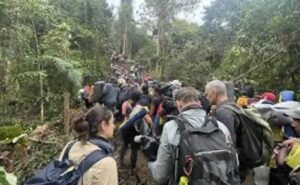
Have you heard of the Darién Gap? I’ve heard it mentioned many times in relation to illegal immigration, smuggling, and other interesting pursuits. But where is it? What is it? And why is it the reason you can’t drive from North America to South America?

In this short video, comedians Jay Foreman and Mark Cooper-Jones of Map Men explain.

This Nicaraguan Surf Resort Is the Family Getaway of the Year 

Rancho Santana got another good write-up last week. This time, it was from a publication called Coastal Living, which features residential and vacation spots around the world. Here is what they said:

Some vacations feel like the adventure is built right in. That’s certainly the case with Rancho Santana, a sprawling, 2,700-acre resort with five separate beaches on Nicaragua’s Emerald Coast, the country’s southwestern shore on the Pacific Ocean. First up is the ride to the property: about a two-hour drive from the capital city Managua’s airport. The Ranch (as it’s lovingly called) arranges door-to-door transportation for guests, so all that remains is taking in the scenery until the big reveal: enormous views of the Pacific with crashing waves, stunning cliffs, and rose-colored sand. Now it’s time for adventure of every kind, and a great mix for families, as well: world-class surf, hiking trails, a turtle sanctuary, and a treetop spa and yoga center, plus farm-to-table cuisine sourced from the property’s working farm. With those five beaches to choose from – each with its own personality of rugged waves and soft sand – even teens can’t claim they’re bored. Accommodations range from family-friendly casitas and ocean-view homes to standard rooms in the cozy inn with breakfast included (and an all-inclusive option). Adventurers seeking an off-the-radar gem: Here’s your next great vacation. Rates start at $320.

My First Wedding at Rancho Santana

We’ve been having weddings at Rancho Santana for many years.

We offer three venues for a “boda” (as they call it in Spanish).

One begins with a traditional ceremony in our beautiful, interdenominational chapel, followed by a formal dinner in a private room that can accommodate up to 150 people.

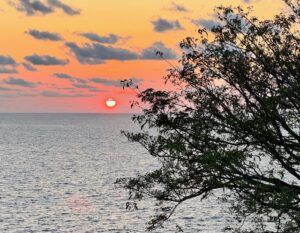
Another takes place at what we old-timers call the “Casa Club,” featuring an informal menu of scrumptious salads, tasty tapas, and oven-baked pizza, overlooking a tree-lined cove and a picture-postcard view of the sun setting on the horizon.
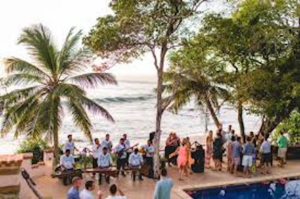
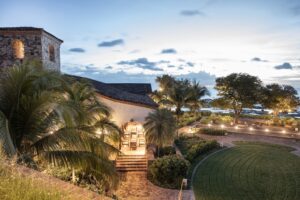
A third option takes advantage of the prime location of our small hotel and principal restaurant, with an elevated platform of grass and stone that stretches out into the ocean like the nose of a ship, giving amazing views of the beach and rugged coastline running north.
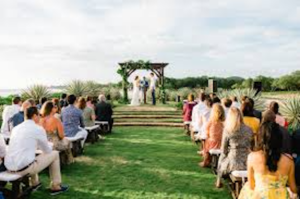
You can check out the details for all of them here.

I meant to ask Luke, the CEO, how many weddings his events team is booking these days. I’m guessing it’s about two dozen a year at the current rate. But word is spreading fast. I have little doubt that – barring some pan-Nicaragua tourism blunder – we’ll be booking at least one wedding a week before the end of this year.

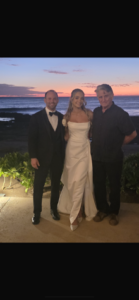
Last week, Rancho Santana was the venue for a very special wedding for me. It was the first one I ever attended.
How I Got Invited 
 
How I know MA, the groom, is, to the best of my memory, a happy coincidence. 
 
About a year ago, Paulo, one of my trainers, introduced me to him as one of his clients that was somehow in the sports fitness and therapy business. I think the meeting was about stem-cell therapy for my shoulder. Either that or it was about setting up a program for getting monthly IV supplementation of various vitamins and other nutrients. Maybe it was for both.
 
Never mind. 
 
MA is a young guy. I think he’s 38. He’s smart. Successful. And likeable. We became fast friends because of the many things we have in common: We had both started businesses and were still very much interested in the art and science of growing a profitable business. We were both practitioners of Brazilian Jiu-Jitsu. And we had a dozen mutual friends – either through mixed martial arts or through business.
 
Since that first meet-up, we trained a few times and spent a few evenings with friends, smoking cigars and talking about just about everything. One evening, we got on the subject of doing business overseas. I mentioned Nicaragua. He told me that he’d been there and was planning to have his wedding there.
 
Where? I asked.
 
“A place called Rancho Santana,” he said. “Have you ever heard of it?”
 
“Yeah,” I said. 
 
And that’s how I got invited. 
 
Here’s What Happened When I Got There 
 
I expected to feel a bit uncomfortable at the wedding since the only person I knew that would be there was MA. I’ve never been a big fan of weddings anyway, so I figured I’d show my face out of courtesy to him and then do an Irish exit as soon as it was possible.
 
But at the welcome party (which took place at La Taqueria, our tapas restaurant), I met his fiancé, who was sweet and beautiful, her family, who were warm and welcoming, and his friends, who were, without exception, smart, interesting, and friendly. 
 
So I stayed.
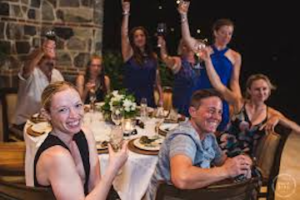
The guests were very complimentary of the resort, its restaurants and other amenities, and the friendliness of the staff. And, of course, they were blown away by the natural beauty of our seaside paradise. (I don’t know how many times I heard people say, “I can’t believe this place exists!”)

Our latest attempt to get people here to see what we have to offer was to invite a bunch of wedding planners down to give them an idea of what the experience would be like for their clients – and it went very well.

Here is a report from one of them.

This is beginning to sound like an advertisement for Rancho Santana. And I suppose it is. But it’s authentic and in no way hyperbolic.
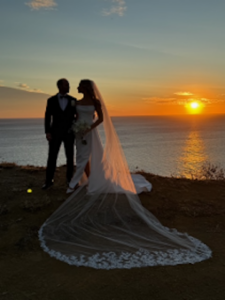
If you or someone you know is looking for a unique and uniquely beautiful venue for a destination wedding, you should come down and check it out!

Just the Facts: 
Central American Countries Rated for Safety

From the Worldpackers website: “For some reason, Nicaragua seems to get an especially bad reputation in terms of safety, but it’s actually one of the safest Central American countries. And where else in the world can you go volcano boarding?”

Take a look…

* Guatemala: Experiences significant crime, with some cities ranking high on safety indices for danger, though tourist areas are generally safer. I have been to Guatemala several times in recent years and had no trouble, nor did I feel unsafe in the capital city.

* El Salvador: El Salvador has been considered the most dangerous of the Central American countries. But since the recent government crackdowns, including record-high incarcerations of gang members, the rates of homicides, other violent crimes, and burglaries have plummeted. When I was last in El Salvador, about a dozen years ago, my business partner and I had to hire an armed guard to accompany us to meetings and restaurants. Today, a colleague tells me the capital feels like Paris 100 years ago.

* Honduras: Historically high homicide rates, particularly driven by gangs (MS-13 and Barrio 18). Of all the Central American countries, Honduras was the one where I felt the least safe.

* Panama: Generally safe for visitors, with caution needed in some city areas. The Darién Gap is a dangerous exception.

* Costa Rica: Often cited as the safest, with strong tourist infrastructure, though petty crime and some violent crime increase caution levels.

* Nicaragua: I’ve been to Costa Rica several times, and although I would agree that it is generally very safe for tourists, I feel safer in Nicaragua. Recorded crime rates are actually lower than in Costa Rica.

If You Go to Nicaragua 

This is what you’ll see…

Colonial Cities & Culture
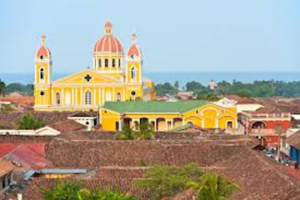
* Granada: A beautifully preserved colonial city on Lake Nicaragua, known for its colorful buildings, cobblestone streets, cathedrals, and vibrant atmosphere.
* León: Rich in history and revolutionary spirit, famous for its stunning León Cathedral (Central America’s largest), lively student scene, and proximity to volcano activities.

Volcanoes & Nature
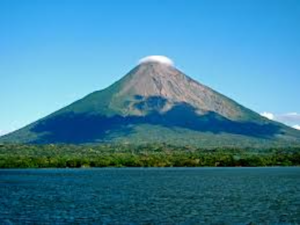
* Ometepe Island: A unique island in Lake Nicaragua formed by two volcanoes (Concepción and Maderas), offering hiking, kayaking, and rich biodiversity.
* Masaya Volcano National Park: See an active volcano crater with glowing lava at night.
* Laguna de Apoyo: A stunning, deep-blue volcanic crater lake perfect for swimming, kayaking, and relaxing.

Beaches & Surfing
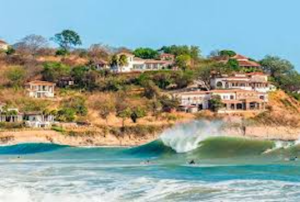
* San Juan del Sur: A popular, bustling surf town with beautiful surrounding beaches and a lively party scene.
* Popoyo & Tola Area: Known for excellent, less-crowded surf breaks for all levels, quieter vibes, and stunning sunsets. This is where Rancho Santana is located.
* Las Peñitas: A nearby beach. Great for sunsets and turtle releases.
* Corn Islands: Remote, laid-back islands with turquoise waters, excellent diving/snorkeling, and a distinct Caribbean culture.

Back in Rancho Santana 

I woke up at 5:30 this morning after seven hours of sleep. I was determined to get some writing done – real writing – but I failed. I got plenty of business work done, though, and a bit of blog writing. And I read (skim-read) two good books.
 
One was Mail and Get Rich by Ted Ciuba, a name I vaguely remember. (Given my memory, we may have been best friends. If so, apologies!) He published Mail and Get Rich in 2000 – 25 years ago. It has been sitting on one of my bookshelves in my home in Nicaragua since… could it have been since 2000? 
 
I’ve glanced at it dozens of times over the years, noting the title’s nod to Napoleon Hill’s 1937 classic Think and Grow Rich, but this was the first time I pulled it out to read. I expected it to be a nostalgic stroll down marketing memory lane and was surprised at how much of it was still relevant. Ciuba even talks about internet marketing, which was in its infancy in the 2000s. So I’m thinking that I should… I don’t know what. Maybe send him a thumbs-up? But after all these years, I don’t even know if he’s still alive. 
 
The other book was What We Talk About When We Talk About Raymond Carver, a series of interviews with Carver’s literary peers. I hadn’t realized it, but the literary world back then (the 1980s) had returned to the States and existed in the faculties of universities that had writing programs. The writers that were interviewed seemed to be as close and as passionate as the Lost Generation, and it made me sad. I couldn’t help thinking that, had I been more aware of what was going on, I might have been closer to it all. But I was just beginning my career as a businessman and a wealth builder and had abandoned, at least for the time being, my aspirations to become a serious writer. 
 
Tonight, I have to begin reading our Mules book club selection for Thursday – a book by that South African writer J.M. Coetzee, which I suspect I won’t like. We’ll see.
 

* * * * *

 
K and I had sunset drinks and a small dinner at the Club House. TG, my friend since fourth grade, who’s been living here for 20 years, joined us. The conversation was good until the two of them started talking about sports – professional basketball or football or whatever is going on right now. I know nothing about sports and am proud of it. Not only that, I get huffy when I have to listen to it being discussed. The worst is that K is completely fluent in virtually every sport known to man. I don’t know why, but I find it irritating.
 

* * * * *

 
K mentioned that R’s bill for various recent medical procedures was over a million dollars, but he paid only $300 out of pocket. This is clear proof that health insurance is a scam – a rigged system benefitting both the insurance industry and Big Medical. Something that could not happen in a truly competitive free market. 
 
Most people don’t get it because they can’t see the forest from the trees. They are happy to put some significant percentage of their earnings into health insurance and taxes that subsidize health costs because they fear what will happen to them if they are not “covered.”
 

* * * * *

 
We are looking forward to having the kids and grandkids here next week. I will try to get a good amount of work done before they get here, but, given the number of business meetings Gio has already scheduled for me, I’m not terribly optimistic about that.

Work, Adventure, and Gratitude: My Tokyo Week

I’m a Lucky Bastard. A Lucky, Grateful Bastard. 

I’m writing this on Sunday, in our room on the 11th floor of the Prince Sakura Tower, which looks down on central Tokyo, a landscape of haphazardly arranged modern, glass-and-steel skyscrapers, mid-century office buildings, and aging wood-framed houses, small restaurants, bars, and retail shops – with the occasional colonial era mansion standing in the middle of it all.

The city is quiet now. But in less than an hour it will come to life, thrumming with the movement of millions starting their day. Like New York or London or Beijing, Tokyo is electric with the dense energy of its people, which makes the infrequent visitor feel humbled and happy in equal measure.

K and I have been here now for 12 days. Our time together, which comprises roughly half of my time here, has been given to touring museums, visiting gardens, and exploring local neighborhoods that K read about in the very considerable research she does before every trip abroad. As I mentioned in my last post, we’ve spent the majority of our time in Tokyo, but we also spent two days in Matsumoto and a day and an evening in Nagano.

For me, the touring part of this trip has been a great success. I’m especially excited about the ideas I’ve stolen from two botanical gardens we visited that I’ll use to make my botanical garden in Florida more fun and picturesque for visitors.

The other half (for me) has been business – one day of preparation and five days of speeches, panel sessions, hot-seat counseling, TV and YouTube interviews, and a half-dozen promotions for my books and next year’s conference events.

I almost can’t believe the success Sean and I have had with this little publishing partnership I started in Japan. In the last 24 to 30 months, the investment newsletter we write together has gone to the top of our publishers’ charts. (Sean does the hard work – running our stock portfolio. I do the easy part – writing opinion pieces about getting rich.) And we’ve sold more of my books to Japanese readers than John Wiley and my other US publishers sold to Americans in the last 10 years.

And get this: The company that sells my ideas on business and marketing launched a new campaign that sold, in its first month, more than 1,000 copies of one of my books for $300 a book!

What lights me up is not the experiences themselves. I’ve had similar experiences throughout my career. What makes me feel so good is that I’m having all this fun at the ripe old age of 75 – a time of life when I should be retired.

I’ve tried retirement. I tried it first when I was 39 and then at 49 and at 59. I didn’t try again at 69 because by then I knew that there was nothing in the retirement picture that was attractive to me.

I feel lucky to be able to continue working at this level – waking up each morning insanely motivated to attempt to cram 12 hours of work into 6, and then waking up the next morning with the same beautifully unreasonable ambition.

I feel lucky to be able to spend the better part of my working time with men and women who are, for the most part, 20 to 30 years younger than I am. I love the challenge of keeping up with them in terms of sheer output. And although I can feel that this is a race I will one day have to cede, I am happy to know that I can – at my age (and because of my age) – stimulate their thinking and inspire them to meet or exceed my output when they reach my age.

I feel lucky to be able to spend most of a week once a year in Japan speaking to several thousand conference and digital attendees – sober, intelligent, middle-aged and older Japanese men and women who, notwithstanding the language barrier, have spent thousands of dollars and come hundreds of miles to hear what I have to say about the economy, investing, and my particular philosophy of building wealth and living a rich life.

I felt lucky the night before last, after my interview with Professor Fuji on his popular podcast, to be invited by him to spend an evening with our mutual teams at a geisha house, one of only two or three authentic geisha houses in Tokyo. I went to a geisha house in Kyoto the last time I was in Japan, but it was nothing like what I experienced here. Some of the rituals – the personal service, the music, the conversations, and the dancing – were similar. But the total geisha experience, thanks to Professor Fuji, was on an entirely different, entirely more exotic, and thoroughly more exciting level.

I remember sitting there between two ethereal beauties, being catered to like I had never been catered to before and thinking, “This is what being a sheik feels like. Better yet – this is how 007 would be treated if he were in Tokyo on a mission!”

So not a bad work week for a man who, had I accepted my culture’s view of my expiration date, would have been back in the States, puttering around the golf course or sitting home watching TV.

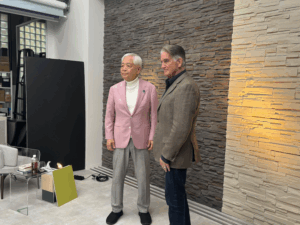
Here I am in the recording studio of Professor Fuji…

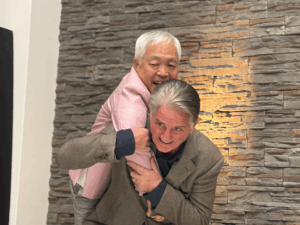
And here I am trying to flip him, but he knows his Jiu Jitsu and has already lowered his center of gravity (which is why he’s smiling!)…

Japan: Work and Wonder

A Week of Speeches and Interviews and Simply Enjoying Being in Japan Again 

K and I arrived in Tokyo on Wednesday. K got us a room on the 49th floor of the Ritz Carlton, which is about as nice as any hotel I’ve been in anywhere in the world. At least, that’s what I told K after checking out the restaurants, the gym, and the spa. K told me I was wrong. She said that every time we see a new city or stay in a new hotel or dine at a new restaurant, I have extreme reactions to it: It’s either the worst or the best. She’s probably right. Nevertheless, if you are going to Tokyo and want to know what I think “the best” feels like, take a look at the Ritz.

The conference started Sunday, but we arrived four days early to do a bit of touring and to give me some time to adjust to the time difference. I don’t know why it is, especially considering how much traveling I’ve done in the last 50 years, but I continue to have trouble with jet lag.

I know what you are thinking: You don’t have the time or the interest to read about my quotidian grumblings, and I should be thankful I get to spend two weeks in Japan and get paid to be here. K agrees. “Stop complaining!” she complains. “You’re either on your laptop, ignoring the world around you, or you are finding things to criticize.”

The lobby of the hotel is on the 45th floor, which is pretty common for luxury chain hotels in downtown Tokyo. Often the lower floors consist of rental or owned apartments, which gives the lobby and the guest rooms spectacular views of the city.

Tokyo is like Denver in that it sits on an elevated plain surrounded by an impressive chain of mountains that resemble the Rockies. On a clear day, you can see Mt. Fuji.

And at dark – which begins here at about 4:30 pm – you have an incredible view of buildings tall and short, all lit up with colorful rooftop billboards and, above them, a network of red lights to keep low-flying aircraft from crashing into them.

The interior of the hotel is opulent, with oversized chandeliers, walled glass panels, and artwork. But there is nothing Trumpian about the choice of lighting, the amount of gold and silver plating, and the color palette of the walls and ceilings.
 
The rooms are spacious and equipped with every amenity you have ever encountered in luxury hotels – which is not surprising when you understand Japan’s history of inventing very little but improving on everything original that comes from the US, the Far East, the Middle East, and Europe. 
 
Enough about the hotel. 
 
Tokyo is one of my favorite cities because it has everything you could possibly want as a tourist – great museums and restaurants, beautiful parks and gardens, world-class shopping, and dozens of discreetly authentic local neighborhoods where you can spend hours enjoying quaint and even exotic scenes and experiences.
 
So there we were, soaking up a bit of that before leaving Tokyo on Thursday to spend three days exploring Matsumoto and Nagano and more of what we can’t get enough of in Japan. We saw enormous ancient forts, magnificent middle-millennium forts and temples, two great modern and contemporary museums, as well as both cities’ more modest tourist attractions.
 
I’m writing this from Tokyo again, in another hotel, the Prince Sakura Tower, which is more of a business hotel located a stone’s throw from the conference, which started yesterday. 
 
And I’m writing this in the lobby bar, which is large but broken up into smaller spaces where one can find comfortable and quiet places to sit with muted classical music and jazz playing in the background – the perfect environment to work diligently and undisturbed, except for the occasional server offering interesting edibles and curated alcoholic refreshments. 
 
I’m going over the notes I’ve made for the presentations and workshops I’ve been asked to give, including two speeches in the venue’s largest breakout room, big enough to hold the 7,000+ attendees we are expecting. (Last year, on-site attendance was only 3,500, with another 1,500 attending via a simultaneous livestream video recording.) I’m also scheduled to appear at a VIP cocktail party for several hundred folks who’ve paid $1,500 each to have me led around, table by table, to thank them for coming, and another more exclusive luncheon with a smaller group who’ve paid $5,000 a piece to have me answer questions they have about growing their businesses and otherwise building wealth (subjects that are the basis of the essays I’ve been writing for them as part of the business we have developed with our Japanese partners over the last two years), which I am more than happy to do until I’m escorted out of the room by the entourage of security personnel that they’ve assigned to me.
 
You’d think I would be anxious about doing a good job with all of this, but no. I’m going to be speaking about what I know from writing and lecturing about these topics for more than 40 years. And though I was riddled with self-doubt when I began speaking publicly as an “expert,” the fear gradually diminished. Now I can’t wait to spill the beans on everything that’s worked for me.

Japan Continues to Fascinate – and Educate – Me
 
To say that Japanese culture is more detailed and more refined than American/Western European culture would be an understatement. 
 
To the Japanese, how you present yourself is a direct reflection not only of your education and sensibilities, but of the quality of your character. The idea that someone can be boorish on the outside but kind on the inside doesn’t feel authentic to them.
 
As I’ve mentioned in previous blog posts, I’ve been making a study of Japanese culture for a book I’m writing, tentatively titled Wealth Culture. It is about why some groups of people seem to do much better than other groups in terms of generating above-average income and above-average, long-term wealth. 
 
My view is that Japanese culture – as it has existed in my lifetime – embraces the values that are essential to building and sustaining wealth. But these values are also responsible for Japan’s high ranking in almost every other important metric of well-being, including education, social engagement, mental health, and longevity.
 
All of which makes me grateful that, nearly 40 years ago, my partner and I did our first joint venture marketing deal with one of Japan’s largest publishers, which opened my eyes to the several relationships with the Japanese that we’ve had since.
 
The current relationship, with a group of very bright, very ambitious, and very supportive young Japanese executives, has me remaking the promises I made and only barely kept in the past: (1) to learn a smattering of Japanese that I could pronounce intelligibly, (2) to be conscious of my native US (New York) instincts to be very direct and sometimes a tad bit crude, and (3) to learn and respect the most important of Japan’s many, many standards of good and honorable behavior.

The Unbreakable Rules of Behavior 
 
There have been cartloads of books written on the subject of Japanese manners and expectations – both in business and in social settings.
 
I’m not going to give you an extensive list of them. What I’ll do instead is tell you about the “rules” that I knew nothing about the first time I did business in Japan, and especially those that are thought to be nearly unforgivable if broken. (Although I’m happy to report that all my Japanese partners have been extremely understanding and forgiving of me – no doubt partially because the Japanese, even the young ones, respect maturity, and I am an old man.)

Bowing vs. Handshaking
 
Banish your good-old-boy, strongly ripped handshake. Reaching out and shaking someone’s hand is seen by most Japanese as not only impolite but vulgar, condescending, and aggressive. If I had to give you an example of an American way of saying hello that had the same effect, I’d say it would be to put the person you are meeting in a headlock and then give him a skull knuckling while announcing, “I love you, ya little motherfucker!”

Instead of shaking hands, the Japanese bow. And with bowing, there are only two rules you will be expected to heed. The depth of a person’s bow is directly related to that person’s position in the hierarchy, given the purpose of the meeting. The person with lower status bows more deeply than the person with higher status. And when you bow, you smile gently.
 
Socializing
 
The Japanese are actually very social people. They enjoy social interactions of most any kind. But as with almost everything else – from architecture and clothing to fine dining and even to performing at a karaoke club – modesty and indirectness are required.  
 
The Japanese are very much aware of the level of crudity and immodesty that Americans often display when they are out and about and having fun. So, they will grant you some license there. In fact, they may enjoy watching you step over the line. Just keep in mind that the line is about 10 yards back from where it is in the USA.
 
Noise Levels
 
Having loud conversations in public areas or on the phone when you are on a plane or train is considered inconsiderate in the US and every Western country I’ve ever been to. And as far as I’m concerned, there is no excuse for it. In Japan, it’s beyond rude. Do it and I guarantee you will have every Japanese person within earshot of you thinking, Nante kuso yarōna nda! (“What an asshole!”)
 
Litter
 
Don’t litter in Japan. Not even a little bit. I wrote about this in an earlier blog post, and it still blows my mind. During COVID, all public trash cans were removed in Tokyo and never replaced. Despite this, there is not one discarded bottle, can, or scrap of paper anywhere. Every street is impeccably clean. What’s their secret? People carry plastic bags to hold their trash until they get home to dispose of it and smokers carry little purses or pouches to hold their cigarette butts.
 
Note: Smoking in public Is basically illegal in Japan. It’s prohibited in all inside spaces open to the public and in all outside spaces as well – except for sparsely located designated smoking areas, which have no chairs, just standing ashtrays. Cigarette smokers can deal with that because they need only about 60 to 90 seconds a dozen times a day to get their fix. For cigar smokers, with the average stick good for 40 to 60 minutes, these areas feel more like shaming centers and penalty boxes than they do like accommodations.
 
Ironically, Japan’s overall smoking rate (around 17.8% to 26.5%) is higher than the US (around 11.6%), with Japan having a significantly higher smoking rate for men compared to women, while the US smoking rates are more balanced between genders.
 
Manners When Eating 
 
* The moistened cloth at your place setting in a restaurant is used to clean your hands before the meal. It is not to be used as a napkin, and never to wipe your mouth. 
 
* Blowing one’s nose at the table is a huge no-no. Leave the table. And never use an unsanitary hankie. Only paper tissues will do.
 
* Slurping noodles, the louder the better, gives the impression that you are enjoying the food. So, slurp away. 
 
* Drink soup by holding the bowl to your mouth with two hands. 
 
* If you’re not good with chopsticks, don’t even try to pick up sushi with them. But don’t despair. Using your hands for sushi is acceptable. (A rule that saved me, big time.)

Other Things That Might Surprise You (Since They Surprised Me) 
 
* Electronic, space-age toilets – called washlets – have been installed in most public buildings, hotel rooms, and 80% of private homes. A control panel attached to the bowl allows the user to select water sprays, seat warming, a blow dryer, deodorizing, and a sound system to mask the tinkle of “doing your business.” 
 
* Presenting and receiving gifts are important customs. Gifts are often beautifully wrapped. When receiving one, it’s polite not to open it immediately.
 
* Taxis are Ubers and Ubers are taxis.
 
* Nobody ever jaywalks. 
 
* Japanese drive on the left, as in England, but they also stay to the left when walking on sidewalks or up and down stairs. If you don’t take care to observe this rule, you may come across as utterly American – as in Ugly American.
 
* There isn’t a neighborhood in Tokyo I’ve ever visited that feels the least bit sketchy. And I haven’t seen a single homeless person or drunk or crazy person on the street. Everyone seems to be going somewhere with a purpose – very different from what sidewalk traffic looks like in most cities around the world. It feels like everyone is employed here and eager to get to work.
 
Conclusion 
 
Japan, IMHO, is a country every Western person with an interest in improving their lives should get to know firsthand by spending at least a week here observing and interacting with as many Japanese people as they can run across. 

A Few Facts About Japan That May Help Explain the Culture 

Population Density: With an estimated 126 million people living in an area of approximately 378,000 square kilometers, Japan is one of the most densely populated countries in the world, with an average of 338 people per square kilometer.

Crime: Though Japanese people love crime and cop movies, the country has one of the lowest crime rates in the world. That is true for the densely populated cities, as well as suburban and rural areas.

The Economy: Japan has one of the world’s largest economies by total GDP, but its per-capita GDP (how much each person, on average, produces) is significantly lower than that of other developed nations.

Employment: Japan has a low unemployment rate, similar to that of other developed nations, but a lower overall employment rate for its working-age population due to a shrinking workforce and a high proportion of elderly people who are not in the labor force.

Education: Japan’s education system is highly standardized, emphasizing rote learning and high achievement in core subjects, particularly math and science. In contrast, countries like the United States have more decentralized systems that allow for greater variation in curriculum. Japan’s system is also notable for its high levels of educational equity, meaning socioeconomic background has less impact on student performance compared to the OECD average and the US.

A Sad Day for Boomers Reflections from Japan

I had a substantial issue planned for you, including an essay on the No Kings Day protests and why it struck me as a sad day for my fellow Baby Boomers. That is what you should be getting today had I finished it before I left the States on Sunday.

But I didn’t. Not quite. So, here it is Wednesday and I’m in Japan again, preparing for a week of speeches and interviews and meetings with my Japanese partners.

Tokyo’s skyline

K and I are also doing a bit of touristing. Yesterday, we saw two fantastic art exhibitions – the first one a retrospective of the paintings (really billboards) of one of my favorite Japanese Edo-period (1603-1868) painters, and the second one an exhibition of Art Deco-period haut couture clothing.

Those activities took precedence over finishing the issue on the protests. So what I’ve done instead is “share” with you a draft of something I wrote for my Japanese readers about what I want to do (but often don’t) with my spare time.

If you are an ambitious sort, you will probably recognize a good deal of familiar thoughts and feelings in that draft. What I’d like to know is if you care about it – i.e., whether it bothers you when you spend an hour or several hours doing nothing or less than nothing. And if not, why not?

And since we’re talking about things we do in our spare time, I’m including some (lukewarm) recommendations for books and movies later in this issue that you might want to check out.