Today, I give you my take on two important issues: the controversy over the possible election of Zohran Mamdani as the next mayor of New York and the No Kings Day protests.
But first, an update on what I’ve been up to in Japan…

Today, I give you my take on two important issues: the controversy over the possible election of Zohran Mamdani as the next mayor of New York and the No Kings Day protests.
But first, an update on what I’ve been up to in Japan…
A Week of Speeches and Interviews and Simply Enjoying Being in Japan Again
K and I arrived in Tokyo on Wednesday. K got us a room on the 49th floor of the Ritz Carlton, which is about as nice as any hotel I’ve been in anywhere in the world. At least, that’s what I told K after checking out the restaurants, the gym, and the spa. K told me I was wrong. She said that every time we see a new city or stay in a new hotel or dine at a new restaurant, I have extreme reactions to it: It’s either the worst or the best. She’s probably right. Nevertheless, if you are going to Tokyo and want to know what I think “the best” feels like, take a look at the Ritz.
The conference started Sunday, but we arrived four days early to do a bit of touring and to give me some time to adjust to the time difference. I don’t know why it is, especially considering how much traveling I’ve done in the last 50 years, but I continue to have trouble with jet lag.
I know what you are thinking: You don’t have the time or the interest to read about my quotidian grumblings, and I should be thankful I get to spend two weeks in Japan and get paid to be here. K agrees. “Stop complaining!” she complains. “You’re either on your laptop, ignoring the world around you, or you are finding things to criticize.”
The lobby of the hotel is on the 45th floor, which is pretty common for luxury chain hotels in downtown Tokyo. Often the lower floors consist of rental or owned apartments, which gives the lobby and the guest rooms spectacular views of the city.
Tokyo is like Denver in that it sits on an elevated plain surrounded by an impressive chain of mountains that resemble the Rockies. On a clear day, you can see Mt. Fuji.
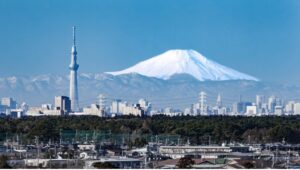
And at dark – which begins here at about 4:30 pm – you have an incredible view of buildings tall and short, all lit up with colorful rooftop billboards and, above them, a network of red lights to keep low-flying aircraft from crashing into them.
The interior of the hotel is opulent, with oversized chandeliers, walled glass panels, and artwork. But there is nothing Trumpian about the choice of lighting, the amount of gold and silver plating, and the color palette of the walls and ceilings.
The rooms are spacious and equipped with every amenity you have ever encountered in luxury hotels – which is not surprising when you understand Japan’s history of inventing very little but improving on everything original that comes from the US, the Far East, the Middle East, and Europe.
Enough about the hotel.
Tokyo is one of my favorite cities because it has everything you could possibly want as a tourist – great museums and restaurants, beautiful parks and gardens, world-class shopping, and dozens of discreetly authentic local neighborhoods where you can spend hours enjoying quaint and even exotic scenes and experiences.
So there we were, soaking up a bit of that before leaving Tokyo on Thursday to spend three days exploring Matsumoto and Nagano and more of what we can’t get enough of in Japan. We saw enormous ancient forts, magnificent middle-millennium forts and temples, two great modern and contemporary museums, as well as both cities’ more modest tourist attractions.
I’m writing this from Tokyo again, in another hotel, the Prince Sakura Tower, which is more of a business hotel located a stone’s throw from the conference, which started yesterday.
And I’m writing this in the lobby bar, which is large but broken up into smaller spaces where one can find comfortable and quiet places to sit with muted classical music and jazz playing in the background – the perfect environment to work diligently and undisturbed, except for the occasional server offering interesting edibles and curated alcoholic refreshments.
I’m going over the notes I’ve made for the presentations and workshops I’ve been asked to give, including two speeches in the venue’s largest breakout room, big enough to hold the 7,000+ attendees we are expecting. (Last year, on-site attendance was only 3,500, with another 1,500 attending via a simultaneous livestream video recording.) I’m also scheduled to appear at a VIP cocktail party for several hundred folks who’ve paid $1,500 each to have me led around, table by table, to thank them for coming, and another more exclusive luncheon with a smaller group who’ve paid $5,000 a piece to have me answer questions they have about growing their businesses and otherwise building wealth (subjects that are the basis of the essays I’ve been writing for them as part of the business we have developed with our Japanese partners over the last two years), which I am more than happy to do until I’m escorted out of the room by the entourage of security personnel that they’ve assigned to me.
You’d think I would be anxious about doing a good job with all of this, but no. I’m going to be speaking about what I know from writing and lecturing about these topics for more than 40 years. And though I was riddled with self-doubt when I began speaking publicly as an “expert,” the fear gradually diminished. Now I can’t wait to spill the beans on everything that’s worked for me.
Japan Continues to Fascinate – and Educate – Me
To say that Japanese culture is more detailed and more refined than American/Western European culture would be an understatement.
To the Japanese, how you present yourself is a direct reflection not only of your education and sensibilities, but of the quality of your character. The idea that someone can be boorish on the outside but kind on the inside doesn’t feel authentic to them.
As I’ve mentioned in previous blog posts, I’ve been making a study of Japanese culture for a book I’m writing, tentatively titled Wealth Culture. It is about why some groups of people seem to do much better than other groups in terms of generating above-average income and above-average, long-term wealth.
My view is that Japanese culture – as it has existed in my lifetime – embraces the values that are essential to building and sustaining wealth. But these values are also responsible for Japan’s high ranking in almost every other important metric of well-being, including education, social engagement, mental health, and longevity.
All of which makes me grateful that, nearly 40 years ago, my partner and I did our first joint venture marketing deal with one of Japan’s largest publishers, which opened my eyes to the several relationships with the Japanese that we’ve had since.
The current relationship, with a group of very bright, very ambitious, and very supportive young Japanese executives, has me remaking the promises I made and only barely kept in the past: (1) to learn a smattering of Japanese that I could pronounce intelligibly, (2) to be conscious of my native US (New York) instincts to be very direct and sometimes a tad bit crude, and (3) to learn and respect the most important of Japan’s many, many standards of good and honorable behavior.
The Unbreakable Rules of Behavior
There have been cartloads of books written on the subject of Japanese manners and expectations – both in business and in social settings.
I’m not going to give you an extensive list of them. What I’ll do instead is tell you about the “rules” that I knew nothing about the first time I did business in Japan, and especially those that are thought to be nearly unforgivable if broken. (Although I’m happy to report that all my Japanese partners have been extremely understanding and forgiving of me – no doubt partially because the Japanese, even the young ones, respect maturity, and I am an old man.)
Bowing vs. Handshaking
Banish your good-old-boy, strongly ripped handshake. Reaching out and shaking someone’s hand is seen by most Japanese as not only impolite but vulgar, condescending, and aggressive. If I had to give you an example of an American way of saying hello that had the same effect, I’d say it would be to put the person you are meeting in a headlock and then give him a skull knuckling while announcing, “I love you, ya little motherfucker!”
Instead of shaking hands, the Japanese bow. And with bowing, there are only two rules you will be expected to heed. The depth of a person’s bow is directly related to that person’s position in the hierarchy, given the purpose of the meeting. The person with lower status bows more deeply than the person with higher status. And when you bow, you smile gently.
Socializing
The Japanese are actually very social people. They enjoy social interactions of most any kind. But as with almost everything else – from architecture and clothing to fine dining and even to performing at a karaoke club – modesty and indirectness are required.
The Japanese are very much aware of the level of crudity and immodesty that Americans often display when they are out and about and having fun. So, they will grant you some license there. In fact, they may enjoy watching you step over the line. Just keep in mind that the line is about 10 yards back from where it is in the USA.
Noise Levels
Having loud conversations in public areas or on the phone when you are on a plane or train is considered inconsiderate in the US and every Western country I’ve ever been to. And as far as I’m concerned, there is no excuse for it. In Japan, it’s beyond rude. Do it and I guarantee you will have every Japanese person within earshot of you thinking, Nante kuso yarōna nda! (“What an asshole!”)
Litter
Don’t litter in Japan. Not even a little bit. I wrote about this in an earlier blog post, and it still blows my mind. During COVID, all public trash cans were removed in Tokyo and never replaced. Despite this, there is not one discarded bottle, can, or scrap of paper anywhere. Every street is impeccably clean. What’s their secret? People carry plastic bags to hold their trash until they get home to dispose of it and smokers carry little purses or pouches to hold their cigarette butts.
Note: Smoking in public Is basically illegal in Japan. It’s prohibited in all inside spaces open to the public and in all outside spaces as well – except for sparsely located designated smoking areas, which have no chairs, just standing ashtrays. Cigarette smokers can deal with that because they need only about 60 to 90 seconds a dozen times a day to get their fix. For cigar smokers, with the average stick good for 40 to 60 minutes, these areas feel more like shaming centers and penalty boxes than they do like accommodations.
Ironically, Japan’s overall smoking rate (around 17.8% to 26.5%) is higher than the US (around 11.6%), with Japan having a significantly higher smoking rate for men compared to women, while the US smoking rates are more balanced between genders.
Manners When Eating
* The moistened cloth at your place setting in a restaurant is used to clean your hands before the meal. It is not to be used as a napkin, and never to wipe your mouth.
* Blowing one’s nose at the table is a huge no-no. Leave the table. And never use an unsanitary hankie. Only paper tissues will do.
* Slurping noodles, the louder the better, gives the impression that you are enjoying the food. So, slurp away.
* Drink soup by holding the bowl to your mouth with two hands.
* If you’re not good with chopsticks, don’t even try to pick up sushi with them. But don’t despair. Using your hands for sushi is acceptable. (A rule that saved me, big time.)
Other Things That Might Surprise You (Since They Surprised Me)
* Electronic, space-age toilets – called washlets – have been installed in most public buildings, hotel rooms, and 80% of private homes. A control panel attached to the bowl allows the user to select water sprays, seat warming, a blow dryer, deodorizing, and a sound system to mask the tinkle of “doing your business.”
* Presenting and receiving gifts are important customs. Gifts are often beautifully wrapped. When receiving one, it’s polite not to open it immediately.
* Taxis are Ubers and Ubers are taxis.
* Nobody ever jaywalks.
* Japanese drive on the left, as in England, but they also stay to the left when walking on sidewalks or up and down stairs. If you don’t take care to observe this rule, you may come across as utterly American – as in Ugly American.
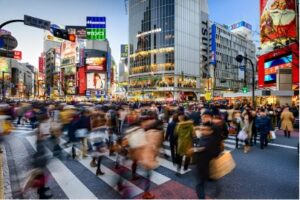
* There isn’t a neighborhood in Tokyo I’ve ever visited that feels the least bit sketchy. And I haven’t seen a single homeless person or drunk or crazy person on the street. Everyone seems to be going somewhere with a purpose – very different from what sidewalk traffic looks like in most cities around the world. It feels like everyone is employed here and eager to get to work.
Conclusion
Japan, IMHO, is a country every Western person with an interest in improving their lives should get to know firsthand by spending at least a week here observing and interacting with as many Japanese people as they can run across.
A Few Facts About Japan That May Help Explain the Culture
Population Density: With an estimated 126 million people living in an area of approximately 378,000 square kilometers, Japan is one of the most densely populated countries in the world, with an average of 338 people per square kilometer.
Crime: Though Japanese people love crime and cop movies, the country has one of the lowest crime rates in the world. That is true for the densely populated cities, as well as suburban and rural areas.
The Economy: Japan has one of the world’s largest economies by total GDP, but its per-capita GDP (how much each person, on average, produces) is significantly lower than that of other developed nations.
Employment: Japan has a low unemployment rate, similar to that of other developed nations, but a lower overall employment rate for its working-age population due to a shrinking workforce and a high proportion of elderly people who are not in the labor force.
Education: Japan’s education system is highly standardized, emphasizing rote learning and high achievement in core subjects, particularly math and science. In contrast, countries like the United States have more decentralized systems that allow for greater variation in curriculum. Japan’s system is also notable for its high levels of educational equity, meaning socioeconomic background has less impact on student performance compared to the OECD average and the US.
Really?
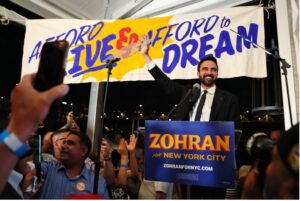
Tomorrow, you will have a chance – not a great chance, but a chance – to defeat Zohran Mamdani. But some of you – maybe many of you – don’t want to do that. You want to elect him.
I get it. Mamdani is a fresh face in NYC politics. He’s energetic, likeable, and boyishly good-looking.
When I first looked him up him six or eight weeks ago, my impression was positive. He seemed pleasant and approachable. Even charismatic. Thus, my initial impulse was that – notwithstanding what I’d heard about his politics – I wanted to like him. Perhaps the way I like Bernie Sanders.
The Conservative Media was very much alarmed by his growing popularity among NYC voters – particularly wealthy Liberals, whose votes generally decide the outcome of the mayoral elections. They said he was a Socialist. They said he refused to condemn 9/11. They said that he was the coddled child of a wealthy family and had never worked an honest day in his life, except for a few temporary jobs as a waiter and barista. Oh, and then there was that failed attempt to be a rapper.
Those are not the sort of ad hominem accusations to which I give a moment’s notice. Were they, how could I have come around, however gradually and begrudgingly, to liking and supporting Donald Trump?
Mamdani’s elevator pitch was a bit more concerning. Free buses. Free education. And free housing for the homeless and “undocumented migrants,” as he called them.
Did he really believe he could fund all of his campaign giveaway promises by taxing the Super Rich? Hadn’t anyone in his election campaign group done the math? Had no one told him that those insanely hardcore New York City lovers were already giving up 51% of their income to taxes? Or that since Bill de Blasio’s disastrous tenure, the city was losing its multimillionaires – its most precious financial resource – by the jumbo jet-ful?
When I brought up the subject to the liberal NYC denizens I count as friends, they seemed saddened and distraught by such questions. “I’m voting for a Muslim and a Socialist,” one of them – a high-income, high-net-worth Jew – gleefully retorted. As if to say, “Take that and shove it down your conservative gullet!”
I remembered reading that on the verge of the Bolshevik Revolution, the luxurious banquet rooms and upscale cafes stirred with happy admiration for the latest trend of the intellectual elite – a movement called Communism.
What were my college-educated one-percenters so excited about? It was free bus transportation and city-owned grocery stores!
Writing in The Free Press (I think it was), James Freeman said, “Grocery stores have been consistently among the most obvious, visible demonstrations of the failures of Socialism.” And that today they look like Russian supermarkets before they reintroduced private Capitalism – warehouses of mostly empty shelves except for periodic shipments of identical boxes and cans of bland and low-nutrition grains and vegetables.
In 2000, “60 Minutes” was doing a story on Boris Yeltsin and the fall of the Soviet Union. Leon Aron, who had written a biography of Yeltsin, described the Russian’s visit to a supermarket in Houston: “If there was an epiphany in Yeltsin’s life it was seeing a US supermarket overflowing with ‘lemons of this color and the shining red peppers of that color… and everything is glistening….’ He was literally shaken by the quality of goods. On his flight back to Russia he sat with his head in his hands, repeating, ‘Look what they’ve done to our poor people.’”
As for his position on the Mideast crisis, Mamdani’s been an outspoken critic of Israel in the manner of most Liberals and Leftists, including my giddily optimistic Jewish friend. As if, other than his contention that Israel’s execution of the war against Hamas has been “disproportional” to the barbaric slaughter of 1,200+ peaceful civilians, he would pose no threat to Jewish Americans living under his mayorship. This, despite the fact that he has refused to condemn the slaughter. In fact, in an interview on Fox News just last week, host Martha MacCallum asked Mamdani whether he believed Hamas should disarm and be barred from future leadership in Gaza. “I believe that any future here in New York City is one that we have to make sure that’s affordable for all, and as it pertains to Israel and Palestine, that we have to ensure that there is peace. And that is the future that we have to fight for,” he said in response.
In fairness to the lack of concern among so many NYC one-percenters and its large Jewish population, there is the argument that the city is just too big and disorganized to be destroyed by one man in a single term. De Blasio couldn’t do it (although he made a good effort), and it’s possible that Mamdani won’t permanently damage New York. But since he might, you have to ask yourself: Why take a chance?
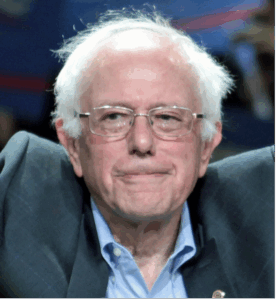
Bernie Sanders Goes to West Virginia
A high school acquaintance who despises Trump sent me this video. I was hoping it wouldn’t trigger my I-Hate-Trump-Haters switch, and it didn’t. It does two things that I liked: It reinforces Bernie’s image as a regular guy. A likeable regular guy. And it shows the power of selling an idea by ignoring subtleties and complexities and having a simple story to tell that is compelling.
Here is how I responded to my friend: Thanks for the video! I enjoyed it. It made me like Bernie again! (Not enough to vote for him, but enough to recognize his modesty, sense of humor, and tenacity.)
Is This How We Baby Boomers Want to Be Remembered?

Some say it was the largest public political event ever staged in the USA. With more than 2,700 demonstrations occurring simultaneously all over the country and an estimated total participation of 7 million, I have no reason to think that’s not true.
The question is whether it was a political protest or some other thing. If there were political issues at stake, it wasn’t well promoted because none of the dozens of marchers I saw interviewed by either the Legacy or the Conservative Media had answers to the question, “What policies, exactly, are you protesting against?”
It was, to be fair, a trick question. The event was titled “No Kings Day,” which sounds like a good-natured spoof of the idea that Donald Trump wants to become king.
And that, I think, is exactly what it was. It was not about the federal budget deficit. It was not about tariffs and the trade war. It was not about inflation or immigration or the increasing possibility of a nuclear war. I’m sure the marchers would have been prepared to talk about those issues had the protest organizers decided to make the event policy-oriented. But as one of the organizers proudly explained after being congratulated for getting so many people all over the country out there to protest, they decided that the best course of action would be to limit the protest to the common bond that tied all of the marchers together: their deeply seated hatred of Donald Trump.
That was interesting. What was equally interesting was the demeanor of the marchers. The organizers encouraged the marchers to come for the fun and bring along their synthetic animal buddies and furry friends – and while they were at it, why not take back the red-white-and-blue?
After all, almost everyone, including many Liberals and a few Leftists, had grown weary of defending “Men can have babies” and “All Whites are racist” and “Jews are the new Nazis” and “It’s okay to assassinate public figures if someone tells you they are nasty and mean.”
Not to mention the growing embarrassment of even the Mainstream Media admitting, in bits and pieces (so it can be missed or intentionally ignored), that the COVID virus was a product of biowarfare – US-funded biowarfare experiments that blew up into a massive, worldwide pandemic of anti-scientific hysteria, which damaged the global economy by tens of trillions of dollars, destroyed tens of millions of businesses, and needlessly caused the deaths of countless millions of people.
Or the embarrassment of discovering that ending the “border crisis” wasn’t complicated at all – that the US could go from allowing two to three million people to cross the border illegally to virtually nothing in less than six months.
I could go on…
My point is that, however much they surely wished it wasn’t true, the No King’s Day organizers realized that, as the polls have been increasingly showing, America’s great flirtation with Woke ideology has run its course as the attitudes of millions of moderate Democrats and Republicans, as well as Black and Brown Americans and almost all of the working class, have reverted back to common sense.
You could see all of this playing out in the way so many of the marchers behaved in front of the cameras. They looked cheerful, sometimes ebullient. When responding to questions, they spoke with conviction and even pride.
But when asked the trick question of what exactly they were protesting, they were taken aback. Most of them answered, “What do you mean?”
If the question was asked again, many of them became visibly suspicious of the reporter asking the question and agitated because, I think, they genuinely didn’t know what to say.
Something had happened between the halcyon days of the BLM protests and No Kings Day. That something, I believe, is that, for the first time in a long time (about 10 years), the protesters didn’t have a quick answer to the question of what they were doing that felt good to them. They didn’t have a bullet point that would make their point cleanly and clearly and justify their stance. Something had happened in the last two years, and increasingly since January. It was as if, while the Legacy Media was flooding them with daily accounts of Trump’s fascist pronouncements and tyrannical decisions, the reasons why those pronouncements and decisions were fascist and tyrannical were no longer being explained.
And they weren’t being explained for two reasons:
1. Some of them were working. In his first nine months in office this time, Trump has accomplished a list of major achievements which the Left, when he announced them, predicted would be ruinous to the country.
2. The Legacy Media was losing audience by promoting the anti-Trump message, and many of their corporate advertisers had decided to get off the Woke train.
This was not a conspiracy or a coordinated effort. It was the result of inevitable, natural fatigue. It happened quite publicly with Bud Light and Target and Disney. But it happened also when the corporate leaders of social media and the Legacy Media, including the NYT, the Washington Post, ABC, CNBC, Facebook, and so many others could no longer tolerate the constant downsizing of their markets and mounting losses as the majority of US consumers moved to digital media as their source of information and news.
I don’t know if you’ve noticed, but I’m seeing it already in the content and the reporting from mainstream TV. The Legacy Media is no longer trying to make liberal and leftist politicians and influencers look good.
Have you noticed how, in the last several months, and especially in the last 30 days, reporters and influencers from the Legacy Media have started to ask liberal politicians like Chuck Schumer, Nancy Pelosi, and AOC tough questions? Did you see the interview of California gubernatorial candidate Katie Porter by a CBS News reporter? Porter scolded the interviewer for asking “follow-up questions” and stormed off the set – and the video went viral.
Why has the conversation on the left turned away from the racism of closing the borders to the racism of forcibly returning illegal immigrants from whence they came?
Have you heard of Black Fatigue? It’s an idea many conservative African American bloggers and influencers are talking about. They say they are tired of all the identity politics, including systemic racism, White privilege, and other doctrines asserting that Blacks are effectively helpless victims in US culture, which is structured to keep the Black man down.
And while I’m on it, why is it that despite the massive success of this Boomer festival of self-love and self-righteousness, Trump’s overall popularity ratings went up?
Many, if not most, of the old White people participating in the No Kings rallies and marches don’t see things this way. They still believe that all Black and Brown people are victims and all White people (mostly men) are racist, sexist, homophobic, transphobic, Hitler-loving fascists. Worse, they still seem to think that in marching, they were once again reprising the courage they displayed 60 years ago when they protested the war in Vietnam.
To be fair, there was a smattering of young White Liberals, including a significant contingency of younger women with oddly colored hair. But in the footage I saw, the only Black people marching were within camera shot of White Liberal politicians who arrived at the destinations with cameras and security people on hand. And if there was a substantial number of
Brown people there, I didn’t see them.
So, what does this all amount to? What does it all mean? What can we say about this record-breaking, last-ditch, Baby Boomer protest against… well, against Donald Trump?
And furthermore, what if, left without talking points to argue their case, all these millions of leftist Boomers cannot dethrone Donald Trump and restore Woke culture as the moral standard of the USA?
Is there still a chance that they will able to influence our government to return to funding and arming the Ukrainians against Russia in the belief that, despite the fact that he has shown no evidence of it whatsoever, Putin will back down and give back his newly acquired territory?
I don’t think so.
Will we once again demonstrate our sympathy for the Palestinian people and respect for international law by withdrawing our support from Israel’s genocidal regime and supporting a two-state solution where Hamas and Hezbollah are once again free to pursue their God-given right and purpose of murdering Jews?
I don’t think so.
Will we reverse the discriminatory policies of Trump’s getting rid of DEI and reinstate the right of less-qualified people to take the positions of more-qualified people because of the color of their skin?
I don’t think so.
Will we end the unconstitutional and totally fascist policy of Trump to move into Blue cities with the National Guard and unilaterally end 20-plus years of massive Black-on-Black murders without even asking the liberal mayors and DAs who spent all that time passing laws and policies that got their cities to the top of the charts?
I don’t think so.
This is a tough time for Leftists and Liberals. Especially those that are paying critical attention to the news and watching the polls.
It’s not by any means a certainty at this time, but I have a feeling that the American political zeitgeist is changing and fast approaching a turning point where the love affair the Liberals and Leftists had with identity politics and Woke irrationality is over. And will probably be over for at least another generation.
And what makes this change especially difficult for the left side of the Baby Boomer generation is that the No Kings protest was almost certainly the last great, politically virtuous battle they will fight after having been unforgivably abandoned by the very groups they had been so long supporting – Big Food, Big Drugs, and Big War.
But 95% of the people that attended the protests don’t see it this way. As Baby Boomers, they have grown up thinking they (we) were – and still are – the generation that went to Woodstock to advocate for peace and love and all those good things. And as far as they can understand, that’s exactly what we were and still are.
Woodstock was a once-in-a-generation social movement that, despite the complete naïveté and self-centeredness of its participants, was also a once-in-a-lifetime party that young Leftists today secretly wish they had attended. But when they had their chance, they apparently didn’t see it as something serious and useful – just a massive celebration of themselves and their high opinion of themselves.
And now – in the last inning of their lives – they were able to do it again
From RG: “Do I have what it takes to be a writer?”
“I’m a college sophomore. I’ve been reading your blog for about a year now, and I’ve read two of your books (Great Leads and The Power of Persuasion). I like the way you write. Whatever the topic, you make your ideas and opinions easy to understand. It feels like writing comes easily for you. I want to be a professional writer someday, but I’m just starting out and worry sometimes that I just don’t have the talent. I wonder if you ever felt that way.”
My Response: The answer is yes. More importantly, many writers, much better than I, have had the same doubts. Here’s a sampling, from Letters of Note, that might give you hope:
“I am very poorly today & very stupid & hate everybody & everything.” – Charles Darwin, letter to Charles Lyell, Oct. 1, 1861
“No one really takes very much interest, why should they, in my scribblings. Do you think I shall ever write a really good book?” – Virginia Woolf, letter to Violet Dickinson, Oct. 1, 1905
“My god it is hard for anybody to write. I never start a damn thing without knowing 200 times I can’t write – never will be able to write a line – can’t go on – can’t get started – stuff is rotten – can’t say what I mean – know there is a whole fine complete thing and all I get of it is the bacon rinds. You would write better than anybody but the minute it becomes impossible you stop. That is the time you have to go on through and then it gets easier. It always gets utterly and completely impossible. Thank God it does – otherwise everybody would write and I would starve to death.” – Ernest Hemingway, letter to Waldo Pierce, Oct. 1, 1928
Orson Welles: He Was Fat, but He Was Fabulous
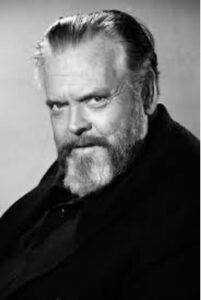
I like this very short clip from Johnny Carson’s Tonight Show for two reasons:
1. It’s Orson Welles.
2. Welles is paraphrasing a famous rejoinder by Winston Churchill. The story (which may be apocryphal) is that a clearly intoxicated Churchill was reproached by the British politician Bessie Braddock. “Sir,” she said, “you are drunk.” To which Churchill replied, “And you, Bessie, are ugly. But I shall be sober in the morning, and you will still be ugly.”