
Yet, it’s on the verge of becoming yesterday’s news!
Can you name the three biggest financial scams of the past 25 years?
If you guessed Enron (around $60 billion), WorldCom (around $165 billion), and Lehman (around $65 billion), you guessed correctly.
The details of these scams, which were big news in 2002, 2008, and 2001, are clearly remembered today by the small percentage of Americans who invested in them (probably in the low millions). But for most people, they simply evoke the vaguest of memories about rich people losing some of their money by betting on fraudulent companies.
However, if I asked you to name two scam artists who ripped off innocent people of billions of dollars in recent years, you would probably remember Bernie Madoff and Sam Bankman-Fried.
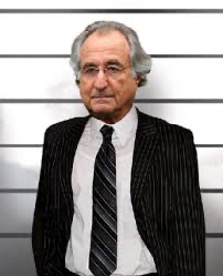

Those stories hit harder, I think, for one very good reason: The rip-offs were conceived of and conducted by individuals, rather than faceless financial corporations.
And if I asked you how big those rip-offs were, you might remember that they were both in the $50 billion to $60 billion range – an amount that seems almost inconceivable, given that they were pulled off by scumbags that had no reputable associations to give them credibility, no government-verified annual reports, and no real, traceable numbers to establish their false claims.
You may even be wondering, “Why haven’t I seen a detailed explanation of how they managed to steal so much money from wealthy, sophisticated investors and even respectable financial institutions?”
Well, the answer is interesting.
Consider that Madoff’s $64 billion “greatest Ponzi scheme in history” shrank down to single-digit billions in unrecovered principal, thanks to clawbacks and Justice Dept. distributions that paid back around 94% of verified claims.
And, in fact, the same thing is true of all of these huge scams: Investors incurred enormous losses thanks to inflated valuations and fake statements. But if you dig down to the hard cash that actually went in and wasn’t ever recovered, the numbers drop dramatically. (Understand, I’m not making light of those losses. They caused real pain for a lot of people. But it wasn’t what the headlines implied.)
I bring this up because all of it is a prelude to a different kind of financial scandal – one that could eventually dwarf the others in terms of money taken not only from the pockets of wealthy and sophisticated investors, but from tens of millions of ordinary American taxpayers who will never see that money again.
It’s a big story – the story of a massive criminal enterprise that involves not only the scamsters themselves, but the political systems in which they operated, including local bureaucracies, the federal government, and the media.
Finally – and this may be the most interesting part – it is a story about culture and immigration and the manipulation of the American dream.
A Factual Expose:
The Largest Welfare Fraud in US History –
Why Are So Few People Talking About It?
You may have seen a fleeting headline or two about “Feeding Our Future,” the Minnesota nonprofit accused of siphoning off roughly a quarter‑billion dollars in federal child‑nutrition reimbursements during the pandemic. Federal indictments include descriptions of fake meal sites, fabricated attendance logs, and money spent on luxury cars and homes instead of food for children.
The case involved approximately $250 million in allegedly fraudulent federal child-nutrition reimbursements, according to Justice Dept. filings. That alone made it one of the biggest welfare fraud cases in recent years. But when federal prosecutors dug into it, the numbers they came up with were much larger.
According to federal and state officials that reviewed the findings, the total fraud money paid out to scammers since 2018 across 14 Medicaid and human-services categories is somewhere between $9 billion and $18 billion.
And that’s just in Minnesota. The same scam and the same group of operators have now been discovered in New York and California.
Especially interesting is how all of this was brought to light. Because it wasn’t uncovered by a famous reporter or a major news outlet. This massive case of fraud was pushed into the national conversation by a 20-something, self-titled citizen investigator named Nick Shirley, who went on YouTube to reveal what he had discovered about empty Somali-run daycare centers billing the state for full-time care. Supplying spreadsheets, emails, and videos of altercations he’d had with those running the daycare centers, Shirley did what mainstream media was unable or unwilling to do.
Internal staff and state auditors had been complaining for years about suspicious billing patterns. The Minnesota Dept. of Education had referred Feeding Our Future to the FBI during the pandemic, and sloppy contracts were flagged by whistleblowers long before Shirley’s story went viral.
But because the state’s Somali population was implicated in the fraudulent activity, the issue became a politically charged hot potato. Early reports about it were called fake news, and the early voices that expressed outrage over it were labeled xenophobic and racist.
Just the Facts:
Why It’s Called the Somali Scandal
Minnesota is home to approximately 94,000 people of Somali ancestry. It is one of the biggest Somali communities in the country, but it remains a relatively small share of the overall state population of roughly 5.7 million.
Yet the demographic distribution of defendants charged in Minnesota fraud cases tied to welfare, Medicaid, and other child-assistance programs has been striking.
As of early 2026, 98 individuals had been charged – and of those, 85 were Somali American, according to federal sources. (Independent demographic research shows that among Somali-headed households in Minnesota, approximately 54% receive SNAP benefits, 73% have Medicaid participation, and nearly 89% of households with children receive some form of means-tested welfare assistance.)
The Somali Fraud in Historical Perspective
What does this all mean?
If you’re measuring scandals by headlines, Bernie Madoff wins. If you’re measuring by suggested wealth destroyed, the big corporate scandals top the list.
But if you measure by something relatable to every one of us in terms of real dollars leaving taxpayers’ wallets that will never be reclaimed, the so-called Somali Scandal was larger, by far, than any scheme ever that bilked taxpayers through government-legislated social services.
What is perhaps more disturbing than the size of the scam is how many Somalis were involved in it. It wasn’t merely several dozen con artists stealing money surreptitiously. It was the thousands – possibly tens of thousands – of Somali parents that were playing the con from the other side by getting cash payments to enroll their children in daycare programs that they knew were fraudulent because their children never used them.
And for me, at least, there is another level of shame and culpability here. It is the politicians and media that didn’t put an end to it for years and years, despite numerous warnings from whistleblowers.
The list of corrupt pols went from local bureaucrats right up to the governor and the government bureau chiefs who stifled whatever investigations the whistleblowing started and continued the funding and distribution of these billions of dollars of stolen money.
And if all that is not sickening enough, when the story was finally brought out by Nick Shirley, the mainstream media began a campaign to discredit him. And when that didn’t work, to accuse him and anyone else who called for justice to be xenophobic racists.
And guess what? The defenders of the largest government/private financial scam in my lifetime has all but disappeared from political and social policy discussions.
It’s now more than four months since Nick Shirley’s vlog went viral. And apart from some “racist” conservatives that want to see more than a dozen or so minor players in the scheme go to jail, nobody in the media – not even the conservative media – is talking about it.
Culture, Clans, and Human Values

Ayaan Hirsi Ali is a Somali-born Dutch American writer, activist, and former politician. According to her, Somalia’s core organizing principle is clan allegiance. In Somalia, every child is taught their lineage and who they “fight and die for.” And when 100,000–150,000 Somalis move to a place like Minnesota, you inevitably get transplanted clan dynamics.
Politics, trust, and conflicts are all filtered through something called “amoral familism,” she says, a term coined by Edward C. Banfield in his 1958 book The Moral Basis of a Backward Society. It describes a social system where loyalty to the family takes precedence over everything else.
Hirsi Ali writes about it here in The Free Press.
And speaks about it here.
