
By Andy Weir
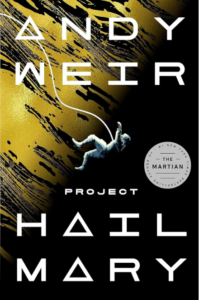
476 pages
Published May 4, 2021
Why I Chose This Book
It was the May selection for my book club, The Mules (“because we have no rules”). I wouldn’t have picked it up on my own – I’m not a regular science fiction reader – but I’m glad The Mules forced my hand.
What It’s About
Ryland Grace wakes up alone on a spaceship with no memory of who he is or why he’s there. His two crewmates are dead in their bunks. As his memory comes back in fragments, the situation reveals itself: The sun is being eaten by a microbe, Earth is heading for a mass extinction, and Grace – a high school science teacher turned reluctant astronaut – is humanity’s last shot at figuring out why one nearby star seems to be resisting the infection. Things get more interesting when he meets Rocky, an alien on the same kind of mission for the same kind of reasons. Most of the book is the two of them – different species, no shared language – figuring out how to talk to each other and how to save both their worlds.
What I Liked About It
The writing is clean and almost invisible. Weir isn’t showing off. He’s using his not inconsiderable literary skills on plot, action, and characterization – not on sentences that want to be admired.
I’m not a regular reader of science fiction, but this is a book that made me think I should read more of it.
I liked the strategy of making the protagonist a high school science teacher. Two reasons: It makes him a common man – a modern hero – and it makes his descriptions and explanations of all the science in the book accessible, like he’s talking to an eighth grader. That, in turn, makes the world he’s describing – the world of space science and the science of space – alive and accessible. Learning interesting facts about biology and physics and astronomy is one of the real pleasures of the book.
All of that lives in what I call a book’s “horizontality” – how well it presents a view of a part of the world, a place, a culture, an area of knowledge. It’s the opposite of its “verticality,” which for me measures how deeply a novel goes in exploring the complexities of being human, both the good and the bad – the underlying universalities as opposed to the surface differences.
This book is wide, not deep – but it wasn’t trying to be deep. It was trying to be fun and smart and true to its science – and on that, it delivers.
What I Didn’t Like So Much
Not much, honestly.
There was the nagging question of whether a high school science teacher would really know all that esoteric science. But Weir mostly handles it by showing Grace working things out as he goes rather than producing the answers fully formed. Fair enough.
The only other thing – and this is small – is that Grace’s manner of expression sometimes sounds like a science teacher trying to talk like a teenager. Which, I suppose, is what science teachers do. Science fiction, like every genre, requires the willing suspension of disbelief, as whatshisname once said. I suspended mine without much trouble.
Critical Reception
Project Hail Mary was a #1 New York Times bestseller, and won the Goodreads Choice Award for Best Science Fiction in 2021. It was widely praised for the central friendship between Grace and Rocky, which a number of reviewers called the emotional anchor of the book.
Interesting
* Weir wrote his first book, The Martian, as a serialized story on his personal website while working as a software engineer. He gave it away free. Readers pushed him to put it on Kindle for 99 cents, and it became a bestseller from there. Project Hail Mary, Weir’s third book, was clearly designed to return to what had worked in The Martian: one stranded man, one cascade of problems, one science-by-the-numbers solution at a time.
* Weir is known for “hard science fiction” – meaning the science in his books is accurate and logical. He famously plotted parts of The Martian on spreadsheets. Project Hail Mary got the same treatment.
* The film adaptation of Project Hail Mary, with Ryan Gosling starring as Grace, was released in March 2026.
My Rating
* Verticality: 2.5 – Gets the human condition basically right, but doesn’t reach for depth.
* Horizontality: 4.5 – Wide, smart, and genuinely educational about the science it touches.
* Literary Richness: 3.5 – Prose is clean and serviceable. It stays out of its own way.
* Bonus Points: 0.5 – For the Grace-and-Rocky friendship, which is the part that stays with you.
Overall Score: 4.2 out of 5.0 – A very good read. Not Sophie’s Choice – but if the only books I got to read were books that scored a 5.0 on verticality, I’d probably jump off a bridge.
