I can’t stop!

When I retired 10 years ago (for the fourth time), I promised myself (and swore to K) that I would desist from starting any new business ventures.

I did my best. Since then, I’ve started only about 10 – one per year. I secretly believe I should get a medal for my restraint. When you have never started a biz, it seems like a daunting task. But after you’ve started a few, all the fear is gone. You feel like making a business out of every cockamamie idea that springs into your head.

K and I renewed our vows on October 6. And in the 60-odd days that have passed since then, I haven’t started a single business. Not one.

I have, however, started a few projects. The most recent involves some of the amazing people that I know at Rancho Santana in Nicaragua.

One is a practicing nurse, real estate developer, teacher, author, entrepreneur, mother, grandmother, etc. She is, I think, 84.

Another is a former Nicaraguan debutante who fell in love with a US Marine who was guarding the embassy here 70-odd years ago, was sent to a convent to get her away from him, walked away from her wealth and status to marry him, raised three children, divorced him, started a dozen businesses, had all sorts of fascinating political and romantic entanglements, and recently took the old bastard back because he had no other place to go. She is 87.

The third is younger. At a mere 75 years old, he has spent his life as an itinerant artist, surfer, and sailor. He has traveled the world, and paid his way by selling his art for food, clothing, and lodging. He has sailed the seven seas, danced with beautiful natives in Bali, survived sea storms and shipwrecks, cancer, and gunplay, and is hard to get hold of because he’s always on to his next adventure.

So, I’m going to make a movie about them. It’s going to be called Triptych. I don’t expect to be able to sell too many copies of it, but I’m super-excited about the chance to record their amazing lives for prosperity.

Compared to starting a business, this is going to be a piece of cake. It should be doable in about a year. We’ll see if that’s realistic.

I’m Smiling!

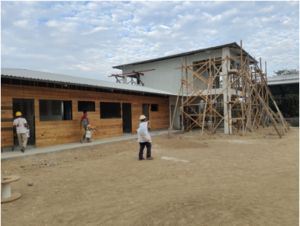
For the past few weeks, our family’s charitable foundation in Nicaragua (run by Number Three Son Michael) has been focused almost exclusively on hurricane relief programs. Meanwhile, great progress has been made on the expansion and face lift of FunLimon.

What began as a knee-jerk response to evident need 20 years ago has matured into a robust educational and recreational community center with 21 full-time employees and 6 additional professional contract positions. The center proudly serves the local community – including 250 direct beneficiaries of its education outreach. This includes 100 kids for the youth program, 30 for the young adult college scholarship initiative, 40 for the vocational courses, and 20 in the adult PC training program.

Happy Tuesday!

I’m feeling good right now because I just finished a meeting about moving forward with Rancho Santana: Then and Now.

This is a book project I’ve been working on for at least 10 years. The idea was to document the amazing history of this place, from when it was a cow farm till it became a five-star resort.

In the beginning, I tried to get my partners here involved in the publication. I thought they’d be interested, but they weren’t. So I put it aside for a while and then decided I would produce it myself. The story should be told.

I say “produce,” because books like this are major productions. The last one I did, Central American Modernism, took many years, involved dozens of contributors, and cost a quarter-million dollars to complete. It’s not like writing an ordinary book manuscript and then having a publisher edit, print, and sell it.

It’s really much more like making a movie. The “script” writer is about 60% done with the text. I just hired an assistant producer, who will help me hire a half-dozen other people – specialists in making a book like this come to fruition.

Re today’s issue… Get ready. It’s a video of a very exciting and out-of-the-ordinary Sumo wrestler.

Conceptual Art?

Hey there. Happy Monday. I have some thoughts for you today about the way I approach investing in stocks.

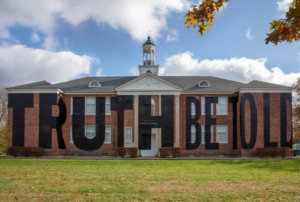
But before we get to that, I want to show you something I came across in one of the online art newsletters I subscribe to. Take a look at this:

“In the small New York State town of Kinderhook,” the piece reads, “artist Nick Cave has found himself in a bit of controversy over his art installation: a mural of black vinyl letters standing 20 feet tall and 160 feet across reading ‘TRUTH BE TOLD.’”

Unsurprisingly, the mural, which covers the entire facade of one side of the museum building (and is visible from the street) has caused a stir. Citizens are asking:

Is it a work of art – a profound and moving mural meant to “provoke a dialog over the George Floyd murder and police racial injustice,” as the artist’s lawyer is arguing?

Or is it just a big, ugly political poster – in which case it would violate various town ordinances?

For me, it’s a sad reminder of one of many unfortunate developments in modern art: a small but effete tributary called Conceptual Art.

In Conceptual Art, the idea behind a piece is more important than the aesthetic result of the artwork itself. In this case, Cave’s idea about racial injustice – presumably that it shouldn’t be denied – is what matters.

So, if you think encapsulating that “idea” into TRUTH BE TOLD is brilliant, this installation is a brilliant work of art. If you think it’s a thoughtless cliché, it’s a failed work of art.

Or, if you feel that artists should stick to making things and leave the making of ideas to people who are good at thinking, you will eschew Conceptual Art altogether.

You decide. Now, on to…

Today is book and movie review day. And I’m happy to be recommending one of my favorites – a classic in noir film and fiction: The Maltese Falcon.

But before we jump into that, I want to pass along a noir story of a different kind: a very brief outline of what’s happened to the global economy over the past 100+ years, courtesy of my colleague and partner, Bill Bonner.

As anyone who’s taken World Economics 101 knows, the Industrial Revolution spurred the greatest economic growth in the history of the world. Led by the US, much of Europe, Canada, and Japan experienced a steady explosion of growth in wealth, productivity, and consumption.

In 1979, China entered the game when then Chairman Deng Xiaoping declared that becoming rich is a “glorious” pursuit, and not just allowed but encouraged free markets in many sectors of the Chinese economy.

Ten years later, the Soviet Union followed, abandoning, as BB says, both Communism and its empire.

Then in 1993, the European Union was created – “a free-trade zone big enough to rival the United States.”

But in the last 10 to 15 years, BB points out, this trend seems to have reversed:

All over the world, people grow old… and want protection from life’s risks and challenges. Even in Europe, the Italians want protection… from the French.

“The Italians in Italy. The French in France,” say the Italians, protesting the sale of Parmigiano Reggiano to French investors.

“Brexit Now!” demand the English.”

To be continued…

On November 18, I talked about moments that I love. One of them is when my boys call me for advice. AF, one of my brilliant nieces, must have read that, because a few days later she called to “ask for my advice.”

AF heads up a group of advertising copywriters for a publishing business in France. She said she felt that her team was sputtering out in terms of coming up with creative new ideas.

I gave her half a dozen suggestions. I can remember two of them…

Drawing from the same wells: You would think that creative people would always be looking for new ideas by constantly searching new and different sources. But oftentimes that’s not the case. Like the rest of us, creative people like to be in a zone of comfort. And that means reading the same half-dozen periodicals, consulting the same online “experts,” and expecting to find new insights by googling for them. That may have worked in the early 2000s, but it don’t cut it anymore. They must find new sources immediately. And they must start reading books rather than internet essays. Books are written by actual experts and will tend to have much deeper insights and much more useful facts and figures.

Expecting too little of themselves: The comfort zone for creatives is not just about researching ideas. It’s also about writing them down. As writers, we find a handful of rhetorical styles and structures we feel comfortable using. And so, we tend to use them. We also fall into a certain level of productivity that feels comfortable. But when it comes to creativity, comfort is a bad thing.

Glad to be back home in Florida. On the way back from the airport I stopped at Paradise Palms & Sculpture Gardens (or the Swamp House, as K once dubbed it) to see how things were doing. I was happy to see that everything was fine.

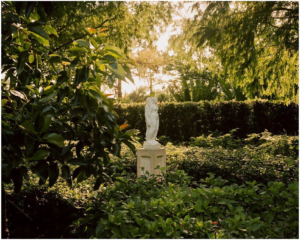
Here’s shot of the Eden garden, which is filled with about a dozen species of fruit trees, including star fruit, avocado, lychee, jackfruit, lime, and orange. At the center is Frank Varga’s.

“Maybe all one can do is hope to end up with the right regrets.” – Arthur Miller


20 Things You Don’t Know About Me

(That I May Regret Telling You) 

I’m not going to tell you all 20 today. I don’t have time and you don’t either. I’ll talk about three of them, and – if this doesn’t turn out to be a huge mistake – I’ll l send a few more in the upcoming weeks.

  1. Transgender Me 

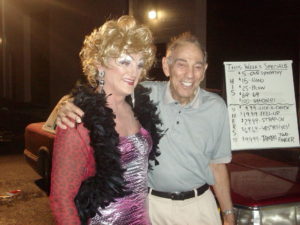
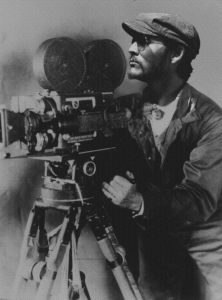
I played a transvestite prostitute in a Herschel Gordon Lewis movie. Yes, that’s me looking like Phyllis Diller on steroids. When I saw myself on film, I was shocked and dismayed. For some reason, I’d always imagined I would make a better looking woman. But Herschel liked the look. Of course, he is the Godfather of Gore and the legendary auteur behind some of the most famously bad movies of the 1970s.

I knew Herschel as a copywriter during the 1990s. He did some work for me. He was a competent, experienced professional. Easy to work with. That’s all I knew about him until my neighbor, Roger, who was a film critic, was telling me about this guy he knew, Herschel Gordon Lewis, a famous filmmaker of the 1970s. I said, “That’s funny. We have a well-known copywriter in our industry with the same name!”

When I realized it was the same guy – and that not only did he have these two very different careers, he was also a respected journalist, a competent piano player, and generally erudite – I decided to make a documentary about him. He agreed, but only if I would produce another movie he’d had in the back of his head for many years. It was called “The Uh Oh!” He wrote and directed it. I co-produced and made this cameo appearance. The movie went on to win many horror film festival awards. Nothing was said about my performance.


     2. Repeat Offender 

I’ve been arrested at least a half-dozen times. The first time I can remember was in 1969.

RR (a high school friend) and I had set off for Woodstock in a car that a guy that worked for RR’s dad had lent us. But then we decided – I can’t remember why – that Woodstock wasn’t going to be all that much fun, so we turned west and set off for California. We had a tent, some camping equipment, and some “mood enhancers” that RR had brought to enhance our experience, and we had many what-seemed-to-be brilliant conversations along the way.

Many of those conversations were about war, government, and politics. (Vietnam was in full throttle then.) And some were more esoteric – such as the electro-physiological explanation we came up with for déjà vu. (A nanosecond short circuit in the brain’s short-term memory wiring.)

We were at a rest stop in Texas when a cop car pulled up behind us. At the time, I knew that being in possession of pot in Texas could get you a life sentence, so I was gearing up to confess and throw myself on their mercy. In the rear-view mirror, I could see that one of the cops was on his walkie-talkie. Then he put it down, came over to our car, gestured for RR to roll down his window… and apologized. “Sorry,” he said. “You guys matched the description of two armed robbers we were looking for.”

He got back in his car and they sped off.

We drove very carefully out of Texas, scrupulously observing the speed limit, and finally reached California. Exhausted, we decided to pull off the highway to take a nap. I scrunched down in my seat, put my feet out the window, and passed out. Next thing I knew, a highway patrolman was tugging on my shoes. He asked RR for his license and registration. RR handed them over.

“This registration is expired,” said the patrolman.

“I didn’t know,” said RR.

“In fact,” said the patrolman, “it expired 3 years ago.”

He paused. “Where did you get this car?”

I looked at RR. He shrugged his shoulders.

The patrolman asked us to step out of the car, and he started rummaging through it. He found the pot in RR’s bag.

He escorted us to the nearest police station, where we were locked up in a holding cell. We were charged with grand theft auto and possession. Our bail was set at $5000. RR’s father bailed him out the next morning. And although my parents could have scraped up the money to cover my bail, they decided a bit of time in a jail cell would edify me.

I stayed there a week. By that time, the grand theft charge had been dropped. The judge fined RR $600 for possession, and fined me $250 ($50 off for each day I had spent in jail).

I could tell you a few grim stories about what I witnessed and experienced that week, but I won’t do that today. What I will say is that – for me – the worst thing about being in jail was not the tight quarters, hard bed, bad food, threats, intimidation, and occasional brutality, but the fact that I could not just get up and walk out the door. You will never know the amazing value of freedom until you’ve been locked up in jail.


  1. Manly Mountain Climber 

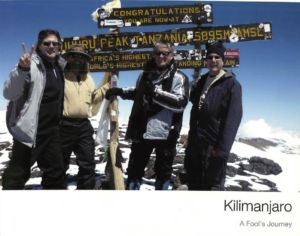
I climbed Mount Kilimanjaro.

For several years, my friend and client Dr. Al Sears had been encouraging me to climb a mountain with him. He was very much into mountaineering at the time, and had been making his way through a series of tall mountains out west.

I had no interest in climbing and was too busy anyway. But I felt guilty saying no over and over again. And so, when he invited me to climb Mt. Kilimanjaro in February of 2010, I agreed, thinking that something would surely happen before then that would make the adventure impossible.

Alas, divine intervention never occurred. And I found myself in Moshi, Tanzania after flying for a total of 17 hours. Our team consisted of Dr. Al, our fearless leader and expert climber; Daryl, the tech expert; Kevin, my childhood friend and one of the funniest most tenacious people I know; and yours truly.

We checked into our hotel (which looked a lot like a military compound) and rested up. We would head for the mountain the following morning.

I woke up with what felt like symptoms of bronchitis, but pressed on to rendezvous with the team and our guide, Raymond, in the lobby. After sorting out a minor miscommunication over weight limits for our gear, we were off. A harrowing bus ride and several warning signs later, we got off the decrepit vehicle and began our climb.

What followed was a five-day ordeal that I can only describe as hellish, painful, unbearable, and insane. Every day was worse and more arduous than the last. I eventually found myself just putting one foot in front of the other while mentally reciting my mantra that it would eventually be over.

My bronchitis worsened and Raymond’s oxygen testing device made it clear that I had pushed myself to the point of concern, but I stubbornly pushed on, pretty much running on fumes. Finally, Raymond put his hand on my shoulder and motioned for me to look ahead. There it was. Uhuru Peak. We had conquered Mount Kilimanjaro.

I staggered to Kibo Hut, a campsite along the mountain route, walked past the table of food laid out for us, and crawled into my cot. Dr. Al checked me out and called for a stretcher.

An hour later, I was on the stretcher, bidding my friend’s adieu. I was smiling. Daryl and Kevin looked envious. Being toted on a stretcher supported by a bicycle wheel was not comfortable, but I was half-delirious and happy to be off my feet. I met up with my buddies at the next stop down,  and we all had a good sleep. The next morning, I felt much better and completed the descent with them on foot.

I will say this about climbing Mount Kilimanjaro: If there is a better way to test the limits of your endurance, I don’t know it. I’m glad I did it and will be proud that I did it for the rest of my life. But would I do it again? NO!

This essay and others are available for syndication.
Contact Us for more information. 

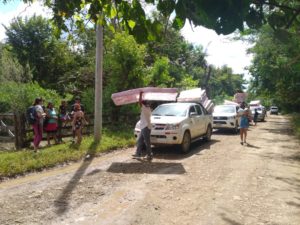
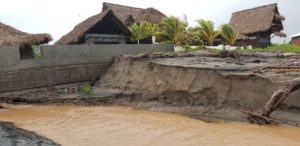
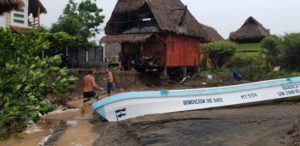
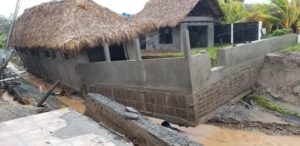
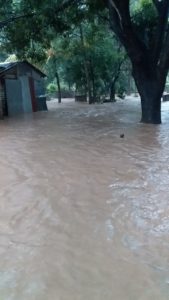
The Aftermath of Hurricane Iota in Limon Uno y Dos 

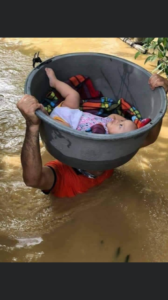
Today, I was planning to show you some footage of a Sumo wrestler that I admire. But when I saw this photo of a man carrying a baby to safety in a tub on her head, I thought I’d make this issue a little photo journal of the effect of and response to Hurricane Iota in our little corner of Nicaragua.


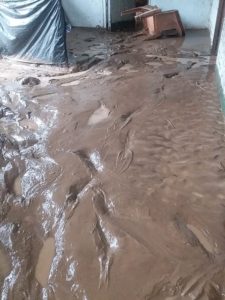
Here’s a good one showing the mud damage…


This one shows the caravans of trucks bringing mattresses from Managua…


And here are more photos of the damage, showing how the flooding can topple structures (including houses) that are built with dirt floors and earthen blocks instead of concrete.


If you would like to contribute to the relief effort, please contact the local director of FunLimon, Bismarck Rodriguez, at bismarck@funlimon.org.

Yesterday in Managua

I spent yesterday in Managua, visiting Harvest, Rancho Santana’s little gourmet bistro, which I’d never seen before, and also an exhibition of Nicaraguan contemporary art sponsored by The French Cultural Center and Ford Fine Art.

The exhibition was a success. Johann Bonilla, our director, did a great job of putting it together. We had planned it a year ago, but considering the state of the Nicaraguan economy after COVID and Hurricane Iota, I assumed it would be postponed. Postpone, however, is not a word THAT Johann understands very well. Despite a university education in the social sciences and a degree in law, he’s a natural intrapreneur. He made the exposition happen without even thinking it couldn’t.

Along with the exhibition, we had a competition with 3 cash prizes. This prompted dozens of entries – and that’s where yours truly came in. As a judge, along with SS, my partner; RH, an art critic friend; JJ, who runs our art biz in Central America; and several others, the task was to narrow the selection to 10, then to 6, and then finally to the winning 3.

It was not easy. So many of the pieces were really good. I’ve long been aware of the high caliber of Central American art. (You may remember the beautiful, illustrated book – Central American Modernism – that Suzanne Snider and I produced recently.) But I was actually shocked by the quality of these entries. They were miles above the sort of derivative and commercial shlock you see in the art shows we have in South Florida.

The pieces were so good, in fact, that I’m buying at least half of them for my collection. They will compete favorably with the modern masters that will hang in the museum I’m planning to open.

It’s interesting to think that here in one of the poorest countries in the Western hemisphere, blighted by political turmoil, the COVID shutdown, and Hurricane Iota, there is this rich source of creative and sophisticated modern art.

Speaking of Johann’s intrapreneurial instincts, today’s essay is about an aspect of that. It’s about moving a growing business from Stage One to Stage Two by creating a culture of speed – one of the most important lessons I ever learned about business.