Kudos for Our Restaurant!

Two years ago, one of the founding partners here at Rancho Santana pitched the rest of us on opening a gourmet bistro in Managua, the capital of Nicaragua, to promote the Rancho Santana brand.

Normally I wouldn’t have considered it. Nine times out of 10, restaurants make for terrible businesses. But this was going to be run by BB, the F&B manager at the ranch. I knew how exacting his standards are. And the investment was modest. Plus, I imagined stopping there for lunch with K before heading off to the ranch. Maybe K and the kids did, too. We decided to chance it.

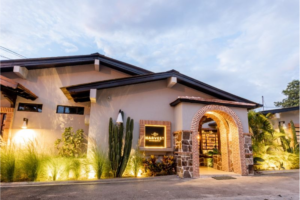
This morning, I got some news from that same partner. It turns out that our restaurant, Harvest, was featured in El Espíritu de América Latina’s 2020 edition of “Latin America’s 50 Best Restaurants” – one of only two restaurants in Nicaragua to receive the honor. BB noted that despite the recent hardships, we should be proud of continuing to represent our community and drawing positive news to the country.

Over dinner tonight (Thanksgiving leftovers), I’m going to try out some of the following fun Thanksgiving facts that Amaru scouted up for us.

Greetings from Rancho Santana!

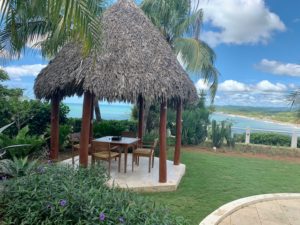
I’m writing to you this morning from my little outdoor “writing studio” that sits next to our new pool, which is being filled with water. When it’s done, late this afternoon, I’m going to test it out. I’m pretty excited about that!

Later this afternoon, K and I will be having an All-American Thanksgiving dinner at La Finca y el Mar, our 5-star restaurant that sits just below our house by the ocean. We won’t be surrounded by our family, as we usually are. But local friends will be there to help us celebrate: TG, a high school buddy that lives here with his son Billy; MT, an amazing octogenarian teacher/ nurse/ entrepreneur/ author; BR and his wife K, who runs our community center here; and LM, a college friend of Number Three Son, who came to work here as an accountant three or four years ago and is now working as general manager.

Today’s essay is about – you won’t be surprised – thankfulness. About my struggle with being thankful and how I’ve recently made some progress.

Happy Thanksgiving!

“The Real Story of Thanksgiving”

Tomorrow we will have Thanksgiving dinner at the Club House restaurant, like we’ve been doing for many years. But this year, our children and their families won’t be with us, thanks to You-Know-What-19.


Today I’m meeting with Bismarck, the onsite director of FunLimon, and a half-dozen other local leaders to get an update on the progress made so far in bringing relief to the community and making plans for the future.


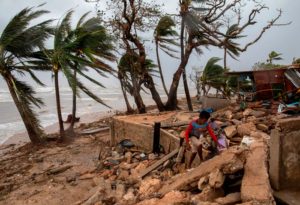
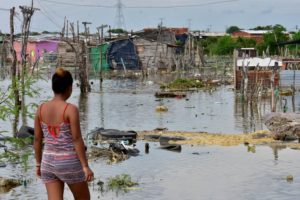
After Hurricane Nate in 2017, Number Three Son Michael, the stateside director of FunLimon, raised more than $100,000. Some of it went to immediate relief (food, water, seeds to help subsistence farmers get back on their feet, etc.), but most of it went to restore almost 400 wells in the local neighborhoods. These were good, deep wells by old-fashioned bucket-and-hole standards, but after Hurricane Iota, they nevertheless filled up with the polluted water running off streams and rivers.


Bismarck and David were able to clean 142 of the wells, but 228 of them had to be completely rebuilt.


“Seems sort of futile,” I said.


“It’s like breaking an arm,” Bismarck explained. “You put a cast on it. It’s fixed. But then the next year you break it again. What are you going to do? Not fix it?”


He’s right, of course. So that’s what we are doing for the time being. But I’m conjuring up a plan to build a network of modern, deep, pipe-and-pump wells and placing them in the local communities for common use. Problem is, new regulations would require us to turn over the ownership and use of such wells to the local government. And so I’m exploring the possibility of putting them on private property that we own so we can be sure they will not be converted later on to public utilities, in which case their future use could not be guaranteed.


Meanwhile, I found a video on YouTube, titled “The Real Story of Thanksgiving,” that I think

“The most beautiful things are not associated with money; they are memories and moments. If you don’t celebrate those, they can pass you by.” – Alek Wek


The Moments I Love 

Midnight at the Swamp House. Starless sky. Rippling breeze on the lake. Just me, my Casa Amigos, and my work.

Ping. It’s from Judith, re an essay I sent in this morning. I make the revision and send it back to her, wondering what she’s doing, working at this hour.

Ping again. It’s from Matt, re a possible acquisition we discussed this afternoon. I answer it, adding, “What are you doing, working at this hour?”

I love that!

Other moments I love:

* Every time one of my boys calls me for advice.


* When BB and I say the same thing to our partners in each of our very different ways.


* Any time my weight drops below 210 pounds.


* Yes, that first cup of coffee in the morning.


* Anytime I ask for forgiveness and get it.


* My Sunday routine: Instead of 2 hours of exercise, doing the NYT crossword while smoking a Padron Aniversario.


* When the conversation turns to anything remotely philosophical, including discussions that start with, “Isn’t it fucked up when…?”


* When Amaru says, “I’m on it, boss!”


* When I score even a single point on any of my Jiu Jitsu instructors.


* Every time Myles smiles a certain way when I’m pushing an idea. I know that means the next day he’ll come back with an improved version of it.


* When I see my nieces and nephews together, treating one another like beloved brothers and sisters.


* When someone I’m mentoring gets it and I know he’ll forever be operating on a higher level.


* Anytime I give someone something – money, time, attention, advice – and it actually helps them, without negative side effects.


* Every time I see my friends looking at K and thinking, “I hope Mark realizes how lucky he is.”


* Almost every time I learn something new.


This essay and others are available for syndication.
Contact Us  for more information. 

A Jolt of Pure Joy! 

Look at this – a film of a snowball fight shot in 1897 in Lyon by the Lumière brothers…

The Lumière brothers are considered to be pioneers in film. This one spans less than a minute, but it’s a tempest of cultural anthropology, giving the viewer an insight into the French that one wouldn’t get from sitting at a Paris cafe.

Here is the text that accompanies the clip, written beautifully by Sam Anderson:

“If you watch the snowball fight over and over, as I will do for the rest of my life, certain characters begin to stand out.

“Down in the bottom-left corner, a thick man with a strong black mustache fires a cheap shot: a wild fastball, from point-blank range, that barely misses its intended target, a slim man who is busy looking the other way. The slim man turns, cocks his left arm, and wallops the big man on his thigh.

“From that point forward, these two are locked in savage, jolly combat. They reload and pelt each other multiple times, until finally – overtaken, perhaps, by the homosocial energy crackling between them – the big man staggers forward and lunges to tackle the slim man like a bear attacking a deer. But once again he misses: The slim man sidesteps and, grinning, shoves the big man into the snow. The big man pops back up, like a mustachioed snow-zombie, and starts pelting the slim man again from behind.”

Anderson’s favorite character, whom he calls the “protagonist,” is the man in in the bowler hat and long coat.

“He  looks as if he has just stepped out of a bank meeting, and yet he abandons himself to this childish street warfare with eager glee.

“While the other fighters stand more or less rooted in place, the man in the bowler covers a surprising amount of ground – he is a free agent, prancing around with lumbering lightness, entering and exiting clusters of people, galloping across the road, following his bliss, attacking willy-nilly with a funky sidearm toss. He seems to take as many shots as he gives, and by the end of the film his black coat is thoroughly dusted with white; you can see the snowballs’ impact blasts as clearly as bullet holes.

“And then there is the bicycle. This is the peak moment of brutality, when the whole group loses its collective goddamn mind. Right from the start, you can see the cyclist coming: a small figure, growing larger every second, gliding smoothly on an angle toward the fray. Before he even reaches the crowd, he starts to take distant fire. And yet he is determined to ride on. When he arrives, all the warring factions turn to unite against him, unleashing a wickedly targeted cyclone. The cyclist takes hard shots to the arm, the face, the back, the neck. Still he pedals forward, hunching his back, spinning his long legs – a stoic hero, intent on gliding through the violence, determined to reach the safety of the other side.

“His legs fly up in the air; his hat lands upside down in the snow. Before he can even get up, the cyclist is pelted again, and someone tries to steal his bike – but the cyclist stands and rips it away, then hops back on, abandoning his hat, retreating, pedaling off the way he came, taking powdery sniper fire as he goes. It is an object lesson in futility, in noble intentions thwarted – one man’s vision destroyed by the sudden madness of a crowd.

“Off in the middle distance, two men stand near a street lamp, watching the mayhem, never moving, like Beckett characters, thinking who knows what.

“On an intellectual level,” Anderson says, “we all understand that historical people were basically just like us…. They lived, as we do, in the throbbing nerve-pocket of the now. They were anxious and unsure, bored and silly. Nothing that would happen in their lifetimes had happened yet. The ocean of time was crashing fresh waves, nonstop, against the rocks of their days. And like us they stood there, gasping in the cold spray, wondering what people of the past were like.”


This essay and others are available for syndication.
Contact Us for more information. 

Anything that is secret, clandestine, loaded with such a supercargo of speculation, misinformation, disinformation and, for that matter, accurate revelations, creates an appetite.” – Charles McCarry


A Reader Asks: Should I Invest in Bitcoin?


Mark – I have a confession. I’ve read about Bitcoin at least a dozen times in the past year or so. I know it’s supposed to be some sort of hot, new investment. It sounds exciting, but you always say not to invest in anything you don’t understand, and I don’t understand cryptocurrencies. I’m trying to figure out if it makes sense for someone like me – a middle-aged, middle-class person with retirement savings of about $500,000 – to invest in them. And if so, how much? Maybe you could write a short explanation “for dummies”… the pros and the cons? – PJ 


Thanks for your question, PJ. You’re not alone. Very few people understand what cryptocurrencies are and how they work. I have a basic understanding, but I’m hardly an expert on cryptocurrencies, let alone currencies generally.


My beat is wealth building, which is a larger and, to me, much more important subject. Building wealth is not about becoming an expert in one or a dozen particular areas of finance. It’s about understanding basic truths about economics and personal finance, and applying commonsense strategies that are respectful of those truths.


I’ve been thinking and writing about building wealth for more than 40 years. I made my share of foolish mistakes when I began to make and invest money, but I did learn from those mistakes and put that knowledge to play as the years passed.


My strategy worked for me. I believe it can work for anyone. But you can decide if it makes sense for you.


I’m going to tell you, very briefly, what I’ve learned about Bitcoin and other cryptocurrencies. And then I’ll explain how I see them fitting into my overall wealth building strategy.


Some definitions… 


Let’s begin with a few quick definitions.


Currencies: I don’t think of cryptocurrencies as investments, per se. In my dictionary, investments are assets with intrinsic value – businesses, real estate, debt instruments, etc. When you buy an asset that has intrinsic value (and preferably income), you are investing.


Currencies are units of exchange. In medieval times, grains were currencies. But using them as units of exchange was impractical because they were perishable, occasionally unavailable, and of only modest value. They could not be used for large commercial transactions for those reasons and because they were too bulky.


Hard Currencies: For commercial transactions, the Romans used gold and silver pieces. They had a thousand times more intrinsic value than grains per cubic meter, and therefore solved the problem of size. They were transportable, which meant they could be used for foreign trade. And when the face of the Roman Emperor was stamped on them, their credibility as units of exchange became universally accepted.


Paper Currencies: When the US dollar was introduced as currency, its value was linked to the value of gold. This gave it the equivalency in value of gold, but with greater ease of use because of its relative weightlessness and its capacity to represent its value in printed denominations.


Fiat Currencies: When President Nixon abandoned the gold standard in 1971, the value of the US dollar became tied not to gold but to a promise backed by “the full faith and credit” of the US Treasury. This might have worked perfectly well had the supply of dollars been limited. But the plan was to create more dollars. To actually create more dollars out of thin air.


Like counterfeiters, the Federal Reserve and the US Treasury teamed up to print more dollars with nothing to back them up but IOUs. And politicians were free to spend unlimited amounts of money on any sort of project they wanted. Paying for government programs was as simple as using a credit card with an unlimited credit line, a low interest rate, and an unlimited time horizon to pay back the debt.


This should have destabilized the dollar’s preeminence as a world currency. It didn’t, because energy trading, which has always been the fundamental factor in modern economies, was done in dollars.


For decades, Republicans and Democrats fought over the issue of this overspending. Fiscal conservatives argued for balanced budgets. But during crises (mostly wars), the spending took place anyway, with the repayments made through inflation and/or GDP expansion years later. Recently, the idea that federal debt was a bad thing has all but disappeared. And that meant, to anyone that understood monetary and fiscal economics, that eventually the US would face a major collapse of faith in the dollar and most probably a massive hyper-inflationary depression.


Cryptocurrencies: Enter Bitcoin. Bitcoin was invented primarily to protect its holders from just such an economic collapse. It was done very simply by Bitcoin’s inventor by limiting the number of “minted” Bitcoins to a specific amount: 21 million. (We don’t know who that inventor was, but we have ideas.)


Because Bitcoins are limited to 21 million, they were (and are) exempt from the fatal flaw of fiat currencies like the US dollar – i.e., the devaluation of each unit of currency when the total number of units is artificially increased. As a holder of Bitcoin rather than dollars, you don’t have to worry about the value of your stocks, bonds, and cash wealth dropping to almost nothing overnight.


Digital Currencies: A second benefit of cryptocurrencies is that they are designed to be exchanged without trackability. In other words, you can buy and sell them in a digital marketplace that is basically invisible. You don’t have to know who sells you their Bitcoin. Nor do you have to know to whom you sell your Bitcoin. And nobody – not even the government – can see what you are doing.


This feature is obviously very attractive to tax dodgers, drug dealers, and money launderers. But it’s also favored by law-abiding folks that believe in financial privacy.


In summary, Bitcoin is a relatively new currency, like the US dollar. But it is digital. It can be held and traded in secret. And it is not subject to devaluation like the US dollar and other fiat currencies.


Bitcoin is the best-known cryptocurrency, but there are many others. Most of them share two traits: They trade on decentralized platforms and offer anonymity. (Thus, cryptocurrencies.) And they are produced in limited supply. (Thus, no risk of devaluation.)


There are digital currencies that are not cryptocurrencies. For example, the digital currency that Amazon wants to introduce will offer some of the benefits that Bitcoin offers, but probably not anonymity.


Those are the primary reasons you’ve been reading about cryptocurrencies these past 10 years or so.


Now, here, per your request, are the pros and cons of cryptos versus the US dollar.


The Pros of Cryptocurrencies 


* When you own a cryptocurrency with a fixed supply, like Bitcoin, you don’t have to worry about its value crashing due to inflation.


* In fact, as demand rises, the value of your stash goes up. (This is what investors in cryptocurrencies hope will happen.)


* Transactions are immediate, permanent, and very difficult to fake. This makes fraud and theft nearly (but not 100%) impossible.


* Transactions take place on a decentralized digital network. This makes it impossible for hackers (government or private) to invade or control the market.


* If Bitcoin ever becomes the dominant global currency, the value of any Bitcoin you own could skyrocket – by hundreds or even thousands of percentage points.


The Cons of Cryptocurrencies 


* Mining, holding, and trading Bitcoin is not free. There is a considerable energy cost involved in keeping it alive and kicking in the digital universe. There are other cryptocurrencies that are less expensive than Bitcoin. In theory, these could one day replace it.


* Bitcoin and other cryptocurrencies are safe, but not 100% safe. There have been instances of loss or theft. Such losses/thefts are unlikely, but possible.


* Because cryptocurrencies are exchanged on a digital ledger called a “blockchain,” every transaction is recorded. If you were forced to give your access code to someone (a thief or the IRS), they could get an exact blueprint of everything you have done on the blockchain since the beginning.


* If the US government declares Bitcoin or other cryptocurrencies illegal, their value could collapse entirely.


As you can see, there are, indeed, pros and cons of cryptocurrencies as currencies. But the reason so many people are interested in them is not their value as a commercial unit of exchange, but as an investment or speculation.


The Future of Bitcoin as a Currency


Early buyers of Bitcoin imagined a world where billions of people would be trading it on the blockchain, freely and anonymously. Many Bitcoin holders still hope this will happen.


I think it’s possible. But very, very unlikely.


There are two reasons.


First, a nation of people doing business anonymously – not just buying and selling goods and services but earning income, too – would be a disaster for the IRS and state and local tax authorities. They could collect Bitcoin for taxes, but they would have no way of doing reliable audits.


The other reason is that if Americans started preferring cryptocurrencies over the dollar, the entire scheme of printing fake dollars to fund the government’s overspending would collapse. Without the ability to print more Bitcoins, they’d have to make do with the ever-diminishing taxes they’d be collecting. Governments would go broke.


They are not going to let this happen.


So, no. I don’t see Bitcoin replacing the US dollar. But if cryptocurrencies become more popular, I do fear the day when the dollar will be replaced by the US Digital Dollar. (See below.)


Bitcoin and Other Cryptos: the Bottom Line


Is Bitcoin – or are cryptocurrencies generally – a smart investment? Let’s try to answer that question now.


I own Bitcoin and several other cryptocurrencies. But as I said above, I don’t consider them investments.


They are not investments because they do not represent shares in growing and profitable businesses. Nor are they bank notes or debt obligations. They don’t produce income. They don’t create value. They aren’t tangible. And the value they have is based entirely on what Yuval Harari, in Sapiens, calls social myths: common beliefs that have no actual basis in reality.


Yes, the bottom line is that Bitcoin and other cryptocurrencies have no – zero – intrinsic value.


But we could make the same argument against the US dollar, which, as I said, is a fiat currency, printed on paper with nothing behind it but the promise of a bankrupt government.


So Why Do I Own Cryptos? 


I own Bitcoin and four other cryptocurrencies. I bought them not because I believed they were destined to appreciate in value, but because I wanted to learn more about them. And I knew that if I bought a small stash, I’d take the time to do it.


I also thought that in the unlikely event that they could, one day, actually skyrocket in value, I’d be able to say, “Yeah, I bought Bitcoin back in the day,” and look smart.


I’ve read many of the arguments in favor of cryptocurrency’s ascendency. Most of them are based on the inherent advantages of either crypto-technology or limited supplies or both.


A recent essay talked about it as a technological innovation, and predicted a great future for it based on historical patterns for disruptive technology. One example: It took 10 years, from 1980 to 1990, for PCs to gain 10% of the US market. But between 1990 and 2000 – just another 10 years – it went from 10% to 90%.


That’s exciting stuff. But although cryptocurrencies are based on an amazing technology – the blockchain – they themselves are not the blockchain. They are digital currencies with some advantages over conventional currencies based on blockchain technology.


These advantages are real and they are valuable to those that use them. And the more people that use them, the more valuable they become.


All that is true. And that’s the reason so many people are still interested in cryptocurrencies. It’s theoretically possible that they could replace the dollar someday.


But, as I said, I cannot imagine a scenario in which the US government would allow it. The current system of fiat currency offers our politicians exactly what they need to maintain their power: a way to promise their constituents anything and everything they could possibly want, without a worry about who’s going to pay for it.


Just in the last year, the hustlers and moochers in Washington, DC, have spent more than 5 trillion in fake dollars on a basket of fundamentally unproductive programs. Their ostensible purpose was to stimulate a stable and prosperous economy. But their ulterior motive – on both sides of the aisle – was to garner voter support.


There once was a time on Capitol Hill when fiscal conservatives – politicians that believed in sound money (currency backed by gold) and balancing the federal budget – represented as much as 50% of the elected officials. That golden era ended when President Nixon ended the gold standard. Of the 100 senators and 435 representatives now in Congress, I count only one that qualifies.


US Monetary Policy If Cryptos Become Too Popular 


Now imagine what would happen if one day 70% – or even 30% – of the US population eschewed dollars for cryptocurrencies. This Holy Grail of fiat currency would collapse and our good people in Congress would have no more promises to make. Our economy would tank and there would be nothing they – or the president or the US Treasury or the Federal Reserve – could do about it.


Not to mention the fact that there would be no way for our elected officials to give themselves salary hikes and beef up their government pensions.


No, they won’t let that happen.


But what might happen is this:


The government will begin issuing its own digital currency. It would offer all the minor benefits of other digital currencies but without the anonymity or the limited supply. And since this new currency would be generated by the government and processed through a “government” blockchain, it would be even better than dollars for them. It would allow them to increase the supply quickly, easily, and anonymously, while also being able to track and trace every single monetary transaction of every single citizen (and non-citizen) in the country.


If such a digital dollar currency were proposed in Congress, I can’t see why it wouldn’t pass easily. The elevator pitch would be an end to white-collar crime and a simultaneous end to tax dodging. Who would have the courage to say no to that?


In summary, I don’t believe any cryptocurrency will ever be allowed to gain a significant hold in the US economy (or any other major economy). Period.


But that doesn’t mean that, in the meantime, Bitcoin and other cryptocurrencies won’t enjoy a big spike or two in demand.


And if they do, those that have speculated in them might find themselves considerably richer.


So, here’s my “advice”… 


Think of these currencies as speculations. Treat them as a way of gambling on the very reasonable chance that in the next several years there will be spikes that boost the value of some of these digital gambling chips by hundreds or possibly thousands of percentage points.


Put a small percentage of your net worth – an amount you’d be willing to lose – into a basket of cryptocurrencies. My basket is about half Bitcoin and half others that have been recommended by colleagues of mine that know much more about this subject than I do.


If and when they do spike, claim some or all of your winnings. Play it like you’d play roulette or bet on a horse race. Enjoy the ride. Play the short game. Don’t count on it for your retirement.


This essay and others are available for syndication.
Contact Us  for more information. 

“Politics is not predictions and politics is not observations. Politics is what we do.” – Paul Wellstone


Thoughts on a Too-Close-to-Call Election 

I’ve never understood how, in a country the size of ours, presidential election results are so often decided by such a thin margin. It just doesn’t seem that the vote could end up being close to 50/50.

As I write this, we don’t know who our president will be. By the time you read this, we may have the answer. More likely, we won’t, and this will turn out to be another election, like 2000, decided by the courts.

I was going to write about the election results and their ramifications today. But since we’re still in limbo, I’ll tell you what I think will happen over the next four years regardless of – and depending on – the outcome.


What will happen regardless of the outcome… 

Nobody’s Leaving: Yesterday, I wrote, facetiously, about people that swore they’d be leaving the country if their man didn’t win. That won’t happen.


The Pandemic: Cases of COVID-19 will continue to mount steadily over the winter. The death count will rise behind it, but at a lower than expected level. Election results won’t matter in terms of fatality rates, but if Biden wins, media coverage of the pandemic will drop considerably.


Police Brutality and the BLM Movement: When African-Americans – armed or unarmed – are shot by police, protests and rioting will follow. Media coverage of the movement will wane if Biden is elected and increase if Trump is reelected. We may see some improvements in local police protocols and policies. But real progress in reducing unnecessary force and other forms of bad police behavior will come from an ever-increasing use of cellphone recordings and postings on social media.


Racism and Antiracism: Regardless of who wins the presidency, the interest in and support of the concepts of white privilege, white fragility, and antiracism will ebb, and efforts to pass a reparations bill will be roundly defeated. Meanwhile, conservatism among Black and Latino voters will rise.


Social Justice and Identity Politics: Universities will ramp up their campaigns for identity politics and Socialism. But university enrollments will go down.


Foreign Entanglements: The Military Industrial Complex will continue to push for more third-world proxy wars, but without success. Instead, a new cold war with either China or Russia (depending on who wins) will begin, with a corresponding arms race that will cost taxpayers trillions of dollars.


* China: Even if Trump wins, China’s economy will continue to grow faster than ours, and will become the world’s largest by the end of the next administration.


* Trade Wars: Current support for tariffs and trade wars will diminish greatly as the negative consequences for the US become clear.


* Prison Reform: There will be continued efforts to reduce the number of non-violent criminals behind bars, but interest in this will diminish considerably before the end of the year.


* Immigration: Regardless of who wins, US immigration policies will remain largely the same.


* Government Spending: The dam is broken. Democrats and Republicans will continue to agree on spending trillions of dollars we don’t have to pay for boondoggles we don’t need.


* Health Care: Even if Trump wins, we will gradually move towards health care for all, but at a level that the system can support, which will be very basic.


* The Environment: Even if Biden wins, the Green New Deal is not happening. We’ll make progress towards a cleaner environment, but at a pace that allows US GDP to inch back to healthy levels. There will be no significant changes in the next four years.


* Infrastructure: Both sides of the aisle will continue talking about the importance of rebuilding US infrastructure, but nothing significant will be done.


* The Supreme Court: If Biden wins, the Democrats will try to pack the court, but they will fail because of the Senate.


What will change, depending on the outcome… 


* Personal Liberty: If Biden wins, there will be less of it.


* Taxes: If Trump wins, some taxes will go down, but not substantially. If Biden wins, taxes will go up.


* Regulations: If Trump wins, there will be more deregulation. If Biden wins, there will be more regulation.


* The Stock Market and the Economy: If Trump wins, the market will rebound, and it may stay up for a while because of continued government spending. But eventually, the bills from the shutdown will come due, and the US will go into a prolonged recession. The poor will stay poor. The rich will get richer. And the working and commercial classes will gradually pay off the bills.


This essay and others are available for syndication.
Contact Us for more information. 
“We don’t create a fantasy world to escape reality. We create it to be able to stay.” – Lynda Barry


Book Your Departure Now!

10 of the Best Places to Escape to Outside of the USA 

K says she’s leaving the country if Trump wins. JM says he’s leaving if he loses.

If their sentiments are common, airfare and other costs of living abroad will be going up. Depending on what happens tomorrow, you may want to plan ahead.

Here is our list of the best places to escape to outside of the USA – the posh places and the charming places (for those on a budget). We compiled it mostly from our colleagues at International Living.


Abruzzo, Italy

La bella Italia: known for its historic cities, beautiful beaches, delicious cuisine, exquisite fashion, and influential art. Pick the right area of the country to call your home and you can spend your weekends driving to its diverse cities and small towns, and you can even take a ferry to the unforgettable islands of Sardinia and Sicily. If you make your home in the region of Abruzzo, in particular, you will enjoy an affordable cost of living that is ideal for those who are no longer working full-time. You will have access to Pescara, which sits along the Adriatic coast, and you will also be close to Rome, vineyards, castles, and villages. Plus, when you don’t want to be on a beach or in the water, you can go skiing instead, as this region is close to it all. With a warm climate throughout the year, you can relax in the sunshine while sipping wine and chatting with friends.

Annecy, France

The big attraction in Annecy, the pearl of the French Alps, is the ski slopes in winter. But this lakeside city is an appealing place to be year-round. Unlike other top ski destinations in France, fairy-tale Annecy is not a tourist town, but a living community that is more cosmopolitan than a typical haunt of snow bunnies. Annecy is a city of art and history that can seem like an open-air museum. Every July, its streets are given over to Noctibules, an annual art festival, and the much-anticipated Fete du Lac in August features the biggest fireworks show in Europe.

Kotor, Montenegro

This tiny seaside country of a half-million people dispersed over an area smaller than the state of Connecticut is nestled between Croatia and Albania in Southern Europe. Bayside Kotor, surrounded by towering mountains on one side and the dazzling Adriatic on the other, is a UNESCO World Heritage site and perhaps the best-preserved medieval town in the Mediterranean. The Old Town square is anchored by the 11th century Saint Tryphon’s Cathedral, but its cafés and shops are lively and bustling with a youthful energy. This is a little-known but friendly, safe, and welcoming corner of Europe, comparable to the historic stone villages in Italy, but more affordable.

Carcassonne, France

Walt Disney is said to have been inspired by its towers, turrets, and ramparts, and you can understand why when the sun rises over the medieval city of Carcassonne in southeast France. At the heart of Cathar country, this was, for centuries, an important fortification. Today, the city of Carcassonne has much to offer tourists and residents, including a medieval castle, St. Nazarius Basilica, boutiques, artists’ workshops, and Michelin-starred restaurants. Life in the Bastide is centered on the Place Carnot, with its pretty fountain, street-side cafés, produce market, and restaurants. Within an hour are the sandy beaches of the Mediterranean, and 90 minutes away is skiing in the Pyrenees.

Città Sant’Angelo, Italy

Perched on a hilltop with views of Gran Sasso Mountain, the Adriatic, vineyards, and olive groves sits 9th-century Città Sant’Angelo. In the heart of Italy’s Abruzzo region, this is one of the greenest parts of Europe, with more than a dozen ski resorts in one direction and 80 miles of coastline in the other. Città Sant’Angelo has earned the title “Borgo,” recognizing it as one of Italy’s most beautiful cities. Sant’Angelo has also been designated a “Città Slow,” a town committed to preserving traditional ways of life and resisting development. Not much has changed in Città Sant’Angelo over the centuries, and that’s the way residents like it.

Ambergris Caye, Belize

The sole Central American country with English as its official language, Belize offers retirees a warm, outdoor-oriented environment, including fishing and barrier reef diving. Cost of living is quite reasonable. Crime is not a problem outside of Belize City. Quality healthcare can be an issue; retirees often return to the US – a two-hour plane ride to Houston – for major medical needs. This politically stable country lures retirees with a Qualified Retired Persons program that offers permanent residency upon showing just $24,000 in annual income. Popular venues for retirees include Ambergris Caye, an island 35 miles northeast of Belize City, and Corozal, a mainland city on the Atlantic Ocean near Mexico.

Puerto Plata, Dominican Republic

The Dominican Republic has swaying palm trees, warm turquoise water, and year-round sunshine in abundance. This small nation boasts about 800 miles of coastline, all of it sandy and inviting. While the southeastern coast can be very touristy, the north coast is less trafficked and naturally stunning, with forested mountains rising behind the white-sand beaches. The city of Puerto Plata provides resort beach living without typical resort beach costs. A couple’s basic monthly budget is about $1100, including rent. If you invest in a place of your own, your monthly living costs could be much less, as property prices in this country are a bargain. You could buy an apartment for as little as $100,000.

Chiang Mai, Thailand

Chiang Mai lures travelers, expats and retirees from around the world with its exceptionally low cost of living, high-quality health care and modern infrastructure. For $330 a month, you could rent a two-bedroom bungalow with a garden, and for $830 monthly, you could settle into a three-bedroom villa with a private swimming pool. Rents normally include utilities and basic cable. You can get around using tuk-tuks, baht buses, and the occasional taxi for just a few dollars a day. Many expats claim it’s cheaper to eat out than to buy groceries, and with all the food options in this city, it’s not hard to eat out for every meal.

Mazatlán, Mexico

Mazatlán boasts more than 10 miles of sandy beaches and a new five-mile boardwalk. You could slide easily into expat life and speak mostly English, or choose to live in a Mexican setting, speaking Spanish and immersing yourself in Mexican culture. One of the biggest benefits of living in Mazatlán is the low cost of living. Basic items for a couple will cost you about $1070 a month if you own your own apartment, and $1380 if you rent a house near the beach. Food prices vary depending on how many American and Canadian imported items you buy. Dinner for two in the city’s best fine-dining establishments costs about $61, including wine and tip. Dinner in a more casual restaurant on the water runs about $31 with drinks.

Da Lat, Vietnam

Da Lat’s cool weather, misty peaks, and pine forest have a historic and otherworldly charm that can be enjoyed at an impressively low cost. Monthly expenses for a couple work out to about $900. Rent can be as little as $194 a month for a studio apartment on the edge of town and $345 to $430 for a more central apartment. Air conditioning isn’t needed in Da Lat, so electricity bills are always low, and utilities are usually included in the cost of a rental. Known as the garden of Vietnam, flowers including roses, marigolds, hydrangeas, and golden everlastings are grown here. Da Lat has its own wine industry, and enjoys a reputation for having some of the best food in the country. A full, delicious meal can be had for as little as $1 a plate.

This essay and others are available for syndication. 
Contact Us for more information.
“By prevailing over all obstacles and distractions, one may unfailingly arrive at his chosen goal or destination.” – Christopher Columbus


Against All Odds: Denver to LA in a Vintage RV, Part III

I woke up feeling conflicted about the luxurious meal we had at Lakeside, a top-rated restaurant in Wynn, a top-rated hotel.

The ambiance was what I had expected: plush and expensive in that over-the-top but still amazing Las Vegas/Dubai sort of way. (Did I mention that the Wynn cost $2.7 billion to build?) And the food was very good.

But it wasn’t any better than the meal we had at that diner in Green River at one-fifth the cost. It’s yet another reminder of something I’ve known for many years but keep forgetting: Paying more for luxury is seldom worth it. Spender beware.

Instead of beating myself up about it, I employed a simple but powerful trick I somehow figured out just last year in my 69th year on the planet: I forgave myself.

I had several hours before my 10:30 meeting. I looked for my laptop. It wasn’t on the desk. It wasn’t in my luggage. It was nowhere to be found. Yikes! I can’t live without it – not even for a single day. I called Lost & Found. It was closed until 9:30. I called the front desk and said that it was an emergency. They switched me to someone that said, yes, they had it.

I had left it at the bar I was sitting at after dinner. How could I have done that? Was this yet another symptom of early onset dementia? Or was it the wine and tequilas and fatigue? I don’t know. I forgave myself for the second time.

I got busy. At 10:30, we had the meeting. We were talking to our publishers, one by one, asking them how their businesses were doing. We actually know how they are doing, but we wanted to know if they are preparing for what could be a challenging year. I had asked for what I always ask for in such situations: three one-year business plans. One that is realistic, one that is optimistic, and one that is pessimistic. I’ve been doing this for 40 years. More often than not, the outcome is halfway between realistic and pessimistic. Rarely does the optimistic scenario turn out to be the reality, but it does happen. This year, it is happening with four of our 11 operating divisions. Still, I showed concern. I wanted to convey urgency. The Second Law of Thermodynamics mandates it. Even if it ain’t broken, I reminded our leaders, you should always be fixing it.

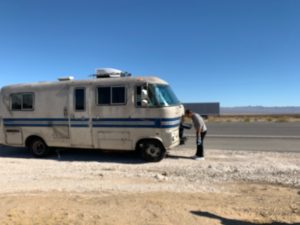
We left at noon, as planned. It was a glorious day – sunny and 70 degrees. Betty the Beast (an appellation I had given the Dodge) moved out on the highway proud and strong. Michael’s tape of 70s music was pumping. It looked like we would be in LA at 4:30 or 5:00. If all went well.

Forty minutes into this last stage of our adventure, Liam announced that the heat gauge was over 200.

“What’s the optimum?” I asked.

“About 200, plus or minus 10 degrees,” Liam said.

“So why are you concerned?”

“The margin is narrow. At 220, you could be in trouble. At 230, you definitely are.”

We pulled off to the side of the road, far away from the left lane where cars and trucks were whizzing by at 85 mph, to let the engine cool down.

I scolded myself for our optimism. We should have considered a worst-case situation before we left. But I’m a Ready-Fire-Aim sort of person. Apparently, Liam and Michael are too. I decided not to fuss about it. I forgave myself. I forgave us all.

Liam and Michael got to work consulting the manual and making phone calls. I found a shaded place nearby to sit and work. What would be the worst-case scenario? Betty the Beast would be too ill to carry on. If so, we’d tow her to a repair shop and then Uber to LA and retrieve her the next day.

After an hour, the engine had cooled down to 185. It was now safe to check the radiator. Liam did and found that the coolant had all but evaporated. That was actually good news. It meant that the overheating was due to a paucity of coolant. Liam filled it up. We climbed in. He started the engine. Betty roared to life.

“If things go well,” I told myself, “we’ll get to LA at 6:30 or 7:00. 6:30 is optimistic. 7:00 is realistic. 7:30 is pessimistic.” But that wasn’t true. Pessimistic would be another breakdown and missing our 8:00 dinner with our extended California family. We sent them a group text, letting them know the new ETA and promising to keep them updated every hour.

Driving through the desert, Betty struggled a bit on the inclines, the temperature gauge rising to 200 and even 210. But on the downhill, she cooled to a comfortable 190. Michael checked our altitude. We were at 4000 feet.

“I guess that’s good news,” I said. (LA is more or less at sea level.) “It’s mostly downhill from here!”

We arrived at Liam’s house at 7:45. Joanna, his wife, to our surprise, was delighted by the look of Betty the Beast. And the twins, Penelope and Fiona, were thrilled too. They called it the House Truck.

We arrived at the restaurant at 8:15. Number Two Son Patrick and his wife Jenny, Brother Chris and his son Vinnie, and Nephew Colin, the movie star, were there to greet us. We had a wonderful meal… all of us together and happy and with so much to talk about.

Mission complete!

This essay and others are available for syndication.
Contact Us  for more information. 
 

“When you go on a road trip, the trip itself is part of the story.” – Steve Rushin


Against All Odds: Denver to LA in a Vintage RV, Part II

6:30: A clear and sunny morning. 29 degrees. Praise the Lord! It’s about 400 miles from Green River to Las Vegas. In a conventional vehicle, it would take less than 6 hours. In the Dodge Travco, whose average speed is about 55 mph, it should take us closer to 8. Assuming no surprises.

The breakfast room is closed due to the COVID Crush Down. But you can order at the hostess stand and they deliver it to you a few minutes later in a Styrofoam container. I once spent a week in jail eating breakfast that was delivered in Styrofoam containers. The eggs were cold. The bacon was greasy. I promised myself I’d never again eat breakfast from a Styrofoam container. There’s some macaroni salad in a plastic container left from yesterday. I have that instead.

We’re off and running at 8:00 am. Liam is driving again. Michael and I have been switching in the shotgun seat, but neither of us has drummed up the courage to relieve Liam at the wheel. The countryside is beautiful. High, dry desert interrupted with dramatic hills and flat-headed mesas that face Route 70, like Sphinxes against azure blue skies. The road is straight ahead of us. Deserted. The Dodge is running nicely.

I’m in the back and I’m working, happy I’m able to type given the way this vehicle moves. It lists right and left slightly – just enough to make you feel nauseated. And its thin, maximally inflated tires vibrate annoyingly, except on the smoothest stretches of road. Thirty years of working in planes, trains, and automobiles has trained me to type under these conditions. I’m grateful for that because I have about a half-dozen urgencies I have to finish by the end of the day.

We stop for gas – as we must do every two hours. The reason, Liam explains, is that the original gas tank, which holds 50 gallons, is rusted out and so he had a considerably smaller tank put in temporarily to get us to LA. That, and the fact that this behemoth gets only 7 miles per gallon. Liam fills the tank while Michael and I chat with K, who is tracking our progress as if she suspects more obstacles lie in our way. Pulling out of the gas station, Liam complains about the cost of gas here: $2.85 per gallon.

It’s my time to sit shotgun. As I walk to the seat at the front, the RV hits a pothole and I’m suddenly clobbered by a sheet of plywood, a roll of carpet, and various other junk that tumbles out of the closet, whose original door has been replaced with a bath curtain. Struggling to climb out of the avalanche of detritus, I stand and fall again as the Dodge rumbles down the highway. Michael looks back on me, trying to suppress a smile. I feel old. Michael hops off his perch and assists me to the shotgun seat. I feel older still.

“So,” I ask Liam in the most neutral tone I can muster, “What’s all that crap doing in there, anyway?”

“Oh, it’s just stuff we haven’t yet thrown away.”

I nod.

“Sorry about that, Dad.”

We are listening to a taped selection of 70s rock and roll.

“What’s with the music?” I want to know.

“It’s Michael’s idea. To match the RV.”

At noonish, we pull off the highway and take a local road that brings us to a stretch of fast food restaurants. We debate the options and opt for McDonald’s. I order my favorite lunch in the world: a double cheeseburger, small fries, and a large Diet Coke. We had hoped to eat inside, but it’s been roped off. So we have our meal on the curb, which is fun.

A couple of hours later, the Dodge is sputtering. Liam is concerned. We take the next exit and find an auto repair shop. I check Google Maps. We are in St. George, Utah. Again, as with yesterday’s repairs, the mechanic is super nice. He checks the engine and tells us we are missing the oil cap, which explains the need to put motor oil in the engine so frequently. The hot oil that’s been spilling out splattered on the spark plugs that were improperly insulated, causing two of them to arc and burn out. He sends a helper to drive to a nearby auto parts store and get replacement spark plugs, along with another air filter, which has gotten dirty since we put in a new one yesterday. The repair takes about 90 minutes. The charge is $160 – three times what yesterday’s cost, but it still seems crazily cheap to me. I’m so happy that we can get going again and possibly reach Las Vegas today that I give the guy a $100 tip.

For the next three hours, the Dodge runs beautifully. We arrive in Las Vegas at about seven o’clock. As we pull in front of the Wynn Hotel, we are greeted by onlookers with grins and thumbs up. There are probably a dozen amazingly and garishly impressive hotels in Las Vegas.  The Wynn, I was told, was one of the best. Our rooms, on the 39th floor, are clean, commodious and luxurious, with floor-to-ceiling windows that provide spectacular views of the now nighttime cityscape of this impossible town.

After showering, we have dinner at the Lakeside Restaurant, which specializes in seafood, some caught this very day in Hawaii and jetted to Las Vegas in time for dinner guests to enjoy. I order a risotto. The boys share a steak. Across from our table is a huge artificial waterfall against which a series of spectacular light shows heightens our enjoyment of the meal. The bill comes to $369 – exactly three times the cost of our dinner last night.

Afterwards, we hit the casino. Liam and Michael go to the roulette table. I sit at a nearby bar that has a poker console in front of every barstool. I order a tequila and club soda and stare at this game in front of me. I feel I should play it, but I realize I don’t want to. Instead, I sip my drink and smoke a really fine Rocky Patel. I’m in bed at 11:00, feeling tired but completely happy to be on this adventure with two of my boys. Tomorrow is the final leg, from Las Vegas to LA. We will leave at noon, after my 10:30 meeting, and should arrive, Lord willing, at around 5:00 – unless… who knows what?


This essay and others are available for syndication.
Contact Us for more information