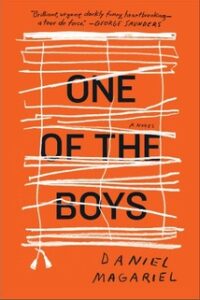
One of the Boys 

By Daniel Magariel

176 pages

Released March 14, 2017 by Scribner

It was in one of several to-read stacks in my office. I selected it to take with me on the trip to Myrtle Beach because (1) it was thin, (2) it had a bright orange cover, and (3) it had an endorsement by George Saunders (a writer I greatly admire) above the title: “Brilliant, urgent, darkly funny, heartbreaking – a tour de force.”

The Story: After a divorce and acrimonious custody battle, a man and his two sons leave Kansas for Albuquerque, where they will start a new life. The boys enroll in school and join the basketball team, while the father works from their apartment. As the weeks go by, the father’s behavior becomes suspect. As the months pass, things go from bad to worse.

One of the Boys is a good book. Compelling, insightful, and well written. It is about love and abuse, ambition and addiction, and dependence and desperation. If that sounds depressing, it is. I was in a low mood when I read it, and it didn’t cheer me up. But it did get me thinking.

Critical Reception 

* “Magariel’s debut is sure, stinging, and deeply etched, like the outlines of a tattoo. Belongs on the short shelf of great books about child abuse.” (Kirkus Review)

* “Magariel’s gripping and heartfelt debut is a blunt reminder that the boldest assertion of manhood is not violence stemming from fear. It is tenderness stemming from compassion.” (New York Times)

* “Because it homes in on instances of abuse to the exclusion of all else, it risks feeling like a deposition rather than a story. Whenever the father appears, he is doing another thing that would scar a child for life. Virtually every adult is a seedy, frightening derelict to whom the boys are exposed through the father’s neglect.” (The Guardian)
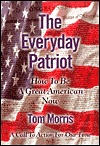
The Everyday Patriot: How to Be a Great American Now 

By Tom Morris

138 pages

Published June 29, 2022

This was one of two books the Mules read in September. It’s short. A quick read. And it’s well intentioned. If you are in the mood for a temporary lift in your political or social outlook, this could do the trick. But if you’re looking for something more substantial, you won’t find it here.

The Everyday Patriot is a call to action. Morris is calling on his fellow Americans to do more than simply vote and have political opinions. He wants them to join him and other “daily patriots” – even those with different views – in making America a better place for all. The way you do that he says, is through one thoughtful action at a time.

Morris believes that a citizen’s political duty goes beyond voting and having political opinions. It includes acts of charity or good will every day. If everybody pitched in and did one thing every day, it would make America a better place to live in.

Noting that we are living in a politically and socially divisive country, he calls upon us to reject negativity and embrace the core principals of the founding fathers: life, liberty, and the pursuit of happiness… plus equality and justice for all.

A chapter is devoted to defining these terms as they were meant in the Declaration of Independence. He also dips into Aristotle quite a bit, who, he argues, inspired the ideas of the founding fathers.

On the one hand, Morris’s call to action is difficult to criticize. He’s saying, “Come on guys. We’re all Americans. Let’s stop the hating and start being nice to one another.” On the other hand, one can imagine how well this would work in the middle of a riot in Times Square, which is about the actual state of things in America today.

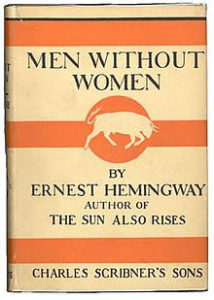
Men Without Women 

By Ernest Hemingway

128 pages

First published in 1927

Men Without Women is Hemingway’s second short story collection. There are 14 stories in all. Most are short and sparse, more journal entries than fully developed stories. But four of them – The Killers, Fifty Grand, Hills Like White Elephants, and In Another Country – are complete and very good.

I read it while I was in the hospital last week, nodding in and out of consciousness. It was a literary balm to soothe my ontological anxiety.

Critical Response 

* Ray Long, editor-in-chief of Cosmopolitan, said that Fifty Grand was “one of the best short stories that ever came to my hands… the best prize-fight story I ever read… a remarkable piece of realism.”

* Percy Hutchinson, in the New York Times Book Review, praised the collection for “language sheered to the bone, colloquial language expended with the utmost frugality; but it is continuous and the effect is one of continuously gathering power.”

* Joseph Wood Krutch called the stories in Men Without Women “Sordid little catastrophes” involving “very vulgar people.”

Interesting 

Hemingway responded to the less favorable reviews with a poem published in The Little Review in May 1929:

Valentine 

(For a Mr. Lee Wilson Dodd and Any of His Friends Who Want It)

Sing a song of critics
pockets full of lye
four and twenty critics
hope that you will die
hope that you will peter out
hope that you will fail
so they can be the first one
be the first to hail
any happy weakening or sign of quick decay.
(All very much alike, weariness too great,
sordid small catastrophes, stack the cards on fate,
very vulgar people, annals of the callous,
dope fiends, soldiers, prostitutes,
men without a callus)

Hemingway’s style, on the other hand, received much acclaim. Even Krutch, writing in the Nation in 1927, said, “Men Without Women appears to be the most meticulously literal reporting and yet it reproduces dullness without being dull.”

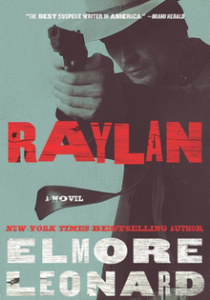
Raylan 

By Elmore Leonard

288 pages

Originally published Dec. 26, 2012 by William Morrow

Raylan, the second of two books I read this month for the Mules, is, in some ways, better than Hombre, which I reviewed on Aug. 26.

It’s a story about a tough deputy US Marshal that returns to the place he grew up in to track down some seriously bad guys. Raylan Givens is a cool cat. Affable and low key – both compassionate and lethal in carrying out his duties among the denizens of the Appalachian Mountains of eastern Kentucky.

Elmore Leonard wrote three Raylan novels based on his short story “Fire in the Hole.” This one, interestingly, was written after FX made a television series – Justified – based on the first two. (See my review of Justified, below.)

Neither the book nor the FX series is high art, but they are both smart, well written, and thoroughly enjoyable. I recommend them.

Critical Reception 

* “In addition to kinetic storytelling and spot-on dialogue, Leonard has a cool wit…. Characters roll from scene to scene, urged on by self-interest and greed, bumping against one another and building up steam until they’re smashing together in orgies of violence.” (New York Times Book Review)

* “The smarter crooks give Raylan grudging respect; his fellow lawmen grant him their highest praise: ‘You’re doin’ a job the way we like to see it done.’ The same can be said of the 86-year-old Elmore Leonard.” (Wall Street Journal)

* “[Leonard’s] finely honed sentences can sound as flinty/poetic as Hemingway or as hard-boiled as Raymond Chandler. His ear for the way people talk – or should – is peerless.” (Detroit News)

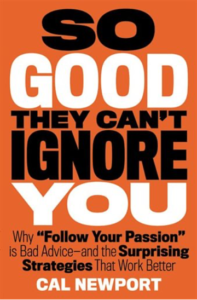
So Good They Can’t Ignore You 

By Cal Newport

288 pages

Published Sept. 18, 2012 by Business Plus

I came across this book while reading a young blog writer that a friend recommended. In talking about something he called “career capital,” a lesson in a course he gives on personal success, he mentioned that his partner in the course had written something by this title.

The subtitle (“Why ‘Follow Your Passion’ Is Bad Advice”) sold me.That’s something I’ve been saying in my books and on my blog posts for 20+ years.

I asked G to order me a copy, and I read it over the weekend. I thought, “I bet this Newport guy subscribed to Early to Rise when I first began to write about this.” He made all the points I made. But he arrives at his advice through interviews: asking organic farmers, venture capitalists, screenwriters, and freelance computer programmers that loved their careers how their passion happened.

It turns out that it takes some thought and effort to end up in a career that you can love. Much of what careers look like from the outside feel very different when you are on the inside, trying to make them work.

Here is some of his advice:

  • Select a career that can offer you all or most of what you want. That is usually some combination of challenging work, good compensation, and recognition for expertise and accomplishment.
  • Identify the most valuable skills in that industry and commit yourself to acquiring them through purposeful learning.
  • When in doubt about what skills to learn, ask yourself: How much will someone pay me to provide that skill?
  • Work hard to acquire those skills and whatever knowledge is needed to go along with them. This becomes your career “capital.” The more career capital you have, the farther you will go in your career.

 Note: Newport doesn’t tell you what particular skills are needed for any of the industries he studies. He seems to believe, correctly I think, that every business in every industry has its unique features.

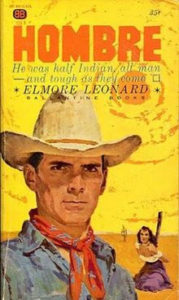
Hombre 

By Elmore Leonard

201 pages

Published Jan. 1, 1961 by Ballantyne Books

This is one of two books by Elmore Leonard that The Mules are reading this month.

 Hombre is genre fiction. It’s a Western, the story of John Russell, a sort-of Apache/White Man that leads a group of passengers to safety after their stagecoach is held up and they are left to die in the desert.

It’s is not one of Leonard’s best books, but it is a good, fast, fun read. So, I’m recommending it.

The Themes 

The most obvious theme is prejudice: White prejudice against Native Americans and Mexicans. Native American prejudice against Whites. And Mexican prejudice against Native Americans and Whites.

But the story also deals with social governance versus individuality – whether democracy is always the better choice. And trust and human nature – whether assuming that there is good in everyone that can be tapped into is an intelligent social perspective.

What I Liked About It 

Like I said, it is a quick and satisfying read. But it also got me thinking.

What I Didn’t Like 

The story is told through the perspective of a secondary character. I generally like this literary gimmick (e.g., The Great Gatsby). But in this case, it felt, at times, artificial and almost intrusive.

Critical Reception 

I couldn’t find any reviews of Hombre by actual critics. But here are some posted by readers on GoodReads:

“Leonard’s spare style and his use of first-person (his only novel to use that POV), is effective at lending the story its mythic tone. It’s deceptively uncomplicated and well-paced, right up to its great final act.”

“Leonard’s story of Russell and of how he earns the name ‘Hombre’ has many aspects of the formulaic Western, but it also shows the genre at its best.”

Sophocles: The Theban Plays 

Translated by Robert Fagles

430 pages

Published Jan. 3, 2000 by Penguin Classics

GG, one of our younger Mules members, suggested reading Sophocles, the great Greek playwright, for our July selection. In particular, he recommended Robert Fagles’ translation of The Theban Plays (Oedipus Rex, Oedipus at Colonus, and Antigone). I suggested reading Hemingway’s To Have or Have Not, which I reviewed here last week. It was decided that we would read both.

I had read Oedipus Rex before. In college. And Antigone and Oedipus at Colonus in graduate school. I knew the plots and I had an understanding of the trilogy’s importance in the history of Western literature, thanks to my teachers. (Including my father, who was, among other things, a reader of Greek and Latin literature.) I expected to have my high assessment of these tragedies confirmed. And it was. But I also got something I hadn’t gotten before: an appreciation for the poetic and rhetorical excellence of these works, thanks in part to the translation by Fagles.

But my enjoyment was most enhanced by the conversation that ensued after GG began our discussion of the Sophocles trilogy by asking, “Who was the greater tragic hero? Oedipus or Antigone?”

In a future blog post, I’ll tell you what I said. For today, I want to simply suggest that if you’ve never read these plays, you should do so. They are short. They are profound. And they are, as I mentioned, beautifully written.

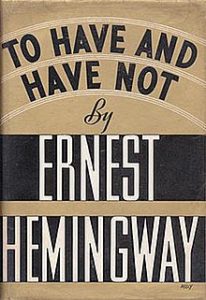
To Have and Have Not 

By Ernest Hemingway

176 pages

First published Jan. 1, 1937 by Charles Scribner’s Sons 

To Have and Have Not follows Harry Morgan, a fishing boat captain during the Great Depression who is forced by economic circumstances into running contraband between Cuba and Key West. Written sporadically between 1935 and 1937 as Hemingway traveled back and forth from Spain during the Spanish Civil War, the book was clearly influenced by the Marxist ideology he was exposed to at the time.

I read it as an antidote to Vauhini Vara’s The Immortal King Rao, the almost unbearable novel I reviewed on June 21. After suffering through her improbable plot, unbelievable characters, and purple prose, I needed something clean and straight. Like three fingers of Jose Cuervo Familia Reserva after a strawberry daiquiri.

To Have and Have Not is not one of Hemingway’s most appreciated novels. In fact, it was severely panned by J. Donald Adams in The New York Times:

“In spite of its frequent strength as narrative writing, To Have and Have Not is a novel distinctly inferior to A Farewell to Arms…. Mr. Hemingway’s record as a creative writer would be stronger if it had never been published.”

I wouldn’t argue that it was as good as A Farewell to Arms. But that’s not a fair comparison. To Have and Have Not is genre fiction. And as genre fiction, it is very good. For me, the plot is strong, as strong as Dashiell Hammett’s The Maltese Falcon. And the dialog is rich, like the dialog of Raymond Chandler’s The Big Sleep. And the characters are wonderfully bad, like those in Jim Thompson’s The Killer Inside Me.

Interesting 

 The 1944 film starring Humphrey Bogart and Lauren Bacall is only loosely based on the book. The story was switched to the underground French resistance during WWII because it was believed that Hemingway’s portrayal of Cuba’s government was in violation of President Roosevelt’s “Good Neighbor” policy toward Latin American countries.

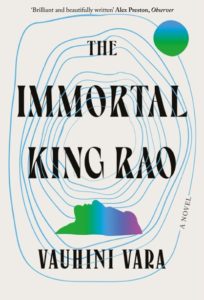
The Immortal King Rao 

By Vauhini Vara

384 pages

Published May 3, 2022 by W.W. Norton & Co.

The Immortal King Rao was The Mules’ book for June. The overriding conclusion was that nobody liked it. And absolutely nobody would recommend it to others. I was in Greece, so I couldn’t attend in person. But I sent in my comments:

“Glad to hear the results – that you all disliked it. I found it to be tedious and lacking any intellectual or literary merit.

“I read To Have and Have Not again this week. God, what a difference! I was reminded of Hemingway’s advice to wannabe writers: ‘All you have to do is write one true sentence. Write the truest sentence you know, and then go on from there.’

“I found no such sentences in The Immortal King Rao. In fact, I can’t recall a single worthy idea, natural action, or believable emotion in the entire book. Nothing that felt true to me. Like The Maid, [LINK TO 2/25]]this is fiction that is all pretense. That can only exist in the imagination of someone that has the luxury of spending her reading time on fantasy.”

The Plot 

In an Indian village in the 1950s, a precocious child is born into a family of Dalits. (See “Interesting,” below.) King Rao will grow up to be the most accomplished tech CEO in the world and, eventually, the leader of a global, mega-corporation-led government.

With climate change raging, he raises his daughter, Athena, in secret (having injected her with genetic code that allows her to access the entire internet and also all his memories). After his death, she finds herself in prison, awaiting judgment by algorithm for a crime she insists she did not commit. While she waits, she writes a lengthy self-defense addressed to the shareholders of the mega-corporation.

Interesting: The Dalits 

 The Dalits (a.k.a. “untouchables”) are outcasts, members of the lowest social group in the Hindu caste system. It’s the name that members of the group gave themselves in the 1930s. (The word “dalit” means oppressed or broken.) Traditionally, they performed spiritually contaminating work that nobody else wanted to do – in particular, anything involving death.

Critical Reception 

The book was almost universally praised. Why? I have no idea. A few examples:

* “The Immortal King Rao is a monumental achievement: beautiful and brilliant, heartbreaking and wise, but also pitiless, which may be controversial to list among its virtues but is in fact essential to its success.” (Justin Taylor, The New York Times)

* “An exacting writer of the digital age, Vara makes her debut with a trippy novel that marries the family saga with a biotech satire.” (Jessica Jacolbe, Vulture)

* “A brilliant and beautifully written book about capitalism and the patriarchy, about Dalit India and digital America, about family and love.” (Alex Preston, The Observer)

About Vauhini Vara 

From a Dalit background, Vauhini Vara is a Canadian-born American journalist, fiction writer, and the former business editor of The New Yorker. She was a reporter for The Wall Street Journal for almost ten years, where she covered Silicon Valley and California politics. A recipient of the O. Henry Award for her fiction, she studied writing at Stanford University and the Iowa Writers Workshop. The Immortal King Rao is her first novel.

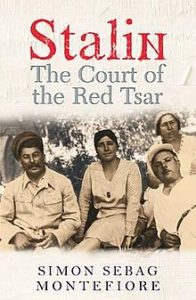
Stalin: The Court of the Red Tsar 

By Simon Sebag Montefiore

848 pages

Paperback published Sept. 13, 2005 by Vintage

I’m just getting into this book, but I can feel that it is going to somehow change my life.

Stalin: The Court of the Red Tsar is a study of Joseph Stalin and his closest associates from the late 1920s to his death in 1953.

Dozens of books have been written about Stalin as a Communist ideolog and a political leader. Montefiore’s book looks at his personal life and the lives of those closest to him. It is, as one reviewer put it, “a study of what can happen when a vicious, brutal, but charming-whenever-necessary killer climbs to power in a system that has nothing by way of checks and balances.”

Interesting 

Stalin was intelligent, persuasive, and charismatic. Even Churchill – no fool when it came to Hitler’s intentions – was wowed by Stalin.

After securing a victory over Hitler, his former ally, Stalin directed a policy of mass murder for almost 30 years. He killed anyone he thought opposed him. And he murdered their wives and children, too. The total body count under Stalin’s regime is estimated to be 20 million to 60 million.

Critical Reception 

* “A book that had to be written…. Montefiore’s biography is different from anything in this genre. A superb piece of research and frighteningly lucid.” (The Washington Times)

* “Stalin retained the admiration of some Western democrats right to the end of his life. Of course, they did not know how vile he was, but they should at least have suspected. Thanks to Simon Sebag Montefiore, there is no longer the slightest justification for thinking of Stalin as anything other than a monster.” (The Guardian)

* “Montefiore has so assiduously collected and vividly presented his case that no future biography of Stalin will be able to ignore this intimate portrait.” (The New York Times)

Click here to watch a compelling interview with the author.