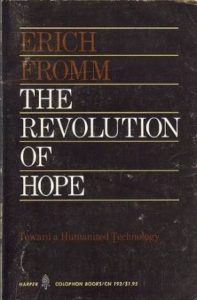
The Revolution of Hope 

By Erich Fromm

162 pages

First edition published Jan. 1, 1968 by Harper Row

I first heard about Erich Fromm when I was in college, in the late 1960s. Fromm’s most popular book, The Art of Loving, was on the reading list for Sociology 101.

I remember being impressed by it. Or wanting to be impressed by it. My sociology professor, whom I admired, praised it. That was good enough for me.

A few weeks ago, I found, in a box in my garage, an old copy of another of Fromm’s books: The Revolution of Hope. I gave it a read, wanting to see how 50 years of life experience might have altered my youthful adulation.

I can see how Fromm’s work was so attractive to my professor back then. And what an effect it had on intellectuals of my generation.

As was true of every social philosopher at the time, Fromm was influenced by Freud and Marx. In The Revolution off Hope, he shows himself to be both an admirer of them and an independent thinker. He shares their generally gloomy outlook on humankind. But he rejects their commonly held view that the human condition is determined by exterior factors. For Freud, those factors were the unconscious and biological drives. For Marx, they were systemic social and economic forces.

Fromm offers a more humanistic view. He argues that man has the ability, through force of will, to cut his own, self-determined path in life.

It is from that perspective that he writes about hope:

“Hope is paradoxical. It is neither passive waiting nor is it unrealistic forcing of circumstances that cannot occur…. To hope means to be ready at every moment for that which is not yet born, and yet not become desperate if there is no birth in our lifetime. There is no sense in hoping for that which already exists or for that which cannot be. Those whose hope is weak settle down for comfort or for violence; those whose hope is strong see and cherish all signs of new life and are ready every moment to help the birth of that which is ready to be born.”

There were many times in reading The Revolution of Hope that I was reminded of Sartre, whom I read a great deal of in graduate school. Fromm seems to see existence, as Sartre did, as a battle between being and nothingness. What distinguishes us from the other animals is free will. And that condemns us to spend our lives resisting the social, economic, and biological forces that, unopposed, would render us passive instruments of authoritarian culture and fascist politics.

There is much in The Revolution of Hope that I was not persuaded by, including Fromm’s limited (and I’d say naïve) understanding of capitalism. In his efforts to bowdlerize Marx, he could be said to be the father of contemporary liberal thinking.

But when Fromm writes about human agency, about not just the potential but the obligation of the individual to think his own thoughts and take his own actions, I find myself, once again, an admirer.

About Erich Fromm
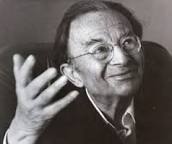
Erich Fromm (1900-1980) was a German social psychologist, psychoanalyst, humanistic philosopher, and democratic socialist. He was associated with what became known as the Frankfurt School of critical theory. His best-known work, Escape from Freedom (1941), focuses on the human urge to seek a source of authority and control. Fromm’s critique of the modern political order and capitalist system led him to seek insights from medieval feudalism. His many works (in English) include Psychoanalysis and Religion (1950), The Art of Loving (1956), and On Being Human (1997). (Source: Wikipedia)
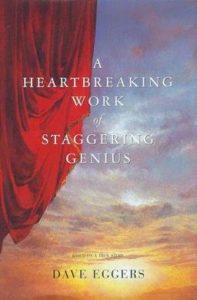
A Heartbreaking Work of Staggering Genius 

By Dave Eggers

416 pages

First published Feb. 1, 2000 by Simon & Schuster

I read it because AS recommended it, saying, “Read it and tell me what you think of it.” (He knows that I can’t resist telling people what I think.)

I liked the title. It’s big. Intriguing. Ambitious. I expected something like Infinite Jest. It wasn’t that, but it was good. So good I had a dream about it.

An old bookstore. Eggers is reading from the book. Afterwards, as he’s signing my copy, I say, “I admire what you did here. You are a better writer than I am.”

He looks quizzically at me, smiles, and says, “No, I am a much better writer than you are.”

I blush and say, “How would you know? You’ve never seen my writing.”

And then he looks to the rest of his fans, who are standing behind me in the queue, and they are smirking.

But I won’t let that color my comments here. Dave Eggers is a very good writer. He is very smart. And he is very good with words. Clever with his sentences. Brilliant in creating layered, evocative descriptions. (See examples, below.) But the story he tells here – an account of his life as a 20-something caretaker of his little brother after both of their parents died in the same year of cancer – feels sometimes too much about his post-adolescent, anguished feelings.

That aside, there is so much to enjoy in this book. To begin with, as a preface entitled, “Rules and Suggestions for Enjoyment of This Book,” he tells the reader that it may not be worth it to read the entire thing from cover to cover and offers his recommendations for passages to read or skip. This is actually an ingenious literary device. As one reviewer put it, it allows the reader “to be fascinated either by the tale only or by the telling of the tale, which keeps him inside the fiction.”

And I really like his writing style – a style that is very much his own. Reading Eggers for the first time, I was reminded of how I felt when I first read Cormac McCarthy – delighted and intimidated.

Here are two examples from the book:

“Can you see us, in our little red car? Picture us from above, as if you were flying above us in, say, a helicopter, or on the back of a bird, as our car hurtles, low to the ground, straining on the slow upward trajectory but still at sixty, sixty-five, around the relentless, sometimes ridiculous bends of Highway 1. Look at us, godammit, the two of us slingshotted from the back side of the moon, greedily cartwheeling toward everything we are owed.”

Or this one, where he describes his mother in her final weeks:

“I step down into the garage and she spits. It is audible, the gurgling sound. She does not have the towel or the half-moon receptacle. The green fluid comes over her chin and lands on her nightgown. A second wave comes but she holds her mouth closed, her cheeks puffed out. There is green fluid on her face.”

Critical Reception 

A Heartbreaking Work of Staggering Genius won many awards, including “Best Book of the Year” from Time magazine, The Washington Post, the San Francisco Chronicle, and the Los Angeles Times. It was a finalist for the 2001 Pulitzer Prize for General Non-Fiction.

* “Is this how all orphans would speak – ‘I am at once pitiful and monstrous, I know’ – if they had Dave Eggers’s prodigious linguistic gifts? For he does write wonderfully, and this is an extremely impressive debut.” (John Banville, Irish Times)

* “A virtuosic piece of writing, a big, daring, manic-depressive stew of a book that noisily announces the debut of a talented – yes, staggeringly talented – new writer.” (Michiko Kakutani, New York Times)

* “Eggers evokes the terrible beauty of youth like a young Bob Dylan, frothing with furious anger…. He takes us close, shows us as much as he can bear…. His book is a comic and moving witness that transcends and transgresses formal boundaries.” (Washington Post)

Click here to watch an interview with Eggers about the book.

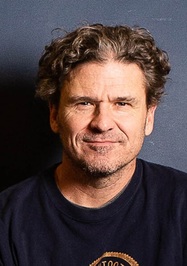
About Dave Eggers

Dave Eggers is the author of more than 40 books, including novels, nonfiction, short story collections, and children’s books. He has written several screenplays for films based on his books, including The Circle and A Hologram for the King. He is the founder of Timothy McSweeney’s Quarterly Concern, a literary journal; a co-founder of the literacy project 826 Valencia and the human rights nonprofit Voice of Witness. In 2005, he was named one of Time magazine’s “100 Most Influential People.” He lives in the San Francisco Bay area with his wife, Vendela Vida (who is also a writer), and their two children.

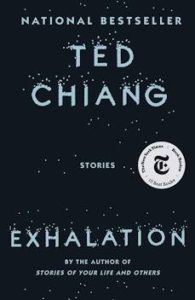
Exhalation: Stories 

By Ted Chiang

368 pages

Published May 7, 2019 by Alfred A. Knopf

I’m halfway through the book, and I’m liking it. I’m impressed by it, yet I can’t say exactly why. Ted Chiang is a writer I’ve never read before. These stories are not like anything I’ve read before. Exhalation reminds me of Haruki Murakami’s Hard-Boiled Wonderland and the End of the World and David Saunders’s Fox 8.

Exhalation feels like a slightly new kind of fiction. Three examples:

* In “The Merchant and the Alchemist’s Gate,” a portal through time forces a fabric seller in ancient Baghdad to grapple with past mistakes and second chances.

* In “Exhalation,” an alien scientist makes a shocking discovery with ramifications that are literally universal.

* In “Anxiety Is the Dizziness of Freedom,” the ability to glimpse into alternate universes necessitates a radically new examination of the concepts of choice and free will.

Chiang’s fiction is fascinating. And inventive. And ingenious. And that means it’s sometimes challenging. But so far, I’m feeling that it’s well worth it. Because, running through everything else it provides, these stories are full of fun.

Critical Response 

The critical response has been universally positive. Almost gushing!

* “Illuminating, thrilling…. Like such eclectic predecessors as Philip K. Dick, James Tiptree, Jr., Jorge Luis Borges, Ursula K. Le Guin, Margaret Atwood, Haruki Murakami, China Miéville, and Kazuo Ishiguro, Chiang has explored conventional tropes of science fiction in highly unconventional ways.” (Joyce Carol Oates, The New Yorker)

* “Delirious and exciting as hell… [Chiang’s] stories brim with wonder and horror, spectacle and mundanity, philosophy and religion. Tapping into a range of speculative traditions, from pulp and fantasy to the rigorous scientific accuracy of hard sci-fi and the popcorn thrills of soft sci-fi, his work has a profound richness.” (Stephen Kearse, The Nation)

* “Exquisite…. The stories in Exhalation are a shining example of science fiction at its best. They take both science and humanism deeply seriously.” (Constance Grady, Vox)

* “An instant classic…. Visionary speculative stories that will change the way readers see themselves and the world around them: This book delivers in a big way.” (Kirkus Reviews)

Ted Chiang was born in Port Jefferson, NY, and currently lives near Seattle. His short story “Story of Your Life” was the basis of the film Arrival.

Chiang has won four Hugo, four Nebula, and four Locus awards, and has been featured in The Best American Short Stories. His debut collection, Stories of Your Life and Others, has been translated into 21 languages.

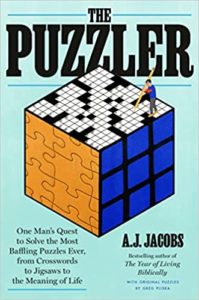
The Puzzler 

By A.J. Jacobs

368 pages

Published Apr. 26, 2022 by Crown Publishing Group

If you like puzzles. Or English. Or humor. Or music. You may like this book. I liked it because it was chock full of interesting facts and worthy speculations about all of those things.

It’s a bathroom book. And by that I mean it can be enjoyed in short “sittings.”

The author, A.J. Jacobs, is what they call an “immersion journalist,” a writer that takes a year or so to explore an interesting topic and then recounts his experiences. He did it before with The Year of Living Biblically and Know It All. He calls them lifestyle experiments.

Here, the deep dive is puzzles. Crosswords, anagrams, rebuses, jigsaws, mazes, chess problems, math and logic, ciphers/secret codes, visuals (think “Where’s Waldo”), cryptics, riddles. He wants to know what makes them so satisfying.

He studies the history. He researches the data. He interviews the experts. He then spends countless hours trying to solve puzzles of every kind. And all the while, he speculates, humorously and sometimes philosophically, about why he’s spending his time doing this.

Here are a few bits from one section of the book, on Anagrams:

Anagrams were originally seen as divine hidden messages from the gods…. According to The Puzzle Instinct by psychologist Marcel Danesi, Alexander the Great once had a dream about a “satyr,” the mythical character that is half-man, half-goat. Alexander was troubled by the dream. What did it mean? He asked his soothsayers, who wisely pointed out that, in ancient Greek, the word for “satyr” is an anagram of “Tyre is yours.” (Tyre was a city Alexander’s army had surrounded.) Alexander took this as a green light from the gods. He invaded Tyre and made it his. Admittedly, Alexander might have found another excuse to invade if not for anagrams. He was a big fan of invading.

In the 17th century, King Louis XIII of France appointed a man named Thomas Billen to be his Royal Anagrammatist at a salary of 1,200 livres a year. Billen’s entire job was to fashion sycophantic anagrams, rearranging the letters in royal names to create flattering descriptions.

The Victorians also liked their obsequious anagrams. Lewis Carroll famously created this one out of Florence Nightingale: Flit on, cheering angel.

But anagrams can also be insulting. In 1936, The New York Times reported that mother-in-law is an anagram for Woman Hitler.

 Critical Reception 

* “[A] weirdly fascinating new book… a romp, both fun and funny. Jacobs explains, in a way I never could, how at various points in our lives puzzles can save us.” (The New York Times)

* “Humans are obsessed with puzzles, and A.J. Jacobs is obsessed with figuring out why. Of all the gifts he possesses as a writer, his second-greatest is his ability to make you think and make you laugh at the same time. In these delightful pages, you’ll find a clue about what his greatest gift might be.” (Adam Grant, author of Think Again and host of the TED podcast WorkLife)

* “A barrel of monkeys’ worth of fun.” (Kirkus Reviews)

* “Ridiculously entertaining.” (Booklist)

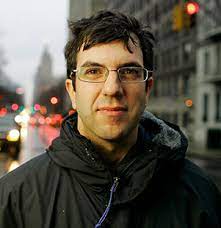
About A.J. Jacobs [bold]

A.J. Jacobs is a journalist and lecturer who has written four bestselling books – including Drop Dead Healthy and The Year of Living Biblically – that blend memoir, science, humor, and a dash of self-help. A contributor to NPR, The New York Times, and Esquire, among other media outlets, Jacobs lives in New York City with his family.

Click here to read an article he wrote about the joy of playing with words.

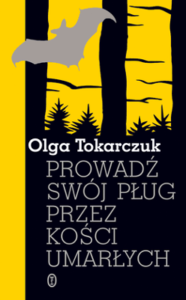
Drive Your Plow Over the Bones of the Dead 

By Olga Tokarczuk

318 pages

Originally published Nov. 25, 2009

Published in English Sept. 12, 2018

This was April’s selection for The Mules, my men-only book club. I listened to most of it, and read only a part of it. The reading was better.

There are many things about this book that are difficult to put a pin in. What can be said with certainty is that it was written by Olga Tokarczuk; it was originally published in Polish; and it was translated into English by Antonia Lloyd-Jones. It was shortlisted for the 2019 International Booker Prize and the International Dublin Award. And to top it off, Tokarczuk was given the Nobel Prize in Literature two months after the novel’s US release.

The Plot 

In a small village in Poland, men are being mysteriously murdered. Janina Duszejko, an eccentric ex-engineer turned school teacher, living alone outside of town, takes it upon herself to figure out what is going on. Her expertise is scientific, but her primary reference point for research is astrology. Her perspective is unsophisticated and unreliable. And she talks, and often acts, like a mentally troubled bag lady.

According to a review in The Guardian, Drive Your Plow is much more than a murder mystery. It’s a primer on the politics of vegetarianism, a dark feminist comedy, an existentialist fable, and a paean to William Blake.

“Though the book functions perfectly as noir crime – moving towards a denouement that, for sleight of hand and shock, should draw admiration from the most seasoned Christie devotee – its chief preoccupation is with unanswerable questions of free will versus determinism, and with existential unease.”

To be sure, the protagonist is constantly wondering about such things.

The reviewer again:

“Janina opens a kitchen drawer and looks at the ‘long spoons, spatulas and strange hooks’ and thinks, in a moment of purest Sartre: ‘I would really like to be one of those Utensils.’ She knows herself to be trapped – ‘I cannot be someone other than I am. How awful’ – but refuses to be a dutiful prisoner of society and gender.”

I found the book whacky and difficult to read. And there were many times I felt like I was plowing over bones – the 21st century’s most bleached out and bone-brittle cliches. But I may be wrong about that. As you can see below, the book has been almost universally praised.

Critical Reception 

* “A brilliant literary murder mystery.” (Chicago Tribune)

* “A winding, imaginative, genre-defying story. Part murder mystery, part fairy tale, Drive Your Plow is a thrilling philosophical examination of the ways in which some living creatures are privileged above others.” (TIME)

* “Shimmering with subversive brilliance…. this is not your conventional crime story – for Tokarczuk is not your conventional writer. Through her extraordinary talent and intellect, and her ‘thinking novels,’ she ponders and tackles larger ecological and political issues. The stakes are always high; Tokarczuk repeatedly rises to the occasion and raises a call to arms.” (HuffPost)

* “Sometimes the opening sentence of a first-person narrative can so vividly capture the personality of its speaker that you immediately want to spend all the time you can in their company. That’s the case with…. Drive Your Plow…. [a] barbed and subversive tale about what it takes to challenge the complacency of the powers that be.” (Boston Globe)

Interesting 

The novel was adapted to film in 2017, titled Spoor (Polish: Pokot), directed by Polish director Agnieszka Holland. It won the Alfred Bauer Prize (Silver Bear) at the 67th Berlin International Film Festival.


About Olga Tokarczuk

Olga Nawoja Tokarczuk is a Polish writer, activist, and public intellectual. She has been described in Poland as one of the most critically acclaimed and commercially successful authors of her generation. All told, she has published a collection of poems, several novels, as well as shorter prose works.

Tokarczuk was born in Sulechow, in western Poland. (One of her grandmothers was from Ukraine.) She trained as a psychologist at the University of Warsaw and, during her studies, volunteered at an asylum for adolescents with behavioral problems.

A leftist, a vegetarian, and a feminist, Tokarczuk has been criticized by some Polish groups as unpatriotic, anti-Christian, and a promoter of eco-terrorism. Denying the allegations and describing herself as a “true patriot,” she turned the tables on her critics, labeling them as xenophobes who are damaging Poland’s international reputation. (Source: Wikipedia)

I didn’t like the book. But I liked some of her answers to questions posed to her in an interview with The Guardian

 The book I am currently reading:

“Yuval Noah Harari’s Homo Deus. This is the second of his I’ve read and it has many inspirations in it – not least a collection of very good ideas for uncanny short stories. I’ve published 10 in Poland already and I now think I should have read Harari before I wrote them.”

 The book that changed my life: 

“I first read Sigmund Freud’s Beyond the Pleasure Principle as a young girl, and it helped me to understand that there are thousands of possible ways to interpret our experience, that everything has a meaning, and that interpretation is the key to reality. This was the first step to becoming a writer.”

The author that influenced my writing: 

“I think in Poland many writers would give the same answer: Bruno Schulz, whose very beautiful, sensitive, meaningful stories raised the Polish language to a completely different level. I love him but I also hate him because there’s no way to compete with him. He’s the genius of the Polish language.”

The book that changed my mind: 

“I would choose two names, rather than specific books, from the world of poetry. When I was a teenager I fell in love with T.S. Eliot. I first stole a book from the library, then started to collect all his works. My favourite poem is ‘The Love Song of J. Alfred Prufrock.’ The second is Czesław Miłosz, who was a great poet and also a great essayist and who changed my mind about writing.”

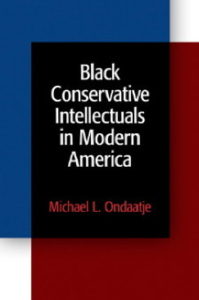
Black Conservative Intellectuals in Modern America 

By Michael L. Ondaatje

232 pages

Published Dec. 3, 2009 by Univ. of Pennsylvania Press

A few years ago, I saw a videoclip of Candace Owens in a debate. I was smitten. Her intelligence, conviction, and articulation of certain conservative principles impressed me. So did her good looks. And, yes, she is Black.

Two years ago, I became a fan of Larry Elder, the conservative talk show host and recent candidate for governor of California. Elder, too, is intelligent and articulate. And he’s also Black. He’s not as good looking as Candace Owens. But he has a sense of humor that is very endearing.

Through Owens and Elder, I heard about Thomas Sowell, the economist, historian, and social theorist from Stanford University. Heavy duty public intellectual. And conservative. And Black.

And that got me thinking about Black conservativism in America. Is it a new thing? A growing thing? An important thing?

And those questions led me to Michael L. Ondaatje and Black Conservative Intellectuals in Modern America.

In this scholarly but readable book, Ondaatje chronicles the development of Black conservatism in the United States from the early 1980s to the present. He does so through the lens of three policy issues: affirmative action, welfare, and education. And by focusing on nine influential Black conservatives, including Supreme Court Justice Clarence Thomas, Thomas Sowell, Shelby Steele, and cultural theorist John McWhorter, as well as Condoleezza Rice and Colin Powell.

What I Liked About Black Conservative Intellectuals in Modern America 

* The book demonstrates that Black conservatism is hardly a new thing. That it has long roots and a distinguished cast of characters.

* Ondaatje does a careful, analytical job of identifying the commonalities and differences of his subjects. He refutes the popular myth that all Black conservatives subscribe to the same thinking.

Critical Reception 

* “A splendid narrative of the rise of Black conservative intellectuals who emerged into the public sphere with the election of Ronald Reagan in 1980…. A first-rate, evenhanded account of Black conservatism that will likely be a pivotal work on the topic for years to come.” (Journal of American History)

* “Thoughtful, well written…. Ondaatje has written a useful assessment of the late 20th century iteration of an important but understudied historical and contemporary intellectual tradition.” (Rhetoric and Public Affairs)

* “Michael Ondaatje has taken on a subject that few have written about so thoroughly and extensively, and his book makes a notable contribution to modern American intellectual history and race relations…. Applying rigorous critical analysis, he also documents their logical failures, intellectual inconsistencies, and suspect arguments.” (Raymond A. Mohl, coeditor of The New African American Urban History)

* “A well-written and important piece of scholarship that aids considerably in historical understanding of Black conservatism in particular and modern American conservatism in general.” (Edward J. Blum, author of W.E.B. Du Bois, American Prophet)

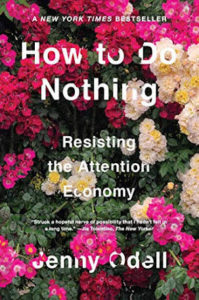
How to Do Nothing 

By Jenny Odell

256 pages

Published April 9, 2019 by Melville House

I’m not sure how I came to read this. It was on my audiobook file. I turned it on accidentally, and then was intrigued by the subtitle. So, I gave it a shot.

I’m about halfway through it now. And I have a theory about how it got onto my audiobook file. It is the sort of book, like The Maid (reviewed here on Feb. 25), that is destined for success. Topically interesting. Politically correct. And lush with complex sentences.

In fact, it was one of President Obama’s “Favorite Books of 2019.”

Unfortunately, the complexity is mostly in its literary style. The thought content is wide, but not deep. The analysis is superficial. The fundamental perspective is anti-capitalist, in the most unexamined way. And the solution it offers – dropping out while still caring (by staying anti-capitalist) – well, it’s only helpful for people who, like the author, make their living as entertainers or educators.

What I Like About How to Do Nothing 

* Odell admits that she is speaking from a privileged position and that “not everyone” can get paid good money to do the sort of thing she’s doing.

* She is right in saying that we can and should “refuse calls for our attention that do not serve us and reclaim our attention, directing it towards people and places and activities that we personally value.”

What I Don’t Like 

As I said, I haven’t finished the book. I don’t know if I will. That’s because my “don’t likes” outweigh my “likes.”

* Her analysis of the “problem” – capitalism – is inexcusably naïve, even for a university teacher. Her view of what’s wrong with the world today? “The colonization of the self by capitalist ideas of productivity and efficiency” and this idea that “we should all be entrepreneurs.”

* Her remedy to the problem: Refuse to do any sort of work that you don’t want to do. Find a job, such as teaching performance art, in a good university or become a writer.

Two examples from the book on how to refuse the demands of attention economy and “do nothing”: (1) Diogenes, whose contribution to philosophy consisted of walking backwards and other exhibits of performance art. And (2) Bartleby the scrivener, Melville’s lovable dope who, whenever asked to do a simple job, replied, “Thank you, but I prefer not to.”

Critical Reception 

How to Do Nothing was named one of the best books of the year by many critics, including those from Time, The New Yorker, NPR, GQ, Elle, and Fortune.

* “A complex, smart and ambitious book that at first reads like a self-help manual, then blossoms into a wide-ranging political manifesto.” (Jonah Engel Bromwich, The New York Times Book Review)

* “Approachable and incisive…. The book is clearly the work of a socially conscious artist and writer who considers careful attention to the rich variety of the world an antidote to the addictive products and platforms that technology provides…. [Odell] sails with capable ease between the Scylla and Charybdis of subjectivity and arid theory with the relatable humanity of her vision.” (Nicholas Cannariato, The Washington Post)

* “An erudite and thoughtful narrative about the importance of interiority and taking time to pay close attention to the spaces around us.” (Annie Vainshtein, San Francisco Chronicle)

About Jenny Odell 

Jenny Odell is an artist, writer, and educator based in Oakland, CA. In 2015, she started an organization she called The Bureau of Suspended Objects. She was then “artist-in-residence” at Recology SF, a.k.a. the San Francisco dump. Her “work” there, which consisted of scavenging, photographing, and detailing the histories of objects that had been thrown out, culminated in an exhibition and archive intended to bring attention to the resources involved in the objects’ production and consumption.

Click here to watch Odell discussing How to Do Nothing.

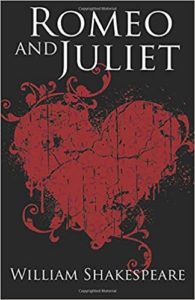
Romeo and Juliet 

By William Shakespeare

Probably written between 1591 and 1596

Both film versions of West Side Story (1961 and 1921) are very good in so many ways. But watching them, I was constantly reminded of the dramatic scenes and beautiful speeches of the Shakespearean tragedy on which they were based.

So, I found my collection of Shakespeare’s plays and read Romeo and Juliet again. And it happened again. Two thoughts: “Shakespeare really was the greatest ever writer in the English language.” And, “Why do I read anything else but Shakespeare?”

Romeo and Juliet is not Shakespeare’s best tragedy. But it may be his most popular. It is certainly the most imitated/emulated/revised/modernized, etc.

If you have never read a play by Shakespeare, do yourself a favor. Read Romeo and Juliet now. Click here.

And there are many versions of the Romeo and Juliet story that you might enjoy.

Click here for a list of film adaptations.

And click here for a list of tales about similarly star-crossed lovers.

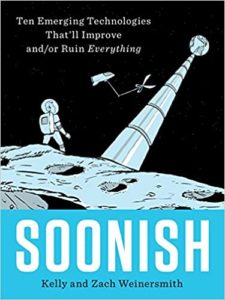
Soonish: Ten Emerging Technologies That’ll Improve and/or Ruin Everything 

By Kelly and Zack Weinersmith

368 pages

Published Oct. 17, 2017 by Penguin Press

Soonish is a fun and fascinating look at transformative technologies that are just around the corner – from robot swarms to nuclear-fusion-powered toasters. Through research and interviews with scientists, the Weinersmiths explore why these innovations are useful, how they might work, and what obstacles for implementation stand in their way.

A brief list of technologies covered:

* Space Exploration: It’s expensive to get into space. The solution, according to Soonish, is space planes, space elevators, and asteroid mining.

* Fusion Power: Something is going on at Sandia Labs with an experiment known as the MagLIF project. It has to do with fusion – splitting atoms. I didn’t understand it, but it sounded exciting. I’ll have to read that chapter again.

* 3-D Printing of Houses: In China, the company WinSun has cleared an impressive hurdle. The company prints the walls and other components of the house, layer by layer, in its factory, and then assembles them on site.

* 3-D Printing of Human Organs: This is a field of study that is well advanced but stalled. The challenge lies in figuring out how to recreate the tiny blood vessels that are vital to organ function. But have no fear. At Rice University, a team led by Dr. Jordan Miller has been working on it.

* Programmable Matter: This sounds crazy, but Soonish imagines a future house that can change its structure depending on the weather. The Weinersmiths argue that this is not just possible, but already in the works.

* Synthetic Biology: An emerging field of study that relies on DNA manipulation to eradicate disease. Recently, biologists figured out how to manipulate the bacterial immune system in a way that allows them to cut DNA at a specific location, remove a piece from one organism’s DNA and add it to another’s. The technology (CRISPR-Cas9) could enable us to do things like cut potential diseases out of human embryos or change the eye/hair color of your future child.

* Precision Medicine: A better and quicker way to diagnose and treat sickness and disease using biomarkers that may be able to instantly detect any unwanted molecules entering your bloodstream, cancerous growths, or even symptoms relating to depression.

* Brain Computer Interfaces: Who knows where this field will lead us? Right now, progress is being made on developing brain-computer interfaces to fix problems like blindness and paralysis. And a deaf patient can now receive a cochlear implant, which uses a small microphone to deliver sounds to a receiver in the patient’s skin. The receiver then translates the sound into electrical signals that are sent to the inner ear. The result has been described as sounding like a low-quality cassette tape recording, which is still far better than silence.

Critical Reception 

“An entertaining look at future tech wizardry, from space tourism and asteroid mining to nuclear fusion power, matter replication, synthetic biology and direct brain-computer interfaces…. The text is very well-researched, with a casual, friendly style (‘Tinkering with the language of life. What could go wrong?’), and color cartoons add a wry counterpoint to the narrative of a future that, as always, might be utopia or disaster.” (Steven Poole, Wall Street Journal)

“Curiosity is a beautiful thing, and Kelly and Zach Weinersmith have it in spades. Their coauthored Soonish is an unabashed nerd-out of a book, zinging from outer space to DNA, hardly pausing for breath…. The gleeful geeking out makes for a great read – I couldn’t help chuckling or outright cracking up a number of times – while surreptitiously teaching some really important science. It’s a winning combination. The sheer breadth of topics covered is also amazing: Probably no other book in history has seriously described the science behind both tentacle construction robots and the human nasal cycle.” (Colin McCormick, Science)

“Fans of science, math, or medicine; gamers; and those who love the weird and wonderful will gravitate to this volume.” (School Library Journal)

TS recommended it to me a few weeks ago. I bought it and put it on top of my “recently recommended” pile.

I might have gotten to it a year from now, but the title intrigued me. So, I picked it up and started reading. It was an easy read. I finished it that evening.

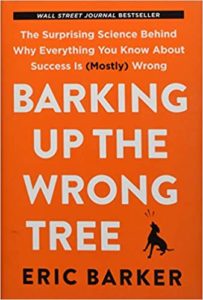
Barking Up the Wrong Tree 

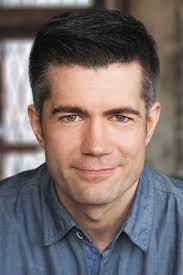
By Eric Barker

320 pages

Published May 16, 2017 by HarperOne

Barking Up the Wrong Tree follows the template of all bestselling self-improvement book by asking, “What are the traits of uncommonly successful people?” But it distinguishes itself from the pack by offering up lots of insights into success that run against the grain, by providing lots of evidence to support those insights, and by bringing them to life with lots of entertaining facts and stories.

What I Liked About Barking Up the Wrong Tree 

Many of Barker’s observations differ from conventional wisdom. (I don’t trust conventional wisdom.) Most of those jibe with observations I’ve made and written about over the last 22 years.

For example:

* There are two kinds of business leaders – corporate executives (who make predictable decisions) and entrepreneurs (who make unpredictable decisions).

* Networks are powerful. It’s as true at IBM as it is with small businesses.

* It’s not enough to do good work in a corporate environment. You have to get noticed. Which usually means you have to toot your own horn. Be modest. Give credit to others. But be sure key people know what you’ve done.

* Quantity produces quality. People that do great work tend to have been doing more work. This has always been my strategy. It is part of my Ready, Fire, Aim philosophy.

Critical Response 

* “Whether you are a connoisseur of self-help books, or despise them, you won’t be able to resist this recipe for living a better life.” (Robert Sutton)

* “Delightfully puckish, evidence-backed and full of insight, this book answers questions about success that have puzzled us for far too long.” (Adam Grant)

* “This book is compelling because Barker’s irreverence is so consistently on-target, relentlessly puncturing the wisdom balloons that most need bursting.” (Robert B. Cialdini)

Click here for a discussion about the book with Eric Barker.

And click here for a short video takeaway from the book.