
“Humility on a Cellular Level” – another fun essay from Dalrymple. Click here to read it.
Solstice
By Joyce Carol Oates
249 pages
Originally published in 1985; reissued in 2019 by Ecco
Joyce Carol Oates is nothing if not a prolific writer. She published her first book in 1963 at age 25, and has since published 58 novels, a number of plays and novellas, and many volumes of short stories, poetry, and nonfiction. She is noted not just for her immense literary output, but also for her range of genres and styles.
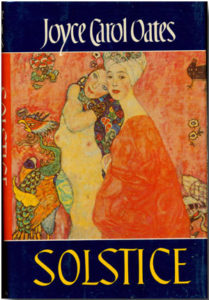
Solstice, first published in 1985, was her 16th novel. I found a copy of that edition in a box in the garage of our home in Nicaragua. It had an alluring cover. I had read only two other novels by Oates and didn’t love either of them. They were smartly written with a nod toward literary experimentation here and there, but I found the stories themselves very ordinary, almost banal. I don’t think I would have given Oates another try, except that some years ago I was in a museum in NYC and I bumped into her, literally bumped into her as we were each looking at the same painting. I apologized. She smiled and said something about the painting, as if we were sharing some little secret. She is a small, fragile-looking woman. I thought, “How can she hold a full-time teaching job and write so many novels?”
Solstice is a quick read. It’s the story of Sheila Trask, a reasonably successful painter (and local celebrity) and Monica Jensen, a beautiful, young, and recently divorced woman that has just come to a small New England town to get away from a short, ill-fated marriage. The two women are very different. Trask is willful, dark, and impulsive. Jensen is compliant, self-reflective, and careful. What begins as a very ordinary, teenage-type infatuation with an older, successful woman moves to something deeper and more exciting and then to something obsessive and nearly fatal in less than a single year.
Reading it, I was trying to figure out whether a story about a clandestine lesbian love affair could have been, in and of itself, a literary experiment. (Oates is known for experimental writing.) I don’t know. I didn’t bother to research that.
But it doesn’t matter. Solstice is about something more challenging that that – something that perhaps one could not writeabout today. I see it as an investigation into the possibilities of lesbian love: Can the conventional patterns and conflicts that are almost universal in heterosexual relationships be avoided in homosexual (in particular, lesbian) ones? To put it in more contemporary terms, it is a novel that explores the dynamics of intersectionality and hierarchy within a lesbian love affair. It is a story, as one critic put it, that puts Hemingway on his head. It is a story of Women Without Men.
Indeed, Sheila Trask has virtually all of the power in the relationship because she stands way above Monica in the power hierarchy. She is older, richer, more successful, and more self-confident. Monica comes into the relationship offering youth, fragility, availability, and remarkable physical – i.e., feminine – beauty.
There is much exchanged in the relationship, each giving the other and taking from the other what she can. In the beginning, Sheila is clearly dominant and uses that dominance to manipulate the relationship to go where she wants it to go. But eventually, Monica, by maintaining her feminine strengths and vulnerabilities, acquires the power.
That’s how it reads to me. You may have a different view. It’s a weekend’s read. If anything said above intrigues you, I can recommend it.
Critical Reviews
* “A powerful beam into the dark places of the soul.” (New York Times)
* “Oates’s novel is spellbinding, entrancing reading.” (West Coast Review of Books)
Interesting Facts:
* In addition to all the writing she’s done, Joyce Carol Oates was a teacher at Princeton for more than 40 years.
* She has won numerous literary awards, including the 1973 O. Henry Award (for “The Dead”), the 1996 Bram Stoker Award (for Zombie), the 1996 Penn/Malamud Award for Excellence in the Art of the Short Story, and the 1970 National Book Award for Fiction (for them).
This is how I remember her…

From Letters of Note…
I’ve never read Rachel Carson’s Silent Spring, perhaps the most important environmental book published in the second half of the 20th century. After reading this heartbreaking letter that she wrote to a friend seven months before she died from cancer, I bought a copy.
September 10, 1963
Dear One,
This is a postscript to our morning at Newagen, something I think I can write better than say. For me it was one of the loveliest of the summer’s hours, and all the details will remain in my memory: that blue September sky, the sounds of the wind in the spruces and surf on the rocks, the gulls busy with their foraging, alighting with deliberate grace, the distant views of Griffiths Head and Todd Point, today so clearly etched, though once half seen in swirling fog. But most of all I shall remember the monarchs, that unhurried westward drift of one small winged form after another, each drawn by some invisible force. We talked a little about their migration, their life history. Did they return? We thought not; for most, at least, this was the closing journey of their lives.
But it occurred to me this afternoon, remembering, that it had been a happy spectacle, that we had felt no sadness when we spoke of the fact that there would be no return. And rightly – for when any living thing has come to the end of its life cycle we accept that end as natural.
For the monarch, that cycle is measured in a known span of months. For ourselves, the measure is something else, the span of which we cannot know. But the thought is the same: when that intangible cycle has run its course it is a natural and not unhappy thing that a life comes to an end.
That is what those brightly fluttering bits of life taught me this morning. I found a deep happiness in it – so I hope, may you. Thank you for this morning.
Rachel
The Blue Streak
By Ellen Lesser
242 pages
Published in 1992 by Grove Press
The Blue Streak was a book I selected randomly from the bookshelves of our home in Nicaragua. I decided to read it because (1) it was thin at 242 pages, (2) I liked the cover, and (3) the author’s name sounded familiar to me in a positive way.
Was Ellen Lesser that elderly British author whose stories I had once read in The New Yorker? I looked at the photo of her on the inside flap of the jacket.

The book was published in 1992 – but still, no, this woman was too young. Of whom was I thinking? Was it Dorothy Lesser? No. Doris Lessing? Yes, that was it.
So, it wasn’t a book by a British author I’ve always admired. But I still liked the cover. And it was still only 242 pages.
So I read it…
The Story: After a shoulder injury, Danny, a recent college graduate and once promising swimmer (his “blue streak”), is floundering – treading water, waiting for life to tell him what to do. When his hard-driving, type-A, successful father dies, Danny has to come home and face the unresolved conflicts in their relationship. The novel deals with Danny’s experience, internal and external, over the next few days.
I read a few reviews. They ranged from lukewarm to derogatory. The main objections were that the characters were conventional. Too stereotypically Jewish.
That’s not at all how it worked for me. I found the book delightful throughout. It’s not epic, but there is a journey – with an anagnorisis, a peripeteia… everything you’d want. The big reveal – moving from blaming one’s parents to understanding what a pain in the ass one was as a child – is as important as any we get in life.
If nothing more, The Blue Streak is a delightfully drawn portrait of a delightfully dysfunctional Jewish family, painted lovingly and with photographic detail by Ellen Lesser.
Critical Reviews
“Although this is pleasant reading, there is nothing sufficiently novel about either the story or the characters (some of whom seem to have come from Roth country) to make this an essential purchase.” (Library Journal)
“Predictable, with insights as stale as yesterday’s bread, but there’s enough to suggest that Lesser could be a better writer if she were less wed to the Zeitgeist.” (Kirkus Reviews)
“Lesser is a dexterous and sensitive writer. Unfortunately, her latest effort is essentially a long short story straining to be a novel.” (Publishers Weekly)
Red Notice
By Bill Browder
416 pages
Published in 2015 by Simon & Schuster
Red Notice was the March selection for the Mules. I was in Nicaragua (for the ceremony inaugurating the new facilities at FunLimon), so I wasn’t able to attend the meeting. But I sent this short review of the book to my fellow Mules:
As Bob S. predicted, this book changed the way I think about Putin and Putin’s Russia.
Browder made a convincing case that Russia operates as a kleptocracy, as he calls it. I also appreciated the insight he had into aspects of highly centralized governments, particularly Socialist/Communist governments. How it creates an insane level of bureaucracy and, more importantly, how it gradually changes the culture – deeply, including what becomes the national personality. Two thumbs up!
Browder’s journey started as the child of Communist parents on Chicago’s South Side, where, in order to rebel, he decided on a career as a Capitalist. He went to Stanford Business School… and from there to the world of US hedge funds… and from there to Moscow, where he made a fortune buying up super-underpriced companies that were being privatized.
The second part of the book is about how the early support he got from Putin disappeared after Putin became partners with the Russian oligarchy that controlled the cash flow from the privatization of those companies, and how that ended in his banishment (he was deported to the UK) and the imprisonment and murder of Sergei Magnitsky, one of the lawyers that worked for him in Russia.
[While in the UK, Browder’s Russia-based offices were raided. While investigating the purpose of the raids, Magnitsky discovered large-scale fraud and theft by Russian officials. After testifying against them, he was arrested. His death in prison in 2009, after 11 months in police custody, caused an international outcry (he was allegedly beaten to death) and led to the signing of the Magnitsky Act by President Obama. The act – formally known as the Russia and Moldova Jackson-Vanik Repeal and Sergei Magnitsky Rule of Law Accountability Act of 2012 – authorizes the US government to impose sanctions against human rights offenders, freeze their assets, and ban them from the country.]
The third part of the book is about how, according to one reviewer, Browder, having “glimpsed the heart of darkness… embarked on an unrelenting quest for justice in Sergei’s name, exposing the towering cover-up that leads right up to Putin.”
Many readers, including some of my fellow Mules, objected to Browder’s view of himself as a crusader for justice. That’s a fair criticism. (You can decide for yourself.) But the book is a page-turner. (Browder claims that if you read just one page, you will not be able to put it down.) And it does provide convincing evidence of Putin as the leader, albeit a very popular leader, of a band of thieves.
Critical Reviews
* “Red Notice is a real-life political thriller about an American financier in the Wild East of Russia, the murder of his principled young tax attorney, and his dangerous mission to expose the Kremlin’s corruption.” (Goodreads)
* “Bill Browder, the unexpected hero and author of this suspenseful memoir, is no ordinary investment banker…. It is fascinating to follow him as he navigates the kleptocratic Russian economy.” (Boston Globe)
* “[A] riveting account of Browder’s journey through the early years of Russian Capitalism…. ‘Russian stories never have happy endings,’ Magnitsky tells Browder, in the book’s most memorable line. Perhaps not, but they do have inspiring ones.” (Washington Post)
* “[Browder’s] freewheeling, snappy book describes the meteoric rise, and disastrous fall, of a buccaneer Capitalist who crossed the wrong people and paid a steep price…. The high stakes make for a zesty tale.” (New York Times)
Interesting Facts
* There is a soon-to-be released movie starring Dwayne Johnson that is titled Red Notice. But though Browder had, and probably has, ambitions to make his book into a movie… this isn’t it.
* The term “red notice” refers to the system of color-coded notices that Interpol uses to share alerts and requests for information with law enforcement agencies worldwide. A red notice is a request to locate and provisionally arrest an individual pending extradition. An orange notice is a warning about an imminent threat to public safety. A green notice provides intelligence about individuals who have committed criminal offenses and are likely to repeat them in other countries. And so on…
* Among many other awards, Browder was recognized in 2017 by GQ as one of the magazine’s Men of the Year for his defiance of Vladimir Putin.
Here’s Browder in 2015 talking about this book to Russian Studies students at Oxford University…
Hamnet: A Novel of the Plague
By Maggie O’Farrell
384 pages
Published in 2020 by Tinder Press
Hamnet is, as the title suggests, a book about Shakespeare’s son and the plague that killed him. It is also a vivid depiction of England – its culture and its economy – during Elizabeth’s reign. It is, perhaps most of all, a compelling portrait of Agnes, Hamnet’s mother and Shakespeare’s wife.
And finally, it is a brilliantly imagined explanation of how Shakespeare came to write Hamlet, his greatest tragedy (with the possible exception of King Lear).
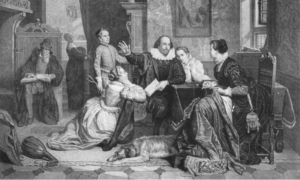
Shakespeare and family. Hamnet is standing on the left.
What historical fiction like Hamnet does is help fill in the factual blanks with inventive imaginings. And there is so much of that in this book.
If you are a student of Shakespeare, you will love it. If you are not, you may love it too, because of the prose and the storytelling. And if you don’t know anything about Shakespeare’s life, you will enhance your enjoyment of Hamnet by spending a little time reading a summary of it in Wikipedia.
Interesting Facts
* Hamlet and Hamnet were variations of the same name. In the 16th century, English orthography had not yet been formalized. One example: There are something like 6 authenticated signatures by Shakespeare, only 2 of which have the same spelling.
* Maggie O’Farrell won the London Women’s Prize for Fiction (along with £30,000) for Hamnet.
* Hamnet was one of The New York Times’ 10 Best Books of 2020.
Critical Reviews
* “Maggie O’Farrell’s writing is intensely detailed and descriptive, allowing the reader to become encapsulated into the world of Elizabethan England. Her extensive research is evidenced throughout and makes for a really absorbing and enjoyable read.” (Off The Record)
* “Of all the stories that argue and speculate about Shakespeare’s life… here is a novel… so gorgeously written that it transports you.” (Boston Globe)
* “O’Farrell brilliantly turns to historical fiction to confront a parent’s worst nightmare: the death of a child…. Hamnet vividly captures the life-changing intensity of maternity in its myriad stages – from the pain of childbirth to the unassuageable grief of loss.” (NPR)
“Microaggressions” and Other Dangerous Words
According to an article in Business Insider, there are 14 things you should never say at work (or anywhere else) because they are “indirect expressions of racism, sexism, ageism, or ableism.”
Here are some examples of these “microaggressions”:
* “You’re transgender? Wow, You don’t look like it at all.”
* “Oh, you’re gay? You should meet my friend Ann. She’s gay, too!”
* “My [female] boss is crazy.”
* “Where are you actually from?”
* “The way you’ve overcome your disability is so inspiring.”
* “Your name is so hard to pronounce.”
* “Are you an intern? You look so young!”
* “Is that your real hair?”
To read the article – which includes much-too-long explanations of why these words are offensive, along with suggestions of what to do instead – click here. (Spoiler alert: Most of the time, the suggestion is “Say nothing.”)
Meanwhile…
An Episcopal church in Manhattan is going the extra mile to insure its children feel protected from such dangerous words as “mom” and “dad.” Read the story here.
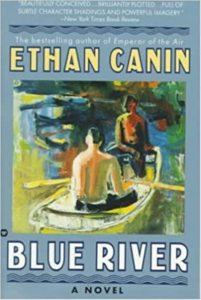
The Blue River
By Ethan Canin
222 pages
Published in 1991 by Warner Books
Blue River is the story of two brothers, Lawrence and Edward, who, after having taken very different paths in life, are reconnected.
Lawrence, the older brother, is an itinerant worker. Edward, the younger, is a successful ophthalmologist with a wife and son. The story begins when Lawrence appears at Edward’s front door after 10 years of absence.
With a start like that, the plot has nowhere to go but where it does go: backwards towards their childhoods, where the divergence began.
Canin’s prose style is clean, but not sparse. The action is unhurried, but not turgid. The characters aren’t fully natural, but they feel true. Something that struck me as especially good: the author’s close observations of small, physical gestures and the patterns of everyday speech.
Reading it, I found myself thinking, “This guy knows how to write.” But my appreciation stayed at that level. I was never swept away by the story or astonished by the prose.
Blue River, despite its short length and clarity, is not an easy book to read. One challenge is that the story is told by Edward, a character who sees himself as successful, smart, and virtuous, but is actually self-centered and smug.
But don’t let that stop you. Canin understands Edward’s limitations. And so will Edward, by the time this story ends.
An investment of, maybe, four hours of your time in Blue River will give you a sufficient, if not abundant, ROI.
Critical Reviews
* “Blue River is beautifully conceived, full of subtle character shadings and powerful imagery. It is brilliantly plotted too, with so many twists and surprises that one hesitates to describe a single incident in the story.” (The New York Times)
* “There are a few moments when Canin might have eased off the confessional or let the reader make the connections without forcing them upon us with one or two excess lines of explanation. But in general the novel is a smooth and graceful movement through one man’s memories and self-reflection.” (Michelle Bailat-Jones)
* “If Ethan Canin’s celebrated debut story collection, Emperor of the Air (1988), was remarkable for its variations in tone, his first novel is notable mostly for its unremitting sentimentality.” (Entertainment Weekly)
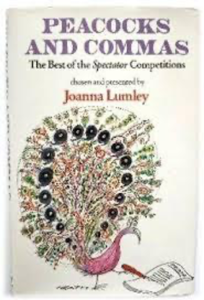
Peacocks and Commas: The Best of the Spectator Competitions
By Joanna Lumley
200 pages
Published in 1983 in the UK by Bodley Head Ltd.
Because I had failed to consider how much time one spends in an airport when reading is not possible (e.g., going through security and being questioned about the mysterious-looking refrigerator part that you brought from the States because it was unavailable in Nicaragua), I was an hour behind on my reading schedule when Nestor picked me up at the airport in Managua.
That gave me only 90 minutes to read Peacocks and Commas – which wasn’t a problem. Because Peacocks and Commas is not the sort of book one should read in one sitting, from beginning to end. It’s a literary treasure chest packed full with parodies and paragraphs, sonnets and soliloquies, epigrams, epithets, epitaphs, and other brief literary forms. And it’s much better enjoyed in brief encounters over time.
I’ll give you a few examples.
For this first one, the challenge to readers of The Spectator was to complete a poem beginning, “It looks like a season of Peacocks and commas.” The winning entry was submitted by an E.O. Parrot.
It looks like a season of Peacocks and commas,
It looks like a winter of colons and Lear;
That Abbey’s a nightmare; they never love Thomas,
Nor Jude the Obscure by Hardy the Drear.
It looks like a season of essays and Emma;
And creative writing, which means they can’t spell;
There’s The Lord of the Flies, The Doctor’s Dilemma,
And Paradise Lost, which they find sheer hell.
It looks like a season of precis and Dombrey,
And dull comprehension they don’t understand;
I dictate all the notes, each writes like a zombie,
The Sixth’s got its Melville, which ought to be grand.
Now yet one more season of grim punctuation,
Of poems they scoff at, of novels they hate,
Of screaming and chalk dust and mental frustration;
I’m retiring next summer; I can hardly wait.
The challenge here: Compose a verse about a tragic hero and a tragic heroine coping with daily matters. This brilliant little parody was submitted by a T. Griffiths.
To shave or not to shave; that is the question:
Whether ‘tis easier on the chin to suffer
The pricks and stubble of an evening shadow,
Or to take soap against a field of stubble,
And by a razor end it? To soap, to shave;
No more. And by a shave to say we end
The shadow and the thousand prickly points
That chins are heir to; ‘tis a consumption
Devoutly to be wished. To soap, to shave,
To shave; perchance to nick: ay, there’s the rub;
For in that sea of foams what nicks may come
When we have lathered all the shrinking chin,
Must give us pause. There’s the respect
That makes calamity of a morning shave,
For who would risk a stinging, painful nick,
When he might save himself the trouble daily
With a handsome beard? Who would shaving bear,
To smart and grimace under trickling foam,
But that the dread of breadcrumbs, clinging egg,
Doth make us rather shave, come the morn again…
An Epigram and an Epitaph
Coffee Percolator
by Tony Brode
Fit for a stately home that stands
In its own grounds, I see
No cause to envy house or lands –
My own grounds stand in me.
Samaritan
by Joyce Johnson
Here lies a man who often sat
And listened on the phone
To those with lives so awful that
At last, he took his own.
The challenge: Write a pretentious wine blurb. The winning selection came from the same T. Griffiths who parodied the Hamlet soliloquy above.
Hitherto synthetic wine could be robust – never svelte. Here’s one I can recommend as actually better than the natural variety; for it is silky as well as powerful, has a soft edge, large-scale yet graceful, and is both fastidious and charming.
Halcyon Harvests 1980 has an aristocratic languor with the bouquet of a great wine possessing real substance. The chemists have wrought a miracle. Free of any sulkiness or vulgarity despite its provenance, this is a true wine whose insinuating first taste has sinewy elegance and a heroic finish. Here is a classic vintage of great depth – its first taste is a minuet, its after-taste a symphony. Need one say more?
Interesting Facts
* In addition to being an author, Joanna Lumley is an activist, television producer, and actress. You may have seen her in On Her Majesty’s Secret Service, The Wolf of Wall Street, and Ella Enchanted, or heard her voice in Corpse Bride.
* Lumley won two BAFTA TV Awards for her role as Patsy Stone in the BBC sitcom Absolutely Fabulous (1992-2012), and was nominated for a Tony for Best Featured Actress in a Play for the 2011 Broadway revival of La Bête. Despite having more than 100 acting credits, she has no formal acting training.
* She is a strong supporter of Survival International and the cause of indigenous rights. She narrated the organization’s documentary Mine: Story of a Sacred Mountain, about a remote tribe in India, and contributed to the book We Are One: A Celebration of Tribal Peoples.
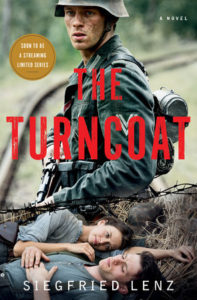
The Turncoat
By Siegfried Lenz
Translated by John Cullen
384 pages
Written in 1951; posthumously published in 2020
The Turncoat is the story of a German soldier’s experience of World War II, fighting for a cause, falling in love, struggling for survival, doubting his beliefs, being captured, joining the partisans, and then finally, after the war, questioning that decision.
The plot has three parts: the protagonist as a German soldier, as a Soviet partisan, and as an office worker under Soviet control.
What unifies the three parts are three themes: the mundanity and absurdity of war, the human impulse to survive, and the questionable tenacity of conviction.
The plot is not gripping, but it’s liberally peppered with incidents, actions, and conversations that are themselves interesting and serve to hold the reader’s interest to the end. The themes (as described above) are presented more in dialog than in action, which renders them more abstract and less convincing. Nonetheless, they raise worthy questions:
* Does a soldier’s allegiance to his country outweigh his moral conscience?
* Is an immoral act committed in war and under orders excusable?
* More generally, is it possible to be a good person involved in a bad cause?
* And perhaps the most important one for Lenz: Is it possible to be absolved from guilt?
My gold standard for rating ambitious books like this is: Has it changed me in some way? The answer to that, in this case, is no. So I would not call this a great book. But I’m the minority in that opinion. As you can see below, most of the critical response to The Turncoat has been very positive.
Note: In preparing for the Mules’ discussion of The Turncoat, I came across this video of a German war veteran recounting the atrocities of his fellow soldiers. Whether or not you read the book, I think you’ll find it interesting.
Critical Reviews
“Never has the aftermath for Germans been better depicted than in Siegfried Lenz’s elegiac, The Turncoat. A newly discovered masterpiece.” (Alex Kershaw)
“This antiwar satire would have been quite a shock to the system of a wounded, divided postwar Germany… darkly comic… explosive… persuasive.” (New York Times Book Review)
“Lenz effectively mines his experiences in the German army [as a deserter and prisoner of war] for this memorable account… [His] meaningful exploration of loyalty owed to one’s country and family is packed with thrills and chills.” (Publishers Weekly)
Interesting Facts
* Rejected by his German publisher, who thought that the story of a German soldier defecting to the Soviet side would be unwelcome in the context of the Cold War (1947-1991), Lenz’s manuscript was forgotten for nearly 70 years before being rediscovered after his death. A posthumous triumph.
* As far as I can determine, The Turncoat has been translated into 10 languages (including Catalan and Slovenian) before appearing in English and, inevitably, being published by the small, independent Other Press.
A Letter from Charles Darwin, age 12, to a friend (Jan 4, 1822)
You must know that after my Georgraphy, she said I should go down to ask for Richards poney, just as I was going, she said she must ask me not a very decent question, that was whether I wash all over every morning. No. Then she said it was quite disgustin, then she asked me if I did every other morning, and I said no, then she said how often I did, and I said once a week, then she said of course you wash your feet every day, and I said no, then she begun saying how very disgusting and went on that way a good while, then she said I ought to do it, I said I would wash my neck and shoulders, then she said you had better do it all over, then I said upon my word I would not, then she told me, and made me promise I would not tell, then I said, well I only wash my feet once a month at school, which I confess is nasty, but I cannot help it, for we have nothing to do it with, so then Caroline pretended to be quite sick, and left the room, so then I went and told my brother, and he burst out in laughing and said I had better tell her to come and wash them herself, besides that she said she did not like sitting by me or Erasmus for we smelt of not washing all over, there we sat arguing away for a good while.
(Source: Letters of Note)