When Men Were Brave…

In 1910, Captain Robert Falcon Scott led a team of explorers on an expedition to be the first to reach the South Pole. On Jan. 17, 1912, after a brutal journey, Scott and his men arrived at their destination only to find that another team had arrived several weeks earlier. Exhausted and crestfallen, they began the 700-mile return trek to the ship they came in. On March 17, Scott describes the death of one of his crew. Scott and the rest of his crew never made it back. (From Diaries of Note)

Read Scott’s journal entry here.

An Amazing Story of Endurance and Survival 

In 1971, Douglas Robertson and his wife sold their farm in England, bought a schooner, and set out to sail around the world with their four children.

After more than a year at sea, as they were rounding the tip of South America to begin their Pacific crossing, killer whales attacked their schooner and sunk it in less than a minute. The six Robertsons piled into a nine-foot inflatable life raft and embarked on an incredible story of survival.

If you are in the mood for a chilling adventure, you can read the whole story here.

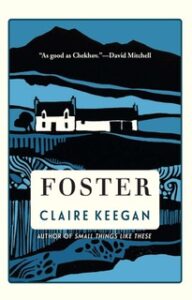
Foster 

By Claire Keegan

128 pages

Published Nov. 1, 2022

I don’t know how I came to have it. But I know how I came to read it. I wrote a review of Small Things Like These, a book by the same author, Claire Keegan, on Nov. 22, 2022. That was my first encounter with her. I wrote then:

“Every once in a while, I read a book that makes me want to read everything the author has written. That is how I feel after reading Claire Keegan’s Small Things Like These….   It’s been a long time since I discovered a writer that humbled me like Claire Keegan did with this book. (The last time, I think, it was Cormac McCarthy.) She writes perfectly proportioned paragraphs. Beautifully simple and simply beautiful sentences.”

This is another small book. And another literary gem. A deeply touching story about a young girl, one of many children in a large family living in rural Ireland, who is sent by her parents to live with a neighboring couple that have no children of their own.

The story is told in the first person. And Keegan does an amazing job of both first-person storytelling and engineering the voice of a child. I was several times reminded of what Mark Twain did with Huck Finn and Tom Sawyer.

What I Liked About It

* The story feels true in a universal way.

* The dialog is rich and authentic in an Irish writerly way.

* The writing is both exquisitely literary and invisible. I’ve never encountered anything quite like it.

What I Didn’t Like 

Nothing.

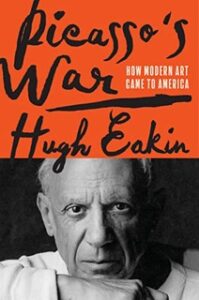
Picasso’s War: How Modern Art Came to America 

By Hugh Eakin

480 pages

1st edition published July 12, 2022

Picasso’s War was recommended to me by DL, a fellow DM publisher and art collector that I’ve mentioned here several times.

Prior to this one, the only book I can remember reading about the history of modern art is The Painted Word by Tom Wolfe. He presented a wonderfully slanted and brilliant hypothesis about how a small group of European artists in the first two decades of the 20th century invented modern art by stripping away the techniques and technicalities that made traditional art subject to rational analysis.

Picasso’s War has a different perspective. It is the biography of a handful of American men and women who, through legal cleverness and promotional genius, practically forced the American art market to accept Fauvist and Cubist pieces by the likes of Jean Derain and Pablo Picasso – eventually creating the world’s largest and most vibrant market for modern art.

What I Liked About It 

* It tells an amazing story, one I had never heard before.

* It is nicely and neatly written. Hugh Eakin writes with authority, the authority you’d expect from the editor of Foreign Affairs. But his prose is clean and mean, which makes for fast, exciting reading.

* The book is filled with fascinating details linking the great artists of this period to the great novelists, poets, and critics.

Critical Reception 

* “[Eakin] has mastered this material, read a mountain of sources, and synthesized them skillfully…. His achievement is keeping the complex plotline moving, while offering sharp insights and astute judgments.” (New York Times Book Review)

* “Eakin spins neglected yarns of art history into pure gold in this clear, sensitive, and deftly written narrative.” (Vanity Fair)

* “Admirable and enjoyable…. The story in Picasso’s War is well told, with an impressive level of biographical detail.” (Louis Menand, The New Yorker)

Is Mass Murder a Thing of the Past?

Bryan Kohberger, the man who murdered four University of Idaho students in the early morning of Nov. 13, 2022, has been charged. The police found lots of circumstantial evidence, including two eyewitness testimonies that put him near the crime scene at the time of the murders.

But the evidence that has a 99.9998% chance of convicting him is his DNA, which he left on a knife sheath found next to one of the victims.

In one of her typically funny, sharp opinion columns, Ann Coulter wrote:

“His capture illustrates why there will be no more serial killers. As the world gets worse in so many ways, here’s one way it’s better. (Unless the ACLU gets its way.) Between the ubiquity of surveillance cameras and DNA, any budding Ted Bundy can commit one hideous murder, but then he’ll get caught. No more victims cut down in the prime of their lives, destroyed families or terrified communities. Monsters like Kohberger get one shocking crime, not a series.”

I think she’s basically right. The only crimes we’ll be able to commit in the future are politically correct ones.

You can read the rest of Coulter’s op ed here.

George Saunders on How and Why to “Freakify” Your Work

George Saunders is among my favorite short story writers. I’ve mentioned him and his books several times in past blog posts.

Recently, strolling through the Literary Hub website, I found a conversation between him and Mike Errico, author of the book Music, Lyrics, and Life: A Field Guide for the Advancing Songwriter.

Early in the conversation, Saunders tells Errico that he began his career as a songwriter. After some years of trying, he concluded that he wasn’t very good at it, so he switched to another one of his interests: writing short stories.

As I alluded to above, Saunders’s short stories are among the best I’ve ever read. And it was a treat to read one of his secrets for writing a great one. He calls it “freakifying” –  something that can be applied to just about any form of creative expression.

I was particularly struck by his definition of art (something that also intrigued Errico): “What’s important is that something undeniable and nontrivial happens between entry and exit,” Saunders says.

“Can you expand on that?” Errico asks.

Read Saunders’s answer, and the rest of the interview, here.

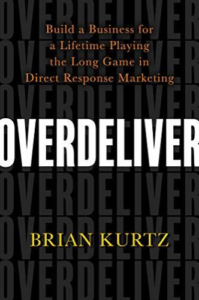
Overdeliver 

By Brian Kurtz

312 pages

Originally published April 2, 2019

Overdeliver is a book about direct response marketing that every entrepreneur and marketing director should read. It was written by Brian Kurtz, a friend of mine that once ran Boardroom Reports, one of the largest direct response publishing companies in the world.

As it says on the jacket, Overdeliver distills “the expertise he’s gained after almost four decades in the industry to teach readers how to build a business that lasts a lifetime.”

In the book, which summarizes 40 years of in-the-trenches experience, Brian explains the ABCs of finding and selling to an audience of buyers “without compromising on the respect and care they deserve.” He explains how to build marketing plans and how to track them so you know what is effective in the marketing you do and what is not, and how to “overdeliver” to your customers so they will continue to buy from you forever.

Click here to watch a very good review of Overdeliver.

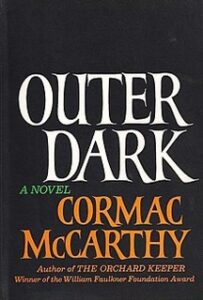
Outer Dark 

By Cormac McCarthy

256 pages

Originally published Sept. 12, 1968

Released in paperback June 29, 1993

This was the January selection for The Mules, my always amusing and superbly insightful reading group here in Delray Beach. We’ve been at it for at least a dozen years. Which means (given our penchant for occasionally reading two books a month) we have read and discussed close to 200 books, about half of them novels.

When we are united in liking an author, we will read two or three books by him/her. For example, we’ve read two of Yuval Harari’s books, several by Malcolm Gladwell, several by Michael Lewis, three of Hemingway’s novels, and several by Cormac McCarthy. Outer Dark was, I think, our third McCarthy.

Cormac McCarthy has published 12 novels. The first, The Orchard Keeper, was published in 1965. Outer Dark, I was surprised to learn, was his second novel, published in 1968. (The year I graduated high school!) As a second book, Outer Dark could have been a sophomore failure. And the early reviews were mixed. But today, some critics believe it to be one of his best.

I liked it very much. I read it once and was once again enchanted by the rawness and liveliness of McCarthy’s prose. Then I listened to it on tape and enjoyed it for its story.

Plot: It’s about Rinthy, a woman who bears her brother’s child and then sets out to find it (if it is still alive) after she discovers that her brother lied when he told her that it had died while she was sleeping.

Themes: The McCarthy standards – the ruthlessness of nature, the underrated human capacity for evil, the extreme difficulty of leading a moral life.

Interesting: The title came from the Gospel of Matthew. Specifically, the meeting between the Roman centurion and Jesus, when Jesus says: “But the children of the kingdom shall be cast out into outer darkness: there shall be weeping and gnashing of teeth.” The story is peppered with other Biblical themes. And as GG, one of our regular members, pointed out, there are also many allusions to Greek tragedies.

Critical Reception 

Though some early reviewers complained about McCarthy’s “increasingly dense style and sometimes arcane vocabulary,” most were good. A few examples:

* “Cormac McCarthy’s second novel, Outer Dark, combines the mythic and the actual in a perfectly executed work of the imagination. He has made the fabulous real, the ordinary mysterious.” (Thomas Lask, The New York Times)

* “There is no way to overstate the power, the absolute literary virtuosity, with which McCarthy draws his scenes.” (Walter Sullivan, Sewanee Review)

The first few paragraphs of the book…

SHE SHOOK HIM awake into the quiet darkness. Hush, she said. Quit hollerin.

He sat up. What? He said. What?

She shook him awake from dark to dark, delivered out of the clamorous rabble under a black sun and into a night more dolorous, sitting upright and cursing beneath his breath in the bed he shared with her and the nameless weight in her belly.


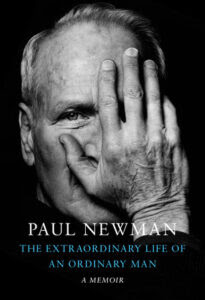
The Extraordinary Life of an Ordinary Man 

A memoir by Paul Newman

Published Oct. 18, 2022

320 pages

I don’t know why, but this book was published 14 years after Paul Newman’s death in 2008 at the age of 83. Like just about every other person in the world that watched American movies, I was a big fan of his. He was in so many good and great movies, including The HustlerHudHarperCool Hand LukeButch Cassidy and the Sundance Kid… I could go on and on.

And he did have an extraordinary life. He was the recipient of numerous awards, including an Oscar, a BAFTA, three Golden Globes, a Screen Actors Guild Award, a Primetime Emmy Award… again, I could go on and on. More important than his awards as an actor, he won the Jean Hersholt Humanitarian Award for his efforts in raising and donating nearly $1 billion to many charities.

Critical Reception 

* “The Extraordinary Life of an Ordinary Man is all voice – which is to say, it is Newman at his best… [It] is twice the book one could hope for, a narrative that is astute, introspective, and surprisingly graceful.” (Michael O’Donnell, The Wall Street Journal)

* “The book is an extraordinary glimpse into the psyche of one of Hollywood’s greatest icons…. You’ll be hard-pressed to find another star willing to share half as much.” (Julie Miller, Vanity Fair)

* “Raw, honest, and revealing.” (Becky Libourel Diamond, BookPage)

You can read an excerpt from the book (from Literary Hub) here.

Seven Books to Help You Build Wealth in 2023 

Sean MacIntyre is a smart guy. He’s also a polymath. I mentored Sean early in his career. Now, he’s the publisher of DIY Wealth, a website that provides guidance on entrepreneurship, investing, and other aspects of building wealth. (You can sign up for it here.)

In this video, he talks about his favorite books on entrepreneurship and wealth building. If wealth building is on your to-do list for 2023, these recommendations are a good place to start. (Including, by the way, the antepenultimate one on his list!)