
Today, I take a crack at answering two somewhat related questions: (1) Will New York City survive Mamdani’s plans to make housing “more affordable”? (2) Is there really a difference between Socialism and Communism?
This essay and others are available for syndication.
Contact Us for more information.
Avoiding Two Real and Present Dangers
One of my favorite longtime friends is a New York City denizen. She loves the Big Apple and is a staunch proponent of its many virtues. She and her husband (also a good friend from long ago) spent a week in and around Delray Beach last week.
We had several great and fun conversations, but we did not dive into a conversation about their recently elected mayor, Zohran Mamdani. She once told me how much she admired him, and that she voted for him knowing he was both a Socialist and an anti-Zionist Muslim. We have too many miles of good memories between us, so I thought discretion in this case would be to keep my mouth shut.
That’s not true. The truth is that I was dying to bring up the topic in a teasing way, but K cautioned me not to do it. I didn’t want to argue because I’ve never won an argument with K. Even scarier: I was afraid I’d discover that she, too, is a Mamdani fan!
So, rather than risk those very real and present dangers, I stayed mute and used the stored energy to write a piece on him for today.
Will NYC Survive Mamdani’s Housing Plan
And Make Housing “More Affordable?”

I mentioned in the Jan. 7 issue that I’ve been wondering how much of what Zohran Mamdani said he’d do as mayor during his campaign was real and how much was just vote-seeking rhetoric.
So far, it looks like the man was not bluffing.
The first hint was his choice for the new Fire Commissioner, Lillian Bonsignore, the second woman and first openly gay woman to be appointed to that post. Critics point out that she is also the first person with no experience as a firefighter to lead the 11,000-person agency. (She does, however, have 31 years of experience in the Emergency Medical Services field, and has strong recommendations from some who worked with her during the three years she served as EMS chief.)
I think she deserves a pass on the issue of “Does she have the skills and knowledge to do her job?”
I can’t say the same thing about Cea Weaver, however.
Weaver is the woman Mamdani appointed to be “tenant director,” where she will oversee, among other things, establishing regulations that affect property ownership, tenant rights, rent-control rules, and so on.
On a 2021 podcast recently unearthed by Washington Free Beacon’s Jon Levine, Weaver says her goal is to make New York City housing “worth less” by mandating rent control regulations. While she is speaking, you can see Mamdani on the side nodding enthusiastically. Then he says, “I get most of my knowledge on housing from Cea, so if you get it from me, it’s just not coming from the source.”
She’s called for the collectivization of property (which she said will particularly affect white families). She’s called property ownership a tool of “white supremacy.” She supports the impoverishment of the white middle class, and she has called for the election of Communists.
She’s also said that it’s important for “white people to feel defeated.”
Putting aside the question of whether making white people feel defeated is something she should be doing, her plan for making NYC housing more affordable is not just wrong, it’s stupidly wrong. Because its two main strategies – rent control and public housing – have done nothing but make housing more costly every single time they have been used. Not only in NYC, but everywhere in the world.
In reviewing coverage of this on one news outlet, I found the following three reader comments that I wanted to share with you:
* “These policies will make NYC a landscape of food deserts. Then Bernie Sanders can start bread lines because bread lines are the best sign that there is bread. This approach will also help the homeless who will move into the open-air drug marts that will inevitably pop up.”
* “If they force housing to be worth less, wouldn’t they then receive less in property taxes? How would they replace those tax dollars? By raising the price of other government services?”
* “This is so surreal. We’re literally watching a bunch of financially privileged Woke postgraduates explore Socialist ideas as if it’s a project for their postgraduate thesis, but who are now in charge of the largest and most diverse city in America.”

Cea Weaver in 2019
About Cea Weaver
Cea Weaver (born Celia Weaver) serves as the director of the New York City Mayor’s Office to Protect Tenants. She previously coordinated the statewide organization Housing Justice for All and was a central figure in the campaign that led to the passage of the Housing Stability and Tenant Protection Act of 2019. As a member of the Democratic Socialists of America, she has advocated for rent strikes and regulations that prioritize housing for community use rather than profit.
Is There Really a Difference Between Socialism & Communism?

It’s a question that comes up almost every time one gets into a discussion about the virtues of “Socialism.” Libertarians, Free Market advocates, and others who understand economics and know the history of Communism in the 20th century (like yours truly) often take the position that there is no difference. And if one wants to push the argument (that they are the same), one could say, correctly, that Karl Marx used the terms interchangeably.
But in looking at the history of this debate since Marx, one has to concede that three useful (two lucid, one somewhat fuzzy) distinctions have emerged:
1. In terms of property rights, Socialism advocates for the collective ownership of major industries, but individuals can own personal property. Communism advocates for complete communal ownership. No private property at all.
2. In terms of wealth distribution, Socialism advocates for the redistribution of wealth by government ownership and/or management of all industries involved in “the means of production” and government control over all social, legal, and bureaucratic activates that affect “quality of living,” including housing, transportation, education, and health care.
3. In terms of achieving political change, Communism explicitly supports the establishment of a central government through violent revolution, whereas Socialism (or rather Socialists) often advocates change through political and legal means and social activism, which can include violent protest.
Just the Facts
The Idea of Communism
Communism is an economic and political concept that was more-or-less invented by Karl Marx and Friedrich Engels, who made the case that the world would be a better place for everyone if class structures, and particularly economic structures, were eliminated.
The Reality of Communism
In the 20th century, it became a system of state power following revolutions in Russia, China, Cuba, and several African states. In every case, Communist governments centralized economic, legal, political, military, and policing institutions. They then proceeded to eliminate personal liberties, including the freedom of speech and other forms of individual expression (e.g., art, music, and theater).
What About Those Nordic States?
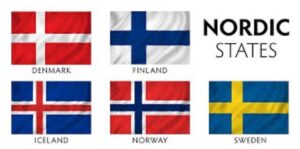
It is often claimed that the Nordic countries are Socialist. But as their own leaders have repeatedly explained, they operate largely Free Market economies, with strong protections for private property and privately owned industries. In Denmark and Sweden, for example, the vast majority of businesses – including banks, manufacturers, retailers, and exporters – are privately owned, not state run. Government ownership is limited and far smaller than in classical Socialist systems.
Sweden’s corporate tax is 20.6%, and Denmark’s is 22%. That’s right in the middle of the US corporate tax rate, which is 21%.
Capital gains and inheritance taxes in Denmark are moderate – lower in most cases than they are in the US. And Sweden abolished its wealth tax (in 2007) and inheritance tax (in 2005).
Meanwhile, these countries provide good social services – in some (but just some) cases, providing more coverage than the US provides. And they have done that without racking up trillions of dollars of debt!
How do they do that?
This is another thing that would make people who claim Nordic countries are Socialist gag if they knew it. The tax systems in Sweden and Denmark work not because they are super-progressive (i.e., super-high taxes for rich people), but because their tax systems are broadly based. Their welfare programs are funded through flat or mildly progressive income taxes and high consumption taxes (VAT around 25%).
Translation: Middle- and working-class citizens – not just the rich – pay a substantial share of the overall taxes, unlike highly progressive tax models often associated with Socialism.
“Socialism vs. Economics: What Really Works?”

Why I Do What I Do
From MH re my Jan. 2 “Predictions” issue: “I’m enjoying your newsletter. I’m glad you took 14 hours to plan your 2026. I started a journal this year with my goals, tasks, and inspirations, and it’s really helpful.”
From RT: “I wanted to share something meaningful with you. I recently translated your English Wikipedia page into Bangla so that people in my country can better understand who you are and learn from your work. Your ideas on business, long-term thinking, and sustainable growth resonate deeply with me. While our contexts may differ, I see a strong alignment in how we both value clarity, realism, and impact over hype. Translating your work felt like a small way of giving back and making thoughtful ideas more accessible to Bangla-speaking readers.”
Economics for Children
The Tuttle Twins take a ride through a world without freedom.